








Terra CEO elaborates on the features and operating mechanisms of Anchor, Mirror, and Chai

 Terra's vision is to use Mirror, Anchor, and Chai to obtain raw financial data, thereby promoting the democratization of new financial infrastructure.
This article was published on the Coinlist blog and compiled by Alyson.
In the past 12 months, the DeFi industry has rapidly evolved, with DeFi projects such as Uniswap, Maker, Aave, and Compound becoming multi-billion dollar protocols. We have witnessed a shift from "decaying finance" to "regenerative finance," with the community setting higher standards for financial responsibility, smart contract security, and user experience.
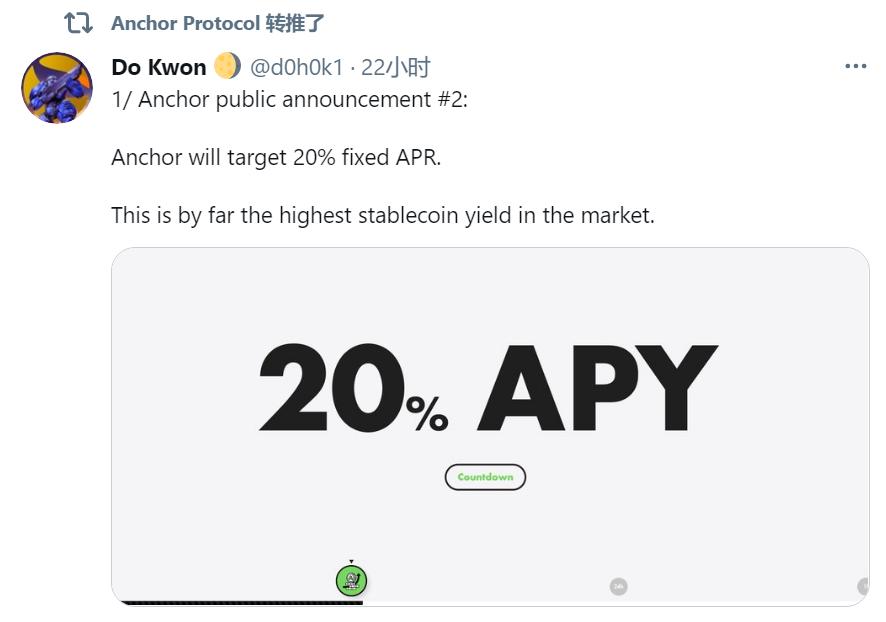
Recently, we invited one of the most exciting projects in the DeFi ecosystem of 2021—Anchor Protocol.
Built by the team behind the blockchain platform Terra, Anchor is a savings protocol that offers stable high-yield rates in the DeFi space for crypto natives, fintech companies, and regular investors. We spoke with Do Kwon, co-founder and CEO of Terra, to discuss what they are building and what makes Anchor more reliable and attractive than other DeFi savings protocols. Let’s get started.
1. First, could you briefly introduce Terra and the problem it aims to solve?
Terra is a PoS blockchain platform built using the Cosmos SDK and based on the Tendermint consensus mechanism. Terra's design is focused on making consumption, savings, and investment easier through tools of a new financial system, thereby facilitating the mass adoption of cryptocurrency, blockchain, and DeFi.
Terra distinguishes itself from other blockchain networks in several key ways:
First, Terra's network is based on an elastic supply model, with its native token LUNA used to collateralize a set of stablecoins that form a suite of applications on Terra, such as Chai (payments), Mirror (investing/trading), and Anchor (savings). The existence of stablecoins constitutes the infrastructure of Terra, creating an environment conducive to network speed and application utility.
Stablecoins on Ethereum have become the preferred medium for transactions on the network; however, on Terra, stablecoins are integrated into the base protocol and even provide an on-chain exchange function, allowing it to serve as a high-throughput, low-fee foreign exchange market.
Second, Terra is built using the Cosmos SDK, which means the network is compatible with the IBC standardized communication protocol and other Tendermint-based applications in the Cosmos Network ecosystem, such as ThorChain, Oasis Labs, and Cosmos Hub. IBC supports fast interoperability between Terra and other networks, enabling the network to benefit from application-specific blockchains and their significant advantages.
2. How does Terra UST achieve stability without backing by real-world assets?
The native token LUNA of Terra provides collateral for a set of fiat-pegged stablecoins operating on the Terra network. The monetary supply of LUNA is elastic, meaning that the circulating supply of LUNA expands or contracts based on the demand for Terra stablecoins (like UST).
The idea is that increased demand for Terra stablecoins equates to a contraction in LUNA supply, as LUNA can always be traded for a stablecoin like UST at the protocol's exchange rate for a value of 1 USD.
For example, if excessive demand for UST pulls the fixed exchange rate above 1 USD, arbitrageurs will be incentivized to burn LUNA worth 1 USD to mint 1 UST, thereby contracting the supply of LUNA. The minted UST can then be sold on the open market for profit. Importantly, this functionality is built into Terra's protocol and can be executed at scale, with up to 10 million USD of UST minted daily before slippage becomes unreasonable.
On the other hand, if the peg of UST deviates below 1 USD, arbitrageurs are incentivized to buy UST on the open market and redeem it for newly minted LUNA worth 1 USD, thereby increasing the supply of LUNA.
As you can see, increased demand for Terra stablecoins (like UST) triggers a contraction in LUNA supply, making LUNA scarcer. The scarcer LUNA becomes, the higher the value of each unit of LUNA.
Moreover, as the usage of Terra applications (like Mirror, Chai, and Anchor) increases, the utilization rate of Terra stablecoins also rises, increasing the velocity of stablecoins in circulation, thus providing more profits for LUNA asset managers. Although Terra's stable assets may exhibit short-term volatility, these individuals will gradually accumulate lucrative long-term cash flows.
3. Terra supports a rich ecosystem of products, including Mirror, Chai, and MemePay. Could you briefly describe why the ecosystem was built and what each product does?
The primary spirit of Terra is to achieve mass adoption. However, this does not necessarily mean that users need to be aware that they are using a blockchain network to gain benefits. Abstracting the complexity of the underlying crypto technology and making it beneficial (like DeFi) has always been a major barrier to the adoption of crypto technology.
With Terra, we aim to identify two main aspects from the perspective of simplification:
a. Allow users to use intuitive and attractive applications.
b. Establish robust incentives for network stakeholders.
In the first aspect, Terra has built a rich ecosystem of applications, including Chai, Mirror, and Anchor. Chai is a payment application in Korea with over 2 million users and a transaction volume exceeding 2 billion USD last year, recently completing a 60 million USD Series B funding round. Chai's settlement is faster and cheaper than traditional payment methods, and users do not need to interact with Terra on the front end at all.
Mirror is a thriving synthetic asset protocol on Terra that provides "mirror" versions of real assets (such as stocks, commodities, indices, crypto assets, etc.). Since its launch, Mirror's total value locked (TVL) has surpassed 1 billion USD in just twelve weeks. Additionally, Mirror is a community-governed protocol that offers a censorship-resistant and user-friendly alternative aimed at competing with companies like Robinhood.
Anchor is Terra's savings protocol that shapes the composability of DeFi and presents it to end-users in a simple manner, allowing for stable, high-yield savings with just a few clicks. On the backend, Anchor standardizes the yield from derivatives of other proof-of-stake (PoS) blockchains, releasing liquidity for major stakeholders in its network and channeling the cash flows from their periodic margin positions to savers.
The second aspect involves a specific question: what is the common theme among the applications built on Terra?
Since they are the primary mechanism for interacting with the protocol, they increase the demand for UST and Terra stablecoins. The use of Mirror, Anchor, and Chai stimulates further demand for UST, triggering more frequent and larger LUNA burns to obtain risk-free arbitrage profits.
The result is that long-term stakeholders of Terra, namely LUNA stakers who can absorb short-term volatility, are rewarded with increasingly scarce LUNA and richer cash flows generated by the adoption of UST and the acceleration of transaction velocity, creating a virtuous cycle.
4. Where do you think Terra is most widely applied? What is your ultimate vision for Terra?
Aside from Anchor, Mirror, and Chai, the usage of Terra's previous two flagship applications was not very strong. According to our estimates, Chai is the most widely used crypto application, not purely speculative, with over 2 million active users and a transaction volume of 2 billion USD last year, currently growing even faster.
In the 12 weeks following its launch, Mirror achieved over 1 billion USD in TVL, placing it among the top 15 DeFi protocols by TVL on any blockchain (including Ethereum). Additionally, Mirror's synthetic assets can be traded on platforms like Terra, Ethereum, and Binance Chain. The idea is to leverage the specific application designs of various public chains to provide Mirror users with options—this is a powerful incentive to participate. Once those in economically disenfranchised areas begin to understand the potential of DeFi and synthetic asset protocols, the growth prospects for Mirror are limitless.
Ultimately, Terra's vision is to use tools like Mirror, Anchor, and Chai to acquire raw financial data (such as in investment, payment, and savings sectors), thereby driving the democratization of new financial infrastructure, allowing DeFi to incorporate trillions of fixed capital and billions of new users who were previously excluded from the financial system.
5. Diving into your latest product announcement regarding the Anchor protocol from January, could you provide us with an overview of the protocol and the origin of the idea?
The Anchor protocol is a savings tool built on Terra that provides a benchmark interest rate for DeFi. Anchor primarily caters to two different audiences:
- Crypto natives
- Ordinary investors from fintech companies
For natives, one of the main challenges faced by DeFi users or professional crypto funds is the variable yield, a byproduct of speculative demand. Predicting cash flows and yields is challenging due to unstable demand for borrowing and other external market factors. Stable yields are crucial for trade financing, and fixed rates are ubiquitous among financial institutions, corporations, and other companies. Additionally, staking positions in DeFi are illiquid, as a large amount of native tokens are locked into the network to generate block rewards and participate in consensus and governance.
For fintech companies and typical traditional financial investors, one of the main limitations of DeFi is the complexity of the space. The proliferation of yield farming, DEXs, money markets, derivatives, and other platforms has made DeFi a dense jungle—let alone the challenges of accurately understanding the implications of composability. In a long-term low-interest-rate environment, achieving high yields is also exceptionally difficult, leading investors and funds into riskier environments like the stock market.
So the question becomes: how do we shape the power of composability while keeping it simple? For example, high yield and composability. More specifically, how can we create a simple DeFi application for ordinary investors or fintech companies that integrates factors to maintain stable yields, attracting yield farmers and professional crypto funds to help release liquidity from staking positions?
Enter Anchor.
First, in terms of supply (bAssets), Anchor's liquid staking derivatives allow stakers of large PoS public chains to deploy their staking positions as liquid capital in money markets. This not only improves capital efficiency across DeFi but also channels cash flows to UST savers within Anchor, namely ordinary retail users.
Anchor stabilizes the yields generated by staking derivatives and passes them on as stable, high-yield savings accounts to anyone interacting with the protocol. This could be an ordinary investor seeking to accumulate interest at a fixed rate, but it also attracts fintech companies, mobile wallets, and exchanges that wish to integrate low-volatility, high-yield savings as a featured product on their platforms and offer it to users via the Anchor API.
Anchor makes this process very simple, allowing applications to subtly infuse the power of composability (for example, achieving high yields from staking derivatives) into their products while hiding the underlying complexity, resulting in a win-win situation.
For DeFi users, Anchor represents a stable savings account that requires minimal management. There is no need to actively shift your capital from yield farming opportunities to other opportunities, no need to spend substantial capital on gas fees, and no need to constantly calculate cash flows from positions. Simply deposit UST into Anchor to earn high yields at a fixed rate.
In summary, Anchor provides a savings tool for ordinary investors trapped in traditional finance's low-yield opportunities, offering fintech platforms a way to provide instant, high-yield savings and improving capital efficiency for stakeholders by releasing capital.
6. How does the Anchor savings protocol work? What makes it more reliable and attractive than other DeFi storage options?
Anchor forms stable yields based on the returns generated by liquid staking derivatives and forwards them to users who deposit UST (the demand side) into Anchor. The functionality of Anchor is similar to any decentralized money market protocol (like the Compound protocol), but it only accepts liquid staking derivatives from PoS functional chains as collateral.
Anchor is attractive due to its simplicity, stability, and appealing yields. For risk-takers on PoS public chains, Anchor opens a pathway to deploy their staking capital in ways that were previously unattainable. This enhances capital efficiency and channels yields to ordinary investors, who can easily access the protocol through integrations with fintech platforms, exchanges, or wallets.
7. What are the crypto trends you are most interested in for 2021?
First, observing how the current macroeconomic and financial backdrop interacts with new users of DeFi. The capital inflow into DeFi has exploded, and the pace of innovation is astonishing.
Second, 2021 has the potential to be a landmark year for interoperability in the industry, as cross-chain bridges are developing, allowing assets to be easily transferred between specific application chains. The concept of ultra-liquid collateral can truly be realized.
Finally, focusing on how user experience evolves and whether DeFi will reach a tipping point for mainstream applications. Accessing DEXs like Uniswap, savings protocols like Anchor, or derivatives platforms like Injective should be as simple as browsing popular social media applications or using an app like Robinhood.
 Risk warning
 Risk warning



Popular articles





