dYdX is caught in a "downward spiral."

 The increasing selling pressure of tokens due to the trading mining mechanism is one of the reasons for the significant decline of DYDX.
Author: Kyle
Source: Honeypot Finance
In September, dYdX, which relied on trading mining for a brief period of popularity, has recently fallen into a downturn due to the side effects of trading mining.
On December 15, the governance token DYDX was priced at $8.3, down 70.2% from its peak of $27.88 on September 30, a decline greater than that of mainstream DeFi protocol tokens such as UNI and BAL during the same period.
The increasing selling pressure on the token due to the trading mining mechanism is one of the reasons for the significant drop in DYDX. According to official documents, the protocol will allocate 3,835,616 DYDX to trading users every Epoch cycle (28 days) for a period of 5 years.
As the price of the governance token continues to decline, the arbitrage effect of trading mining on dYdX has sharply decreased, leading to a comprehensive decline in trading data on the platform. Data shows that on December 14, dYdX's trading volume was $1.389 billion, down 85.3% from the peak of $9.5 billion; on the same day, the open contract volume on dYdX was $910 million, down 40% from the peak of $1.52 billion. Additionally, the total locked value and new user growth rate on dYdX have also significantly slowed.
Facing challenges in a comprehensive "downward spiral," dYdX has users on social media calling for the team to increase the use cases for DYDX to boost market performance. Some users have suggested that dYdX should emulate DEXs like PancakeSwap by adding NFT and new asset issuance business segments to enhance the protocol's attractiveness.
In this sluggish situation, how can dYdX break the deadlock?
DYDX Operational Data Shows Comprehensive Decline
The decentralized derivatives trading platform dYdX has recently seen a sharp decline in momentum, with not only the governance token DYDX experiencing a significant drop, but also open contracts, new user numbers, and other data showing varying degrees of shrinkage.
On December 15, DYDX was priced at $8.3, down 70.2% from its peak of $27.88 on September 30. Although the entire market has shown a downward trend recently, the drop in DYDX has exceeded that of most mainstream DeFi protocol tokens; in comparison, UNI's drop during the same period was 35%, and BAL's was 26.3%.
Clearly, the significant drop in DYDX is not only related to the weak market conditions but also exposes some issues within itself.
Looking back at dYdX's highlights, it began with the protocol releasing the governance token DYDX in the form of "retroactive airdrops + trading mining." On August 3, dYdX announced an airdrop of DYDX to over 36,000 early interaction users, who needed to complete the corresponding trading volume within 28 days to receive the full airdrop.
At the same time, trading mining on dYdX also commenced. According to official documents, 25% of the initial DYDX supply, or 250 million DYDX, will be allocated to users interacting on the dYdX Layer 2 protocol over the next 5 years; each Epoch cycle (28 days) will allocate 3,835,616 DYDX, aiming to incentivize all traders to use the dYdX Layer 2 protocol, enhance market liquidity, and raise awareness.
After the launch of trading mining, dYdX attracted a large influx of traffic in a short time. Data shows that on August 3, the trading volume on the dYdX protocol reached $218 million, setting a historical high at that time. During the week from August 1 to 7, the number of active users on dYdX exceeded 7,000, nearly a 7-fold increase compared to before.
In the first Epoch cycle from August 3 to 31, DYDX was still in the "blind mining" phase until September 8 when DYDX began its first distribution, and the token had its first price in the secondary market, around $12.5. The cost for users participating in the first trading mining was about $3, and the huge arbitrage space attracted more users to dYdX to mine.
During the second and third mining periods, a large number of users and funds flooded in, making dYdX a phenomenon. To obtain more DYDX, users ignored transaction fee consumption and traded frantically, pushing the dYdX protocol to its peak.
On September 28, dYdX's 24-hour trading volume reached $9.5 billion, surpassing Uniswap and ranking first among all DEXs. Moreover, this achievement even exceeded the combined total of three mainstream centralized exchanges: Coinbase, FTX, and Huobi Global on the same day.
The impressive trading data performance caught the market's attention, and on September 30, the price of DYDX reached a peak of $27.88.
However, with the continued trading mining, dYdX releases over 3.8 million governance tokens every 28 days. As the circulation gradually increases and market speculation weakens, DYDX also entered a downward channel, continuing to decline for more than two months until the current price of $8.3.
Some have referred to DYDX's recent weak performance as a "downward spiral." As the token price continues to fall, users' enthusiasm for trading mining also wanes, leading to a comprehensive decline in dYdX's operational data.
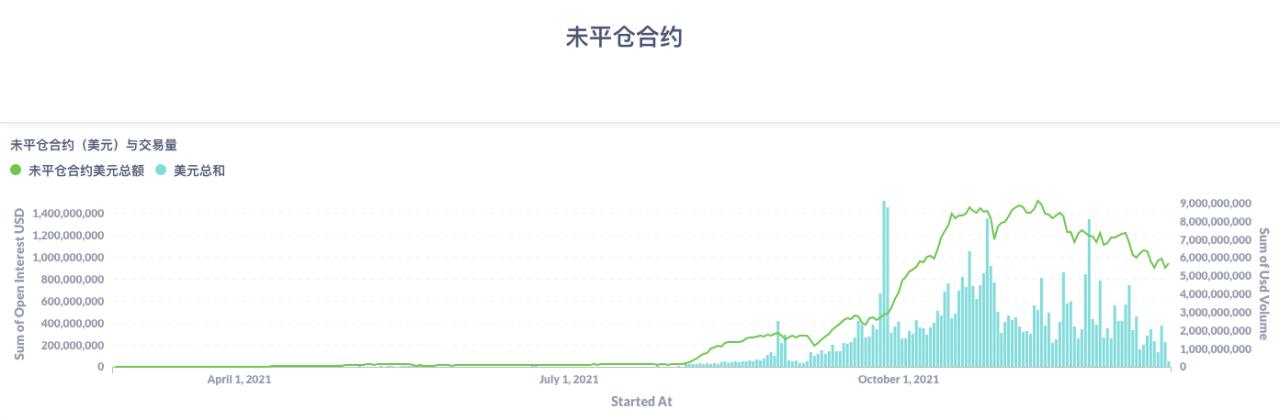
dYdX's open contracts and trading volume show a downward trend
Official data shows that on December 14, dYdX's trading volume was $1.389 billion, down 85.3% from the peak of $9.5 billion; on the same day, the open contract volume on dYdX was $910 million, down 40% from the peak of $1.52 billion. The significant decline in trading data has exacerbated DYDX's downturn in the secondary market.
Users Expect dYdX to Empower the Governance Token
In the official dYdX community, most users are dissatisfied with its recent performance, and many DYDX holders have stated that they have already sold off their holdings.
The relatively good news is that during the period of declining trading volume and token price, dYdX's total locked value (TVL) has not seen significant loss; as of December 15, dYdX's TVL was $972 million, still at a historical high. However, from the growth curve, the growth momentum of dYdX's TVL has clearly slowed down.

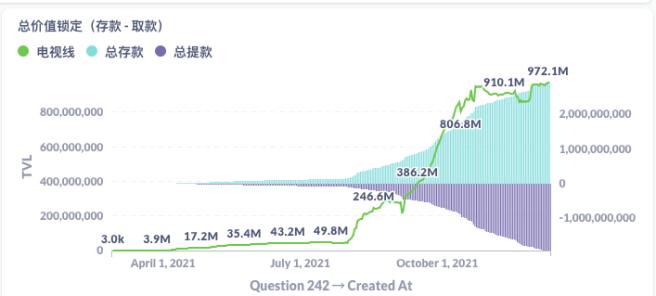
dYdX's recent TVL growth rate has slowed
Between September and October, dYdX's TVL grew from $280 million to $600 million, an increase of 114.28%. However, in the past month, its TVL increased from $910 million to $972 million, with an increase of only 6.8%.
Corresponding to the slowdown in TVL growth is a significant decrease in the number of new users on dYdX. Data shows that during the week from August 1 to 7, dYdX added 8,373 new users, while between September and October, dYdX averaged about 1,500 new users per week. Since November, the average number of new users per week on dYdX has dropped to around 300.
With the slowdown in TVL growth and the continuous decrease in new user numbers, dYdX's growth vitality is declining. The poor data performance has, to some extent, exposed the side effects of dYdX's trading mining; as the selling pressure on the token gradually increases, DYDX continues to decline, and users are increasingly lacking the motivation to trade on dYdX.
Users who previously engaged in trading mining on dYdX told Honeypot Finance that there is now basically no arbitrage space for trading mining, and the "mined" rewards can only offset the trading fees consumed. "Although it's still decent, the attractiveness of dYdX has indeed decreased significantly. After all, compared to centralized exchanges, trading on dYdX incurs additional Gas fees for withdrawals, and claiming mining rewards also costs over $100 in Gas fees."
How can dYdX escape its current sluggish situation in this downward spiral?
On social media, some users have expressed hope that dYdX can provide more use cases for the token, stating, "Increasing demand will enhance price performance, which is beneficial for reversing the situation."
Currently, the use cases for DYDX are relatively limited; besides participating in governance voting, holding a corresponding amount of DYDX only offers a fee discount. However, many users feel that under the long-term existence of the trading mining mechanism, the fee discount seems somewhat inadequate, "because the mining amount is tied to the consumed fees; if the fee consumption decreases, the mining quantity will also reduce."
In this predicament, some users have suggested that dYdX could emulate PancakeSwap by adding business segments such as NFTs and new asset issuance to provide more use cases for DYDX. Recently, there were rumors in the community that holding a certain amount of DYDX might lead to an NFT airdrop from dYdX, but as of now, dYdX has not taken any action in the NFT or GameFi sectors.
For dYdX, the decline in market data and the slowdown in user growth are the dilemmas it currently faces. Ultimately, dYdX needs to address the side effects brought by trading mining.
 Risk warning
 Risk warning