








A Comprehensive Understanding of Gitcoin: Technical Solutions and Current Weaknesses in Public Goods Funding

 Gitcoin's ultimate goal is to reach "Quadratic Lands," an ideal world where public goods can receive regular funding and democratic maintenance.
Original Title: Gitcoin and Championing Public Goods on the Open Web
Author: Eshita Nandini
Compiled by: Wang Xin, Chain Catcher
Public goods in the real world include clean air, drinking water, free education, and law enforcement—these goods and services are non-excludable and non-rivalrous. Typically, public goods are funded through taxpayer contributions and government allocations, as they are intended to benefit everyone residing in that jurisdiction. However, moving the idea of funding public goods to the internet is a much more daunting task, as there is no single entity that can manage all public goods, especially in a decentralized open-source network.
Closed-source projects are private goods because they are competitive and excludable. Web3 encourages a massive shift towards open-source projects, and Gitcoin is a key part of getting these projects off the ground in the Ethereum ecosystem.
1. Introduction to Gitcoin
Gitcoin was founded in 2017 by Kevin Owocki, Vivek Singh, and Scott Moore, and is a project within the Consensys portfolio that focuses on paying salaries to developers of open-source software. After years of development, Gitcoin completed a $11.3 million funding round led by Paradigm, allowing it to spin off from ConsenSys and become an independent entity.
Gitcoin is a platform focused on funding and grants for developers of the open web, empowering them to build public goods for the internet. In the digital realm, this means public technologies, public blockchains (like Ethereum), free education, newsletters, services, and privacy-related products. Gitcoin has four main ways to address this initiative, enabling the Web3 community (especially developers) to earn, learn, connect, and fund:
- Earn: Get paid while contributing to open-source projects
- Learn: Participate in projects like hackathons to gain Web3 knowledge
- Connect: Integrate into the broader Web3 developer community
- Fund: Donate to or raise funds for open-source projects

This article will focus on Gitcoin Grants, as it is an important aspect of the development of the Ethereum application layer.
2. GTC and the Community
Shortly after completing a funding round, Gitcoin launched the GTC governance token in May 2021. The total supply of GTC tokens is 100 million, with 15% airdropped to past users, 35% allocated to existing stakeholders (i.e., team, investors), and 50% allocated to GitcoinDAO. The goal of launching GTC is to gradually decentralize Gitcoin and promote the development of GitcoinDAO, which will focus on recruiting developers and building tools for public goods.
The governance framework of GitcoinDAO is a fork of Compound (i.e., its architecture is inspired by it). Currently, the DAO has about 18,000 members, and according to DeepDAO statistics, the community voting participation rate is approximately 0.43%. To encourage participation, Gitcoin has adopted an "administrator" or "delegate" system, allowing the community to recruit representatives to vote on behalf of community members, thereby increasing voting participation.
Administrators are a crucial aspect of GitcoinDAO's success: they have additional responsibilities to support all matters, including deciding on funding round parameters, improving products, and monitoring and flagging potential fraud on the platform.
Workstreams are the primary mechanism for organizing work and operations within the DAO. They are similar to the "pod" concept used by Orca or the "working groups" used by Index Coop. Each workstream has its own budget, leadership structure, and independent processes—like a sub DAO (subDAO).
3. Financial Portfolio
Compared to most projects, Gitcoin has a fairly diversified asset base, with 46 different assets in its financial portfolio. Below are the top 5 tokens currently held by Gitcoin—surprisingly, GTC is the second most valuable asset after AKITA.
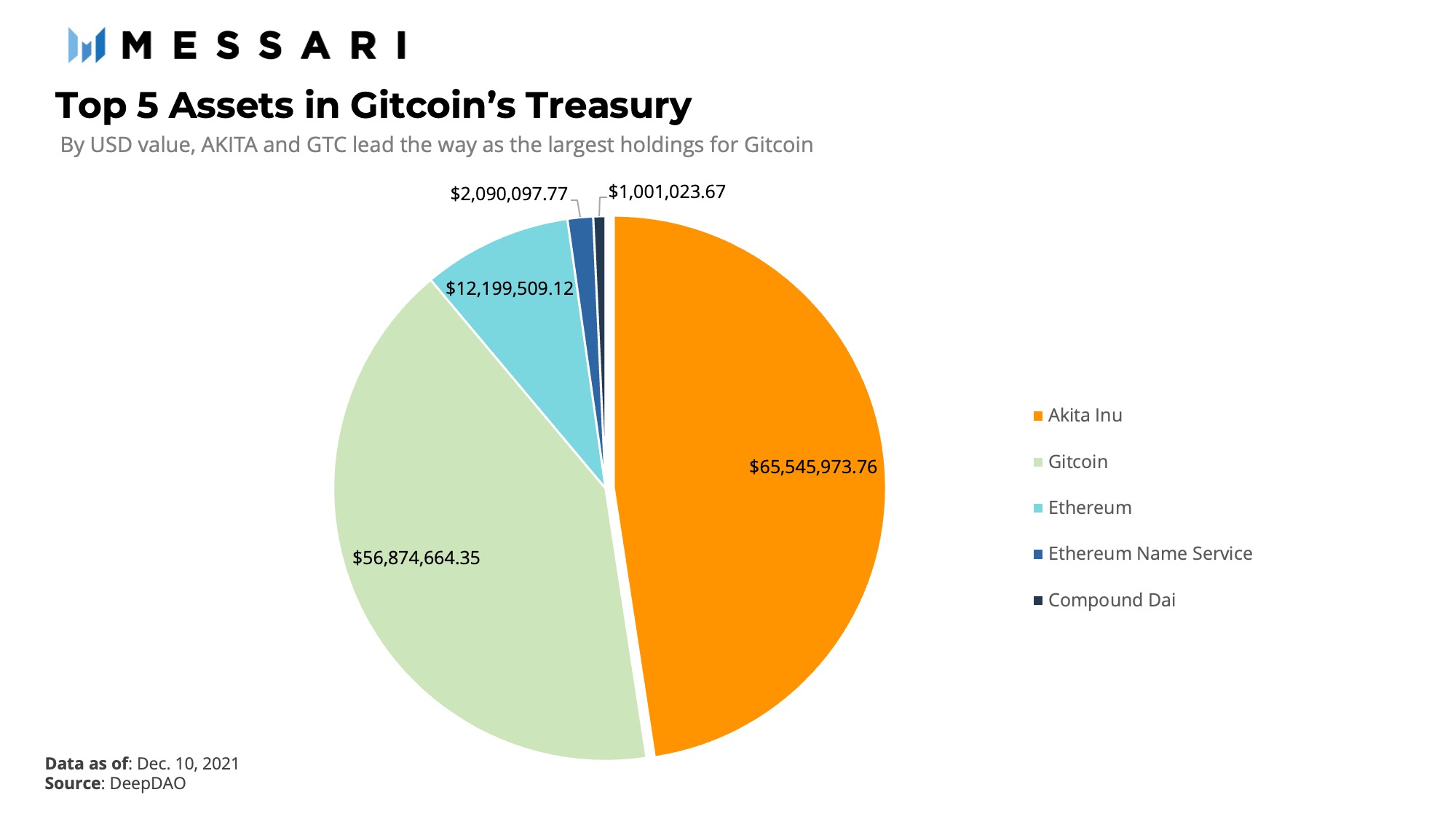
In May 2021, Vitalik Buterin received a large amount of AKITA tokens from the Akita Inu team and began donating 490 trillion AKITA tokens (worth $5 million at the time) to the Gitcoin community to fund development, projects, and grants.
After this event, the community voted to gradually sell all their AKITA assets, but the Akita Inu team intervened and threatened to fork the project if the Gitcoin community voted in favor, aiming to prevent Gitcoin from using these tokens.
This threat from the Akita Inu team led Gitcoin to modify its decision on how to handle the tokens—they chose to continue executing the buyback and burn plan for the token shares that would help fund the AKITA LBP. This example of an external team influencing governance decisions caused unease both internally and externally, as it made decisions based on external threats, which is atypical for a closed governance system like a DAO.
4. Grant Round Process
Gitcoin completed its 12th round of grants on December 16. Since the first round of Grants in February 2019, the team has iteratively improved the Grants product with each round to enhance the experience for both grantors and grantees.
Gitcoin typically focuses on low-value donations from different individuals, as many users have suffered from rising gas prices in the past. In recent years, Gitcoin has integrated layer 2 transactions and batch transactions to help reduce gas fees for donors. With the continued rise in gas prices, Gitcoin's 12th fundraising round utilized the Polygon/MATIC system for batch checkout, thereby reducing the gas fees incurred. In this way, contributors can choose to donate cheaply to multiple projects. Additionally, starting from the 7th round, a zkSync checkout system was implemented to settle donations for multiple projects at once.
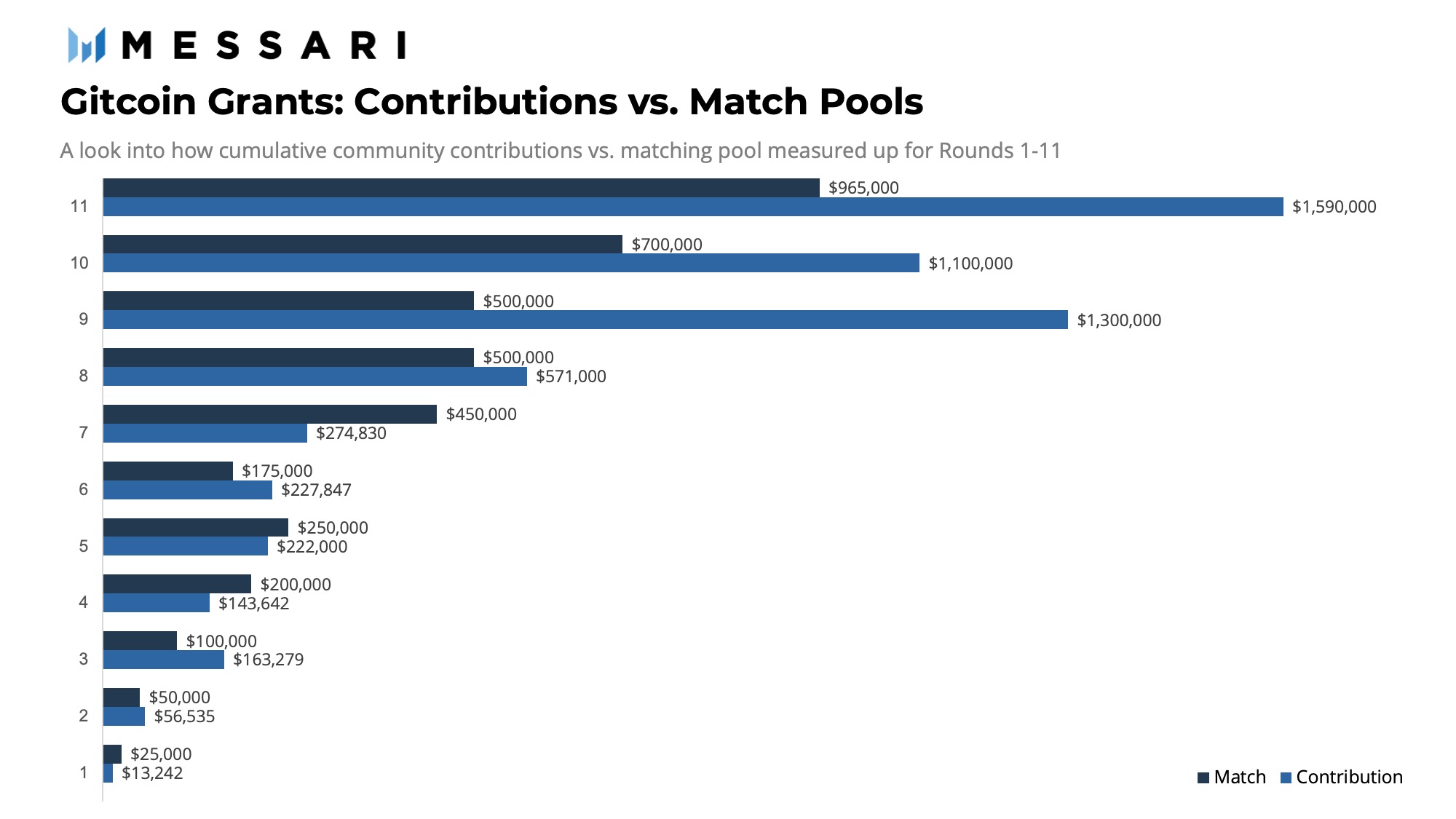
The 11th round of Gitcoin Grants reached an all-time high (ATH) in both the donation pool and matching pool, consistent with the growing trend of developers and tools in the Ethereum ecosystem. (The original text was published on December 16, 2021, when the 12th round of Grants had not yet concluded.)
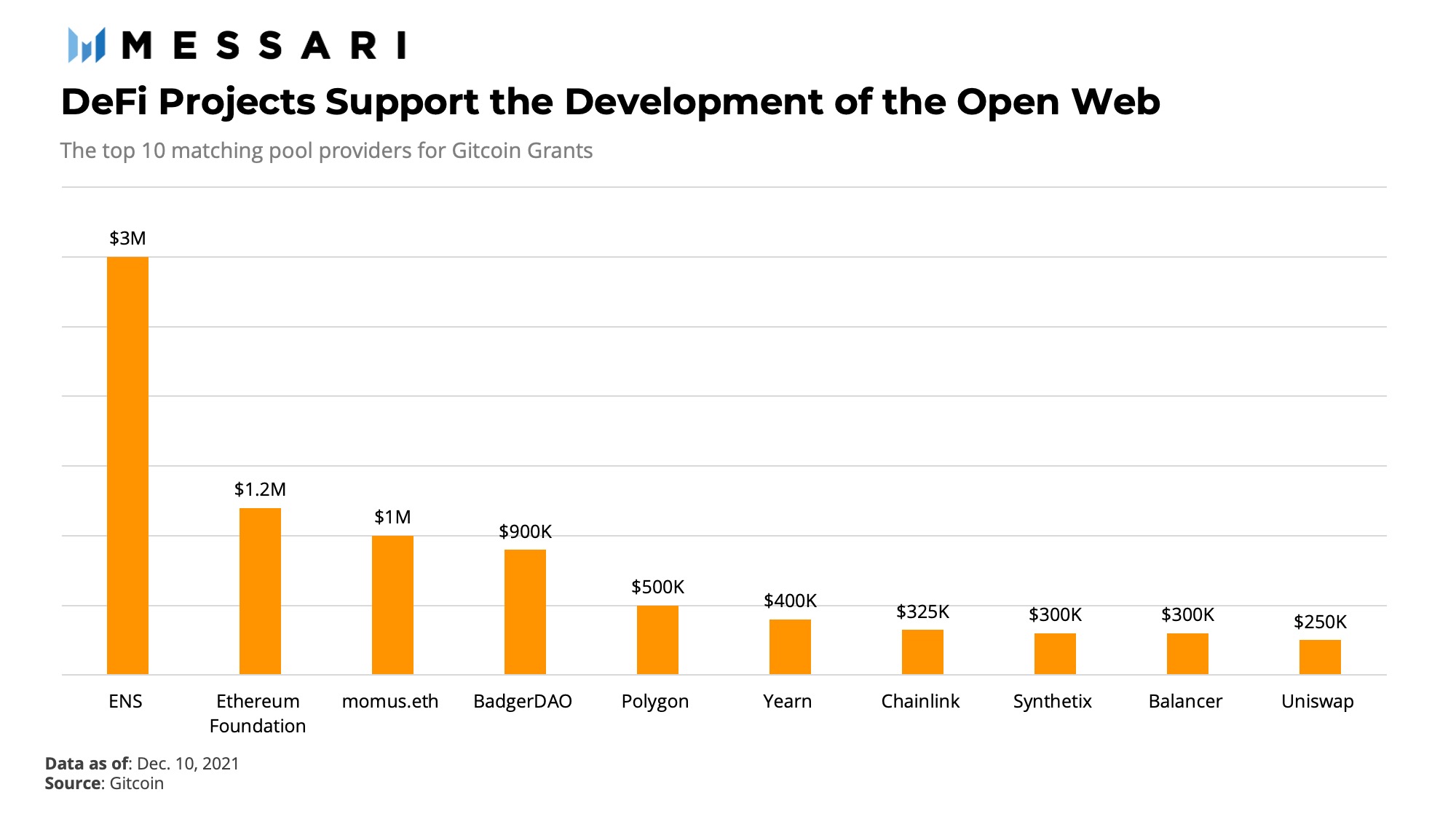
The Ethereum Foundation and Vitalik Buterin are strong supporters of the Gitcoin grants system, as evidenced by their contributions to the matching pool. Additionally, many DeFi projects continue to provide funding—indicating that Gitcoin is indeed a focal point for open-source development. Notably, projects like Yearn and ENS, which have not been funded by venture capital, have also been strong supporters of Gitcoin Grants.
5. Entering the Quadratic World
One of the most important tools used by Gitcoin may be "Quadratic Funding." The concept of Quadratic Funding advocates for the spirit of public goods—encouraging the maximum number of people to participate.
Quadratic Funding is mathematically the best way to democratically fund public goods, working by matching the funds contributed by temporary funders with those contributed by larger funders, resulting in a larger matching fund that benefits the projects favored by the crowd. Gitcoin's ultimate goal is to reach "Quadratic Lands", an ideal world where public goods can receive regular funding and democratic maintenance.
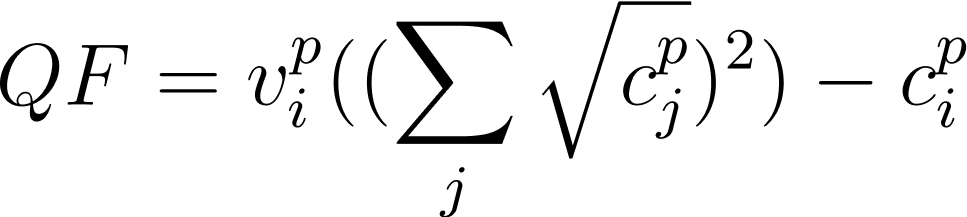
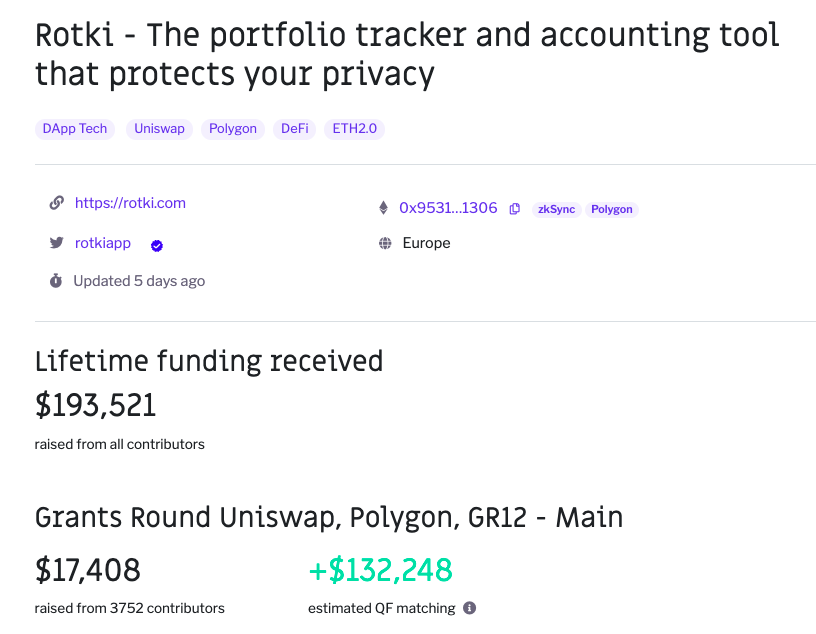
Quadratic Funding (QF), or the amount of matching funds, is equal to the square root of each contribution (C), summed and squared. For example, Rotki received $17,408 from 3,752 contributors. This input brought in about $132,248 in additional matching funds.
Although quadratic funding is mathematically sound, collusion and fraud can occur in practice.
6. Building an Ecosystem Resistant to "Sybil Attacks"
As Gitcoin Grants become increasingly successful, with $5 million in funds being transferred each quarter, projects have begun to rely on grants to leverage community funds. With the increase in funding volume, there has also been an uptick in spam small grants for several projects.
While QF provides a way to understand where the public wants funds to flow, it does not guard against attacks.
Gitcoin requires linking GitHub accounts to use it, and since the 7th round, it has also offered verification options through BrightID—those who complete BrightID verification have higher weight when calculating the matching pool. In the 9th round, the increase in fraud prompted the team to think about a system that could resist "Sybil attacks"—a significant topic for the broader DAO ecosystem. (Note: "Sybil attacks" typically refer to individuals attempting to control a network by creating multiple account identities, nodes, or computer coordinates.)
Similar to QF, the Mirror team also employed quadratic voting in a WRITE Race round. In this case, the number of ballots is far less important than the number of voters. If one candidate can reach a small number of large donors, giving them a lot of votes, while another candidate is supported by multiple voters (even though they have fewer votes), the latter candidate will rank higher.
Some candidates received votes from accounts that appeared to be bots—this was evident to the Mirror community. However, the team could not fully understand how these bot accounts were created or vote on the competition.
Robust detection methods and infrastructure are crucial for accurately detecting fraudulent activities. Often, seemingly hostile behavior may be innocent, so relying solely on code to eliminate participants without a second review can lead to very inaccurate results.
To address future adversarial behavior, the Gitcoin community has taken the following steps:
- Deploy detection algorithms to flag patterns that may be related to fraudulent activities
- Community involvement in detecting fraud, with administrators having the final say in defining what to focus on and reviewing potential false positives detected by the system
- Projects like Proof of Personhood Passport (PoPP) are advancing work on internet identity and privacy. PoPP helps achieve one person, one vote, rather than a symbolic one-vote system, greatly enhancing fraud prevention, increasing security, and providing a better basis for quadratic voting and fundraising.
7. Next Steps
For Grants, the team has been working to improve transparency in donations and provide a better experience. We will see more from the Gitcoin team regarding the use of quadratic funding to build smarter systems resistant to "Sybil attacks," which will connect with other parts of the Ethereum ecosystem.
Broadly speaking, Gitcoin still primarily builds on Web2 infrastructure and remains quite centralized from a technical perspective. Over the years, Gitcoin has accumulated a significant amount of centralized debt as a centralized system, which will need to be addressed as it gradually becomes a DAO, similar to resolving technical debt.
Currently, there is a workflow within the Gitcoin team dedicated to decentralizing Gitcoin's API and Grants process, allowing anyone to participate or fork the project. The ultimate goal of Gitcoin DAO is to achieve a state that is antifragile and credibly neutral.
 Risk warning
 Risk warning

Popular articles





