








Messari: NFTs will restructure the music industry, starting with the creation and consumption of music

 The revival of NFTs is transforming all media from traditional formats and business models to digital-native ones, while owners of art NFTs discover the intrinsic value of art and artists beyond profits.
Author: Eshita Nandini, Messari
Compiled by: Yangz, DeFi Path
The resurgence of NFTs is transforming all media from traditional formats and business models to digital-native ones. Visual art has been a prominent form, with sales reaching billions of dollars, and the market size and participants continue to grow. Art NFTs have seen trading activities around profile pictures (PFPs), generative collectibles, visual effects, digital/physical works, game objects, and more. Typically, art NFT owners discover the intrinsic value of art and artists beyond profits, and blue-chip collectibles have also performed well, despite the fact that NFT investments largely lack liquidity.
Music proves to be a more complex situation, as it involves the multi-layered creative and production efforts of many people/entities. Compared to static images, audio content is dynamic, requiring iterations in sound, creation, and production value before reaching its final form. However, the impact of NFTs on music seems to be something that both artists and builders are striving to figure out, as NFTs provide artists with more opportunities to unlock additional revenue and channels, including bringing fans into the mix.
The market quickly formed a consensus: NFTs will restructure the entire music industry, primarily by changing the way music is created and consumed.
Current Competitive Landscape
A variety of groups have formed to support music in areas such as discovery, production, and distribution.
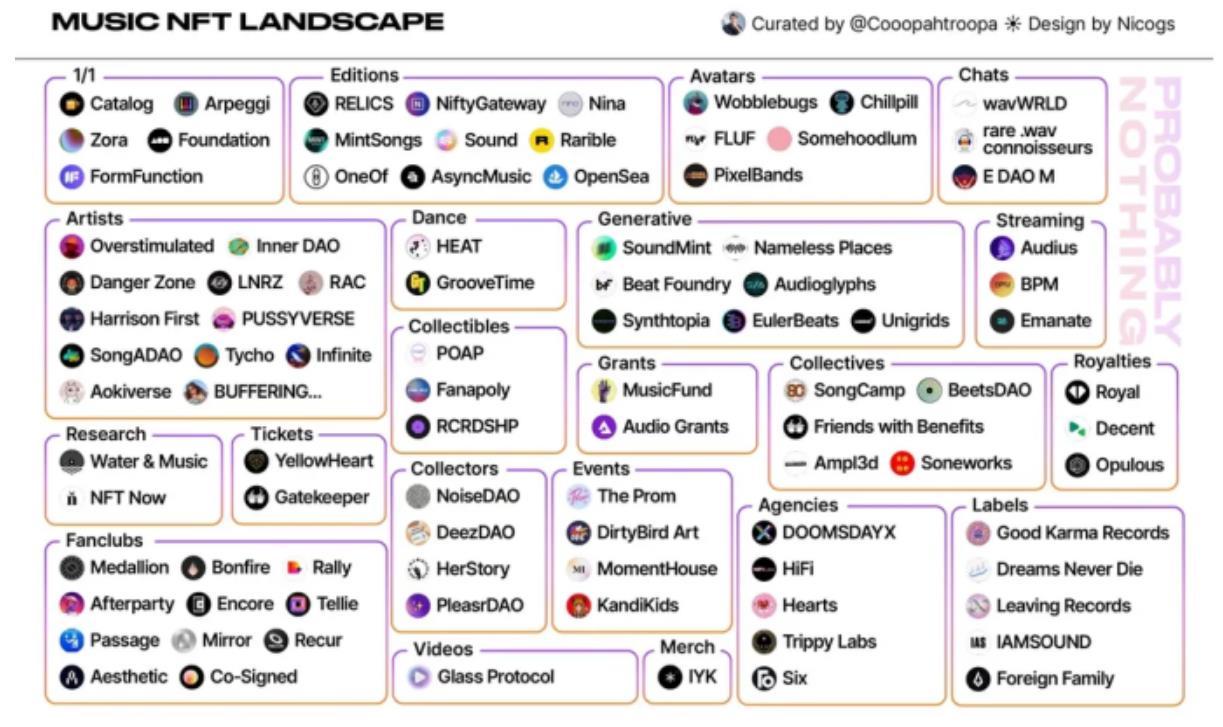
In terms of infrastructure, almost all chains supporting NFTs have music trading activities, but transactions on Ethereum and Tezos are rebounding.
Ethereum
Most Web3 NFT platforms are primarily built on Ethereum, such as Foundation, Zora, and OpenSea. Additionally, several major music NFT markets worth mentioning include: Catalog, SongCamp, MintSongs, and Sound. Let's take a look at one of them—Sound.
As of now, 90% of music streams are generated by top artists. Sound allows artists to initiate an auditory party; at the same time, listeners can comment on their reactions to songs and save those moments as limited edition NFTs—this mechanism incentivizes organic discovery rather than just playing Top songs or Top playlists like Spotify.
The platform's secondary sales total is rapidly approaching $1 million.
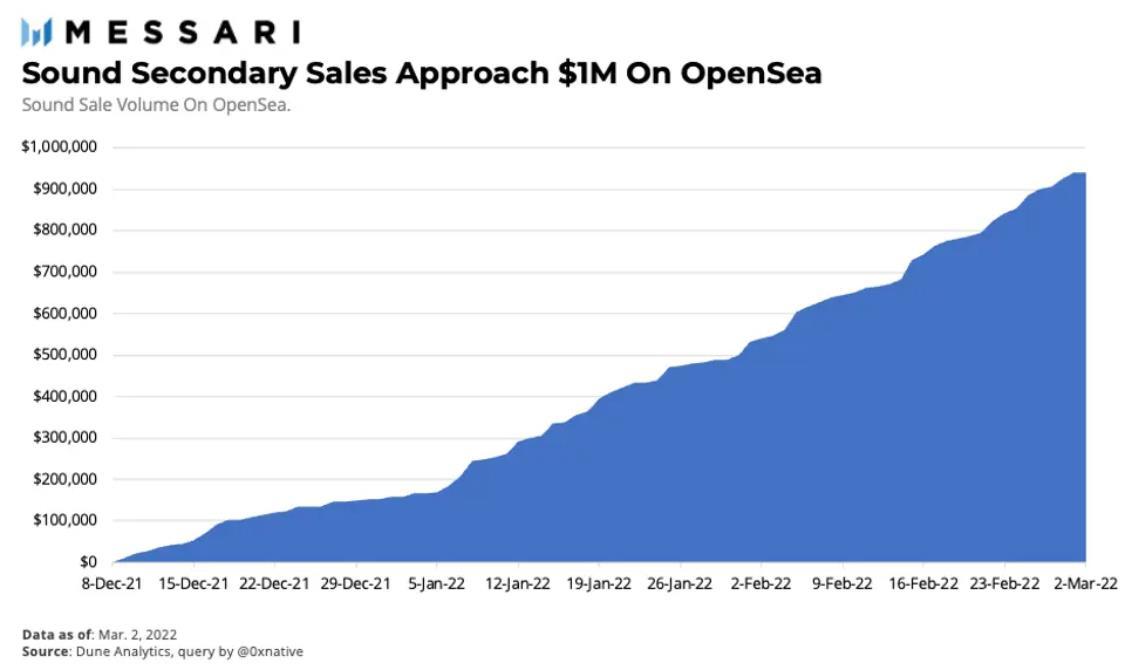
Sales on Sound account for only a small portion of OpenSea's trading volume, while blue-chip NFT collectibles dominate most of the share. When traders can see more liquidity around music or audio NFTs, it may pique interest.
Tezos
Due to Tezos' environmentally friendly proof-of-stake consensus mechanism, established artists often choose to launch projects on Tezos.
There are some interesting and upcoming partnerships being established with Tezos, indicating that Web3 solutions will begin to explore more. In December, an unreleased record produced by Whitney Houston sold for $1 million on OneOf (Tezos NFT market), marking the highest auction price on Tezos to date. Doja Cat launched an NFT series on OneOf, accompanied by concert tickets and access to her Discord among other benefits. Warner Music Group recently announced a partnership with OneOf to provide services for their artists, making OneOf the most significant music NFT platform on Tezos.
Music Intermediaries: Record Labels and Streaming Services
In an ideal world, art would flow directly from creators to consumers, but due to the challenges of distribution and discovery, it often does not work that way. In the traditional music industry, intermediaries that artists typically rely on include: record labels and streaming services. It is important to note that artists come in various types, from part-time, full-time, DIY, pure producers, independent artists to those signed to major record labels. Depending on their circumstances, each artist will choose different ways to monetize their work.
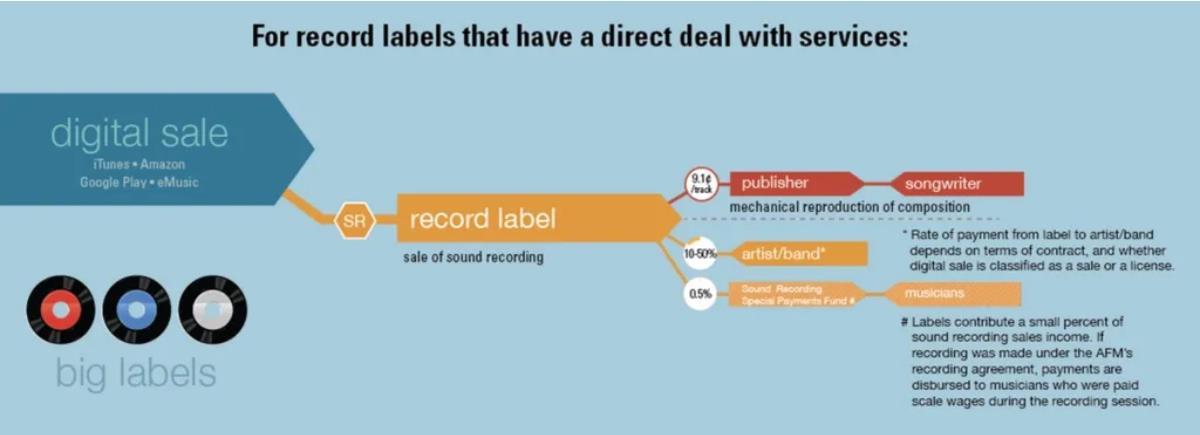
Kyle Samani, managing partner at Multicoin Capital, proposed viewing record labels as venture funds, equating artists to high-risk startups. Given this analogy, the current music environment is highly oligopolistic. The music industry today is dominated by three major record labels: Universal Music Group, Sony Music, and Warner Music Group, which determine who will be the hottest artists in the world. By the end of 2021, these three record labels generated over $20 billion in revenue.
Collector DAOs: The New Record Labels
Risk DAOs are becoming increasingly popular, with many people gathering to raise funds and deploy them into music NFTs. As we move toward permissionless investing, more casual investors will enter as angel investors or invest through services like Republic and choose to take on early-stage risks. Fans and collectors themselves can decide which artists are "successful" through direct investment, making record labels no longer necessary.
The infrastructure provider for risk DAOs, SyndicateDAO, launched earlier this year, and within two weeks, over 450 investment DAOs were formed. While we cannot clearly prove that all of these will remain operational and inject significant capital into the ecosystem—it still serves as an indicator of interest in self-managed venture funds.
While artists are beginning to use more Web3-native channels for artistic creation, the demand for record labels will not suddenly disappear; rather, the new demands from artists will force record labels to evolve to adapt better. While the three major record labels as we know them today may persist, several new "record labels" will emerge. Retail investors can now participate in music collections along this natural path, and collector DAOs will play a role in determining which artists become mainstream. With so many DAOs and fans influencing this decision, a new fan model will emerge to sustain this situation.
We have already seen art NFT collector DAOs focusing on curation and supporting artists in many different ways. For example, Flamingo DAO now has a portfolio worth over $1 billion and has become an early investor in several high-value NFT projects. Under the umbrella of Tribute Labs, Noise DAO aims to collect music NFTs and curate works, but also engages in recruiting and artist development (A&R). Today's record labels have strong curation capabilities, as they are responsible for discovering and funding new talent, ultimately shaping the music we consume.
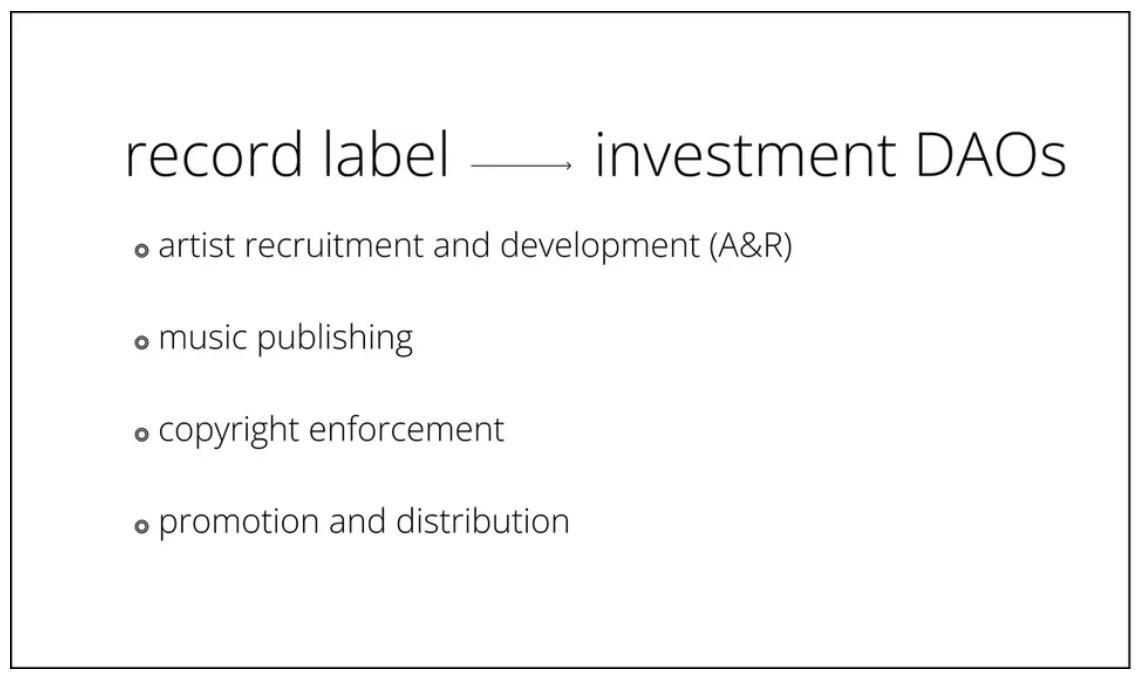
Music collector DAOs will ultimately act as record labels by taking on all these functions in some way, which is a natural progression, as investing in NFTs is often an investment in creators.
Web3 Streaming Services
Streaming services often pay artists very little, with top artists benefiting the most as they accumulate the most traffic. Apple Music pays its artists $0.01 per stream, while Spotify pays $0.003. Audius is a Web3 streaming platform that, due to their token ($AUDIO) structure, pays nearly $0.35 per stream.
The most streamed tracks on Audius have 500,000 streams, while Spotify has 3 billion streams. Given that the latter is a household name, artists can also do well through Audius in addition to traditional streaming channels.
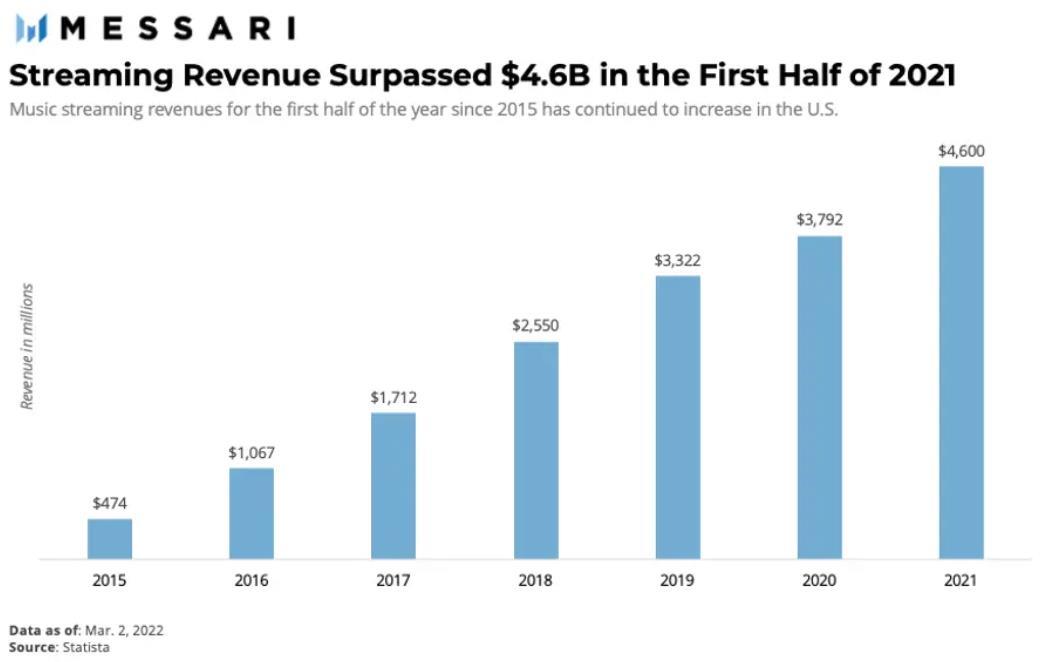
Music streaming is an important industry, but only a small portion of the revenue reaches the artists. Web3 streaming platforms like Audius can provide artists with a better revenue structure.
NFTs as a Catalyst for Transformation in the Music Industry
When music transitioned from analog to digital, it changed forever. At the hardware level, recording and producing music became easier—artists can now fully create at home with more portable devices and software, allowing new genres and diverse artists to enter the stage. After digitization, physical CD sales plummeted, and artists had to adapt to using streaming services, putting more effort into live performances. However, the pandemic paused all of this, forcing artists to start live streaming events. The internet catalyzed the shift from tapes, CDs, and MTV music videos to a streaming world, and now to NFT-based music.
The simple opportunity to use NFTs for music is to tokenize tracks or entire albums. NFTs create a plethora of opportunities for artists to rethink their creation and distribution models. As mentioned earlier, minting and auctioning music works is just one way NFTs provide opportunities for artists and music development.
Here are some interesting applications of NFTs that artists can leverage:
Ownership of Tracks/Albums/EPs
Artists can sell 1/1 versions of singles or albums. Most NFT markets allow direct sales of audio files. For instance, Catalog allows artists to sell singles or albums as NFTs, supported by Zora. So far, approximately 622 records have been sold on the platform, with an average price of $2,311.
Royalty Tokenization
To share in an artist's success, the best example is sharing royalty sales. EulerBeats is a generative music project and one of the earliest experiments in tokenizing royalties. 27 songs released the genesis track and copies of that track. The genesis holders of each track earn 8% of royalties each time a new copy of that track is sold. Additionally, they hold commercial rights to the track.
Royal allows fans to purchase tokenized royalties and earn proportional shares when digital service providers (streaming services) pay artists. Fans can also trade royalty tokens outside the platform and receive exclusive benefits for holding tokens.
Similar to streaming services, token holders may see negligible returns on investment when sharing royalties with artists until the platform gains adoption. Additional value is generated through the utility that artists will soon provide to their token holders.
Music Social Tokens
Social tokens allow artists to gradually achieve decentralization. With the launch of tokens and the formation of DAOs around those tokens, artists can leverage this to tokenize fan experiences and interactions. RAC is an artist and producer who utilized this potential when launching his social token $RAC. He recently released an operating system called racOS, providing exclusive products for token holders.
Generative Music
Generative tracks are another way music NFTs allow fans to engage more in the actual creative process, sometimes even giving them the ability to own an artist's track and create their own remix versions.
Soundmint focuses on one-on-one collaborations with artists to help them release their NFT series. Their first collaboration was with Kloud, releasing a visual collection paired with DJ-produced content. Kloud has released all intellectual property and commercial rights of these works to collectors and plans to allow collectors to extract sounds from their NFTs to create new tracks/music.
Challenges of Music NFTs
As this is still a new idea and new monetization method, there are still some issues that make using music NFTs less than ideal. If an artist chooses to sell their music solely through NFTs, the current market atmosphere will be unsustainable and unprofitable. According to data from the music research DAO Water Music, compared to 1.4 million active OpenSea investors, there were only 500 independent music NFT collectors on Ethereum by the end of 2021. These investors tend to be wealthy NFT investors and lean towards established artists.
As Li Jin wrote, creator models are beginning to trend towards those few but highly paying fans. For artists, this means having a smaller group of true fans can generate greater revenue, which effectively strips power from record labels, as followers and traffic are huge indicators of who they support and accept.
This model disrupts the concept of fan bases. Typically, a creator accumulates millions of fans, but most of them contribute $0 and consume music through channels like Spotify, some subscription-based service, or YouTube, or do not pay for streaming at all. However, those loyal fans always buy records, merchandise, concert tickets—along with sponsorships and any other collaborations they may have outside of fandom, all of which contribute to the creator's income.
On the other hand, getting some large sales from a few fans does not guarantee that those fans or collectors will return for future releases, especially since most music NFT collectors today are NFT whales. However, large sales do provide artists with more opportunities and capabilities to spend more time on other channels.
Limited Exposure
Artists' music exposure will continue to rely on mainstream channels and additional strategies that have already gained traction. TikTok is a major channel for artists to gain viral traction through sound snippets, and a few artists have organically made it onto the Billboard Top 100 or Spotify's Viral 50.
For native NFT artists, exposure is limited, as there are not many users on these platforms compared to existing services. On the other hand, artists like 3LAU and Steve Aoki already have existing audiences that can easily pivot to purchasing their works.
Risks/Returns for Established Artists
Established artists do not spend time cultivating community or utility around their NFTs. For example, Snoop Dogg recently released a mixtape on OpenSea that did not meet the quality expectations of fans. Established artists have the ability to generate incredible income from NFTs, but the same artists and their teams are unlikely to spend time interacting with fans on their own Discords or setting up experiences specifically for them, as opening up to their broader fan base may be more profitable.
Many collectors continue to become NFT whales, and they may not be true fans, making it difficult to gauge whether interpretations of preferences for music NFTs are accurate.
NFTs Cannot Solve Music Copyright Issues
This may not be obvious to consumers, but the current processes in the music industry are quite outdated and complex, with several types of copyrights tied to music ownership.
For example, when Scooter Braun's holding company acquired a record label, Taylor Swift's album master was sold, forcing her to re-record her album. The master is the original recording of a track or album, and the owner has the legal right to profit from it. In Taylor Swift's case, the record label refused to sell the music rights back to the artist. Such situations are common, with record labels holding absolute rights over artists. Rights, terms, and royalties are often fragmented, with record labels ultimately profiting more than artists and retaining most rights to the music. Typically, record labels hold the master control over signed artists' works, while artists usually have the right to receive 15% of royalties.
While smart contracts provide the ability to publicly outline agreements and terms and programmatically allocate royalties, music copyright remains complex, and putting them on-chain does not necessarily resolve the fundamental issues. Opulous offers anyone the ability to trade shares of music copyrights and provides DeFi loans backed by real-world music assets and royalties. The team launched their music security NFTs (S-NFTs) on Republic, allowing Lil Pump and KSHMR to stake shares in their royalties and offer them as NFTs. According to Water Music, the team did not register the S-NFT with the U.S. Securities and Exchange Commission, which may become an issue in the future due to the current activities and ambiguous regulations.
However, the timing is right.
Despite the inherent challenges of putting something on-chain, music will continue to explore tokenization solutions. Major record labels and artists are already experimenting across various chains and platforms. Currently, there are over 50 music NFT projects actively trying to sell NFTs or collaborate with artists, and the reality is that not all projects will survive. It is equally undeniable that there is a growing appetite for music NFTs, regardless of their form. Here are several key indicators:
- The NFT market is generally thriving;
- Artists are realizing that the outdated structure of record label deals is detrimental to them;
- A gradual shift towards one-on-one fan models rather than one-to-many fan models (OnlyFans, Patreon);
- Web3 platforms have begun to embrace well-known artists (Steve Aoki, Diplo).
As traditional music contracts are clarified, NFTs offer the ability to enhance licensing efficiency in the form of smart contracts. Additionally, artists have new ways to profit, and fans have the ability to become true investors. Regardless of the impact of music NFTs, artists signed to record labels are missing out on revenue occupied by record labels, even losing rights to their intellectual property in the process. In the new, improved music industry, we will see artists regain control over their art and revenue streams and share them with their consumers and fans.
 Risk warning
 Risk warning
Popular articles





