








Survival Rules for Investing in the Crypto Market: Please Reclaim Your Attention and Make Informed Decisions

 Compared to being addicted to the colorful social media, learning to develop sustainable investment strategies is the true way to survive.
Written by: 0xRusowsky
Compiled by: Amber, ForesightNews
In this fast-paced world of information and data exchange, everyone is fighting for your attention. You often find yourself overwhelmed by a massive amount of information. This can easily lead to an addiction to Twitter, making you mistakenly believe that the information on CT can bring you wealth and success.
This perspective forces you to constantly refresh your feed in hopes of getting "first-hand" news shared by others. In reality, this only leads you to despair, as there is almost no alpha in such a noisy environment. When your brain is flooded with information and ultimately unable to effectively distinguish between real alpha and junk information, you will be discarded by the market.
Before diving into the main content, it is important to emphasize that this is not an investment guide or advice; it is merely some personal insights and reflections from my investment journey.
A Common Issue We Face
You often find yourself blindly believing some voices on social media. You might be "brainwashed" into buying a new token because you see a lot of text about its potential for price increase on social media, and you may hold "hundredfold" expectations for this token with strong marketing capabilities. However, the actual price movement of the token often does not meet your expectations, and you may even become the "bag holder" at the peak.
Advice
First, you need to understand that true alpha is very scarce. The so-called "alpha" that is widely promoted on social media is likely backed by a lot of ulterior motives.
Of course, I do not deny that social media is a very important learning tool for the crypto market, but you must not become overly reliant on it, especially avoid blind following. If you rush to make investment decisions just because you read a few articles or scrolled through a few posts, you will most likely incur losses.
Therefore, it is crucial to build an investment framework that suits you.
Investing with a Plan
It must be acknowledged that during my investment journey in cryptocurrencies, I have indeed learned a lot from social media, which has greatly helped shape my current perspective on this market. Some knowledge is easily accessible, such as project information or technical content, especially when some people hold tokens of new projects; they will naturally promote them, leading to a plethora of project introduction information on social media platforms.
However, there is another side to the story: the background information of these market participants. Their financial habits, investment methods, and strategies are generally not public.
As is well known, the vast majority of large market participants have experienced multiple cycles of cryptocurrency and generally possess rich experience in traditional financial markets. If you do not have similar accumulation, you should learn to understand the thinking patterns of these "big players," rather than simply copying their investment portfolios at random time points.
The reality is that the behavioral patterns of the investors you admire are completely different from your own immaturity.
Do you think these people would blindly invest in a project without conducting due diligence after reading a few tweets? Would they invest in those so-called "to the moon" shitcoins? Would they casually manage their positions and risk?
In fact, most people who can outperform the market and accumulate astronomical wealth have a sufficiently professional investment plan and can stick to it.
It is also worth mentioning that those who entered the crypto market earlier generally gained some wealth due to market dividends. However, if you do not formulate a reasonable investment strategy and merely rely on luck to navigate the market, you are not fundamentally different from those friends you look down upon (who may think this market is just gambling).
In summary, if you want to broaden your investment path in the crypto market, it is necessary to establish a sufficiently professional investment strategy, and mimicking the behavioral logic of professionals is one of the shortcuts to building an investment framework.
Making a Plan
So, how do you become a successful investor?

Step 1: Learn to Filter Out Noise
You must learn to reclaim your attention.
The first step is to organize your Twitter feed. Sort out the list of people you follow. Browse through all the accounts you follow. Unfollow those accounts that do not provide genuinely valuable information. Unless you are a short-term trader, I also do not recommend following any accounts that share market analysis opinions.
Additionally, you can unfollow projects that you are sure you will not be interested in. Human energy is limited, and no one can be an expert in all fields.
Step 2: Collect Insights
Build an insightful information stream and turn it into your exclusive resource library.
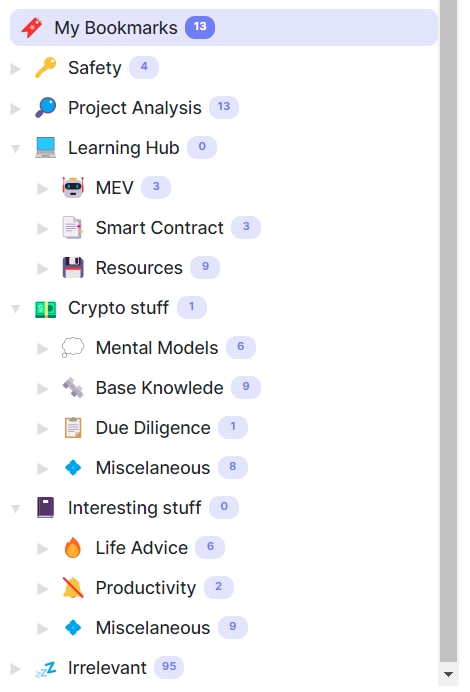
Personally, I like to save posts and articles that seem interesting. You can use some tools to categorize these quality contents by different themes.
Of course, there are indeed some alpha in the information shared by others online. Although establishing a partnership with someone willing to share quality information with you is not simple, once successful, it can greatly enhance your resource integration efficiency.
My suggestion is to communicate directly with people through comments or private messages. Become someone who shares alpha. Do not expect any returns. This altruism will ultimately bring rewards.
Step 3: Learn
This is where the miracles happen.
Once you have collected and organized the information, it is time to process it. You need to digest this knowledge.
Master the basics. To succeed, you need to understand how this industry operates. You do not need to become a developer, but you should know the underlying logic behind your investments (Bitcoin, PoW, Ethereum, PoS, AMMs, Curve, Oracles, and Liquidations, etc.).
And learn to conduct appropriate due diligence. Once you understand the basics, every time you see a new project, you will have a critical starting point. You will be able to judge whether it is interesting. Then you can try to understand the protocol's mechanisms, assess the project's tokenomics, and judge the project's prospects through the community and team background.
Step 4: Establish an Investment Strategy That Suits You
You need to determine which stories will succeed in the long run. I like to think of it as a roadmap that gives you a sense of direction. Since you believe that some stories will succeed in the future, you should ensure that your investments align with these core narratives.
Everyone's focus may vary; some may prioritize decentralization, others may be optimistic about the future of privacy, and you might trust that DeFi will bring a larger-scale financial revolution, or you may be a believer in the prospects of cross-chain development. Ultimately, which field you are more optimistic about depends on your own research and preferences.
You should not expect to establish clear preferences from the start, but as long as you maintain the right mindset, your judgment will gradually strengthen, and you will be able to better understand this market.
Perhaps your investment strategy is imperfect at first, but this model will be refined through your continuous learning. As long as you ensure that 90% of your investments align with your long-term vision, the likelihood of falling into the trap of foolish projects will be greatly reduced.
Although this may be the most challenging step, it is also the most important one. Ironically, most people do not spend any time thinking about this issue at all.
Sit down and think carefully about how you view this market, clarify which tracks you believe have a greater chance of success, and what the reasons for that success are. If you can clarify these questions, you will be closer to establishing an effective investment strategy.
Step 5: Execute
This is a very volatile and rapidly growing market. Because of this, your investments will continue to grow in the long run, but if you invest blindly, you are likely to incur losses. If you want to outperform the market, you need to learn to build a portfolio to control risk.
I feel that in the sea of information on social media, almost no one discusses this topic. Your subscription feed may be filled with various projects, but hardly anyone shares their risk management strategies. People may provide you with information about a position that only accounts for 2% of their portfolio, while after reading a few posts, you might allocate 15% of your assets to that project, leading to a huge discrepancy in the risks you both bear.
I strongly recommend that you build at least two types of portfolios, such as an aggressive portfolio focused on growth during bull markets and a conservative portfolio aimed at capital preservation during bear markets. Planning these two types of portfolios can effectively control your personal exposure to risk.
As long as you are well-prepared, when the market begins to turn, you will not have to wait in despair for a recovery; instead, you can take action to protect your assets more effectively.
Everyone's risk tolerance is different. However, when determining target portfolios for different scenarios, the types of assets are very important. Generally, I categorize cryptocurrencies into the following major categories:
Stablecoins: USDT and USDC, etc. Theoretically, they have the lowest risk, as their prices do not experience significant fluctuations. For widely used stablecoin assets, the risk mainly lies in value decoupling, which is unlikely to happen.
Mainstream Coins: Bitcoin and Ethereum (no need for "etc." here, currently the only two). These assets have survived multiple cycles of bull and bear markets and have established a very strong market consensus. Currently, Bitcoin has actually entered the threshold of macro financial market assets, and these assets have the strongest survival ability during prolonged bear markets.
Blue Chips: Those assets that have proven to have sufficient influence and value and are currently undervalued. These assets are likely to outperform mainstream coins in the future, and identifying these assets in advance is the essence of building an investment strategy. However, since "identifying in advance" means the project is still in its early stages, you need to be able to select potential projects that are most likely to be seen by more people in a fiercely competitive market.
"Shitcoins": They could either go a hundredfold or go to zero. These projects require detailed due diligence before investment; you need to gather as much relevant information as possible, and also pay attention to risk control during the investment process.
However, it is important to note that due to the rapidly changing nature of the early-stage crypto market, you should maintain flexibility when executing your established investment strategy. The goal of building a portfolio should be to create a psychological framework that helps you manage risk.
Establish a Project Evaluation Checklist:
Before looking at a new project, you can list a detailed evaluation process and execute it to ensure that you do not make irrational judgments out of impulse. This is especially important when you are making a medium to long-term investment.
- Ensure you have a basic understanding of the project
- Read the documentation on their website;
- Follow the project's Twitter and check its historical posts;
- Study the project's token economic model. Understand the initial token distribution and unlocking periods, etc.;
Understand the founders and core team of the project
Join the community and observe the community atmosphere
- Ask questions in the community to assess whether community members understand the project well;
- Listen to the project's online sharing;
- Try to reach out to the founders;
- Look for competitors in the same track
- Identify the project's differentiators and competitive advantages;
- Use the historical performance and market capitalization of competitors as a reference to judge growth potential;
After completing all this research, you should be able to answer the following questions:
- Does this project have real market demand? What problems can it solve or what services can it provide?
- Why would people want to buy this token? How will the protocol generate revenue?
- What does the tokenomics look like? Is the distribution fair?
- Is the team reliable? Do the founders pay attention to community dynamics? Is the team continuously working on optimization?
- Is the community active? Do community members establish a real consensus, or is it merely speculative?
Of course, figuring out the answers to all these questions does not guarantee that an investment in a project will succeed, but it can also reduce the likelihood of failure.
Step 6: Iterate
As time goes by, we learn new things, and our perceptions change. Because of this, you should regularly reassess your understanding and goals. This is a continuous iterative process. You should constantly challenge your past self.
In summary, I hope everyone learns to approach investment professionally, just as you would treat your job. The content on social media is indeed interesting, but remember, you are here to make money, and the capital market is ruthless, so do not be fooled by those with ulterior motives, and do not blindly invest with a gambling mentality.
Ensure that every project you invest in aligns with your judgment, so even if this investment ends in failure, you can at least take the opportunity to reassess and optimize your investment strategy, which is also a form of gain.
 Risk warning
 Risk warning

Popular articles





