








Understanding the Super Exchange Protocol Verse: When NFTs Become the Medium of Exchange...

 The ability of digital objects to become their own medium of exchange will bring about a paradigm shift in media, culture, infrastructure, and identity on the internet.
Author: Kiran, Founder of Verse
Compiled by: DeFi Dao
Over the past few months, I have been obsessed with the concept of NFTs as digital objects, and how this idea/framework provides a new paradigm for the exchange of internet-native objects.
Let’s first consider the impossible scope of physical objects. You could argue that, literally speaking, anything made of atoms is an "object," and trying to pin down a specific definition here is futile. But we can focus on an important characteristic of IRL objects that will help us understand the true potential of "digital objects": ownership.
The core innovation of blockchain as a public ledger separates the concept of digital ownership from physical ownership, which lacks any decentralized consensus mechanism. However, despite having created this powerful infrastructure to redefine the nature of ownership of digital objects, we still rely on the exchange systems established for physical objects.
In the physical world, any form of object exchange requires a market where objects temporarily exist within the permissions of their owners. As we know, traditional markets require liquidity from both supply and demand sides to succeed. For Uber, the "liquidity providers" are passengers and drivers. For Airbnb, they are guests and hosts. For StockX, they are sneaker buyers and resellers. In any of these markets, if one side's trading volume dries up, the other side will soon follow into decline until the entire event collapses.
In the past year, we have witnessed the explosion of the first truly ownable digital object market: NFTs. NFTs come in numerous form factors, extending the imagination to the long-tail functionalities that digital objects provide: membership cards, access tokens, interactive games, status symbols, artworks, certificates, and more.
Echoing the rapid development of NFTs is the rise of the NFT market -- although all structures are very similar to markets for physical goods and services.
For example, on Opensea, the structure and design of the market are what you would expect from a typical physical goods giant like eBay. This traditional market structure creates a winner-takes-all environment, where success is binary: if you have the most liquidity from buyers and sellers, you might win. If not, you may suffer a painful death. It’s no surprise that OpenSea and Magic Eden have consistently enjoyed over 90% market share of NFT trading volume, despite their fees and downtime being higher than many competitors.
It’s not hard to imagine that over time, today’s large aggregators in the NFT market ecosystem will gradually disintegrate. We have already seen a surge of niche markets designed specifically for trading narrow categories of NFTs, like Catalog Works. Undoubtedly, specialized markets will become useful destinations for certain types of unique collectibles.
However, in almost all cases, nearly all NFTs are traded using some form of auction model and are economically tied to third-party markets. Regardless of whether the market is large or small, we still have to go there to trade. We still have to search for prices. The economic outcome remains a struggle for liquidity lock-in. Ultimately, despite having these new, internet-native digital objects, we still treat them as physical objects for exchange, subjecting them to the same centralization, dependency, liquidity, and inefficient pricing constraints.
But what if there were another way to exchange digital objects -- a way that truly makes items autonomous and decentralized? What if items didn’t need a market to exchange? What if items were the trade?
Verse: The Hyperexchange Protocol
The Verse protocol gives every digital object an embedded, autonomous exchange. Structurally, this means that every ERC-721 NFT created through Verse has a fundamental ERC-20 market as support. Let’s analyze how it works.
Through the protocol, creators can deploy a pair of contracts consisting of an ERC-20 exchange contract and an ERC-721 Hyperobject contract. The dynamic price and supply of the ERC-20 token are managed by a bonding curve acting as an AMM. Simply put, this means anyone can buy and sell tokens at any time, with instant liquidity, while the contract programmatically adjusts the price based on circulating supply. Anyone holding at least 1 atomic unit of the ERC-20 token can redeem their tokens. Redeeming tokens will transfer the holder's ERC-20 to the paired Hyperobject contract, which will mint a new NFT and transfer it to the redeemer in exchange.
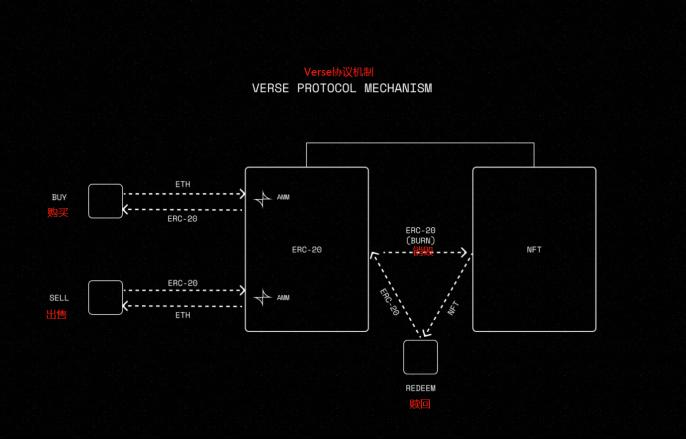
For example, suppose I am a creator, and I have created a digital basketball court NFT called "Swish Court" through Verse. On Verse, I deploy a pair of contracts containing the ERC-20 $SWISH contract and the ERC-721 Swish Court NFT contract. Then anyone can immediately buy and sell $SWISH tokens. Anyone holding at least 1 $SWISH can redeem their tokens, burning 1 $SWISH to receive a Swish Court NFT in return.
Thus, digital objects serve as their own medium of exchange, possessing an autonomous market. Since the object essentially provides its own liquidity, it can be exchanged without the jurisdiction of intermediaries.
This new exchange structure offers numerous benefits for both creators and consumers.
Consumers now have instant liquidity to buy and sell continuous quantities of NFTs. Individuals who may not afford a fixed price to purchase an NFT can now buy a small portion of the underlying ERC-20, while whales can still make larger purchases. Therefore, this mechanism allows for exchanges along the price curve, maximizing market efficiency.
Additionally, creators can have complete control over how they price their NFTs throughout their lifecycle. Creators can specify the underlying reserve rate and the initial slope of the ERC-20 price curve, fine-tuning their desired pricing as demand rises and falls. In this way, creators can set a practical limit on the supply of NFTs and enforce a degree of scarcity.
Perhaps most importantly, Verse enables digital objects to exist autonomously anywhere on the internet without needing to connect to a market. Imagine scrolling through a website, seeing an NFT created by Verse, and being able to exchange it instantly. It’s like walking down the street, seeing a pair of Nike Dunks, and being able to put them on your feet in an instant -- instead of having to track down the lowest price, go to the store, and buy them. Thus, the protocol catalyzes a new form of discovery, allowing items to be exchanged where they are consumed.
Ideally, we first create objects and let them operate in many spaces. This way, users and objects are at the top of the food chain.
But if we focus too much on space and/or proprietary integration, we risk (again) letting space stand at the top, making users/objects the fuel they lock in. ------dom
What excites me most is the new capabilities that arise when you can combine the ERC-20 mechanism with NFTs. Compared to physical objects, digital objects have three core characteristics that open up a world of possibilities. Digital objects are stateful, programmable, and networked. Digital objects can represent anything you can code, and have an exchange built into the object, not just facilitating better forms of trade.
For example, consider a Web3 media network like Mad Realities. Imagine a future where there is a Mad Realities "plot idea NFT" created by Verse, where the NFT owner can set the tokenURI to their recommendation for a new plot idea. Then, all holders of the underlying ERC-20 can stake their tokens to different NFTs, effectively curating their favorite ideas and choosing which ideas make it to the show. As the show becomes more popular, more people will pitch their ideas to the relevant NFTs, and correspondingly, the token prices will rise, rewarding stakers for their curatorial work.
Or consider a digital Kith hoodie, minted as a blank NFT. Instead of minting a random pattern (similar to the traditional 10k PFP project model), you could customize the pattern of your digital hoodie based on limited attributes in the contract, and "build your own NFT." Then, suppose each owner's design is available for purchase in a virtual market; you could use the underlying ERC-20 token as NFT-specific currency to buy patterns from other creators and put them on your hoodie. Such a system would incentivize the creation of an economy around NFTs and allow token holders to create value without needing to separate from the asset.
Suddenly, you have items, markets, and social graphs all wrapped together. Each item becomes its own micro-economy, with native incentive mechanisms that encourage investment builders to develop living space and systems for the objects. Through recent projects like OKPC, we have seen innovative experiments treating NFTs as objects with their own states and operating systems. And Verse is designed to enhance these concepts at the protocol level.
It’s worth noting that Verse is best suited for objects that are not necessarily unique in nature -- or have varying degrees of "rarity." In the long run, I believe the protocol will incentivize the creation of NFTs that feel more like usable items rather than collectibles. While saying "it's too early" is a cliché, I truly believe we have barely scratched the surface of what digital objects can really achieve. By introducing a better way to exchange digital objects, I firmly believe Verse will facilitate the development and proliferation of previously unmaintainable and underexplored NFT use cases.
Today, I am excited to open the Verse beta and start collaborating with NFT creators and builders to explore the best projects that Verse can help realize. If you are a creator interested in establishing a new NFT paradigm, let’s talk. If you are a full-stack elite engineer, solidity developer, or community leader, please email me ;)
The scope of digital objects is unfathomable, but one thing is certain. They will fundamentally change the architecture of the internet, affecting our relationships with media, culture, digital infrastructure, identity, and more. Verse is the hyperexchange protocol: a superstructure capable of autonomously exchanging digital objects and creating a composable, infinite internet.
 Risk warning
 Risk warning

Popular articles





