








Data Analysis: GameFi Economic Model and P2E NFT Asset Holding Trends

 The token economy has a certain supply and demand relationship and acts on players/users and investors in the gaming environment.
Author: NFTGo
Key Takeaway
- The value of GameFi Tokens is partly determined by the daily active user growth (DAU) and the Burn/Minting Ratio.
- Utility is related to the Burn/Minting Ratio.
- According to the market capitalization ranking of segmented tracks on NFTGo.io, GameFi ranks fourth in the NFT industry, with a total trading volume of up to $3.29 billion.
- Investors hold P2E NFTs for the medium to long term.
Currently, most P2E games are on Ethereum (ETH) or Solana (SOL). Unlike traditional games, the ownership of in-game assets in P2E games belongs to the players, not the companies, which is one of the reasons GameFi can disrupt the gaming experience.
In traditional games like Counter-Strike, Fortnite, GTA, FIFA, and LOL, players acquire equipment and purchase skins, relying on game studios. The term "rely" means that the custody of assets is entirely determined by the studio, which can do anything with the assets.
Additionally, most casual gamers do not have much opportunity to earn real money in real life by selling assets or creating new items. In traditional games, only a few community markets can be profitable, with the Steam community market being one of them.
Token Economy
A new economic model is emerging in the digital world, where players can earn Tokens, create their own digital assets (some P2E have a "breeding" system), and hold custody of digital assets. The Token economy has a certain supply-demand relationship and operates within the gaming environment of players/users and investors.
Most GameFi platforms have two or more Tokens. The first type of Token is the governance Token. The second type of Token acts like a "FIAT scheme," where this Token is used to upgrade game characters. We can consider the P2E game Token economic model from the following dimensions:
1. Market Capitalization & Supply
Market capitalization is a key indicator of the total value of a Token, measured in US dollars. Market capitalization is calculated based on the size of the capital pool invested in the project, using the formula "circulating supply multiplied by the current price of the Token." Paying attention to market capitalization can help better understand the future value of the Token.
A high price for a Token does not necessarily mean its market capitalization is higher than that of other Tokens.
For example, if Token A is priced at $1 with a circulating supply of 100, and Token B is priced at $2 with a circulating supply of 25, people might typically think Token A has a lower value. Let's calculate the market capitalization for both:
Market Capitalization = Token Price x Circulating Supply
A's Market Capitalization = $1 x 100 = $100
B's Market Capitalization = $2 x 25 = $50
The fact is that since A's market capitalization is higher than B's, A is more valuable. Therefore, this metric can help you understand the growth potential of digital assets. The most common way to categorize Token market capitalization is as follows (B: Billion):
- Large Market Cap: +10B
- Medium Market Cap: 1B-10B
- Small Market Cap: Below 1B
It is also important to note that, as seen in recent market conditions, the market capitalization of most digital assets can fluctuate significantly. Additionally, it is advisable to pay attention to the circulating supply of Tokens. Some Token wallets may be locked or burned, meaning they are held only in smart contracts/wallets and not circulating in the market.
2. Token
Digital assets have two economic models: inflationary and deflationary.
Inflationary Tokens refer to Tokens with a net increase in circulation, while deflationary Tokens refer to Tokens with a net decrease in circulation.
Inflationary Tokens: As mentioned earlier, GameFi has a Token that can be used as a "FIAT scheme" (Fiat-to-NFT), meaning the Token is used in an inflationary manner, with no maximum supply. When players play the game, it will be re-released for circulation. In reality, printing money by banks leads to inflation, and the same applies in the virtual world. Sometimes Tokens have no upper limit, and their supply is infinite as long as players keep playing the game, Tokens will continue to be minted.
Deflationary Tokens: Deflationary Tokens are the opposite of inflationary Tokens. The main difference is that deflationary Tokens have a maximum supply limit at launch, and not all of them are released to the market on the launch day; or they may utilize a burning mechanism, allowing the supply of deflationary Tokens to decrease over time. The burning mechanism typically relies on a burn wallet—removing a fixed percentage of Tokens from the market at specific times.
3. Distribution
When a project is about to launch, a key point to observe is distribution. Distribution refers to the ratio of Tokens between the core team and private investors related to the project.
Each project has its own distribution model, and there is no one-size-fits-all solution. In most cases, the distribution ratio for the core team (founders) is between 5%-20%, while private investors account for 3%-32%. The fluctuation in these numbers depends on how much funding the team hopes to raise for project development. Initially, the funds allocated for circulating supply often account for only 10%-20%, and eventually, all supplies will be released. Besides the aforementioned ratios, the remaining portion will go to two places: one wallet for locking funds and another for marketing, promotion, and other uses.
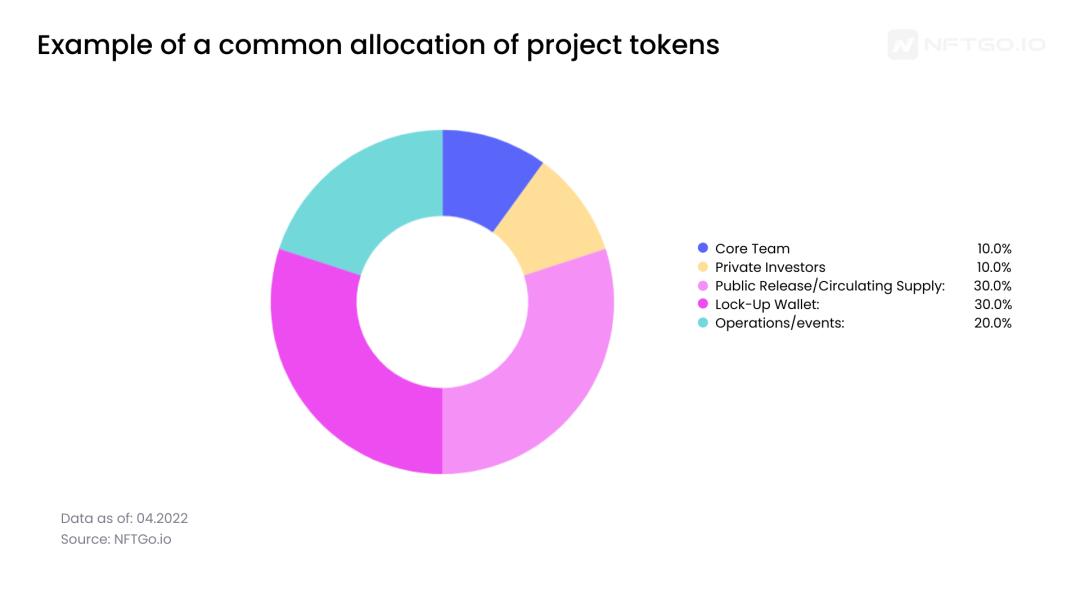
Common project Token distribution schemes; Data source: NFTGo.io
4. Utility and Growth
The value of a Token also depends on the utility and growth of daily active users (DAU), with DAU being correlated to Token prices. If a Token has a wide user base, the daily minting/burning ratio will also be high, but if the utility is insufficient, the Token price will ultimately decline, as the minting and burning ratios will exert high inflationary pressure on the Token.
In the P2E ecosystem, the most common solutions to reduce inflationary pressure on Tokens are:
- Breeding
- Component upgrades
- Staking
- Liquidity pools
As long as the Token has utility and the burn/mint ratio remains stable, the inflationary pressure on that Token will decrease. Some projects may use capital (profits) to boost the Token, which is a dangerous signal; this practice is not sustainable in the long run, as the project merely uses funds to profit from its own construction and development, creating a fictitious price.
The following chart illustrates the relationship between DAU (daily active users), Token prices, and utility for some GameFi Tokens currently in the market.
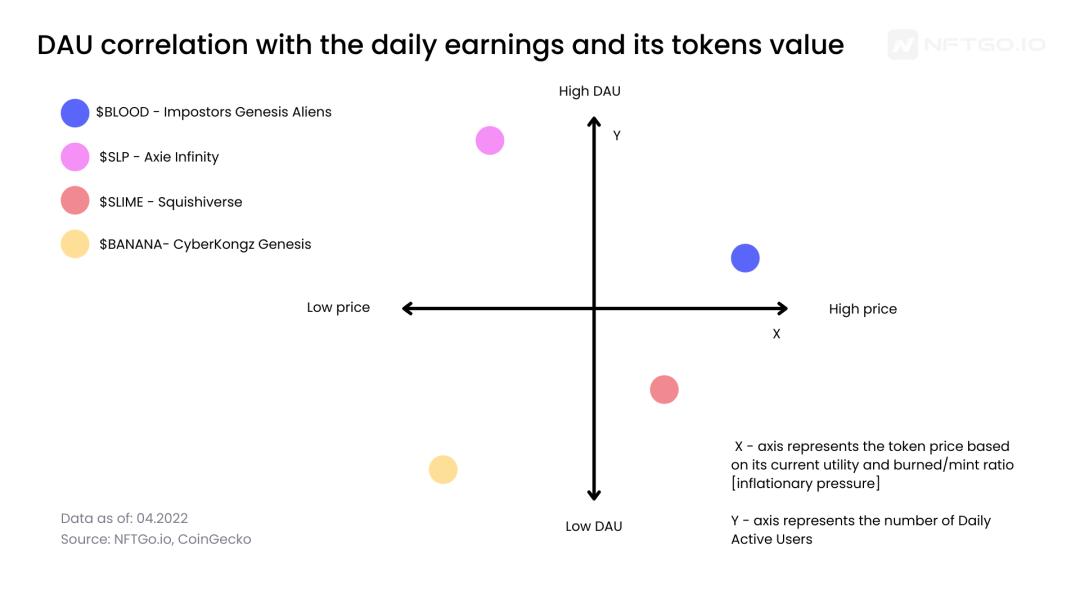
Correlation between DAU, revenue, and Token value; Data source: NFTGo.io, CoinGecko
If inflationary pressure arises from the burn/mint ratio, there may be a situation where DAU is high but Token prices are low. If the burn/mint ratio is too high, the Token will inevitably depreciate due to a lack of utility (burning mechanism). Some collectibles prefer to have low prices, high DAU, and high burn/mint ratios in a short period, as this allows for more circulating supply, but after a while, the circulating supply (such as skins, levels, land, NFT traits, etc.) will decrease with the emergence of new burning mechanisms, and ultimately, prices will stabilize.
Having both low daily income and DAU is not the worst-case scenario, as during such times, the NFT project is usually relatively cheap.
To better assess Token performance, you need to consider the following external factors:
- Macroeconomic trends: overall sentiment in the digital asset market, stock market, NFT market, current gaming development trends, etc.
- Current floor price
- Return on investment (ROI)
- Market liquidity
- Future Token utility
- Policies
Overview of the P2E NFT Market
The gaming industry, with its fun and utility, attracts people to join Web3. The total value of P2E games is approximately $1.69 billion, ranking fourth in the NFT industry's market capitalization.
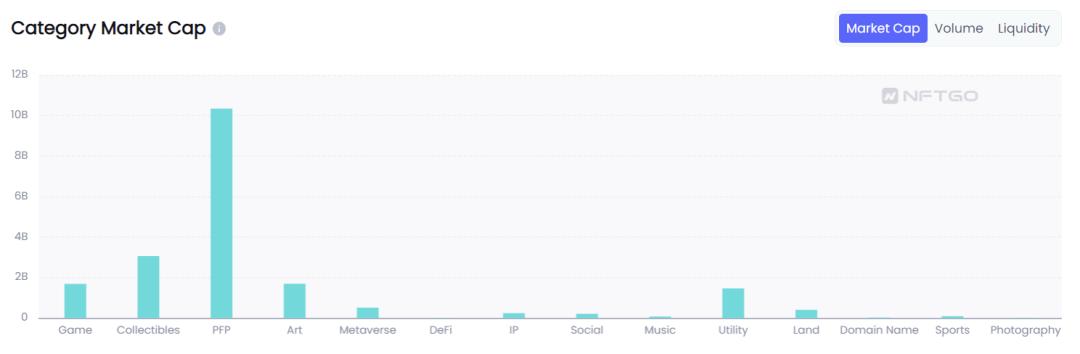
Market capitalization of various on-chain industries; Data source: NFTGo.io
GameFi experienced explosive growth in 2021, and recently, the popularity of P2E has also risen, with the total trading volume of NFT games reaching $3.29 billion, ranking third.
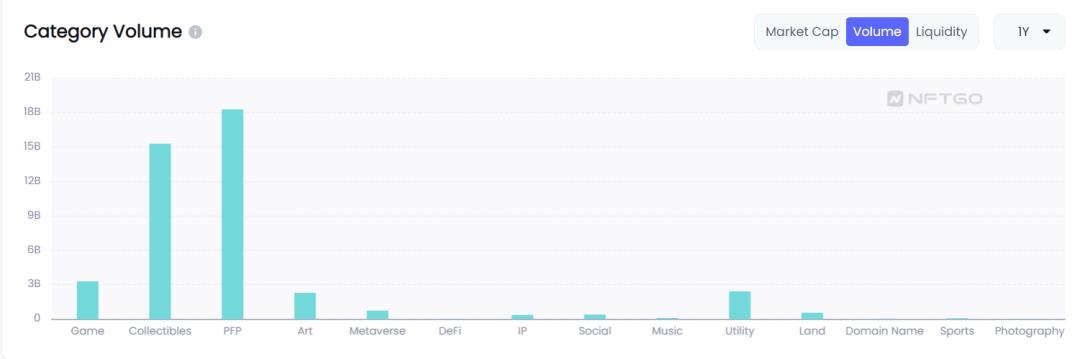
Total volume of various on-chain industries; Data source: NFTGo.io
Holding Trends
To understand the holding time development trends in the P2E industry, we analyzed 18 P2E collectibles on Ethereum and derived the holding patterns. The chart below shows the holding periods of the 18 collectibles.
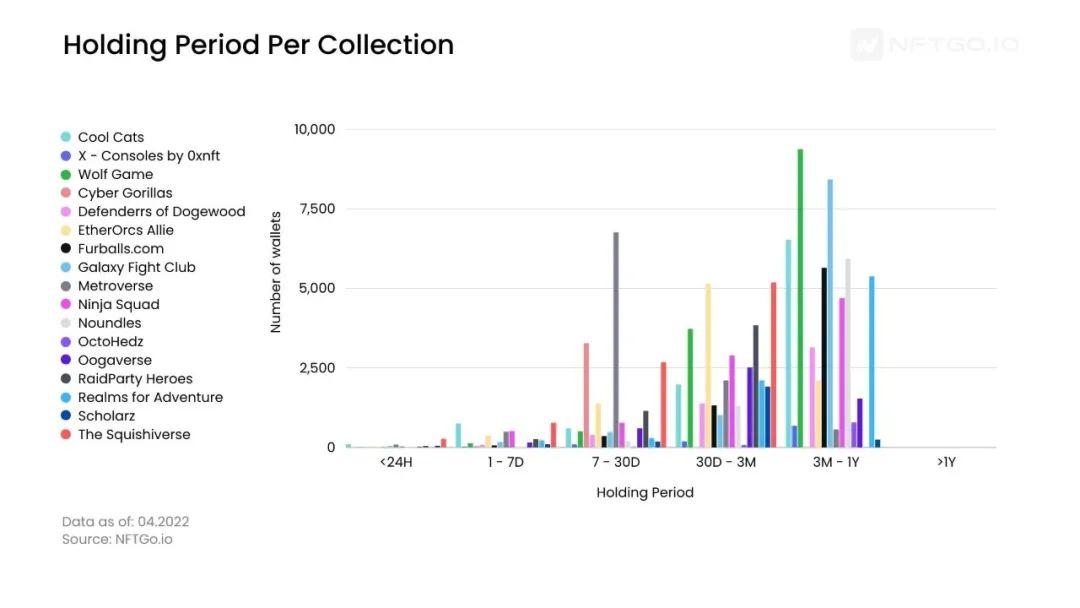
Holding periods of each collectible; Data source: NFTGo.io
As shown, the most significant holding period pattern is 3 months to 1 year, as P2E NFT holders tend to invest for the medium to long term due to passive income and the potential appreciation of assets.
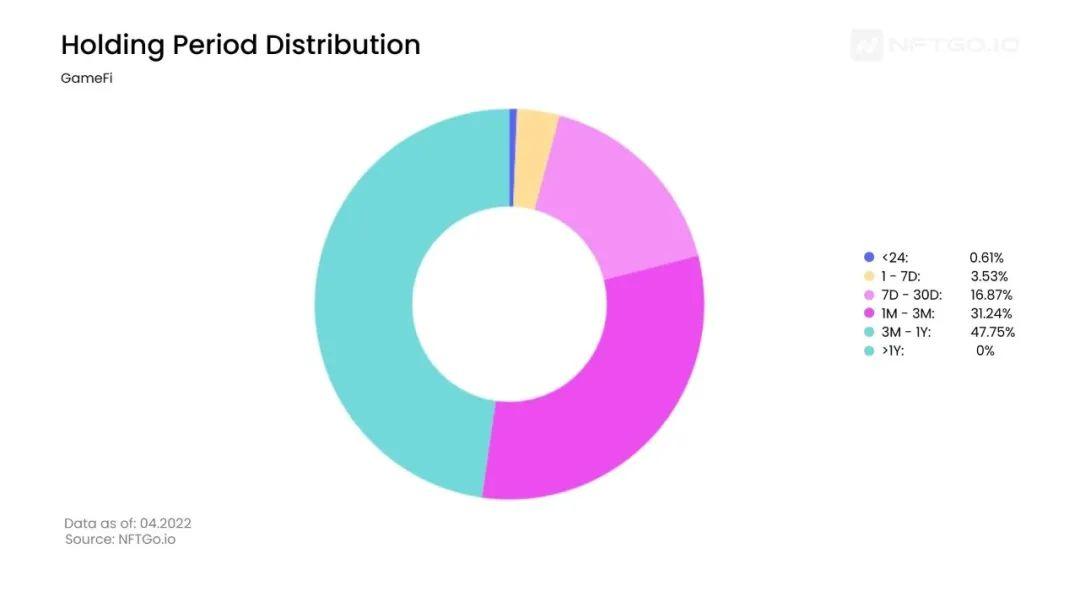
Holding periods in GameFi; Data source: NFTGo.io
We compared the holding period distribution of GameFi and BAYC and found commonalities between the two:
- Less than 4% of people sell their NFTs within 1-7 days
- Medium-term investors trade within 1-3 months
- The vast majority of investors hope to hold assets for more than 3 months
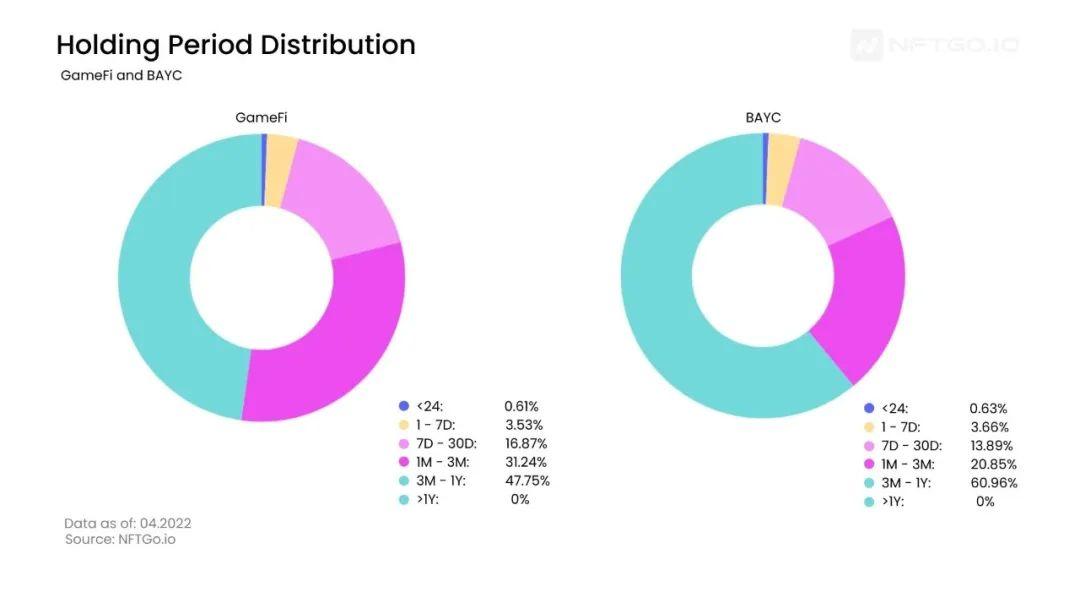
Holding periods of GameFi and BAYC; Data source: NFTGo.io
GameFi ROI
To calculate the return on investment (ROI) for P2E, consider the following factors:
- Gas fees for purchasing NFTs from the market
- Daily value to liquidity ratio (DLV). The DLV is calculated as: (Daily Value * Supply) / Liquidity
The higher the DLV, the greater the asset's volatility.
- Liquidity
- Threshold value of market capitalization (TLV). TLV is the ratio of market capitalization to liquidity. If the ratio is greater than 1, the Token is overvalued. If it is close to 0, the Token has room for growth. The TLV is calculated as: Market Capitalization / Liquidity.
The chart below shows P2E with high ROI on Ethereum:
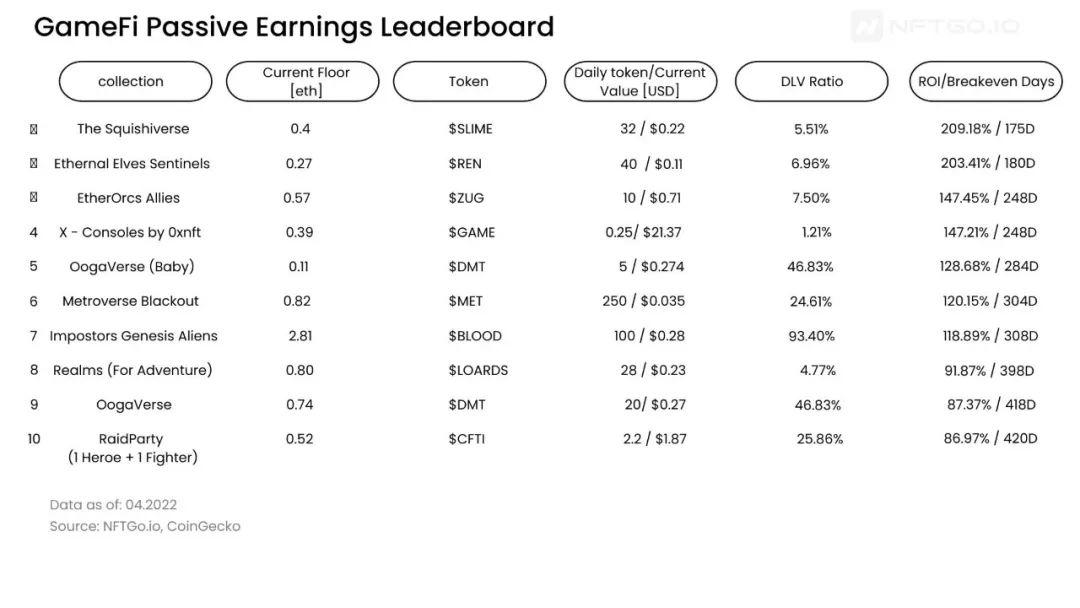
GameFi passive income leaderboard; Data source: NFTGo.io
Note: The information in the above chart is for reference only. Investing in digital assets (such as NFTs and digital assets) carries high risks, and you should consult a financial advisor before making any investment decisions. NFTGo does not provide investment advice and is not responsible for any losses incurred from investing in digital assets.
Conclusion
GameFi is the video game market under the Web3 ecosystem, based on the community and for the community. GameFi allows players to earn and trade Tokens in exchange for any desired digital assets. Most importantly, players have custody of their digital assets.
But most importantly, enjoyment remains the fundamental purpose of gaming.
 Risk warning
 Risk warning

Popular articles





