








What problems are likely to arise when a DAO develops rapidly?

 Although the future of DAO is constantly changing, participants are always at its core.
Author: Marina, W3.Hitchhiker
Revision: Evelyn
In June, the DAO management platform Dework completed a $5 million seed round financing, led by the renowned crypto investment firms Paradigm and Pace Capital; the DAO payroll payment system Utopia secured a $23 million Series A financing led by Paradigm; the DAO operation platform CharmVerse completed a $3.8 million seed round financing, with participation from Spartan Group and others… …
Thus, DAOs continue to garner increasingly "huge" financing in our view, and even Olaf Carlson-Wee, the founder of Polychain, publicly praised DAOs: he believes that the amount raised by DAOs has surpassed traditional IPOs, and that the fundraising amount in 2022 will exceed $1 trillion.
At the same time, there has been much heated discussion about DAOs in the market. For example, can DAOs replace traditional companies in operations? Will DAOs likely surpass crypto investment VCs? How does DAO, as a new form of social division of labor and cooperation, attract more quality personnel to join?
Regardless, the era of DAOs is coming, and no one can stop it. Especially in the current market environment, where there aren't many new hotspots, apart from a few occasionally popular NFT projects, DAOs have begun to be highly anticipated by countless people ------ DAOs are starting to specialize, giving rise to various types of DAOs for different scenarios. If we focus on a specific DAO, we might wonder: as more and more newcomers join the DAO, and the pace of business expansion does not keep up with the influx of personnel, will various problems arise?
This article will attempt to explore the common dilemmas and solutions faced by DAOs in rapid development, for discussion purposes only, and not as investment advice.
1. Contributors of the DAO
Regardless of the organization, its core and fundamental aspect is human management, which is particularly important in the context of DAOs. When management sees an influx of newcomers into the community, they need to think about how to guide and manage this fresh "blood."
(1) Newcomer "Onboarding" Management
Clearly, "onboarding" management in the Web3 world is different from that in Web2. In the Web2 world, a group of people gathers in one place (usually an office) for familiarization and face-to-face work communication, with a dedicated human resources department leading newcomers to "integrate" into the company; whereas in the Web3 world, DAOs need to consider the pathways for newcomers to enter: after learning about this DAO, how to find the entry point → after finding the DAO organization, what should I do, which tasks are suitable for me → after participating in a task, what else can I do, and so on.
Of course, in small-scale DAOs, MODs can answer or guide, but as the DAO's visibility gradually increases, there should be an onboarding page to present this information.
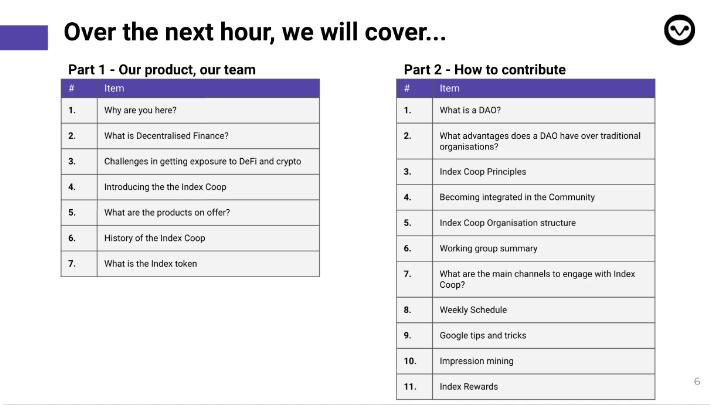
For example, Index Coop (one of the best-performing DAOs in the DeFi world, which bundles various assets into index financial products, has a clear goal, and provides a very comfortable experience for contributors) operates very well. This organization has not only one community but has successfully developed several, allowing people from all over the world to join, participate, and contribute value. One of the ways Index Coop stands out among many DAOs is that they have preemptively set up potential dilemmas that each participant might encounter upon entering the community, along with corresponding solutions, with every step thoughtfully considered and meticulously planned.
Discord, as a common entry point for crypto communities, is also a typical entry point for newcomers to enter the respective community, so the first thing newcomers can do upon entering the community becomes very important. Newcomers can start with #introductions, then receive a welcome from community members, and be guided on where to find more information (analogous to an operation manual) and answers to other questions. The guiding rules in the image below can clearly inform participants about what this community is doing and where to resolve any confusion.
(2) Member Engagement
One of the advantages of DAOs is that they can gather the best talents and resources from around the world, but the most challenging issue is still the human factor. We have previously addressed how newcomers enter, participate, and how to achieve/deeply govern, but we also need to consider the flow and vitality of community members.
As community participants increase, and many talented individuals emerge, how can we identify these outstanding individuals and place them in suitable "positions" to maximize their impact? When a task is assigned, what happens if the "homework" is poorly done? Is there an emergency plan? The community should be a group of people gathered together for a specific goal, where not only task completion matters, but also warmth and atmosphere. Can the DAO community regularly plan interesting activities to stimulate enthusiasm and enhance cohesion?
How to ensure the above issues are effectively resolved? Below are a few points to spark discussion: the core idea is to ensure that participants have fun in the community, can establish connections, and feel that their contributions align with the community's vision.
- Regularly hold all-member meetings to publicly discuss task completion status and next steps;
- Invite a KOL from a specific industry as a special guest for Twitter Spaces to gather quality insights and inspire new ideas from contributors;
- Publish community topics for focused discussions on certain issues and provide feasible solutions (different proposals require members holding corresponding tokens or NFTs to vote);
- Establish connections in the #introductions section of Discord, such as recommending this new member to delve into a specific channel or try new areas;
- Provide extra surprises, such as inviting influencers to drop into the community to distribute benefits; hold an online "party" after completing a task or organize offline events;
- When setting tasks, plan according to the roles of contributors and allow contributors enough time to supplement and improve, etc.
(3) Member Mobility in the DAO
Clearly, whether in Web2 or Web3, early contributors who create value for the DAO will not stay in one organization forever. In a DAO, compared to having 400 people involved in core governance, if only 4 people are involved, the risks are much greater; if we want the community to develop healthily and sustainably, it is also crucial to involve newcomers in community governance. The community needs a large number of new contributors to provide fresh blood, primarily to decentralize governance and prevent power from concentrating in a small group of "familiar" individuals, and the key to this initiative is to minimize the cost of transition.
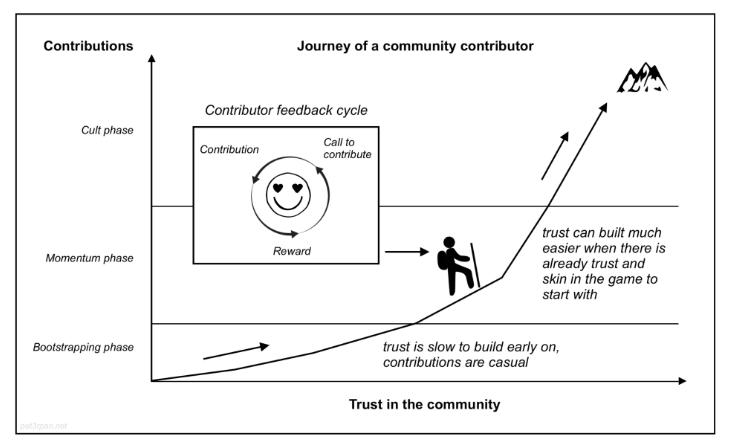
The journey of DAO contributors, source: pet3rpan.net
DAOs are not as automated as we might think; they are more like a simulation of on-chain governance processes, and they should be fluid. Here are two common methods by which DAOs grant governance rights and qualifications to members:
- Token-based governance method: Participants can become members of the DAO by holding the corresponding tokens;
- "Social" governance method: Participants become formal members by making outstanding contributions to the DAO.
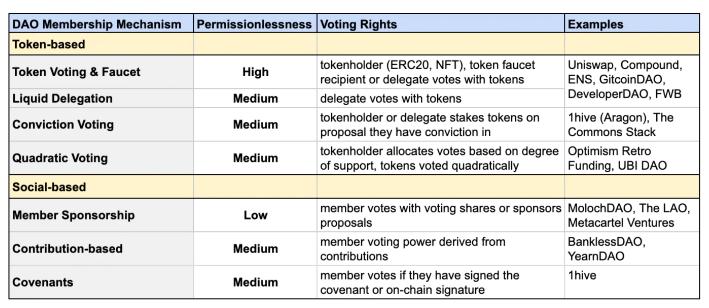
The first type of governance tokens should not be minted all at once but should increase in quantity as the community develops; in short, an appropriate inflation model should be adopted. When DAO members exit, they can choose to sell their tokens and thus relinquish their governance rights.
The second method encourages more participants to contribute, which is beneficial for the DAO. Vitalik Buterin has also mentioned that token-based governance is poor, and it would be better to base governance voting rights (and limit voting scope) on the basis of contributions. When core contributors need to exit the DAO, their participation level should be considered; if they are less active in daily governance, the weight of their contributions should decrease accordingly, thus achieving the purpose of exit.
2. Governance
According to the latest data released by Electric Capital, DAO governance activities have shown explosive growth compared to last year.
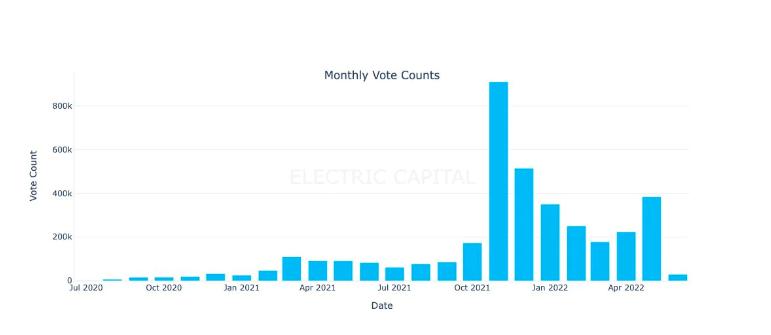
Monthly voting numbers of DAOs, source: Electric Capital
As mentioned earlier, the governance methods of DAOs primarily fall into the two categories above. The following section will focus on how to optimize the process when making significant decisions in a DAO (such as allocating resources from the treasury, assigning roles to contributors, how to distribute incentives, etc.), for example, the process should be: initiate a proposal ------ centralized discussion ------ voting decision.
- Organize all questions in one document, where everyone can fill in and comment (e.g., Notion/Google Doc);
- Initiate a Discord section for mature proposals;
- Concentrate discussions on the proposal during community meetings;
- Publish formal proposals on DAO governance tools like Snapshot;
- Delegate members with governance rights to vote.
DAO governance also helps the community move in a favorable direction. Of course, this process is not suitable for all DAO organizations, but following this path can maximize the decision-making efficiency of a proposal while allowing members with DAO governance rights to fully exercise their power, thus improving the community and stimulating member participation.
3. Information Flow Management
This point deserves special mention. From an industry perspective, various information emerges daily across different sectors; from the perspective of DAOs, rapidly developing DAOs also face a "three abundance" situation, namely, many channels, many meetings, and many activities.
When I participate in a DAO and urgently want to quickly reach the parts I care about most (task progress, encountered issues, when community meetings are held, etc.), I often find myself overwhelmed by a flood of information. To enable members to quickly receive actionable tasks, a clear information flow is needed. As mentioned earlier, the core elements involve managing collaboration tools, arranging and notifying various meetings, and tracking execution progress (for information display and updates).
- Collaboration tools mainly involve the Discord community, which, due to its channel divisions, can significantly reduce information interference;
- Meeting arrangements and notifications: set up a meeting reminder bot in Discord; synchronize weekly agendas/activities in Google Calendar;
- Execution progress: Notion is a tool commonly used by most DAOs, but how to set up the pages to be clean and orderly, and how to allow members to quickly reach (information display and updates) their target locations needs consideration. For a quality guiding page example, refer to Index Coop's Notion.
4. Establishing Incentive Mechanisms
The incentive mechanisms of DAOs include DAO tokens, POAPs/NFTs, bonuses, stablecoin-based salaries, etc., which will not be elaborated on here.
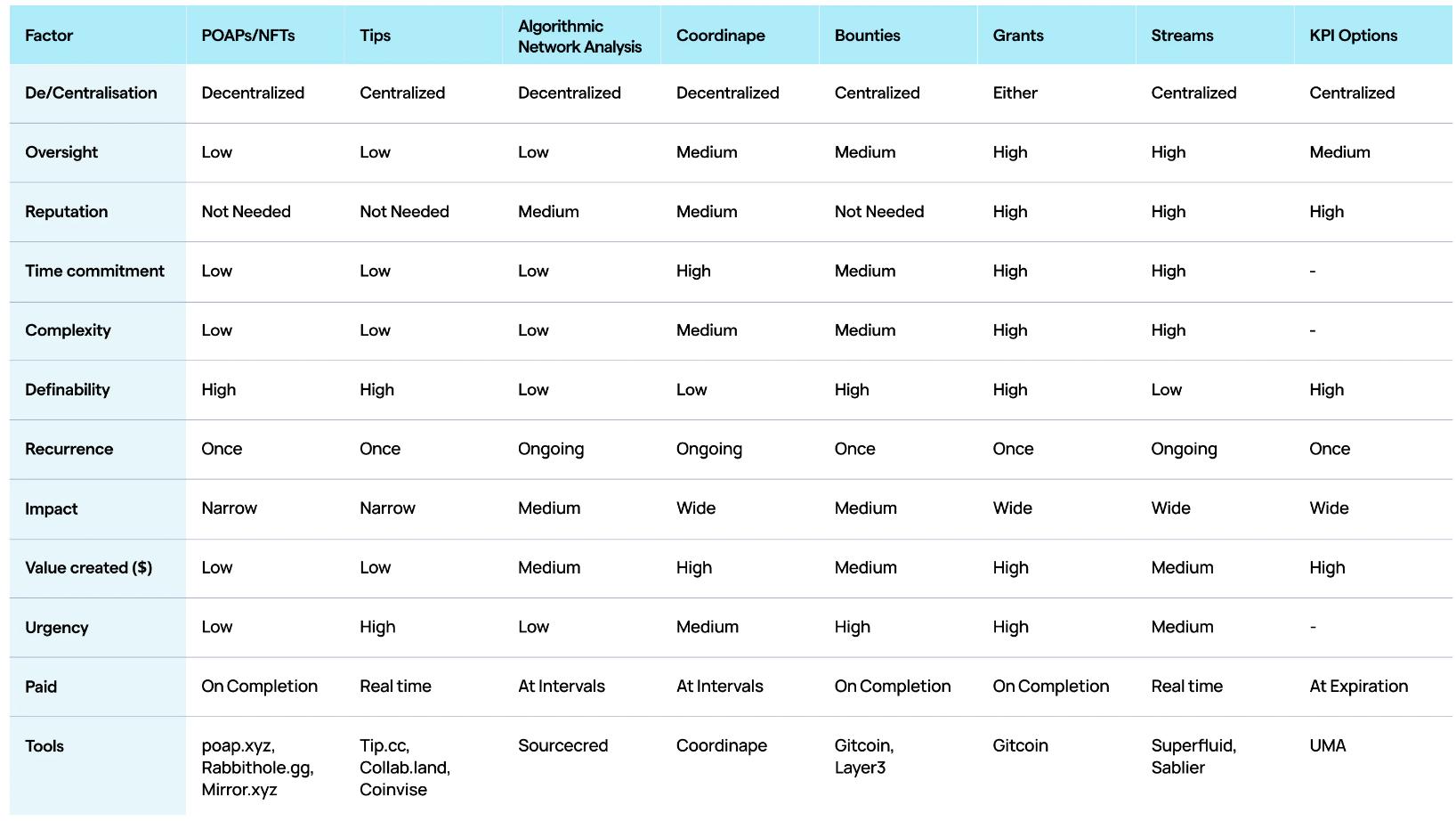
Incentive methods and dimensions of DAOs, source: Aragon blog
- Determine the forms of incentive distribution
Since there are multiple forms of incentives, a rapidly developing DAO will also face the challenge of designing different incentive mechanisms, i.e., how to encourage community contributors to make continuous contributions and actively participate in activities and claim tasks.
Each DAO has different incentive methods; for example, Venture DAOs may focus more on the returns from projects in which contributors participate; Protocol DAOs mainly incentivize by issuing tokens to maximize income from the protocol; Media DAOs focus on content dissemination, with incentive methods including tokens (Bankless DAO), bonuses, etc.
- The process and standardization of incentive distribution
When the form of incentives involves "funds," it is necessary to consider the "treasury" and voting issues, and the specific distribution standards may vary based on community member roles; here we will only discuss the former. The premise is that the DAO has specific tasks at a certain stage, and small amounts of funds can be planned and proposed in advance, while large amounts of funds (the entire budget) must be approved through voting on platforms like Snapshot.
It should be noted that as the number of members in the DAO increases, it is essential to establish a distribution process in advance (e.g., who can apply ------ where to fill out the application form ------ review process ------ display of distribution progress) and standardization (whether a bot can be set up to follow certain rules, which can be adjusted based on the DAO's development to reduce human interference and the serious lag in incentive distribution).
Conclusion
Although the future of DAOs is constantly changing, participants are always at the core. A person can purchase many types of tokens, join various Discord channels, try many types of DAOs, and abandon many DAOs, but only a small portion of people will truly retain and use the tokens they hold, and even fewer will become long-term contributors. The measure of a DAO's success is not how many members it has, but how many true core contributors can make high-quality proposals for the community; and whether it can retain contributors through the "token" method.
DAO governance and incentive mechanisms have always been the center of discussion, and the market continues to adjust and iterate new methods. DAOs began to emerge like mushrooms after rain in 2022, and if we want to be part of a DAO, we must learn to manage the complex information flow, and of course, DAOs should also optimize in this regard.
 Risk warning
 Risk warning

Popular articles





