








What will happen to miners after the Ethereum merge?

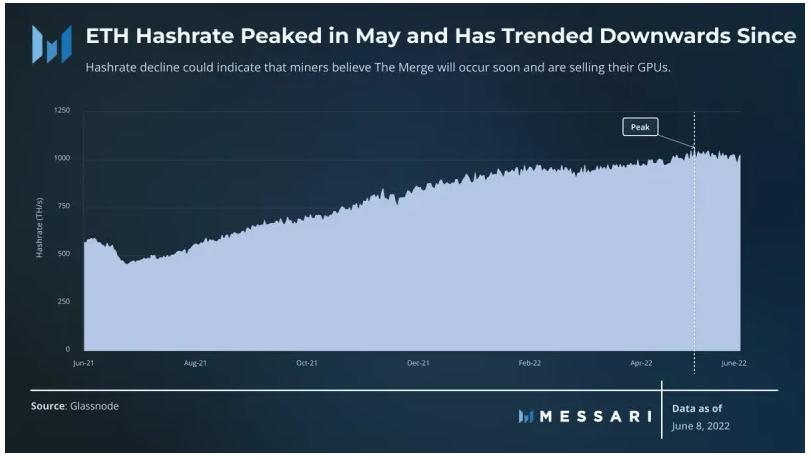
 In May 2022, Ethereum's hash rate peaked. Since then, its hash rate has been on a downward trend, indicating that miners expect the merge to happen soon.
Original Title: 《What Will Ethereum Miners do After The Merge?》
Original Author: Sami Kassab, Messari
Translation: Biscuit, Chain Catcher
Summary
- The Ethereum Merge will force $19 billion worth of PoW miners to seek alternative paths.
- Most existing Ethereum miners cannot find PoW coins with equivalent economic benefits in the market. The total market capitalization of GPU-mineable tokens, excluding ETH, is $4.1 billion, accounting for about 2% of ETH's market cap. ETH mining revenue accounts for 97% of daily income for GPU miners.
- Many large miners plan to shift to data center-oriented businesses, focusing on providing high-performance computing services.
- Miners can contribute GPU computing power to Web3 protocols such as Render Network, Livepeer, and Akash.
The long-awaited Merge will transition Ethereum from a proof-of-work (PoW) to a proof-of-stake (PoS) network. Due to its early reliance on GPU computing power to support the PoW mechanism, Ethereum created a globally distributed mining industry that generated nearly $19 billion in revenue in 2021. The scale of industry participants has evolved from individual miners with small rigs to large mining companies operating thousands of machines and going public.
The PoS mechanism does not use computational power to determine which miner should create new blocks but relies on the collateral staked by nodes to determine the creator of new blocks. Therefore, if Ethereum successfully transitions to PoS, Ethereum miners will be phased out. So, what impact will the Merge have on miners and mining hardware?
Decline in Hash Rate
Despite the Ethereum Merge being promised for years, ongoing technical challenges have continually delayed its timeline. Based on the eagerness of ETH core developers and the successful Merge of the Ropsten testnet, barring any unforeseen circumstances, the mainnet Merge is expected to be on track between August and September.
In May 2022, Ethereum's hash rate peaked. Since then, its hash rate has been on a downward trend, indicating that miners expect the Merge to occur soon. The decline in hash rate may be due to miners shutting down GPU rigs and turning to the trading market after the testnet Merge.
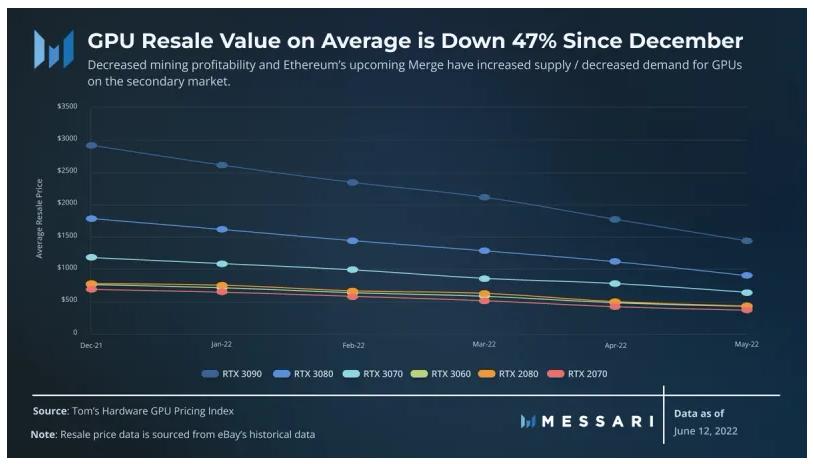
This can be further illustrated by observing the trend in resale prices of GPUs. Over the past six months, the resale value of popular mining GPUs, including RTX 3090, 3080, 3070, 3060, 2080, and 2070, has rapidly declined. Since December 2021, GPU prices have fallen by an average of 47%. The recent drop in cryptocurrency prices has negatively impacted mining profitability and increased the supply of GPU mining rigs on secondary markets like eBay. Finally, as the Merge approaches, fewer miners are willing to invest in new mining rigs.
ASIC and GPU Mining Rigs
Ethereum mining rigs are divided into two types: ASIC and GPU. ASIC (Application-Specific Integrated Circuit) is computer hardware designed for a specific purpose, with hash algorithms written for Ethereum in Ethereum ASIC miners. GPU miners can solve complex PoW computations and can also be used for more general applications. For example, GPUs frequently appear in workstations and gaming computers for rendering images, encoding videos, or performing any other applications that require repetitive calculations.
Due to the distributed nature of the Ethereum mining industry, it is challenging to determine the exact ratio of ASIC to GPU miners on the network. Michael D'Aria, CEO of BitPro, estimates that 90% of miners are based on GPU rigs, while the remaining 10% are based on ASIC rigs. Michael Carter, host of Bitsbetripping and focused on crypto mining consulting, told Messari that he estimates 20-30% of miners on the network are based on ASIC rigs.
The issue with Ethereum ASIC miners is that they can only be used for ETH mining and cannot be repurposed for other applications. Ethereum Classic is the only other PoW cryptocurrency that can be mined with Ethereum ASIC miners, as its hash algorithm is compatible with ETH's algorithm. If mining Ethereum Classic is unprofitable, then ASIC miners are unlikely to have a resale market and will likely be discarded after the Ethereum Merge.
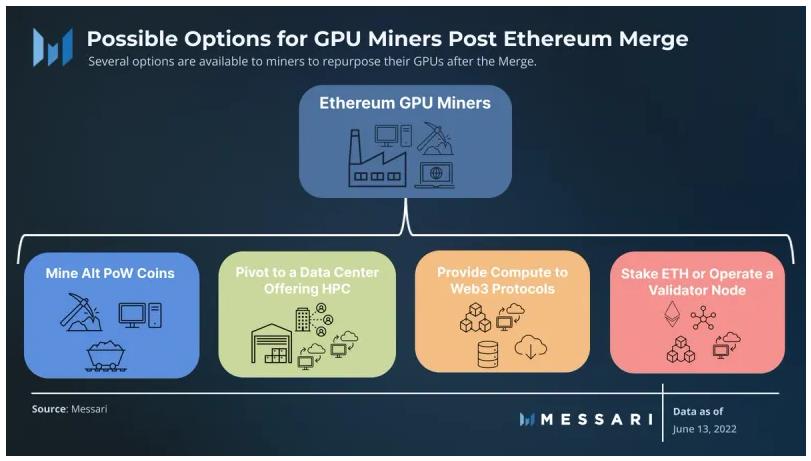
Thus, after the Ethereum Merge, GPU miners become the only Ethereum mining hardware that can be repurposed for other applications. After analyzing a large number of GPU repurposing options, we have identified the following viable solutions:
- Mine other PoW tokens
- Provide high-performance computing data centers
- Offer computing power for Web3 protocols
- Sell mining rigs and stake mined ETH to participate in PoS
Mining Other PoW Tokens
For some crypto enthusiasts, mining has become a hobby. They tend to passively earn cryptocurrency from mining equipment or gaming computers. For others, mining is an investment business aimed at generating returns.
As Ethereum abandons the PoW mechanism, both types of miners want to know which other PoW tokens can still be mined. Some miners have indicated in related posts on Reddit that their strategy after the Ethereum Merge is to switch to mining any profitable cryptocurrency. Using the site WhatToMine, which relies on computing mining revenue, miners can determine the profitability of mining cryptocurrencies based on specified rig types and electricity costs.
Some large miners also seem to be taking a similar path. Sue Ennis, Vice President of Hut 8, told Messari that Hut 8 is considering mining other PoW tokens, such as Ethereum Classic, after the Ethereum Merge. However, they continue to hold only BTC on their balance sheet. Hut 8 also plans to switch its GPU hash power to Luxor Mining Pool to mine tokens including BTC, DASH, ZEC, and SC, with all profits paid in Bitcoin.
The problem for miners transitioning from mining ETH to other PoW tokens is that the market size for these tokens is far smaller than Ethereum's. As of June 9, the total market capitalization of GPU-mineable tokens, excluding Ethereum, is $4.1 billion, accounting for about 2% of Ethereum's market cap.
Since hash rate cannot be used to compare the computational power of networks with different hash algorithms, total miner revenue becomes the next best metric. Among the top seven GPU-mineable tokens ranked by miner revenue, Ethereum accounts for 97% of total income for GPU miners. Ethereum Classic ranks second, accounting for 1.9% of total income for GPU miners. This indicates how small the market size is for GPU-mineable tokens without Ethereum.
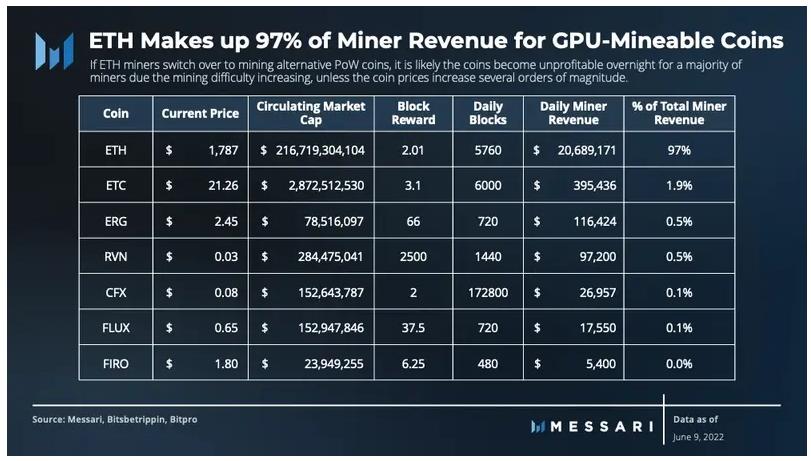
A common misconception in the mining field is that an increase in hash rate will lead to a rise in token prices, whereas, in reality, it is quite the opposite. If ETH GPU miners flood into a PoW token overnight, it will significantly increase the mining difficulty of that token, leading to lower mining rewards. The end result is that most miners will not be profitable. Only those miners who can access the cheapest energy will remain profitable, likely being institutions and large mining companies. Therefore, only a small portion of ETH hash power can migrate to other GPU-mineable tokens.
The only way for other public chains that can be mined with GPUs to receive Ethereum hash power is for their token prices to rise several orders of magnitude. Given that user activity on these public chains is far lower than Ethereum's, the probability of their token prices significantly increasing is very low. Moreover, most PoW public chains lack a community, aside from the miners themselves.
For example, even though Ethereum Classic (ETC) ranks second in GPU miner revenue, the network only locks a total value of $120,000 and about 35,000 daily active addresses. In contrast, Ethereum locks a total value of $50 billion, with over 493,000 daily active addresses. This disparity indicates that the significant price increase of ETC over the past two years is unrelated to the network's fundamentals and is primarily driven by speculation. Therefore, even if ETC's value is largely speculative, miners will find it challenging to find alternative mining coins with actual value and network usage.
Overall, a large-scale migration of miners to other PoW tokens is unlikely to be a sustainable solution. An increase in hash rate will lead to increased mining difficulty, pushing most miners out of the profitable range. Unless the prices of mining coins rise several orders of magnitude, the network can only accommodate a small portion of Ethereum's hash rate, which is unlikely to happen based on the current fundamentals of these projects. However, it is still possible that a PoW network will reach consensus among miners and be adopted.
Data Center-Oriented Business
The scale of Ethereum miners has evolved from individual miners with small rigs to large publicly listed mining companies operating thousands of machines. While small miners may easily transition after the Ethereum Merge, it will be very difficult for large miners who have heavily invested in mining hardware, dedicated warehouses, and power-related infrastructure to make their next decision.
Hut 8 and HIVE Blockchain are two large publicly listed mining companies that have already announced their strategies post-Ethereum Merge. Both Hut 8 and HIVE Blockchain have stated that they will transition to the high-performance computing industry. Both companies have acquired data center businesses to reposition their enterprises for transformation. These data centers aim to provide alternative network services for cloud computing giants like Amazon.
Hut 8 and HIVE Blockchain have heavily invested in high-performance GPU graphics cards used for mining Ethereum, enabling them to repurpose GPU graphics cards for providing high-performance cloud computing services. Hut 8 describes its GPUs as "the Ferraris of GPUs," and they are one of NVIDIA's three key clients. Hut 8 specializes in providing cloud hosting services for projects in the Web3 industry, including blockchain infrastructure, game rendering, and NFT storage.
As gaming, artificial intelligence, and film animation continue to thrive, the demand for high-performance computing will continue to grow. Once the Ethereum Merge occurs, this growth presents an opportunity for large miners to gain significant new revenue sources.
Providing Computing Power for Web3 Protocols
The goal of Web3 is to rebuild the internet on open, decentralized, and permissionless protocols. To achieve this, distributed infrastructure needs to be established as a foundational layer. This includes building infrastructure for video streaming applications, rendering 2D and 3D objects, and cloud servers. The commonality among these services is that they rely on a network of distributed participants to provide GPU computing power services.
Miners can redirect their GPU computing power to a few Web3 protocols, including:
- Render Network: A distributed GPU computing power marketplace that allows users to contribute computing power for rendering. The network enables GPU miners to sell their rendering capabilities to anyone in need, such as artists, designers, and researchers.
- Livepeer Network: A decentralized network for processing video streaming that relies on miners using GPUs to provide video transcoding services.
- Akash Network: A decentralized cloud computing marketplace that provides a collaborative platform for providers with excess computing power and users seeking computing power. Akash aims to integrate the GPU market into its platform in Q2 2022, enabling the network to handle data-intensive workloads such as machine learning, artificial intelligence, and cloud gaming.
These Web3 protocols will welcome GPU miners seeking new opportunities. Notably, certain protocols (such as Akash) may set additional hardware capital thresholds for miners to become computing power providers. This solution is open not only to small miners but also to large miners. In the future, Ennis told Messari that Hut 8 will open its data centers as node operators/providers for Web3 protocols such as Render Network.
Transitioning to PoS Staking
Miners who have accumulated ETH from mining can choose to sell their GPU mining rigs and become Ethereum PoS validator nodes. The network requires validators to stake at least 32 ETH to run a validator node. In return for validating transactions, validators earn rewards in the form of block rewards, slashing incentives, and MEV. Depending on the number of stakers and the level of network activity, the yield may range from 7% to 13%. For miners who do not have 32 ETH or do not want to take on the risks of running a validator node, they can also participate in staking through ETH 2.0 staking service providers.
Future Use Cases for GPUs: Zero-Knowledge Proofs (ZKP)
Zero-Knowledge Proofs (ZKP) allow users to cryptographically prove that they know a secret without revealing the secret to the other party. ZKP is an essential solution for blockchain scalability and enhancing privacy. As ETH 2.0 focuses on a rollup-centric roadmap, zk-rollups are becoming increasingly popular as a second-layer scaling solution, with projects like Starknet and zkSync leading the way. Other projects using ZKP outside of rollups include Mina, Filecoin, and Zcash.
Paradigm recently published an article on hardware acceleration for ZKP. The article discusses how the increasing popularity and complexity of ZKP will require specialized hardware support to reach the expected scale, creating a market similar to Bitcoin mining:
"As users seek more expressive, high-performance, and private computing, the complexity of using ZKP will increase. This will slow down the speed of generating proofs, necessitating the use of specialized hardware to generate proofs in a timely manner."
"Similar to Bitcoin miners, hardware operators' work needs to be compensated. A complete ZK mining and proofing industry will emerge in the market, starting with enthusiasts generating proofs in their CPUs, then GPUs, and finally FPGAs. Compared to Bitcoin, we expect ASICs may take a long time to be adopted."
When Bitcoin was first launched, anyone with a standard CPU/GPU could mine Bitcoin. Eventually, professional miners developed more efficient hardware (ASICs), making CPU/GPU mining unprofitable. ZK mining is likely to follow a similar path, starting with standard GPU miners and then developing more efficient mining machines (ASICs or FPGAs). ZKP is still in its infancy, but Paradigm predicts that the ZK miner/prover market may grow to a scale comparable to the PoW mining market in the future.
Conclusion
After the successful Merge of the Ethereum mainnet, the GPU mining market for PoW tokens may rapidly shrink. As miners realize that mining other PoW tokens will only allow a few miners with access to cheap energy to remain profitable, most GPU mining rigs will be resold on the secondary market. Miners willing to invest time and money will be able to transition to high-performance data center operators or node providers for Web3 computing protocols—both of which are rapidly growing markets.
Elena Burger, a deal partner at a16z, reminds us that advancements in most new technologies require hardware support. "All major industries in the tech sector—from cloud computing to computer graphics, artificial intelligence, and machine learning—have encountered development bottlenecks that require faster computing speeds and more efficient hardware." While the Ethereum Merge may seem like the end of GPU mining, it could also usher in a new era as displaced miners seek new opportunities in Web3.
 Risk warning
 Risk warning

Popular articles





