








Revealing the $1 billion major creditor of Three Arrows: Voyager, which attracted a large amount of deposits from U.S. customers and mainly provided unsecured loans

 The current total loan value of Voyager is 2 billion dollars, which includes approximately 1 billion dollars from 3AC consisting of 15,250 BTC and 350 million USDC.
Author: Wu Zhuocheng, Wu Says Blockchain
Editor: Colin Wu
Preface
The sudden exposure of 3AC's $1 billion major creditor, Voyager, is very mysterious. Its assets are enormous, reaching $6.2 billion last year, mainly from customer deposits. Data shows that the number of customers grew by 115,000 in the first quarter, but it also incurred a loss of $61.44 million in the same quarter; most of the loans provided are unsecured. Voyager emphasizes in each financial report: based on its due diligence, the company believes that the borrowers are quality financial institutions with sufficient funds to meet their maturing debts; former U.S. Comptroller General and former Binance U.S. CEO BRIAN BROOKS serves on the board.
Main Text
Voyager is a cryptocurrency asset brokerage that offers services such as order execution, market data, wallet, and custody services. It also launched the Voyager Loyalty Program for customers holding a certain amount of VGX to unlock various tokens, including VGX staking rewards, yield reward boosts, and cryptocurrency cashback rewards.
As of March 31, 2022, total revenue for the first quarter was $102.7 million, a year-on-year increase of 70%, but a quarter-on-quarter decrease of 38%. The net loss for the quarter was $61.44 million, with an adjusted EBITDA of -$53.5 million.

The company's main business is to provide services for customers to buy, sell, or execute cryptocurrency asset orders, thus the primary source of operating income is transaction fee revenue. Due to global market conditions, Voyager experienced low trading volume in this quarter, leading to a decrease in trading revenue. Trading revenue for the first quarter was only $33.39 million, a year-on-year decrease of 38%. The company claims it will strengthen and expand its wallet payment business and has acquired Coinify to enhance merchant payment system capabilities.
The second business of the company is interest income from cryptocurrency asset loans. Most of these loan agreements are unsecured loans, which can either have a fixed term of less than one year or be open-ended. Interest income for the first quarter was $31.03 million, a year-on-year increase of 3.6 times, and this business is gradually replacing trading operations. From the financial report, it can be seen that collateral is only about 1/10 of the total loan amount.
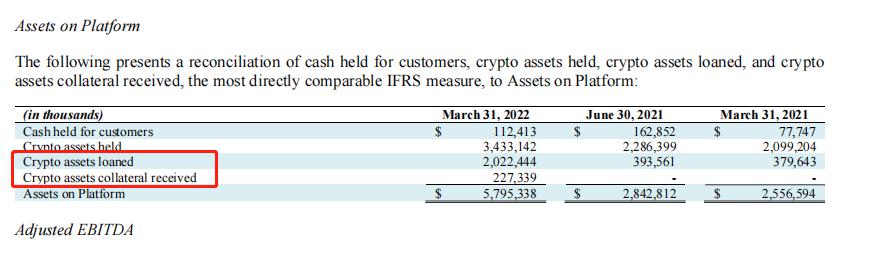
As of the first quarter, Voyager's receivables in cryptocurrency are as follows:

Primarily consisting of USDC, ETH, and BTC, with a total value of $2 billion. The main companies applying for loans are the following seven, with the loan rates described in the table being cryptocurrency-based rates.
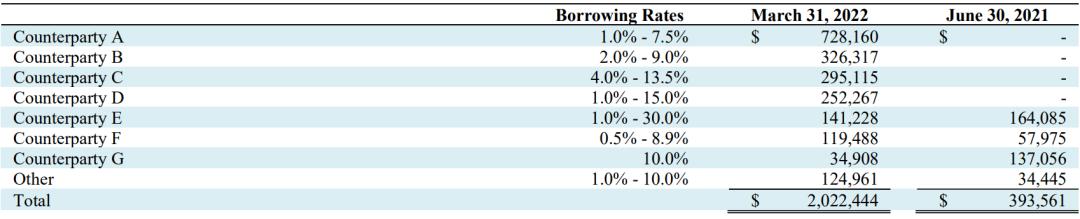
According to previous official announcements, this batch of loans includes 15,250 BTC and 350 million USDC from 3AC, with a total estimated value of about $1 billion (based on market prices at the end of March), accounting for half of the total. While we cannot know the exact identities of the seven companies, based on the amounts owed and the disclosed company registration addresses (Company A in the British Virgin Islands, Company B in Singapore), it is very likely that both Company A and B are 3AC.
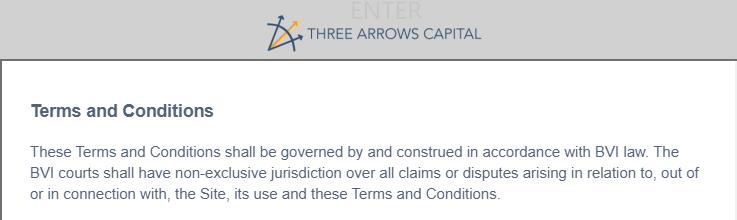
The official website of 3AC also shows: the BVI court has non-exclusive jurisdiction over all claims or disputes arising from or related to this website, its use, and these terms and conditions.
https://www.threearrowscap.com/
Additionally, as of March 31, 2022, Voyager also held 25,000 BTC, 270 million ADA, 170 million VGX, and a series of other cryptocurrencies, with a total value of $3.43 billion. Therefore, the total cryptocurrency assets held and receivables amount to $5.68 billion, which is nearly all of its assets. According to last year's annual report data, Voyager's total assets were $6.22 billion, with total liabilities of $5.9 billion, of which $5.68 billion were customer-stored cryptocurrency assets. In the first quarter, customer accounts grew by 115,000, primarily in North America, and it also hired four-time Super Bowl champion Rob Gronkowski as a brand ambassador.
We can view Voyager as a bank that absorbs depositors' cryptocurrency assets, providing basic services such as transfers and transactions while also lending deposits to other institutions to earn interest. From this perspective, we can measure the risk level through two indicators: one is the reserve ratio, and the other is the bad debt ratio.
Voyager's deposit reserve ratio is 60.4% (34.3/56.8). For banks, this is a very safe number, which basically would not cause a bank run. However, companies like Voyager clearly do not have the same risk tolerance as banks, so it is necessary to retain more reserves.
As for bad debts, a typical enterprise or bank's short-term loan (within one year) bad debt ratio is considered safe if it is below 5%, while Voyager's short-term loans (which 3AC needs to repay by June 27 this year) have a bad debt ratio as high as 50%, which is very dangerous.
Due to its business model, Voyager faces significant regulatory pressure in the U.S. In its first-quarter disclosure, it stated that from March 29, 2022, to April 13, 2022, the company received stop and desist orders from state securities departments in Indiana, Kentucky, New Jersey, Oklahoma, and South Carolina, as well as similar orders or notices from Alabama, Texas, Vermont, and Washington. These orders typically claim that through the rewards program, the company engages in the issuance and sale of unregistered securities or investment contracts in the form of customer accounts, allowing customers to earn rewards from their eligible cryptocurrency asset balances.
Ironically, in each financial report, Voyager emphasizes: based on its due diligence, the company believes that the borrowers are quality financial institutions with sufficient funds to meet their maturing debts. The company's due diligence procedures for its lending activities may include reviewing the borrower's financial condition, the liquidity levels of applicable assets, reviewing the borrower's management, reviewing certain internal control procedures of the borrower, reviewing market information, and monitoring the company's risk exposure thresholds. The company's risk management committee meets regularly to assess and monitor the credit risk of each counterparty.
In December 2021, the well-known industry figure BRIAN BROOKS, who previously served as Chief Legal Officer at Coinbase, U.S. Comptroller General, and CEO of Binance U.S., joined the Voyager board.
On the 22nd, Voyager officially announced that it would reduce the withdrawal limit from the original $25,000 to $10,000 within 24 hours, with a maximum of 20 withdrawals. It also signed an agreement with Alameda Research to obtain a credit line of $200 million and 15,000 BTC to ensure that Voyager's customers would not be affected by the collapse of 3AC. This move can address the short-term liquidity crisis, but if 3AC is unable to repay its debts, Voyager's Damocles sword will remain hanging.
Alameda, controlled by SBF, became a shareholder as early as 2021: in October 2021, Voyager signed a subscription agreement to issue and sell 7,723,996 shares of common stock to Alameda Research Ltd. at a price of $9.71 per share, with a total purchase price of $75 million. The transaction was completed on November 22, 2021.
Other information:
Q1 2022 Financial Report https://www.investorx.ca/doc/2205160432437296
2021 Annual Financial Report https://www.investorx.ca/doc/2202141905159335
Updates on 3AC https://www.prnewswire.com/news-releases/voyager-digital-provides-market-update-301572971.html
 Risk warning
 Risk warning




Popular articles





