








Messari Q2 Compound Report: Lending and Borrowing Hit All-Time Lows, Liquidation Business Increased by Over 70%

 In the second quarter, Compound's outstanding loans and deposits decreased by 77% and 70% respectively, while the clearing business was the only category that experienced growth, increasing by over 70% quarter-on-quarter.
Written by: Sean Butterfield, Messari
Compiled by: Frank, ForesightNews
Key Points:
- In Q2 2022, Compound's outstanding loans and deposits decreased by 77% and 70%, respectively;
- Adjusted net profit grew by 66% in Q2;
- The protocol utilization rate fell to a historic low of 27.3%;
- Compound Labs opened the Compound III code repository for developers and auditors;
- Plans to integrate the ZK-Rollup scaling solution Aztec to reduce gas fees and provide privacy lending services;
Introduction to Compound
Launched in September 2018, Compound allows users to borrow and lend assets from a collateral pool without permission, with interest rates set using a model based on the proportion of borrowed assets (i.e., utilization rate).
In May 2019, Compound launched its V2 protocol, introducing features such as individual risk models and smart contract gateways; in April 2020, Compound replaced the protocol's administrators with community governance, allowing COMP token holders to control the protocol; in June 2020, Compound distributed COMP tokens to users through a pioneering liquidity mining program.
The total market capitalization of cryptocurrencies fell from $2.05 trillion in Q1 to $910 billion in Q2, a decline of about 56%, marking the lowest level since January 31, 2021, but Compound withstood the pressure test in Q2.
Performance Analysis
Macroeconomic Overview of the Compound Lending Market
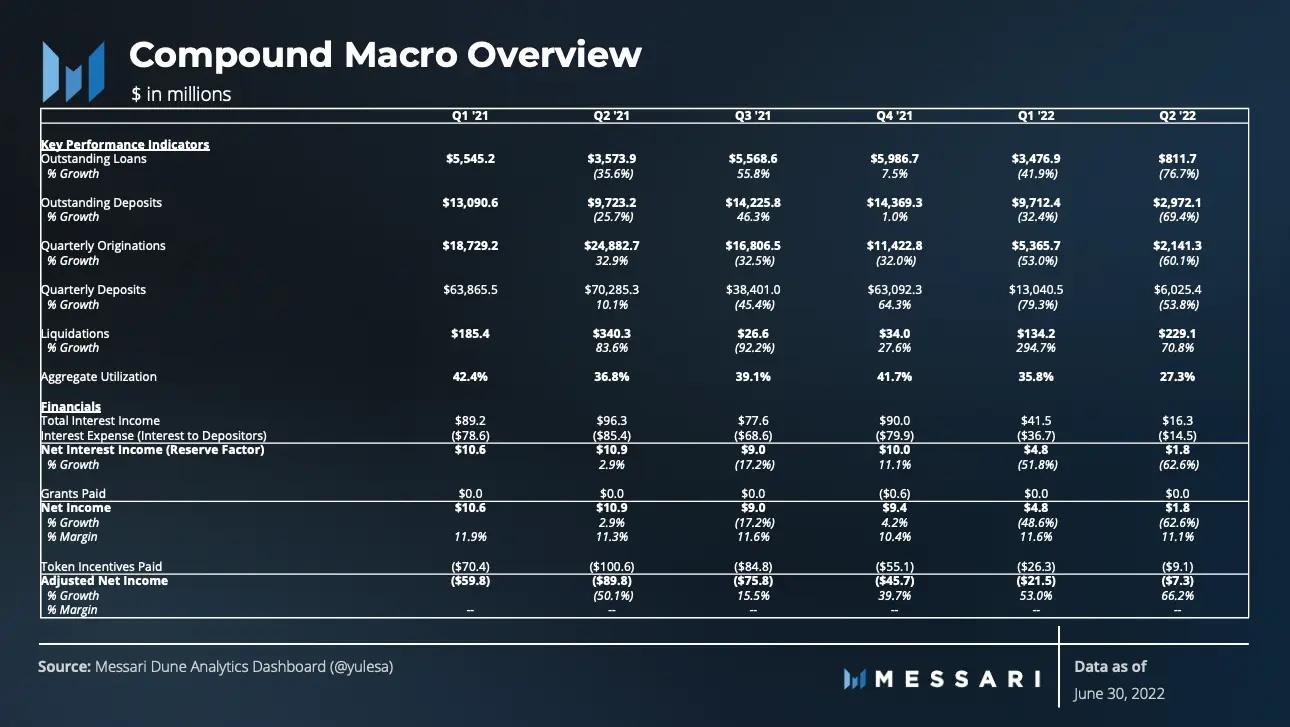
Compound's key performance indicators (KPIs) continued to decline in Q2 2022, with many metrics reaching historic lows.
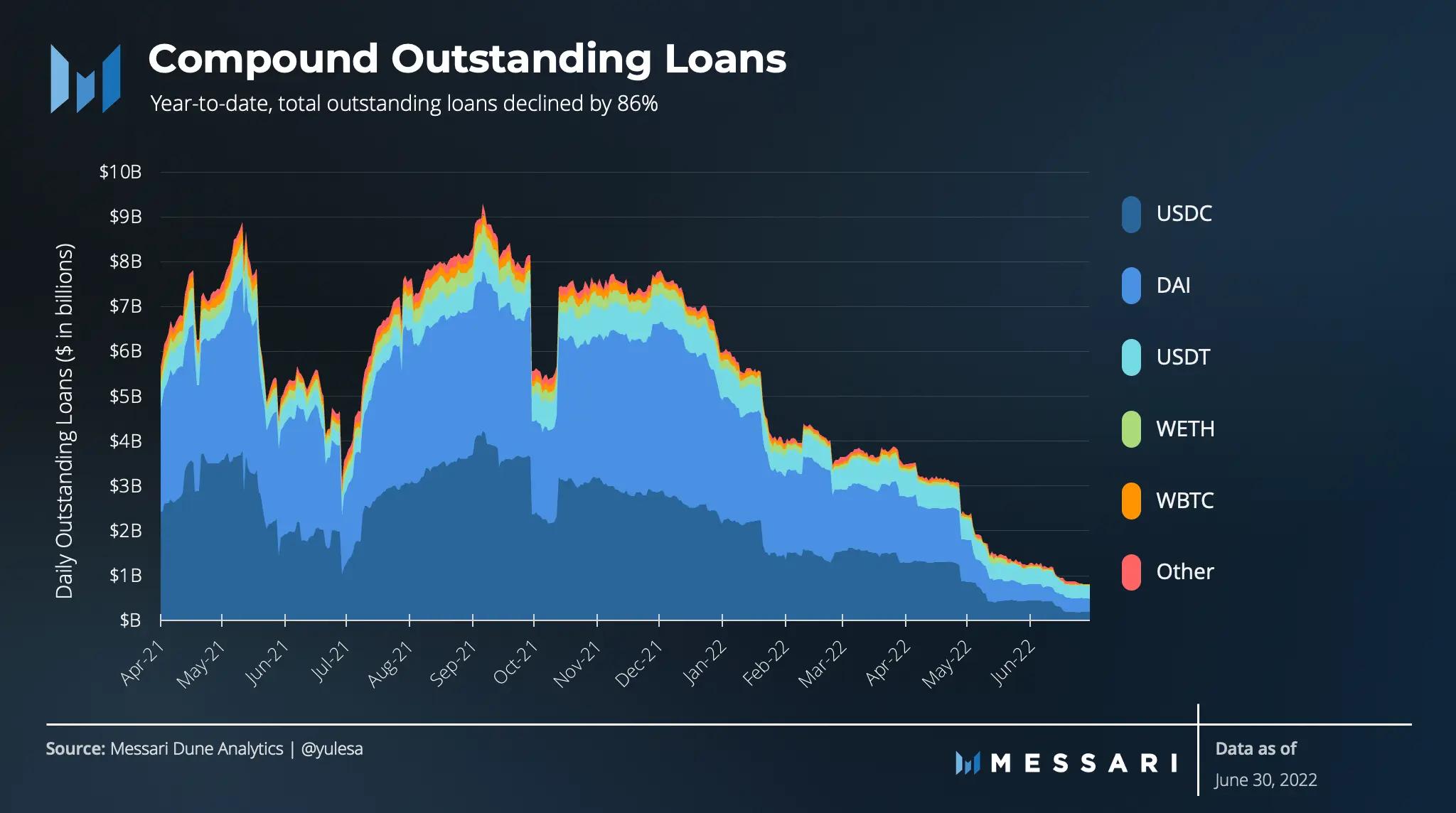
In Q2, both outstanding loans and deposits hit historic lows—with loans dropping 77% from $3.5 billion in Q1 to $812 million in Q2, while deposits fell 70% from $9.7 billion to approximately $3 billion.
Quarterly loan issuance decreased by 60%, further demonstrating insufficient market demand for leverage, and this figure has declined 11 times since Q2 2021; over the past 12 months, quarterly deposits reached a historic low of $6 billion, and similar to the previous quarter, liquidation was the only category to show growth, increasing by 71% compared to Q1.
Despite the decline in financial data in Q2, the increase in liquidations allowed Compound's net profit to grow by 11%, while adjusted net profit (excluding paid token incentive fees) increased by 66%, primarily due to the passing of proposal 092, which reduced COMP rewards by 50%.
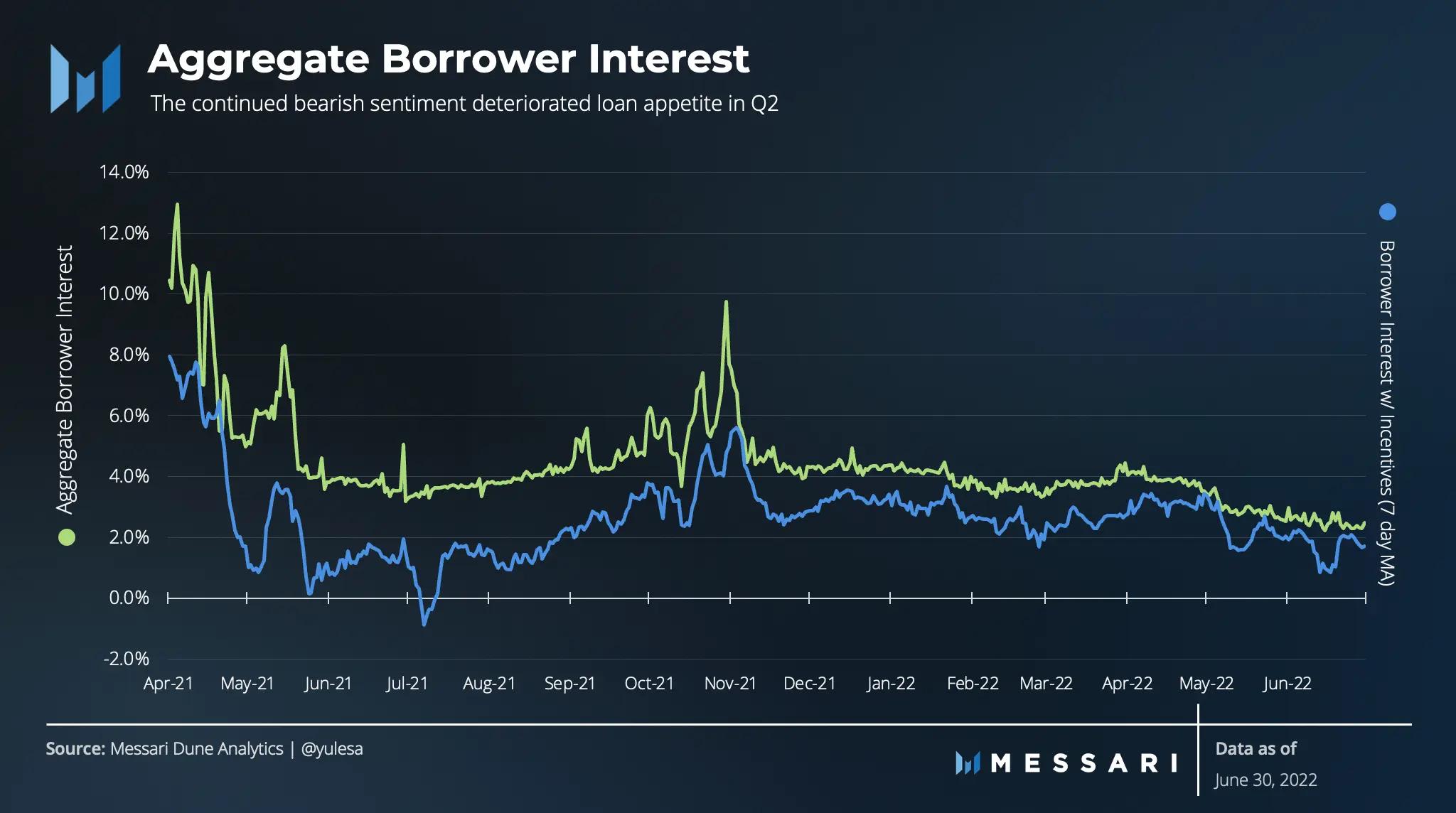
Borrowers' annualized interest rates peaked at 4.32% at the beginning of Q2, then bottomed out at 2.21% by the end of the quarter, directly related to the decline in borrowing costs and loan demand amid bearish sentiment in the overall crypto market.
The average annualized interest rate for borrowers in Q2 hovered around 3.12%, down from 3.85% in Q1, due to decreased demand for leverage during the market cooling period in Q1.
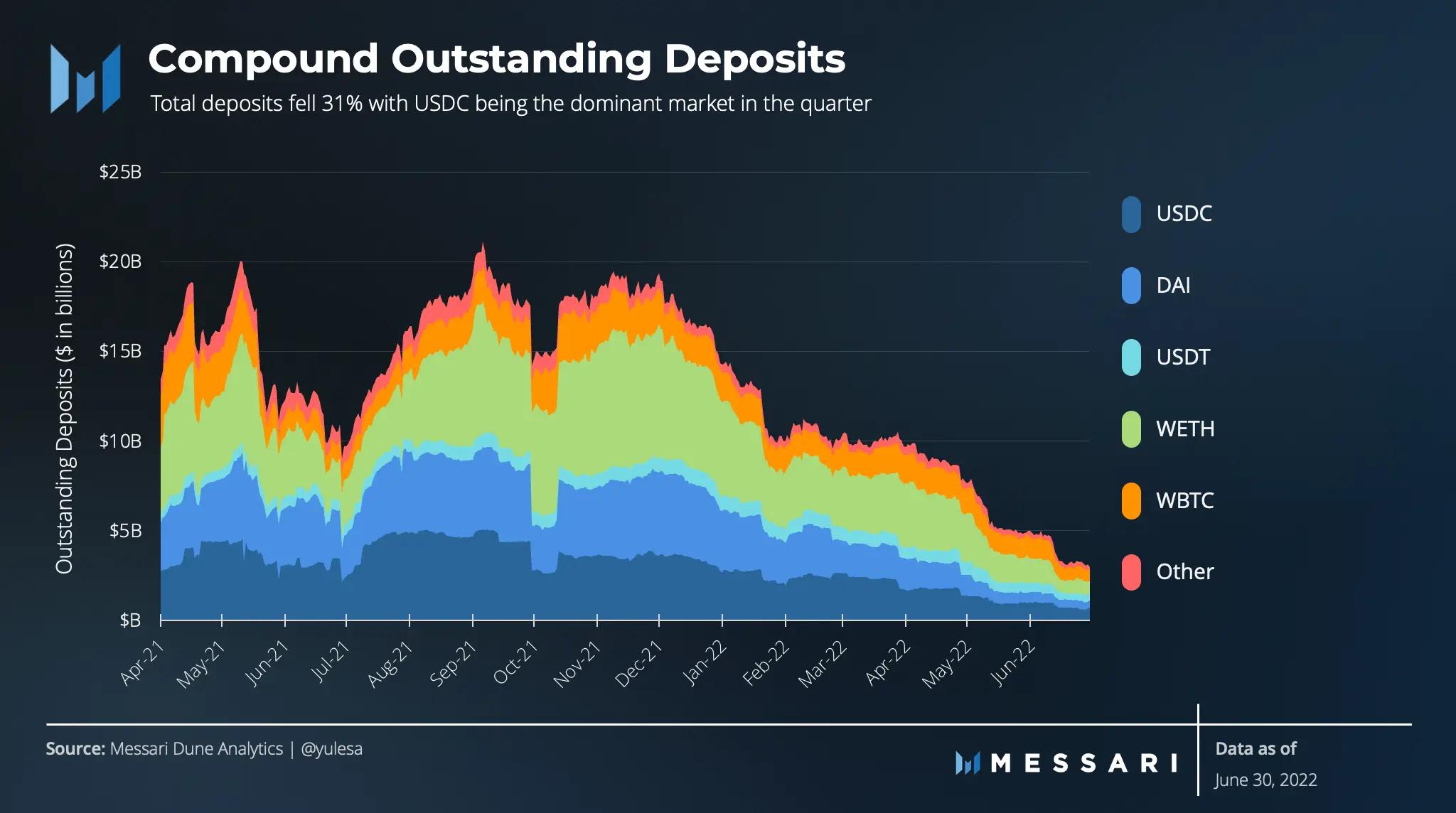
Given the current market sentiment and the halving of COMP incentives, deposits in Q2 fell by 31%, down 79% year-to-date.
Additionally, USDC surpassed WETH for the first time to become the most popular deposit asset this quarter, likely due to ETH's value dropping over 70% this year.
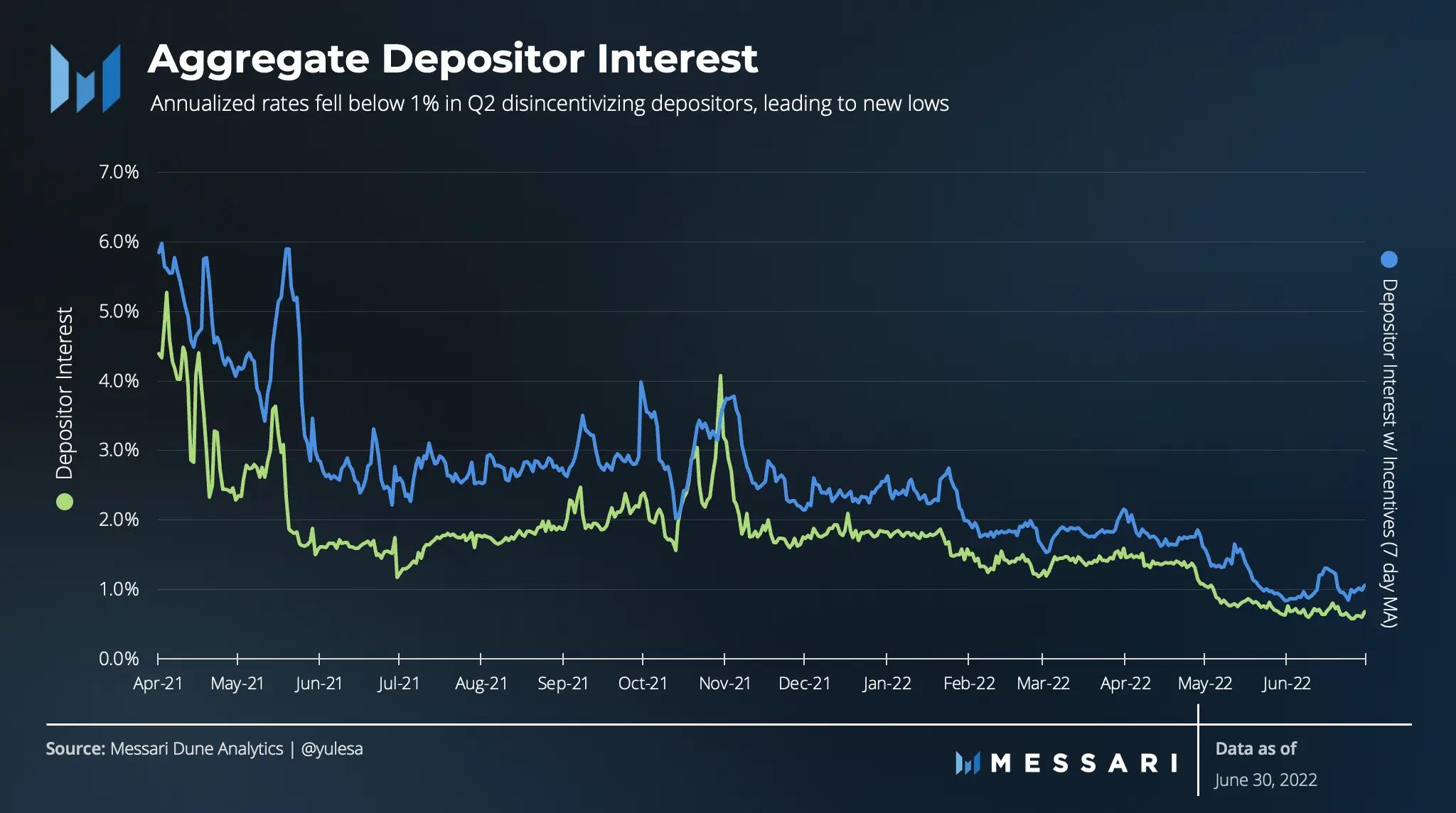
This quarter's deposit annualized interest rate dropped to 0.58%, the lowest level since launch. The average quarterly deposit rate was 0.95%, down from 1.51% in Q1, with depositors' rates peaking at 1.52%, marking a 51% decline in average annualized rates year-to-date.
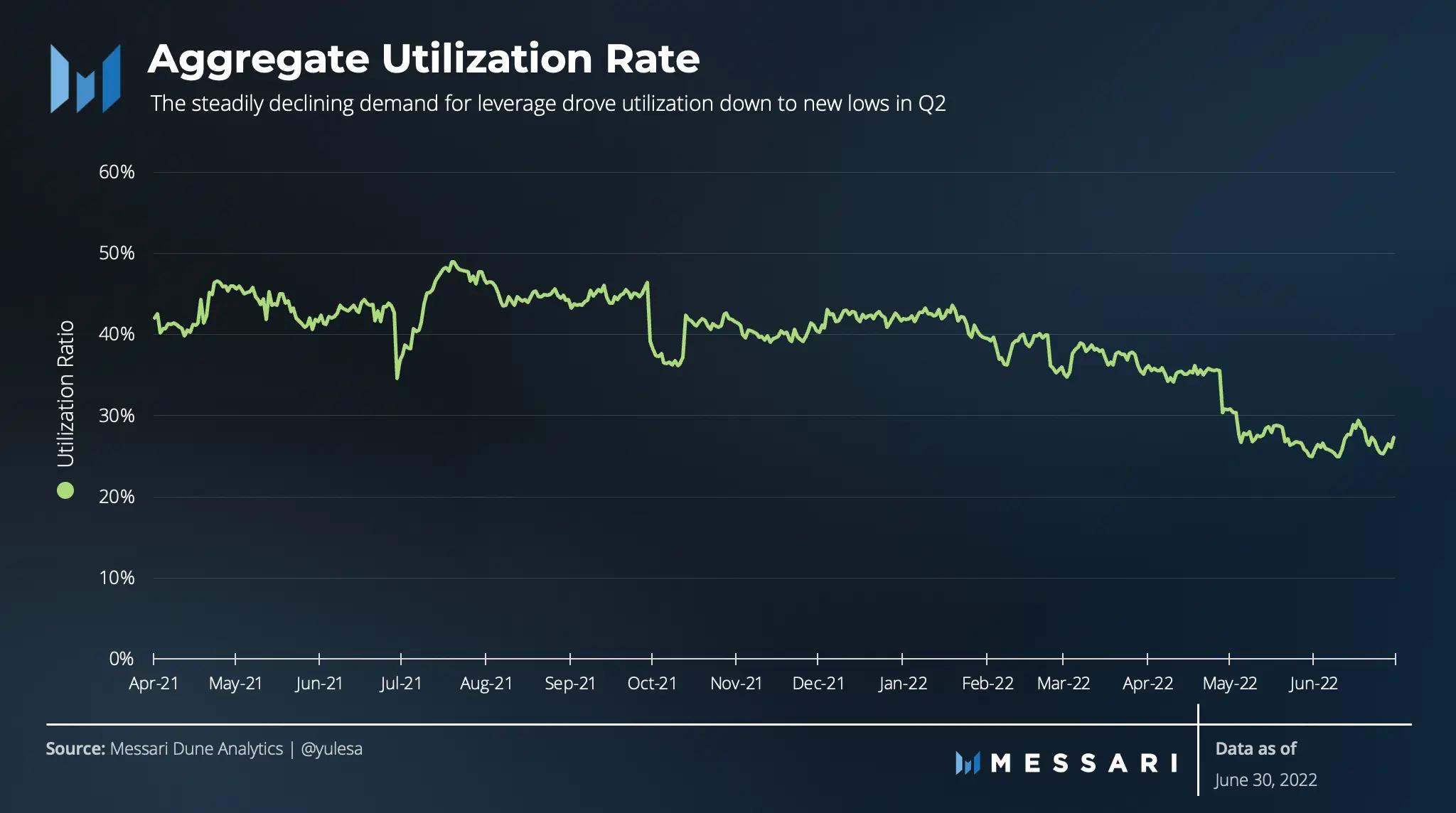
Since Q4 2021, overall loan demand has declined, and Compound's total utilization rate has also rapidly decreased, falling 35% year-to-date, with a minimum utilization rate of 27.3% in Q2, aligning with user concerns about economic recession and overall market turmoil.
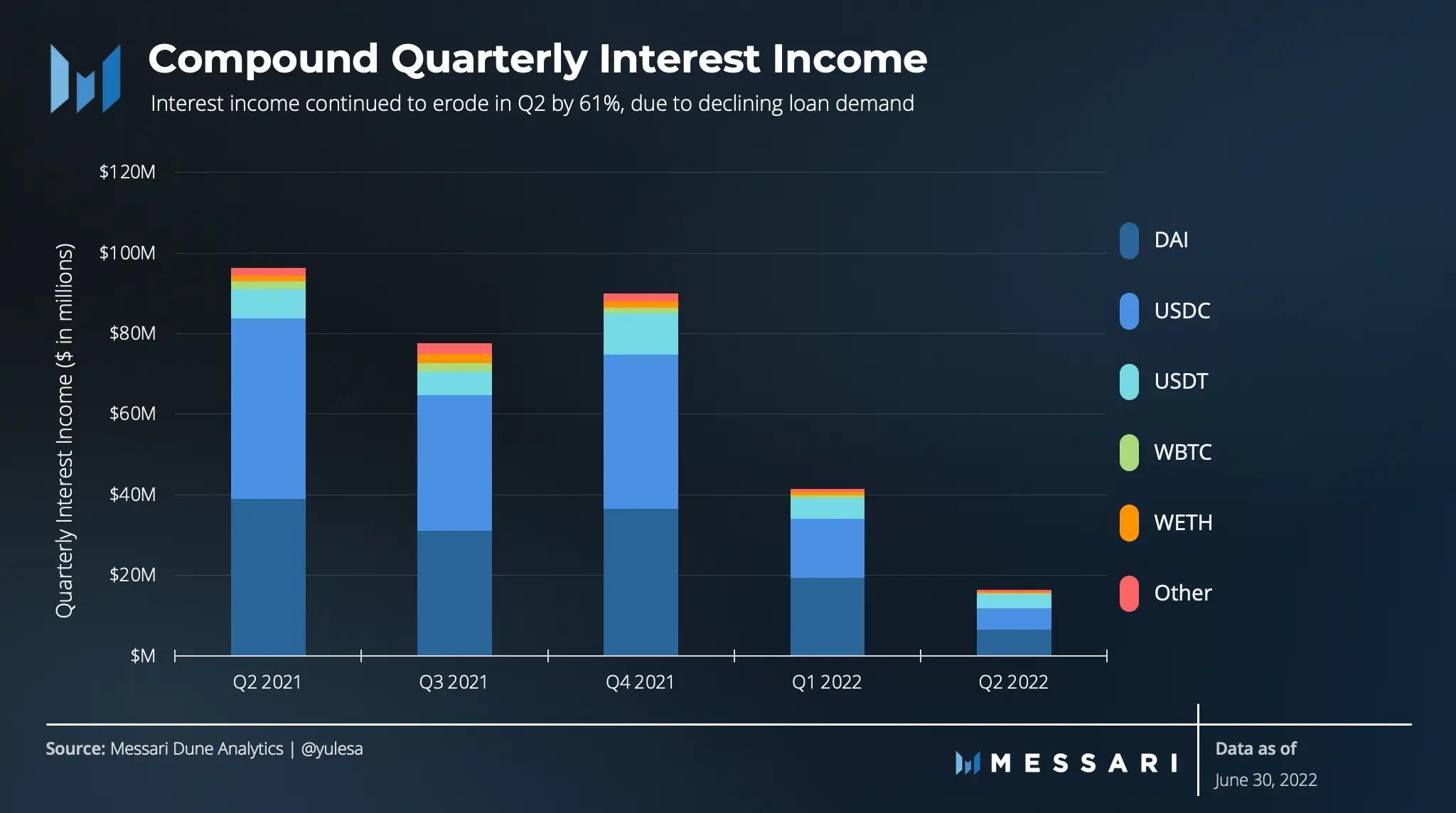
Compared to Q1 2022, interest income fell by 61%, further validating this downward trend, with this figure down 82% year-to-date, where USDC, WBTC, and DAI accounted for 86%, 84%, and 82%, respectively.
Interest income has declined for the second consecutive quarter by over 50%, primarily due to decreased loan demand.
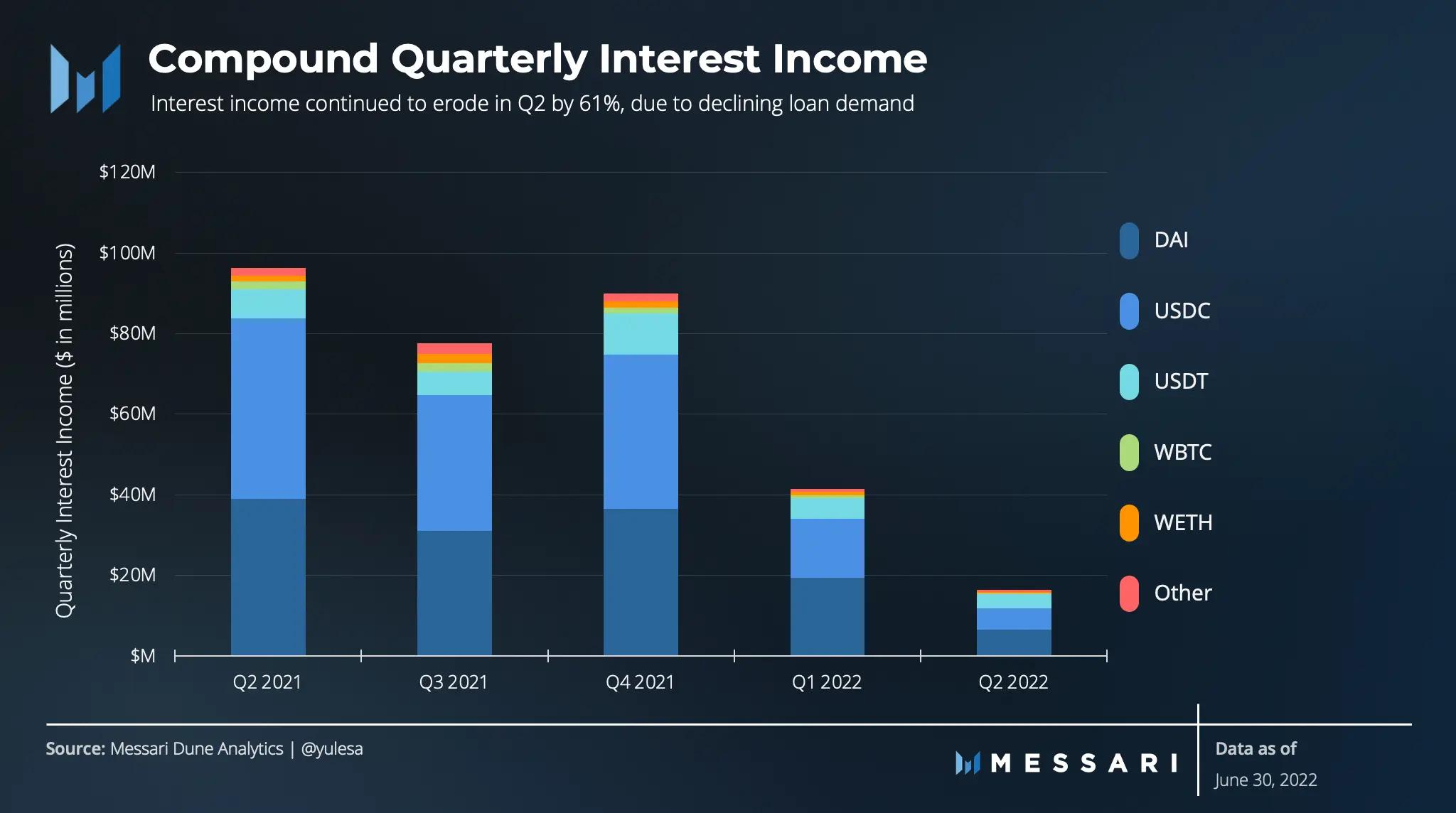
Similar to interest income, protocol revenue fell from $5 million to $2 million, with DAI declining 67% from the previous quarter, accounting for over 53% of Q2 protocol revenue.
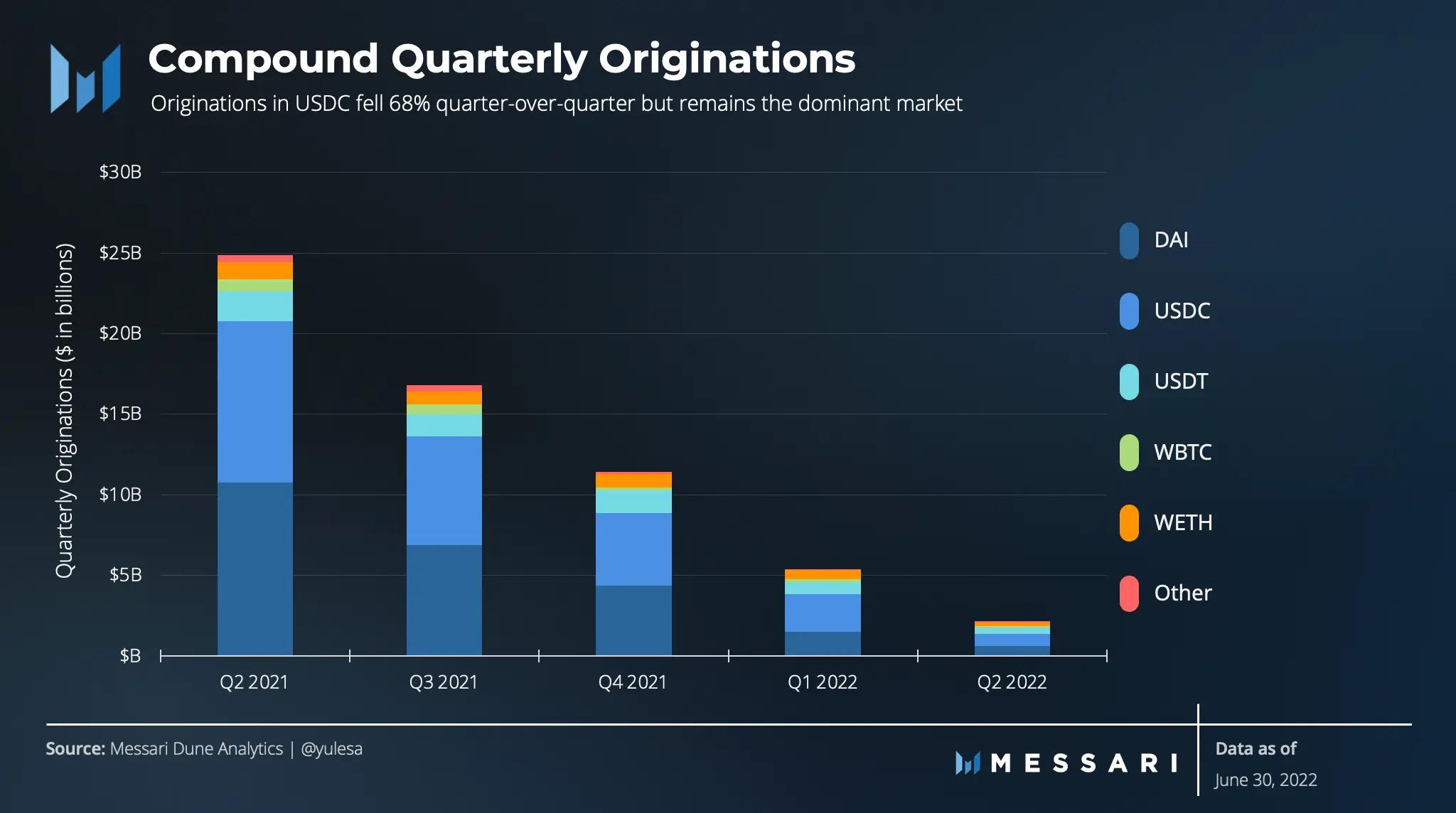
Total loans this quarter decreased by 60%, with USDC leading the way, as new loans dropped by $2.9 billion, a decline of 68%. WBTC, DAI, and WETH all saw declines of over 50%, at 62.6%, 59.5%, and 54.2%, respectively, with USDC and DAI reducing their funding scales by $800,000 and $600,000.
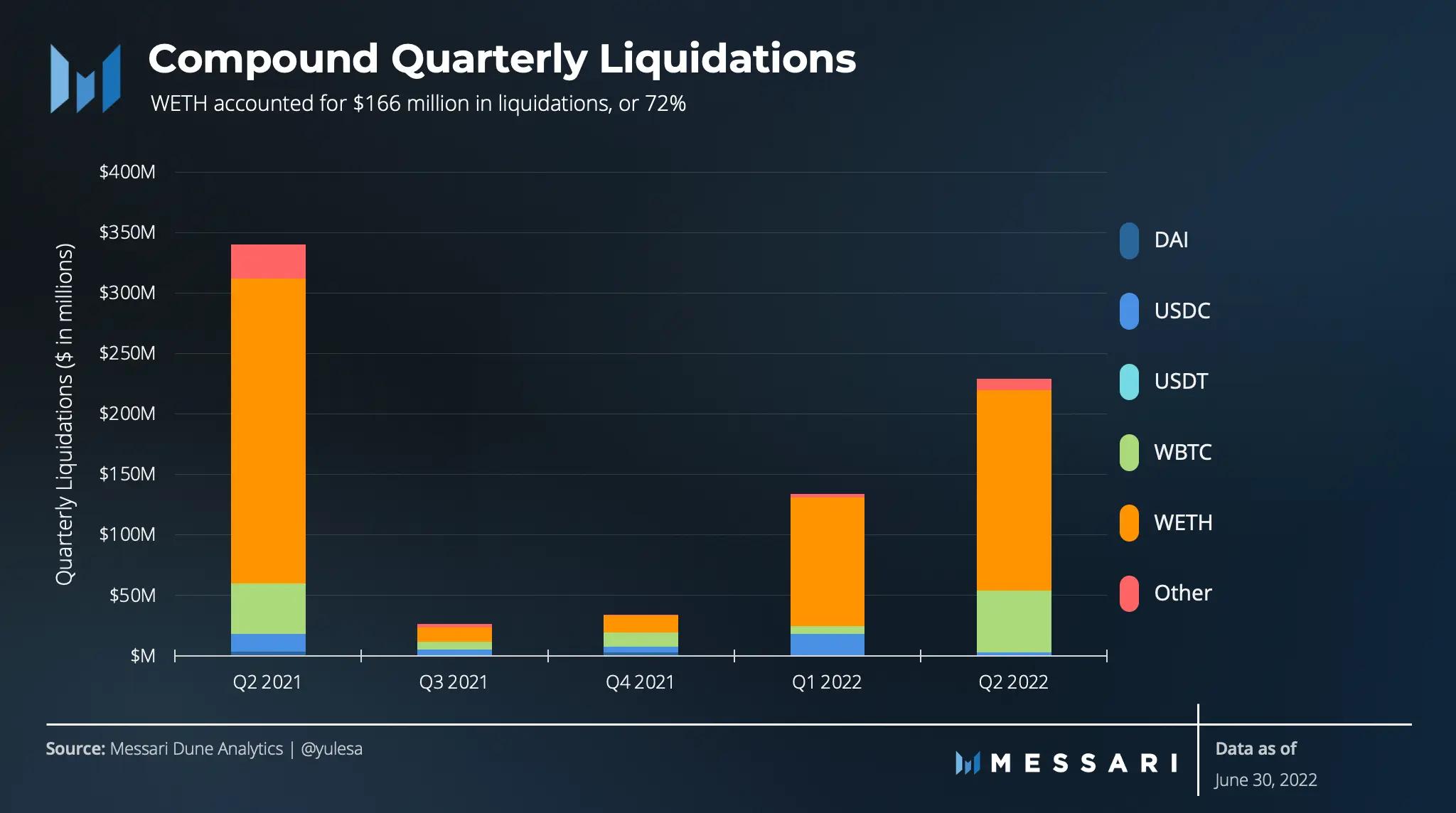
As the overall market experienced volatility, Compound's liquidations began to heat up. Liquidations in Q2 increased from $134 million in Q1 to $229 million, driven by liquidations in the WBTC and WETH markets, which saw increases of 687% and 56%, respectively.
WBTC liquidations rose from $6.6 million in Q1 to $52 million in Q2, while the WETH market had liquidations of $166 million this quarter, and USDC liquidations fell from $18 million in Q1 to $3 million in Q2.
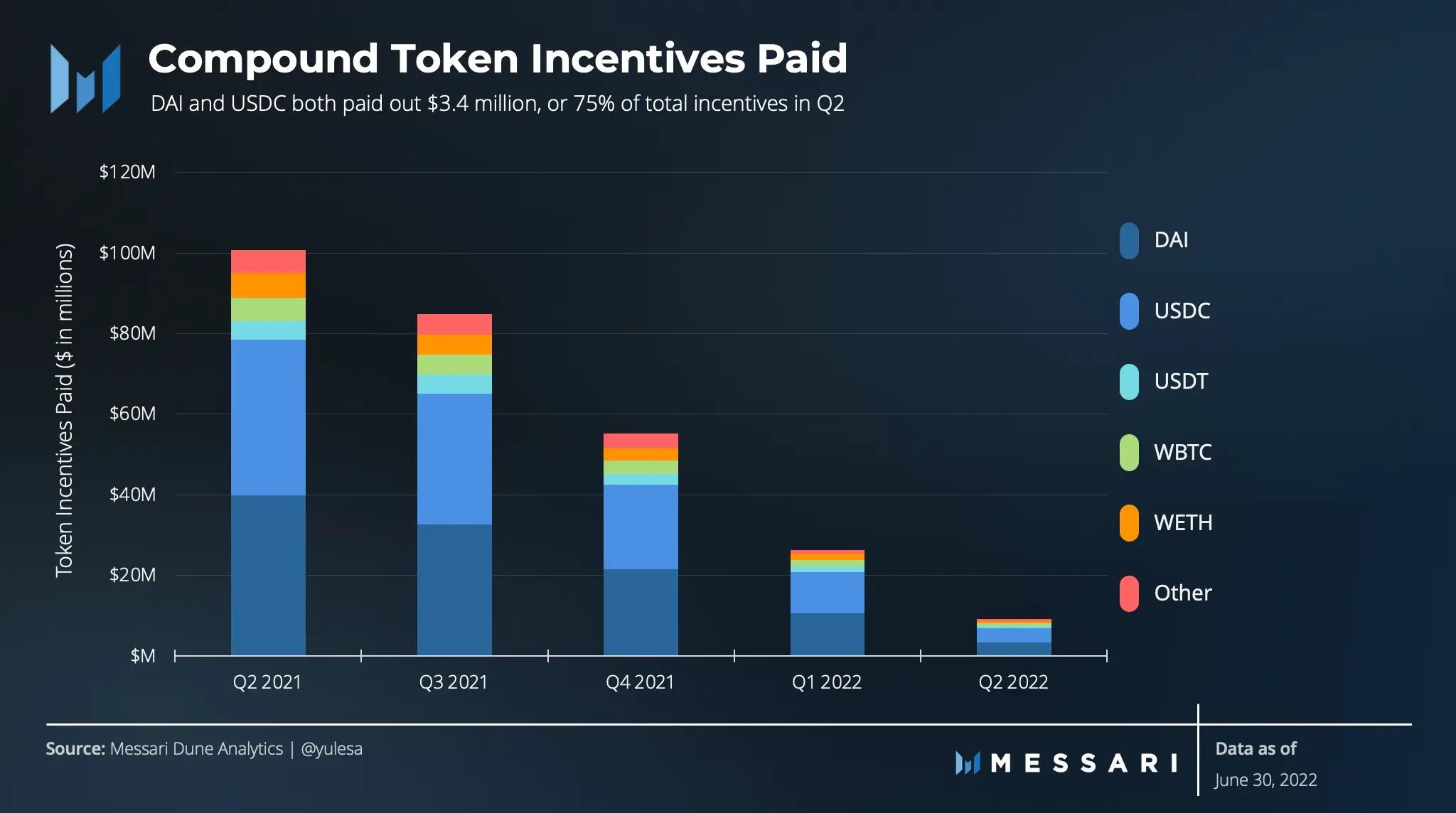
In governance, Compound passed proposal 092 at the end of Q1, resulting in a 66% decrease in COMP token incentives in Q2, following a 52% decrease in Q1.
Microeconomic Overview of Compound's Five Major Lending Markets
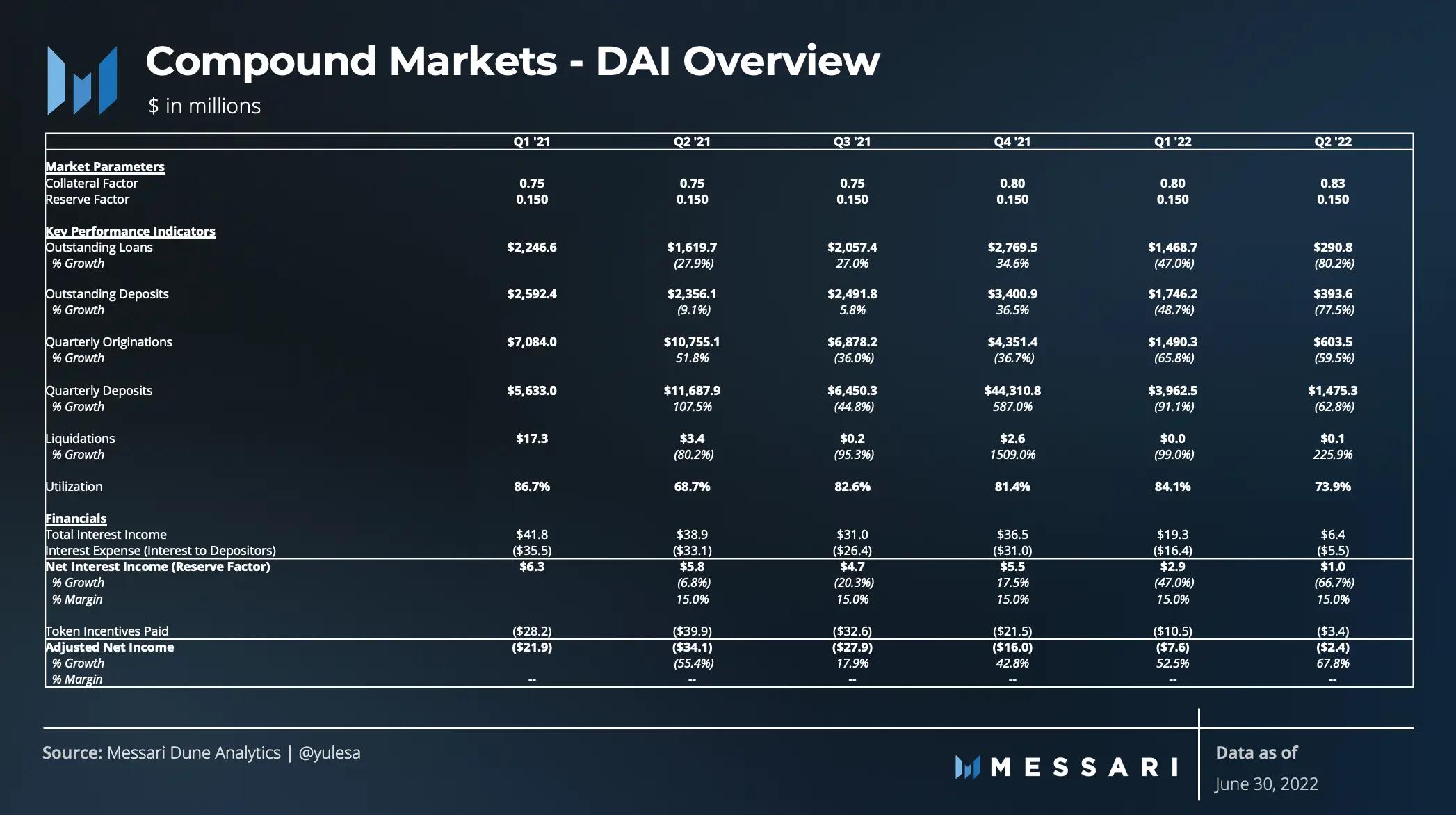
Most performance indicators in the DAI market continued to decline compared to the previous quarter. Although DAI's balance in Q2 was $291 million, down 80%, DAI remains the preferred currency for outstanding loans year-to-date; however, USDC has replaced DAI's dominance in outstanding deposits—falling from $1.7 billion to $394 million in Q2.
Compared to other markets, interest and protocol revenue are areas where DAI has reached or exceeded metrics—falling from $1.5 billion in Q1 to $604 million in Q2, a decline of 60%, but the rate of decline was slower than the previous quarter, with DAI liquidations surging 226% to $100,000, primarily due to no liquidations in the previous quarter.
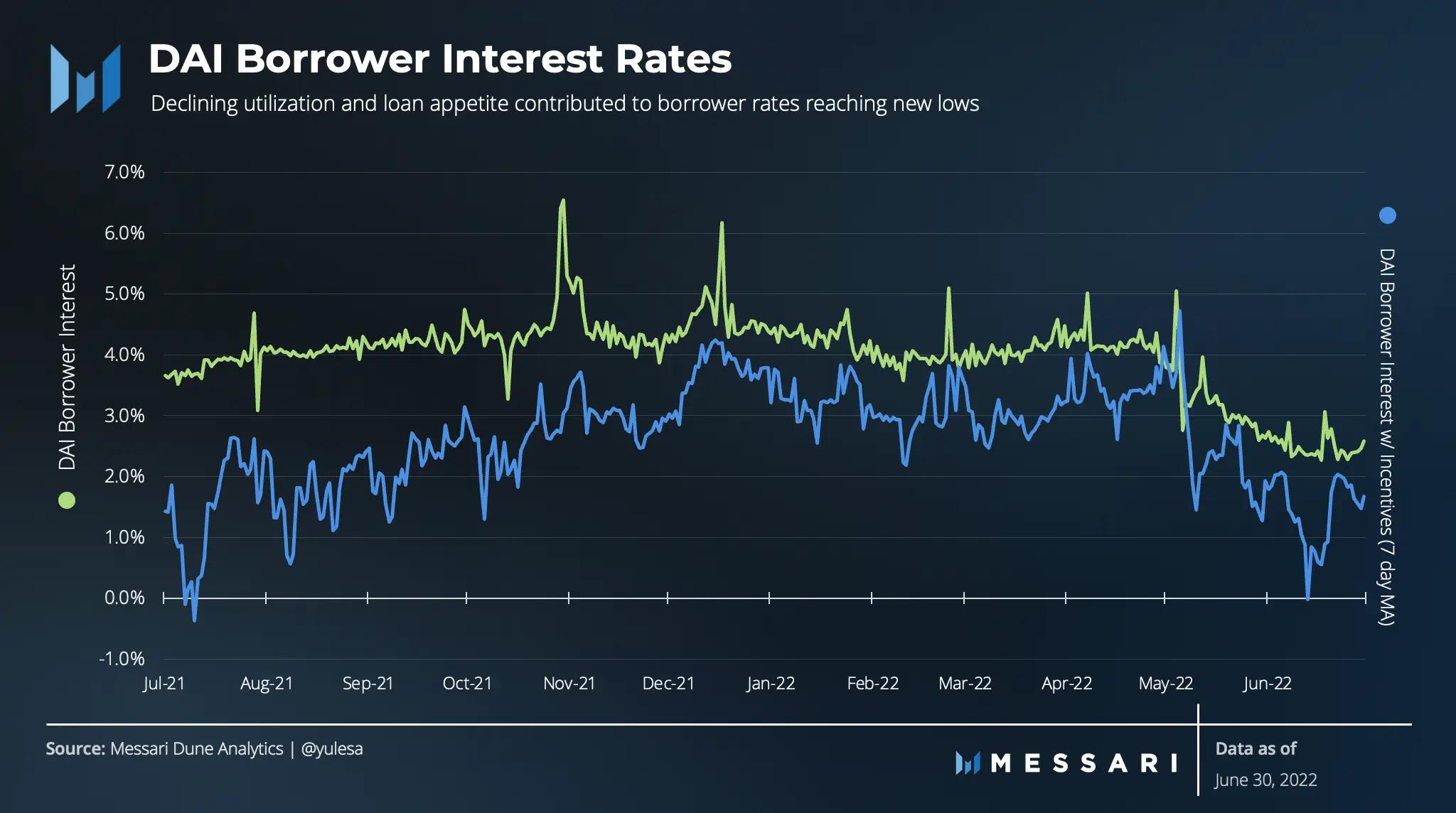
Utilization rate dropped from 75.4% in Q1 to 26.7% in Q2, a decline of over 60%. Naturally, this led to the average annualized interest rate falling from 4.12% in Q1 to 3.31% in Q2. Borrowers' rates fell below 2.5% for the first time, dropping from a peak of 5.05% at the beginning of the quarter to 2.27%.
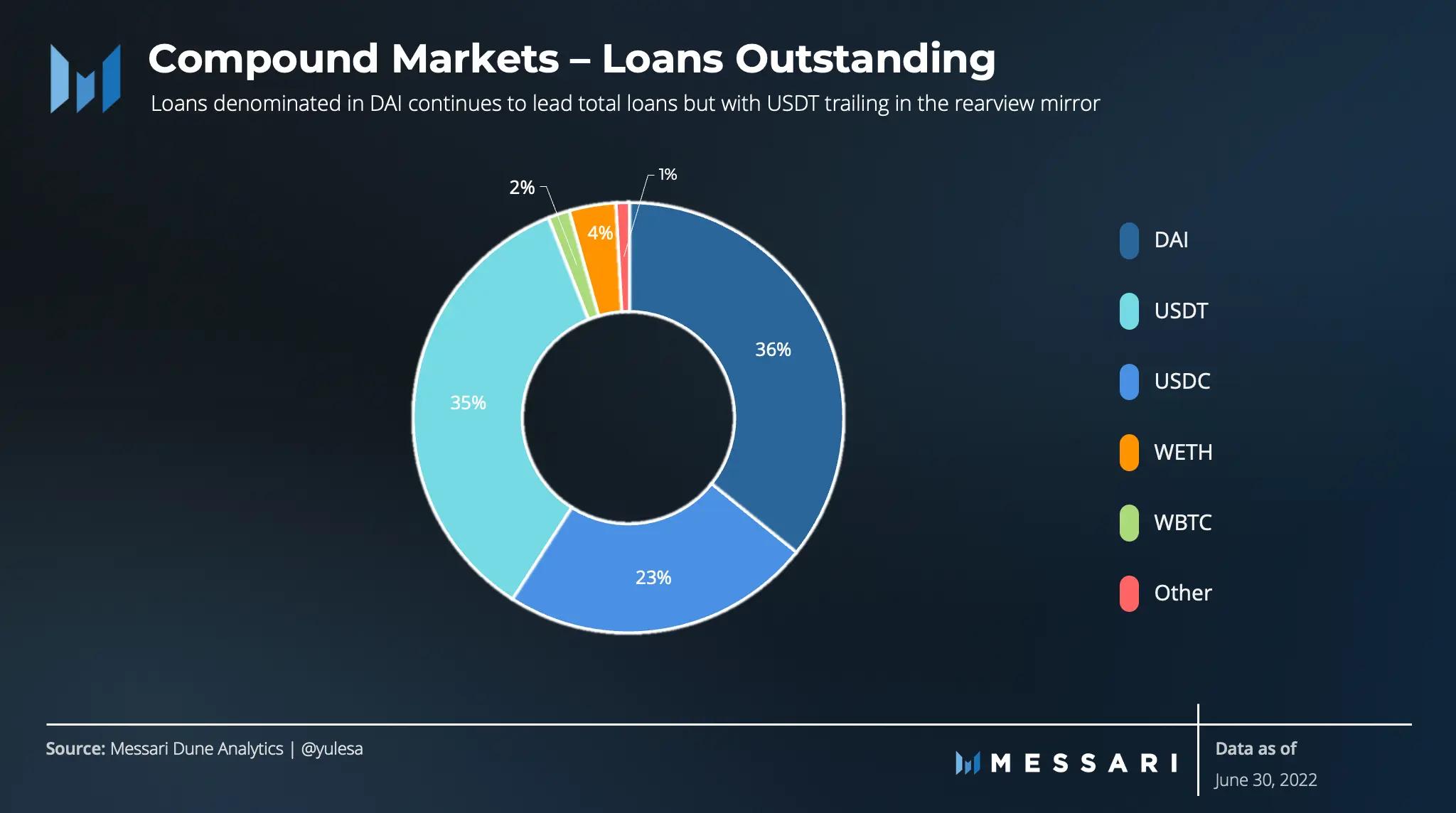
DAI's market share in the loan market was taken by USDT, while USDC was the main competitor in Q1, currently accounting for 36% and 35% of all outstanding loans, respectively.
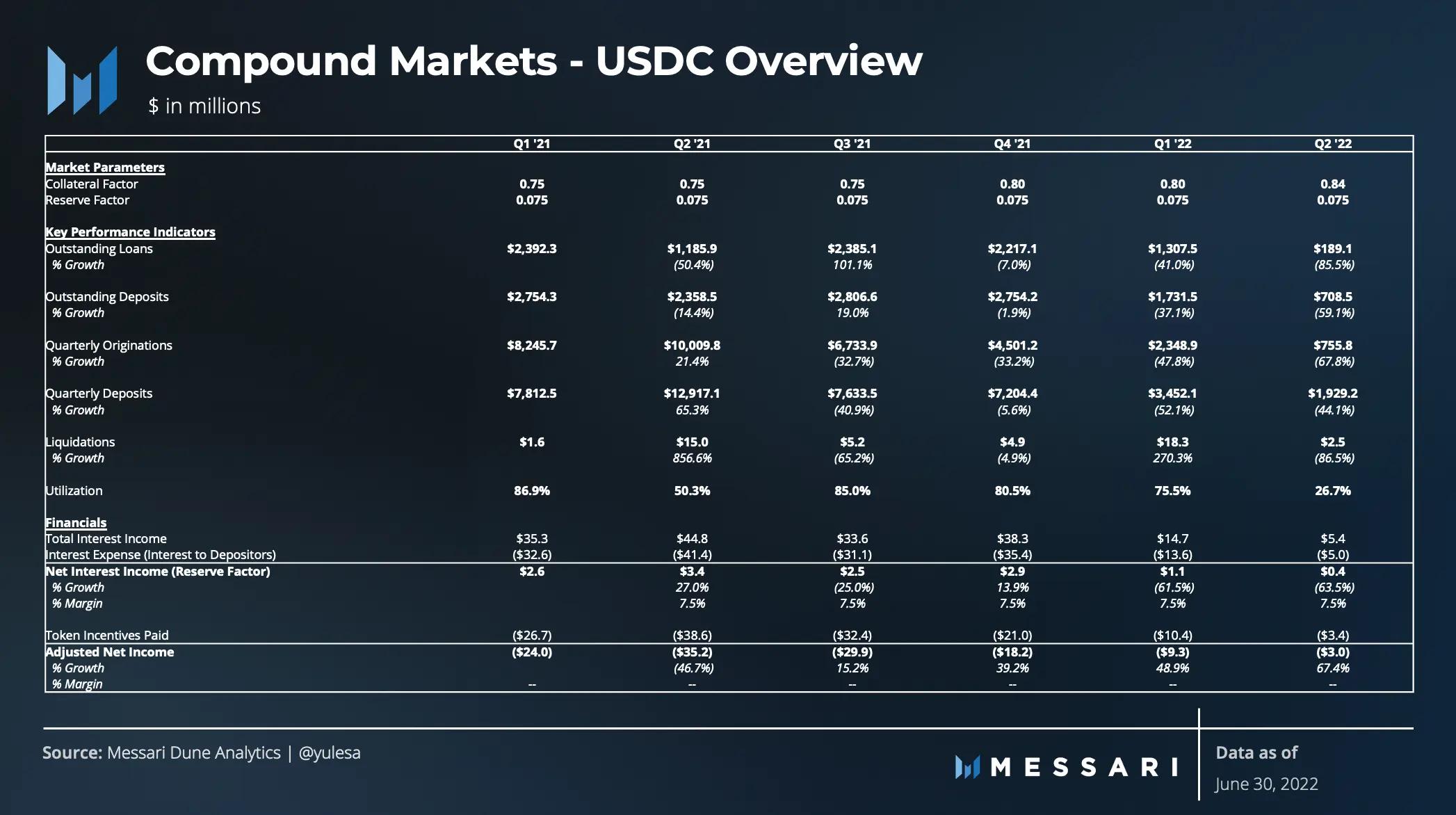
USDC has effectively been the fiat stablecoin used for deposits and loans on Compound, however, in Q2, USDC's position as the second-largest in outstanding loans after DAI was replaced by USDT, although USDC's outstanding deposits remain the second-largest market.
Notably, USDC experienced the largest decline in all outstanding loan markets, dropping from $1.3 billion in Q1 to $189 million in Q2, a decline of 86%, with deposits falling to a historic low of $709 million, a decline of 59%.
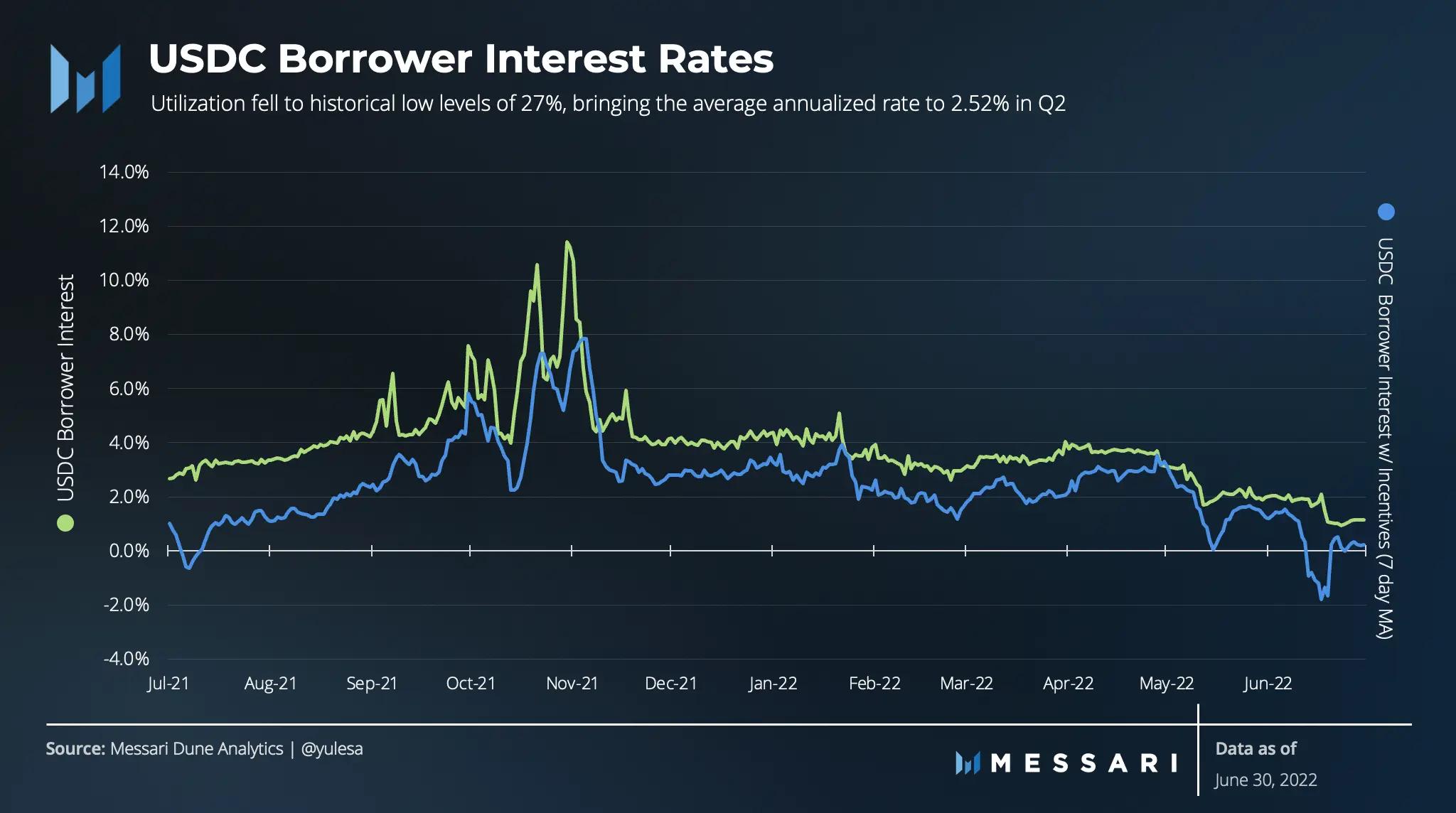
The overall decline in outstanding loans and deposits severely impacted utilization rates, causing them to drop from 76% in Q1 to 27% in Q2.
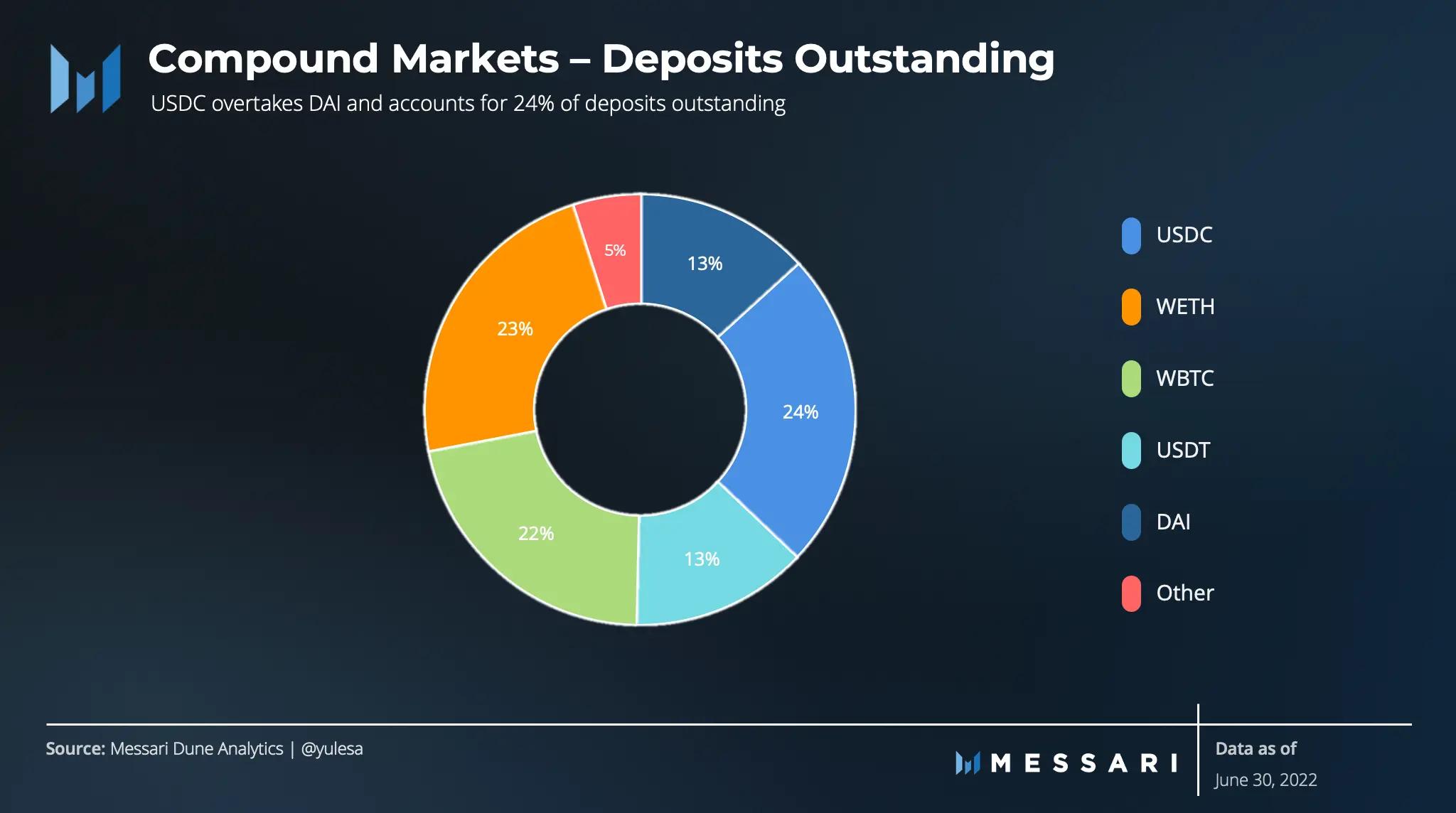
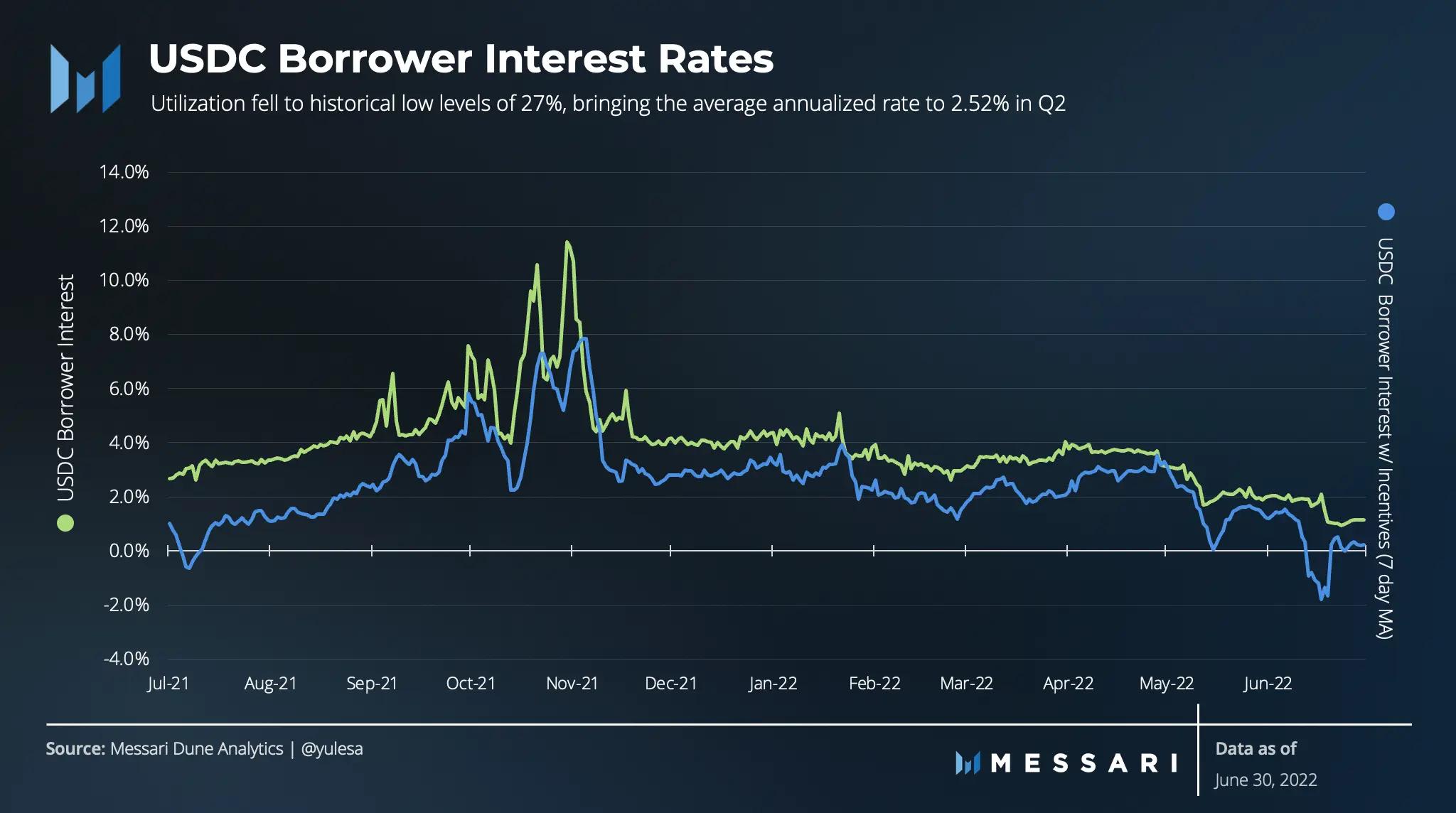
USDC's borrowing rate fell to below 1%, reaching a low of 1.15% this quarter. Borrowing rates peaked at 3.94% at the beginning of the quarter, with an average annualized rate of 2.52% in Q2, as users adjusted to the current market conditions, with USDC leading in total outstanding deposits, followed by DAI.
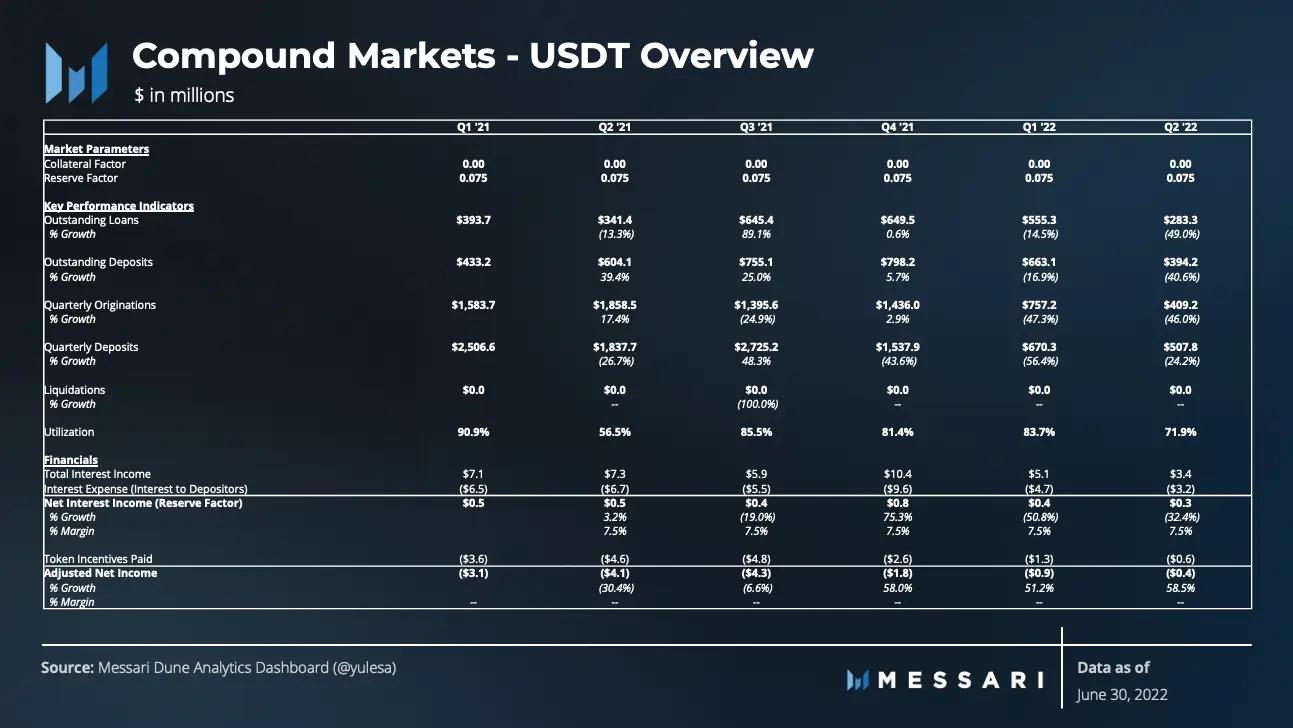
Similar to the previous quarter, USDT's outstanding loans and deposits saw a slight decline compared to DAI and USDC. Loans denominated in USDT fell from $555 million in Q1 to $283 million in Q2, a decline of 49%, while deposits decreased by 41% to $394 million.
USDT maintained the highest utilization rate across all markets at 72%, with an average annualized borrowing rate of 3.4%. USDT rates peaked at 4.87% in early April, then hit a low of 2.58% in Q2.
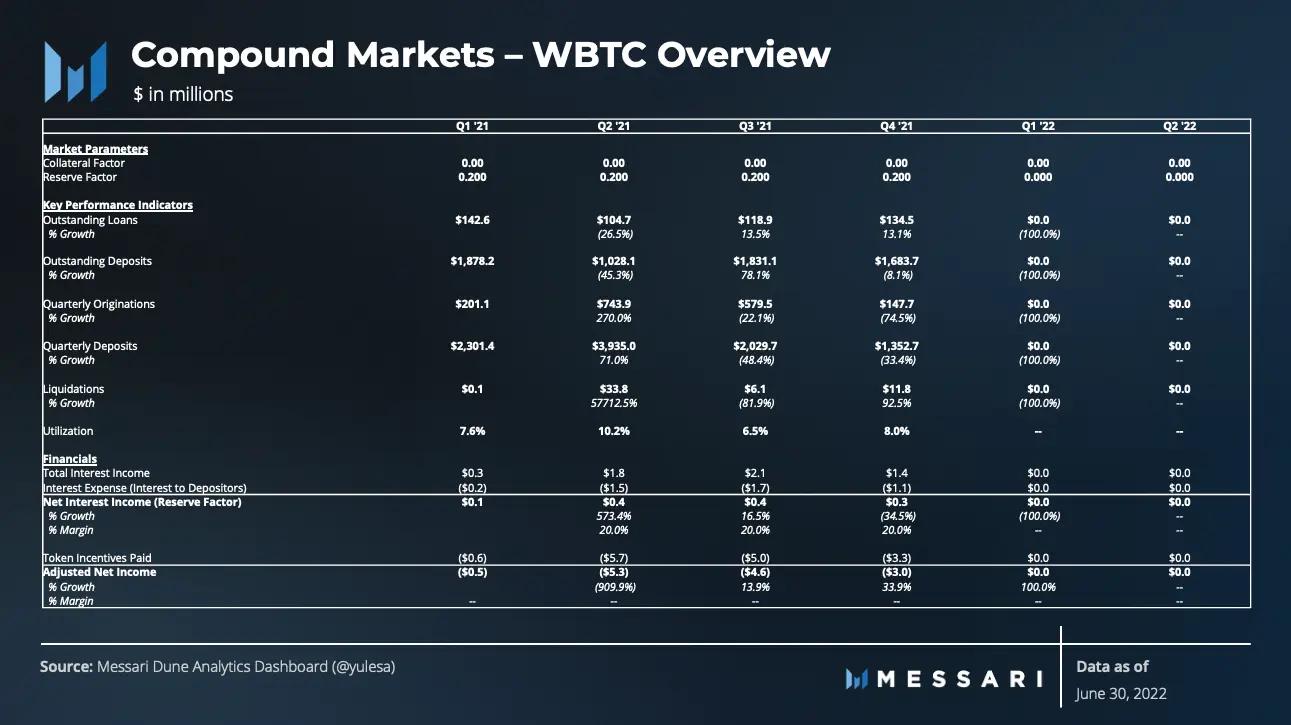
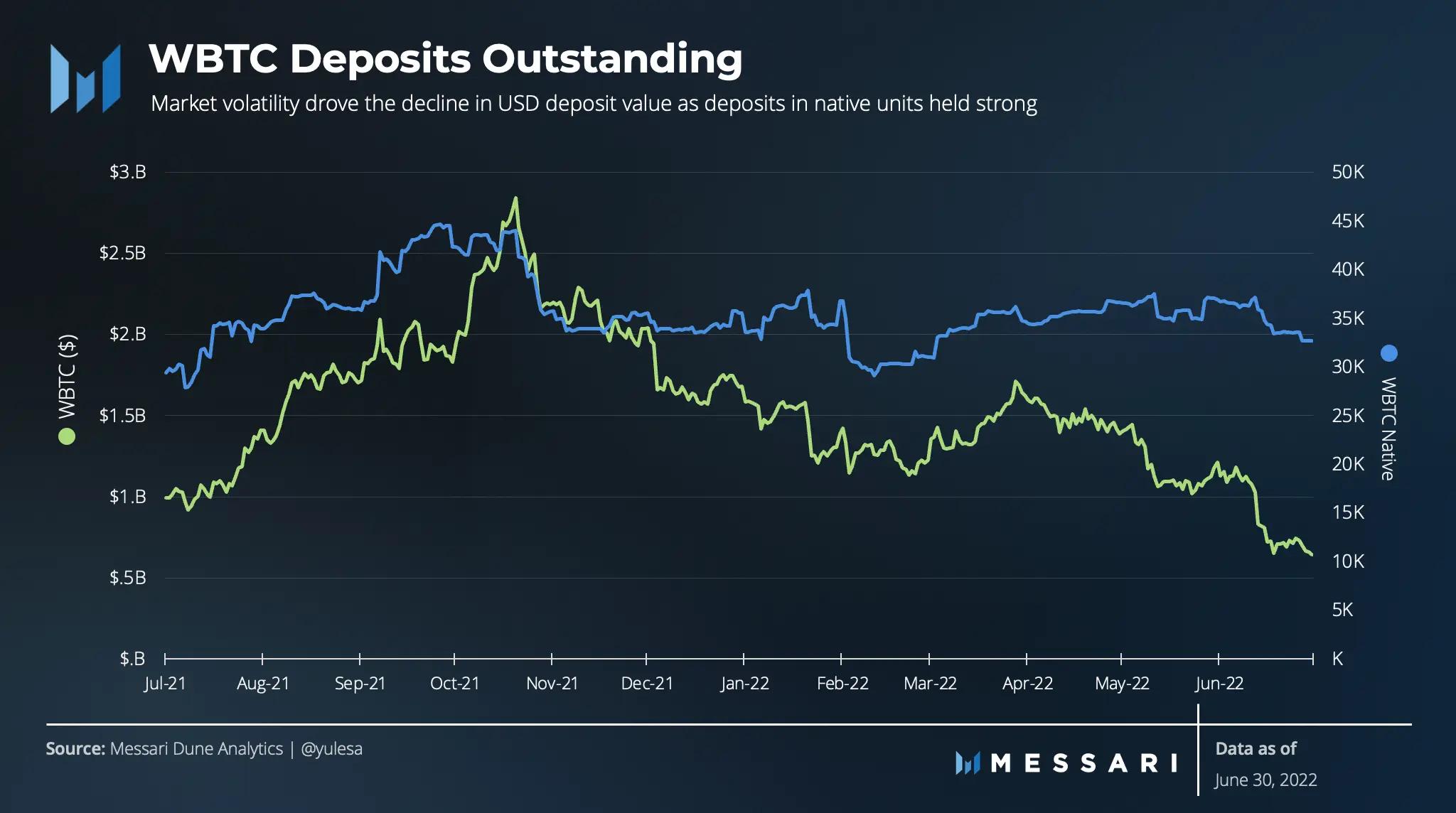
The dollar value of outstanding WBTC deposits continued to plummet in Q2, dropping from $1.6 billion in Q1 to $643 million in Q2. In contrast, the number of native tokens in WBTC deposits only decreased by 6% quarter-over-quarter.
The dollar value of outstanding loans fell 74% to $13 million, while the number of native tokens in WBTC decreased by 38%.
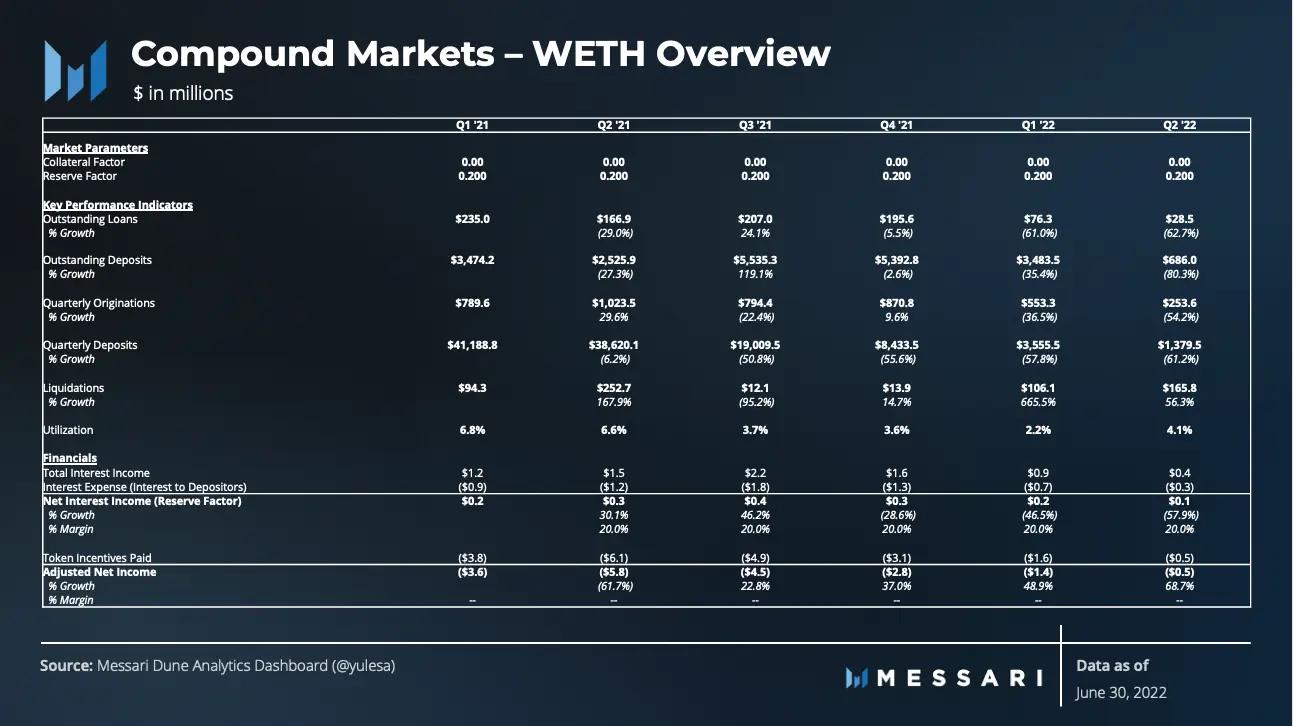
Historically, WETH has been the primary form of deposits in Compound, however, USDC took the lead in Q2. Outstanding WETH deposits fell from $3.5 billion in Q1 to $686 million in Q2, an 80% decline, while native deposits decreased by 38%.
Unlike the other top five markets, WETH's outstanding deposits declined faster than outstanding loans—outstanding WETH loans fell 63% to $28 million, while native WETH loans grew by 18%. The increase in the number of users deciding to borrow WETH during volatile periods may be a positive signal in the short term, especially compared to WBTC.
Compared to other markets and the overall protocol, WETH's utilization rate increased by 86%, reaching 4.1%. Additionally, the shaky market continued to drive up WETH liquidations, increasing from $106 million in Q1 to $166 million in Q2.
Qualitative Analysis
Governance and Key Events
With the governance and collaboration assistance from Gauntlet and OpenZeppelin, the Compound market underwent adjustments this quarter, including collateral factor adjustments across seven markets, lowering borrowing limits in the MKR market, implementing cTokens, and granting funds to Aztec.
Aztec Integration
Governance approved proposal 105, granting Aztec a $100,000 funding subsidy, with $50,000 disbursed upfront and the remaining $50,000 released three months after the project launch. Aztec is a ZK-Rollup scaling and privacy solution that significantly reduces gas costs, and its zero-knowledge proofs will enable users to conduct private deposits and loans.
Overview of the Grant Program
Version 1.0 of the Compound Grant Program successfully funded over $1 million across 30 grant projects; however, due to a lack of centralized resources, the CGP remained inactive in Q2.
Roadmap
Compound III
Since the beginning of this year, discussions about the new multi-chain version, Compound III, have been brewing. At the end of Q2, Compound Labs released a code repository to the community to help shape the multi-chain strategy, allowing developers to begin integrating, auditing, and suggesting any improvements to the codebase.
The goal of Compound III is to create a more gas and capital-efficient cross-chain platform while simplifying governance processes. Some key changes to the existing protocol include:
- Interest calculated on a single borrowable base asset (USDC);
- Using all other assets as collateral to reduce risk and improve capital efficiency;
- Separating borrowing and liquidity collateral factors;
Conclusion
During the volatile period of the Q2 market, DeFi proved its resilience, showcasing the versatility and effectiveness of a fully functional and transparent system in the face of selected centralized lending institutions' failure to achieve transparency and lack of risk management practices.
Although the current market conditions are the primary reason for the overall decline in Compound protocol activity, there is still a need to incentivize new and existing protocol users in a better and more sustainable way. The Aztec integration aims to break barriers in terms of gas optimization and privacy.
The release of the Compound III code repository by Compound Labs presents another opportunity to showcase community and governance power, ultimately determining whether Compound can become a more capital-efficient cross-chain lending protocol, depending on the steps taken and future development plans.
 Risk warning
 Risk warning



Popular articles





