








Can celebrity-endorsed NFTs still be purchased?

 The once bustling NFT market has also cooled down, and the NFTs endorsed by top celebrities have ultimately ended up in a mess.
Author: Jasmine, Hive Tech
Since NFTs entered the consumer market in the form of social network avatars and digital collectibles, celebrities from the entertainment and sports industries have begun endorsing various NFTs, with some even participating in the issuance and production of certain NFT projects.
From June to August this year, the American consumer rights protection organization Truth in Advertising (TINA) noticed the phenomenon of celebrities promoting NFTs and began collecting information on how these celebrities use their personal social media influence to promote NFTs. They subsequently sent warning letters to 19 celebrities who had promoted various NFT projects, reminding them to disclose their relationships with the promoted NFT projects, or they would be suspected of deceptive marketing. The organization stated that it reserves the right to notify regulators.
Among the celebrities who received warning letters were top stars like singer Justin Bieber, Madonna, and NBA player Shaquille O'Neal. "Some celebrities have personal stakes in the NFTs and/or NFT companies they promote, but they have not disclosed this, which violates federal law," TINA also warned consumers to be cautious of potential financial losses when purchasing NFTs promoted by celebrities.
There have already been instances of celebrities being involved in deceptive NFT promotions. In May of this year, the NFT project Candyverse, promoted by American comedian Anthony Anderson, ceased updates, resulting in losses for hundreds of investors.
Not only overseas celebrities are endorsing NFTs; stars from the Chinese entertainment industry are also keen on this trend, and they too have ambiguous relationships with the projects. The cooling of the NFT market has caused the value of NFTs endorsed by celebrities to plummet, leaving behind a mess.
19 Celebrities Warned by TINA for Promoting NFTs
In August of this year, another 17 overseas celebrities were warned by the American consumer rights protection organization Truth in Advertising (TINA) for promoting NFTs. The organization sent letters to these celebrities, reminding them that promoting NFTs on social media could involve deceptive marketing, urging them to disclose their substantial connections with the promoted NFT projects to avoid infringing on consumer rights.
TINA is a non-profit consumer rights protection organization dedicated to protecting consumers from deceptive advertising and is also an advertising oversight agency. Once illegal activities are discovered in advertisements, the organization will send legal complaint letters to regulatory authorities.
Since June of this year, TINA has begun sending warning letters to celebrities involved in deceptive NFT marketing, initially disclosing only two celebrities—singer Justin Bieber and actress Reese Witherspoon. By August 8, the list of warning letters issued by the organization had increased by 17, covering celebrities from various professions, including well-known singers, actors, hosts, and athletes, with Madonna and NBA star Shaquille O'Neal also on the warning list.
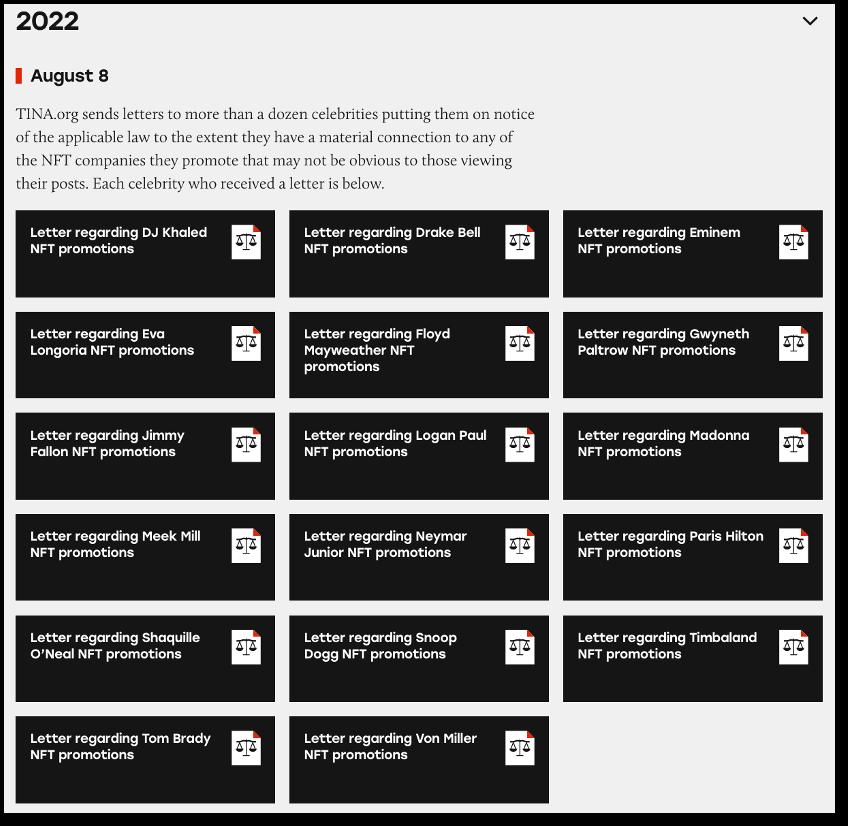
In August, TINA issued warning letters to 17 celebrities promoting NFTs.
These warning letters highlight the phenomenon of celebrities endorsing various NFTs.
"This is a field filled with deception," TINA found during its investigation, noting that the deceptive categories include but are not limited to these celebrities "failing to clearly and prominently disclose the material connections between the promoters and the NFT companies," as well as omissions of other important information, such as "the risks associated with investing in such speculative digital assets, potential financial damages from such investments, and the potential benefits the promoters receive from promotional activities."
The first batch of celebrities to receive warning letters included well-known singer Justin Bieber and actress Reese Witherspoon. Bieber was listed as a "partner" on the website of the NFT project inBetweeners, while Witherspoon appeared in the official promotional announcements for the NFT project World of Women, where she and her company Hello Sunshine collaborated with the NFT company. Although these NFT projects included celebrities in their official promotional information, TINA pointed out that neither of these celebrities disclosed these relationships in their promotional posts.
In the warning letter to Justin Bieber, TINA stated that they found Bieber engaged in "deceptive marketing" for certain NFTs created by the InBetweeners company, specifically noting that "Bieber did not disclose his substantial connection to the company when promoting InBetweeners NFTs on his social media accounts, nor did he disclose that these posts were advertisements."
InBetweeners marked Bieber as a "partner" on its official website, while the NFT project described Bieber as a "collaborator" on its official Instagram page.
In the warning letter to Justin Bieber, TINA illustrated the posts he had made on his personal Instagram account promoting InBetweeners NFTs, which served as evidence for the organization to inform Bieber of the deceptive marketing issues, stating, "We reserve the right to notify regulatory authorities."
Furthermore, TINA mentioned in the warning letter that Bieber never disclosed the risks associated with investing in such speculative digital products when promoting NFTs (in which he personally holds shares in the company), and the potential financial losses from such investments. Considering Bieber's fan base—millions of Generation Z teenagers and young adults—these overlooked important details are particularly significant for them. "Unless the above issues are fully corrected by June 17, Bieber is engaging in deceptive marketing activities."
On July 1, Bieber's attorney responded to TINA's letter, stating that Bieber had always clearly indicated that he was a member of the InBetweeners team and had never concealed their relationship. He also did not promote NFTs as investment opportunities or encourage his fans to purchase any specific NFTs, thus deeming it absurd to warn him that "investing in NFTs carries risks."
Although Bieber does not believe there is any issue with spreading information about InBetweeners on social media, his attorney stated, "Bieber will update his posts about InBetweeners to further emphasize his relationship with the company."
Celebrities Promoted a Total of 47 NFT Projects
According to the warning letters disclosed by TINA, Hive Tech found that a total of 47 projects had been promoted by these celebrities on their social platforms.
Among them, the most promoted project was the Bored Ape Yacht Club (BAYC), endorsed by 8 celebrities, including TV host Jimmy Fallon and Brazilian soccer star Neymar Junior. The female-themed World of Women was promoted by 5 celebrities, 4 of whom are well-known female stars, including singer Madonna and Gwyneth Paltrow, who played "Pepper Potts" in Iron Man.
Actor Drake Bell, who rose to fame from the American TV series "Drake & Josh," is the celebrity who promoted the most NFTs on TINA's warning list, having promoted up to 12 different NFT projects on his personal social media. In addition to well-known projects like Bored Ape Yacht Club and CryptoPunks, he also promoted many niche NFTs.
American socialite, actress, and model Paris Hilton's enthusiasm for NFT promotion is second only to Bell, as the Hilton hotel heiress has endorsed 8 NFT projects, including Origin Protocol, in which she invested and served as an advisor.
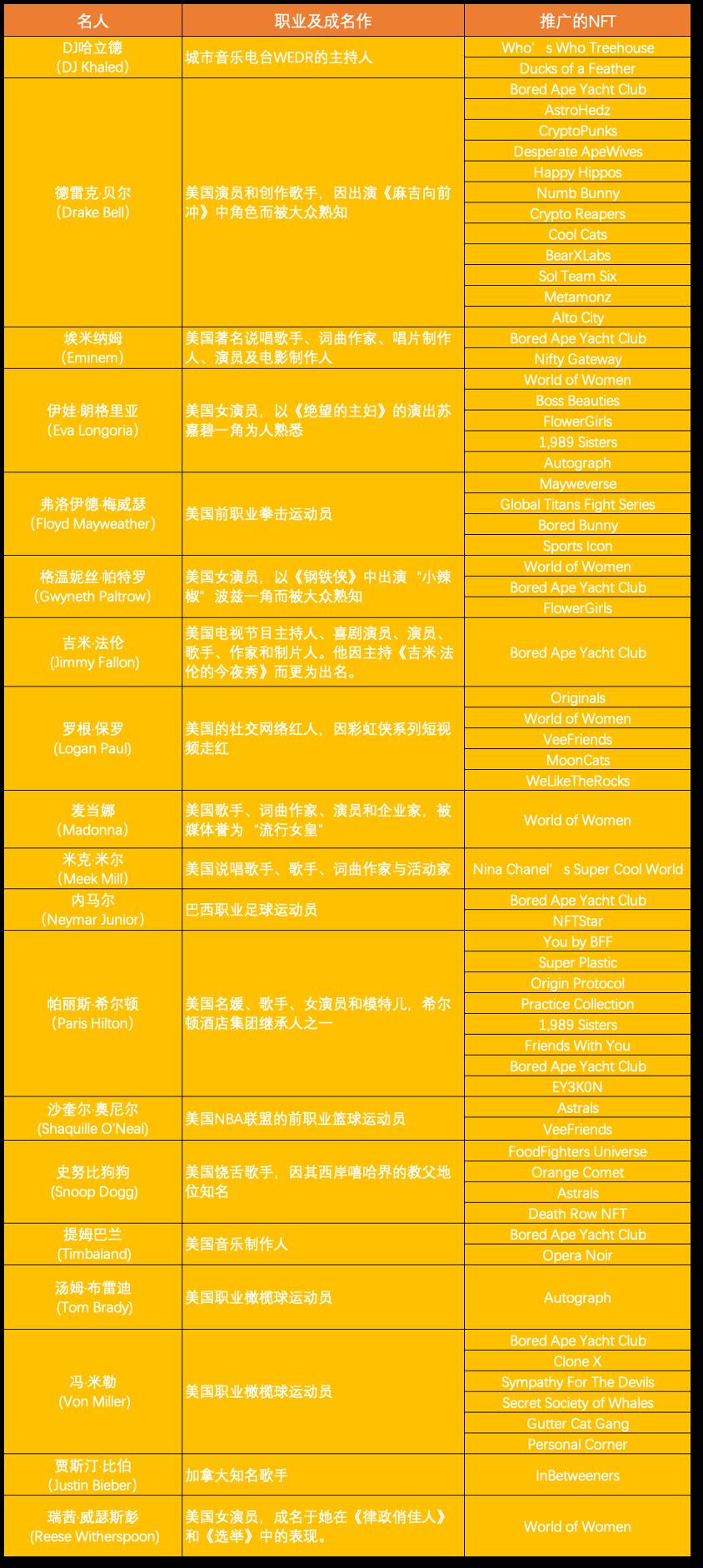
A list of NFTs promoted by the 19 celebrities named by TINA.
TINA pointed out that some celebrities have personal stakes in the NFTs or NFT companies they promote, but they have not disclosed this, stating, "This violates federal law." TINA emphasized that the Federal Trade Commission (FTC) requires that when influential figures on social media have any financial, personal, or other material relationships with a brand, they must clearly and prominently disclose this information.
TINA cited a precedent where, in October 2021, the FTC sent penalty notices to hundreds of advertisers, informing them that misleading endorsements could lead to substantial financial penalties. The FTC stated that when celebrities endorse brands on social media, "if they do not disclose the sources and amounts of any compensation paid directly or indirectly in exchange for the endorsement, it may be illegal."
Comedian Criticized for Endorsing a Potential Scam NFT Project
In addition to the issue of disclosure, TINA also investigated an incident involving the celebrity endorsement of the Candyverse project, implying it could be a potential scam.
Investor Bob stated that in March of this year, he began to worry about the Candyverse NFT project due to the founder's prolonged silence. Initially, he planned to accept a loss of $300 on his investment, but the involvement of actor Anthony Anderson changed his mind.
In April of this year, Anderson was announced as a new team member for the Candyverse project. He had previously played Detective Kevin Bernard in the TV series "Law & Order" and had been nominated for an Emmy Award.
On April 6, he posted a video on social media stating, "I’m excited to share my ownership of a unique metaverse project called Candyverse." Candyverse consists of 10 unique themed areas, including events, games, social activities, and plots.
"We are preparing to launch the first plot sale, inviting you to grab Candyverse NFTs. By obtaining Candyverse Critter NFTs, you can now reserve your spot and whitelist your wallet for early access to land, NFTs, and special airdrops. Join me and be part of the most unique metaverse experience ever; you won't be disappointed." In the video, Anderson also included promotional text and various hashtags related to Candyverse, linking to the relevant website.
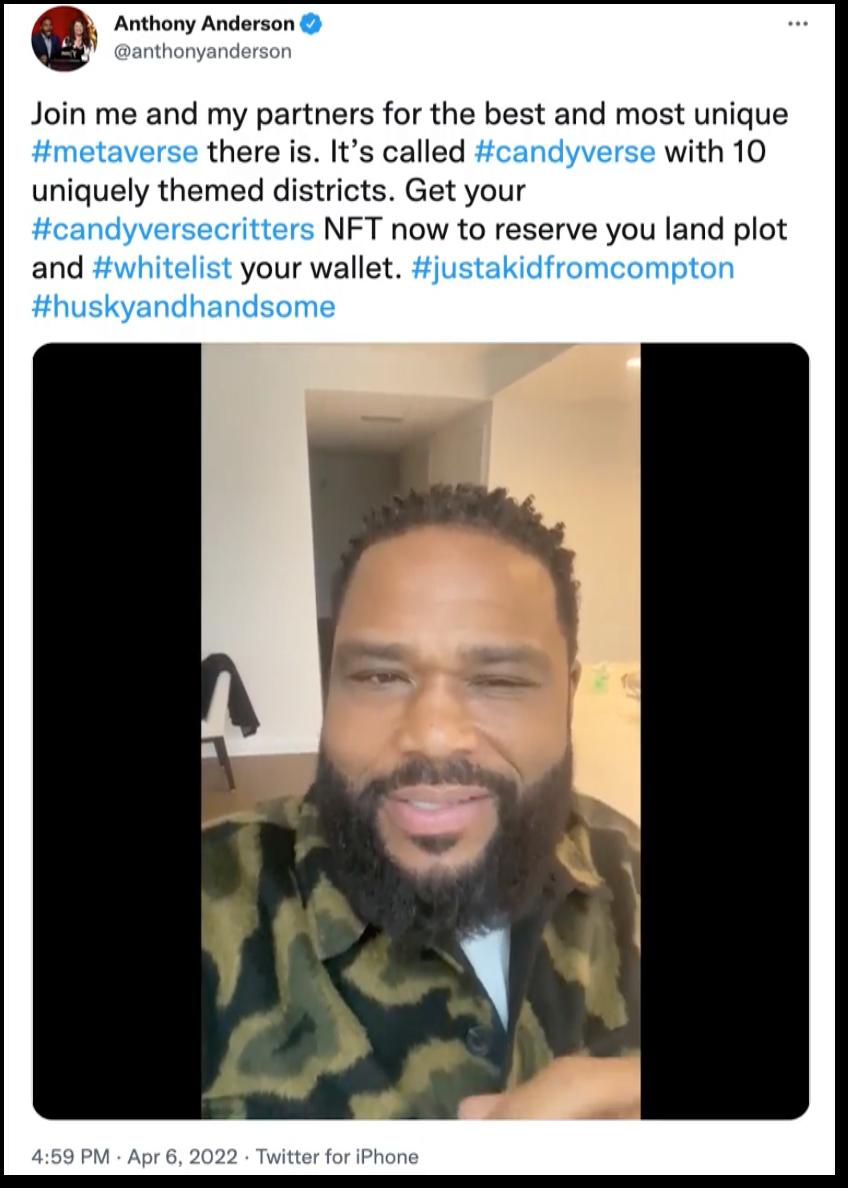
Anthony Anderson endorsing Candyverse.
However, Anderson did not post any further information about the Candyverse project afterward, and the project did not proceed with the planned construction of the 10 themed areas. Nevertheless, the project's official website continued to claim that consumers could earn "passive income," encouraging consumers to purchase NFTs at a price of 0.09 ETH (approximately $170).
Aside from Anderson, the project's founders and team remained anonymous, leading to increasing concerns among investors about the project potentially being a scam. The project's official Twitter account later began to downplay Anderson's role in the project. On May 17, the account tweeted that Anderson "is not involved in the project's daily operations," and that he was merely a passive marketer, stating, "It's not his fault." After that, the official Twitter account of Candyverse ceased all updates.
Candyverse had already been labeled as a Rug Pull scam by some NFT enthusiasts (where a crypto project team inflates the token price after creating a token project, withdraws funds, and then runs away when the price drops to zero). After the project stopped updating, the Twitter KOL Rug Pull Finder, which specializes in warning about risks in the NFT space, directly criticized Anthony Anderson, stating, "You should learn how to conduct proper due diligence instead of aimlessly promoting NFT projects to your fans for compensation."
Anderson did not respond to the online accusations. Many investors told TINA that they increased their investments after Anderson promoted the project, with some investors claiming that hundreds lost money in the project, stating, "Even with investment experience, I was deceived."
The phenomenon of celebrity endorsements for NFTs is not unique to overseas markets; some stars in the Chinese entertainment industry are also keen on purchasing or promoting NFTs, with some even collaborating directly with certain NFTs. Jay Chou has promoted the Phanta Bear NFT, which investors once referred to as "Jay Chou Bear," while Wilber Pan has endorsed the NFT project Innocent Cats.
However, as NFT sales plummeted from $12.6 billion in January to around $1 billion in June this year, the NFTs endorsed by celebrities could not withstand the downturn. "Jay Chou Bear" dropped from an initial 8 ETH to as low as 0.3 ETH, a decline of over 95%; while the floor price of Innocent Cats has fallen from 0.43 ETH in January to the current 0.0099 ETH, a decline of over 97%.
Similarly, some Chinese stars rarely disclose their substantial connections and economic interests with projects when endorsing NFTs, and they do not clearly indicate this as advertising during promotions.
In the overall winter of the crypto market, the once-bustling NFT market is also cooling down, and the NFTs endorsed by top celebrities ultimately leave behind a mess. As the consumer rights protection mechanisms for related NFTs have yet to be established, consumers who purchase NFTs based on celebrity endorsements can only know the ups and downs of their investments.
 Risk warning
 Risk warning

Popular articles





