








1confirmation Partners: Purists and Tourists in Crypto

 Understanding the spirit of openness, purism, and tourism psychology is the best way to reduce costs.
Original Title: 《Purists and Tourists in Crypto》
Author: Nick Tomaino, Co-founder of 1confirmation
Compiled by: Overnight Porridge, The Way of DeFi
In 2009, Satoshi Nakamoto released the Bitcoin white paper and open-source code, and since then, the Crypto industry has maintained an open spirit. From the very beginning, anyone could copy the code, change the marketing approach, and launch their "own" tokens and networks. Thousands of tokens and networks followed, some of which continue to have their own imitators.
The open spirit of Crypto is contrary to traditional business wisdom, which suggests that when you create a product that people find useful, you should protect it and prevent others from copying and competing. The open spirit prioritizes collective progress over the short-term profits of any one group—by allowing anyone to easily copy and build products, you can cultivate the wisdom and creativity of the entire world, theoretically leading to greater progress. This open spirit works well, and I believe that without it, Crypto would not make sense in today's world—though it comes at a cost.
The benefit of the open spirit is that anyone can improve upon existing products, bringing more utility to the world. The cost of the open spirit is that anyone can simply copy products, combining narratives with marketing strategies, extracting profits from people while contributing nothing to progress.
There is a viewpoint that imitators and value extractors contribute to long-term progress—even if unsuspecting retail investors are deceived by some shiny object in a broad imitation chain (Terra/Luna) or investment scams (3AC), perhaps it will raise awareness and the industry's long-term resilience anyway. But value extractors have clearly harmed many people (and the industry's perception), and I think it's important to explore whether the costs of the open spirit can be reduced.
Some believe that gatekeepers (regulators, trusted brands) are the best way to lower the costs of the open spirit. But this not only lowers costs but also stifles them. Gatekeepers hinder progress—this has been seen across various industries, including finance, before Bitcoin. I believe that understanding the open spirit, purism, and tourism mindsets is the best way to reduce costs, and the purpose of this article is to help anyone start thinking about this concept.
Purists and Tourists
Purists are those who are deeply knowledgeable about the history and nuances of craftsmanship—they appreciate the subtleties and consider all that has come before when building, bringing something truly new to the table. The products made by purists may be too niche for the mass market, but they are original and built with care.
Tourists are those who do not care about history or nuances; they just want to create a product that resonates with people. What they are building may resonate for a time, but tourists come and go easily. If a product becomes too touristy, it lacks long-term durability, and what was popular one day can disappear the next.
The psychological model of tourism and purism was articulated beautifully by fashion designer Virgil Abloh. His point is that the greatest impact in design comes from the intersection of purists and tourists. Based on this mindset, he created and led some of the world's most influential consumer brands, such as LV (Louis Vuitton) and Off-White. When I learned about his approach, I realized it was the same as the one I have used in the crypto space over the past decade.
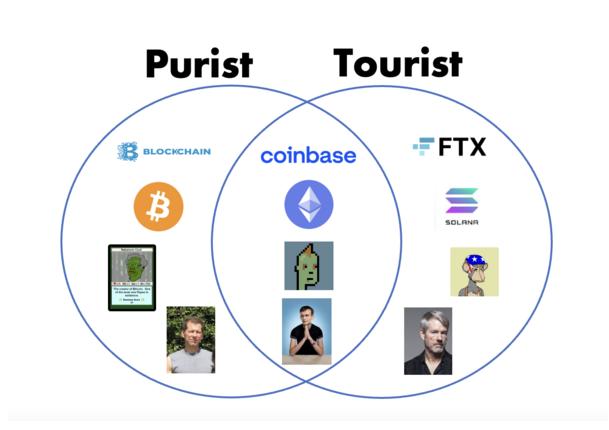
Here’s how I view purists, tourists, and the intersection of both from the perspective of crypto companies, cryptocurrencies, NFTs, and founders:
Purists:
Blockchain.com is an OG self-custody wallet company. The founders of the company believe that the true use of BTC lies in its ability to allow people to be their own banks and maintain censorship resistance. To this day, their core product remains true to this, demonstrating a profound understanding and appreciation of the industry. Although they have been trying to move beyond their niche user base, they failed to adapt when Ethereum emerged—proving that custodial wallets (Coinbase) offering simple buy/sell functionality and ETH self-custody wallets (Metamask) were the bigger ideas.
Bitcoin is an OG cryptocurrency. It birthed an industry and is the reason we are here today. It serves as a very effective immutable store of scarce value, but beyond that, it has not evolved much. BTC maximalists rightly point out many scams that followed BTC, but they also mistakenly label true innovations that have pushed the space forward as "scams," such as Ethereum.
Rare Pepe was created in 2016 as an NFT collection on Bitcoin, predating all NFTs on Ethereum. Rare Pepe NFTs were created on Counterparty, a Bitcoin-based protocol, but for many reasons, including a lack of interoperability with BTC wallets, it never moved beyond a niche user base. Rare Pepe still has a strong brand and collector base among crypto natives, but in terms of attention, it has been surpassed by Ethereum-based NFT series like Cryptopunks and BAYC.
Hal Finney was an early Bitcoin user and received the first Bitcoin transaction from Satoshi Nakamoto on January 12, 2009. He was also a core engineer at PGP Corporation, one of the most important cryptography companies before the emergence of cryptocurrency, and arguably one of the most significant early contributors to the cypherpunks listserv and BitcoinTalk forum. His work was crucial for the industry we have today, but only a small portion of users in the industry have heard of him.
Tourists:
FTX was an exchange founded in 2019. The company did not provide anything new or additional to the industry, but they aggressively marketed and captured market share during the 2020-2021 bull market. Given that the team behind the exchange also operated a trading firm called Alameda Research and traded many tokens on its platform, few questioned this, leading to a questionable history. Currently, there seems to be a strong media narrative behind the company.
Solana was launched in 2019 as an "Ethereum killer," positioning itself as a "blockchain built for mass adoption." The project did not propose any original ideas, but they made some design trade-offs that made it cheaper and faster than Ethereum in the short term. I believe these design trade-offs allowed Solana to succeed during the bull market with retail capital inflow, but ultimately this will hinder its long-term success. When a blockchain is purely about efficiency optimization, lacking anything interesting culturally or communally, and genuinely lacks new products that push the space forward, the upside potential is limited.
Bored Apes (BAYC) is a PFP project launched in 2021. It emerged after thousands of other PFP projects but managed to gain early grassroots adoption and then received significant support from celebrities like Justin Bieber, Jimmy Fallon, and Stephen Curry.
Michael Saylor emerged during the 2021 bull market to promote Bitcoin. He did not build anything interesting in the crypto space, nor did he have any interesting theories about crypto—he simply mimicked what the Bitcoin community had been saying for over a decade. However, his company MicroStrategy gained attention for purchasing BTC, and he has since become a media personality.
Between Purists and Tourists:
Coinbase is an exchange founded in 2012. It was the first product that allowed users to easily link bank accounts and purchase BTC, and it has been at the forefront of making crypto accessible to the masses for nearly a decade. The company decided early on to custody cryptocurrency on behalf of users, which added some centralization that some purists dislike, but undeniably, the product has been very important in onboarding newcomers to crypto.
Ethereum was launched in 2015, six years after BTC. Without Ethereum, we would not have the concepts of decentralized finance or NFTs. Ethereum made some sacrifices in decentralization compared to Bitcoin, but it is undeniable that most of the industry's innovation over the past seven years has come from the Ethereum blockchain and the developer ecosystem that has emerged on top of it.
Cryptopunks is an OG 10K PFP series that helped catalyze today's NFT-led creative empowerment revolution.
Vitalik Buterin is the founder of Ethereum, an inclusive founder who has led the blockchain ecosystem in pushing the industry forward in the public eye, embodying all the qualities you would hope to see from a crypto leader.
I am not saying that my views on purists, tourists, and the intersection are something everyone should believe. I know many will question my perspective and claim their investment positions are at the crossroads. The fact is that most public discussions about crypto revolve around the positions people hold. But I believe that thinking about this concept and drawing your own conclusions can greatly help you build and invest in a noisy industry, and the goal here is simply to encourage more people to think about this concept.
 Risk warning
 Risk warning

Popular articles





