








Blur's trading volume surges, and the NFT market welcomes a new game changer
 The emergence of Blur has broken the long-standing monopoly of OpenSea in the NFT market, bringing the NFT market into a new round of competition. When the market is large enough, healthy competition will create a positive cycle for the entire ecosystem to promote development.
Author: Daniel Li, CoinVoice
As a rising star in the NFT trading market, Blur has quickly become a major trading venue since its launch in October last year. According to Dune Analytics, Blur's total trading volume has surpassed 750,000 ETH, with nearly 1.6 million transactions. With Blur announcing the release of its token on February 14 and the start of its third airdrop, competition between Blur and the leading NFT project OpenSea is intensifying.
Blur's Strong Rise, Surpassing OpenSea?
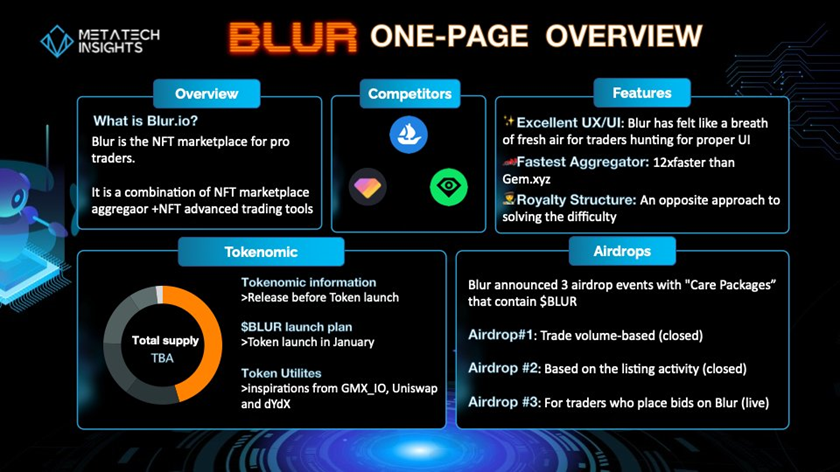
Blur is an NFT marketplace and aggregator designed for professional traders, featuring many innovative functions. Its team consists of developers from renowned institutions such as MIT, Citadel, Five Rings Capital, Twitch, Brex, Square, and Y Combinator. Blur aims to provide traders with better features and faster transaction speeds than existing platforms. Officially launched on October 19, 2022, Blur's trading volume exceeded that of GEM within just three days, making it the highest-volume NFT aggregator, leading to it being referred to as the younger version of OpenSea + GEM.
OpenSea is a platform that integrates minting, buying, selling, and viewing NFTs, founded by Devin Finzer and Alex Atallah in December 2017. It is often referred to as the "eBay of crypto assets" or the "Web3 Amazon." When it first launched, OpenSea was a startup with only five employees and fewer than 3,000 active users. Now, OpenSea has over 2.3 million active users. OpenSea has long been the leading project in the NFT space, monopolizing over 80% of the NFT market share until the emergence of Blur, which quickly captured a significant portion of the NFT market share and challenged OpenSea's leading position.
According to the latest data from Dune Analytics, since February, Blur's NFT trading volume has consistently exceeded that of OpenSea. Compared to OpenSea's 36%, Blur holds a 46% market share weekly. In the week ending February 6, Blur's NFT trading volume exceeded 9,200 ETH, valued at approximately $15.2 million, while OpenSea only reached $11.3 million. In terms of 24-hour sales, Blur captured 33% of the market share, while OpenSea accounted for 28%. From the data alone, it seems that Blur has surpassed OpenSea to become the leader in the NFT market, but the reality may not be so straightforward.
In addition to being an NFT trading market, Blur is also the largest NFT aggregator globally, holding over 70% of the market share in this field. The Blur aggregator consolidates listings from leading markets such as OpenSea, LooksRare, and X2Y2, allowing users to trade NFTs across multiple platforms through a single portal (including its own portal). These trading data are counted in Blur's market share. In contrast, all NFT transactions on OpenSea are completed within OpenSea itself. The trading volume on Blur has a significant amount of inflated data, and in the past month, due to expectations of airdrops and the upcoming token release, there has been a notable phenomenon of volume manipulation on the Blur platform. Overall, while Blur is impressive, it may still be too early to say that it has surpassed OpenSea.
OpenSea's Blockade and Blur's Breakthrough
Blur's ability to gain substantial traffic in a short time is not only due to airdrops but also related to its implementation of ultra-low or even zero royalties. The royalties for NFTs on Blur are set by the traders themselves, meaning that if traders do not pay royalties, original creators do not earn any income from secondary sales. This practice has sparked significant controversy in the NFT market. Although Blur has stated that it will encourage traders to respect copyrights through airdrops in the future, it has yet to disclose specific royalty incentive formulas.
Due to the royalty issue, Blur faced a blockade from OpenSea. In November 2022, OpenSea implemented a new policy: NFT projects seeking mandatory royalties must blacklist markets that do not respect them, including Blur. The strong rise of Blur has made OpenSea uneasy, prompting it to establish a defensive line through new policies to protect its dominant position against emerging competitors like Blur. The OpenSea team developed a tool that enforces fees, meaning that NFT collectibles that choose to fully utilize fees cannot be traded on Blur at all. This move not only garnered support from NFT creators but also deprived its main competitor, Blur, of NFT collections. In the short term, this policy proved effective, as new NFT series like Yuga Labs' Sewer Pass chose to ally with OpenSea and blacklist Blur.
Shortly after the blacklist policy was implemented, Blur quickly identified a loophole: Seaport. Seaport is a decentralized web3 market protocol developed by OpenSea, which is open-source and permissionless, allowing anyone to use it for free. Blur utilized Seaport to create a new NFT trading system. Since Seaport is not on OpenSea's blacklist, Blur's new NFT trading system can bypass the blacklist restrictions, allowing NFT projects that previously blacklisted Blur to trade through Blur's new system while enforcing royalties. OpenSea, however, is powerless against this, as it also relies on the Seaport protocol. If OpenSea were to blacklist Seaport, it would mean restricting itself as well. In this battle of blacklists, Blur achieved a temporary victory. With Blur's strong rise, competition with OpenSea is bound to become more intense, and this blacklist incident may just be the beginning.
Carefully Calculated Blur Airdrop
Airdrops are a common method for crypto projects to attract new users, especially in the highly competitive NFT market, where airdrops have become a necessary strategy to gain significant attention and attract a large number of users in a short time. However, compared to previous NFT market airdrops, Blur's airdrop has notable differences, incorporating new rules that maximize benefits for Blur.
1. Multiple Rounds of Airdrops with Extended Duration
The Blur airdrop has been ongoing for nearly six months since the project's official launch and is still not over. The third round of airdrops will be released on February 14 alongside the Blur token. Such a long-lasting airdrop is rare in the NFT market. The continuous airdrop has attracted a large amount of traffic and user attention to the platform, enabling Blur to surpass OpenSea in trading volume in a short time, with the ongoing airdrop playing a significant role.
2. Scale Addition Increases User Attraction
In addition to the frequency and duration of airdrops, another characteristic of Blur's airdrop is that each round is larger than the last. The first airdrop started in October, requiring users to list an NFT on the Blur platform within 14 days to participate. The second airdrop launched on December 5, targeting all participants actively listing and trading on its platform, with a scale ten times that of the first. The third airdrop will start on February 14, with Blur officials stating that it will be the last and largest airdrop. The cumulative scale of each airdrop has raised user expectations while maintaining attraction for new users, resulting in each Blur airdrop quickly drawing in a large number of new users.
3. Introduction of Loyalty Data Increases User Stickiness
While airdrops can attract a large number of users in the short term, a significant drawback is that once the airdrop ends, user attrition may occur. Blur recognized this when formulating airdrop rules and introduced a new data element: loyalty. The loyalty score is related to the user's actual trading volume; if users engage in volume manipulation or fake trading, their loyalty score will decrease.
In Blur's three rounds of airdrops, loyalty has been one of the requirements mentioned each time. Loyalty does not affect the number of care packages users can receive in the airdrop but directly influences the luck of users when opening packages. The higher the loyalty, the greater the probability of opening higher-tier attribute packages, which are categorized as rare, uncommon, legendary, and mythical. In other words, the higher the loyalty, the greater the chance of receiving more BLUR tokens. The introduction of loyalty reduces malicious volume manipulation by users and, on the other hand, increases the platform's stickiness to users by encouraging multiple transactions, positively impacting user retention.
4. Targeted Goals for Each Airdrop Round
Looking at the three rounds of airdrops, it is evident that the Blur team has systematically approached airdrop operations, with each round targeting specific user groups. The first round rewarded NFT users who remained active during market downturns, attracting more people to use Blur for the first time. The second round incentivized sellers while encouraging users to utilize tools like tiered listings and one-click listings introduced by Blur. The third round incentivizes buyers. This multi-faceted approach enhances liquidity on the Blur platform and allows users to fully experience all of Blur's products.
Blur's Excellent Performance is Key to User Retention
The outstanding performance of the Blur platform, undoubtedly bolstered by its carefully calculated airdrops, is what truly retains users. The Blur platform is simple and intuitive, enhancing the infrastructure for NFTs and improving the experience of professional traders in the NFT market. Additionally, its operating speed is ten times faster than other NFT markets, allowing users to quickly capture scarce NFT resources. Furthermore, the zero-fee structure and customizable royalties firmly meet the current market demands. Blur has also been dubbed the "best NFT monitoring tool" due to its professionalism and convenience.
Rich Data Analysis Tools
In terms of data, Blur is more user-friendly for professional traders. OpenSea requires constant window switching to view different data, while Blur does not. In the default settings, NFTs are listed in order of daily trading volume, displaying key data such as floor price, number of NFTs owned, and various price and trading volume metrics. It can also track the rarity of all NFTs, estimated collectible value, and even generate rough profit and loss statements.
Moreover, for users looking to buy at the bottom, Blur provides corresponding tools. All NFT series have a floor price depth analysis chart that shows how many NFTs are listed above different floor prices. Combined with other data provided by the platform, users can more intuitively assess whether the current price level is suitable for entry.
Ten Times Faster Transaction Speed than GEM
In terms of speed, Blur is ten times faster than GEM, capable of listing all pending transactions' NFTs in less than a second and automatically updating the list every four seconds. This rapid display and real-time data updates provide significant advantages for Blur users looking to snipe NFTs, as the probability of securing rare and highly collectible NFTs on Blur is usually higher than on other platforms.
Additionally, Blur's gas priority settings help users gain an edge over competitors purchasing NFTs through other exchanges or aggregators. Most importantly, Blur's contracts are more optimized than those of other markets, saving users up to 17% on gas fees.
Comprehensive Incentive Measures
Unlike many other NFT markets that charge transaction commissions, Blur maintains a 0% NFT trading fee rate, which is a significant attraction for users. Furthermore, Blur's airdrop program has quickly garnered a strong social following. Currently, Blur has launched two rounds of airdrops, incentivizing more users to join, with the third round set to begin on February 14, coinciding with the release of the Blur token.
Conclusion
The emergence of Blur has disrupted the long-standing monopoly of OpenSea in the NFT market, ushering in a new round of competition. When the market is large enough, healthy competition can bring about a positive cycle that promotes development within the entire ecosystem. As a game-changer in the NFT space, Blur presents a more diversified NFT market. Its specialized trading interface and the combination of marketplace + aggregator also provide insights and directions for future entrants in the NFT market. Overall, Blur is a highly promising new NFT platform, and its future is worth looking forward to.
 Risk warning
 Risk warning

Popular articles





