








FVM is about to launch! Read this article to understand the latest status report from the Filecoin Foundation

 If the Filecoin virtual machine is successfully launched, it will be able to drive the next generation of applications beyond storage use cases. Some important examples include perpetual storage (similar to Arweave), low collateral loans issued to storage providers, and decentralized computing.
Author: Protocol Services, Filecoin Foundation
Key Information
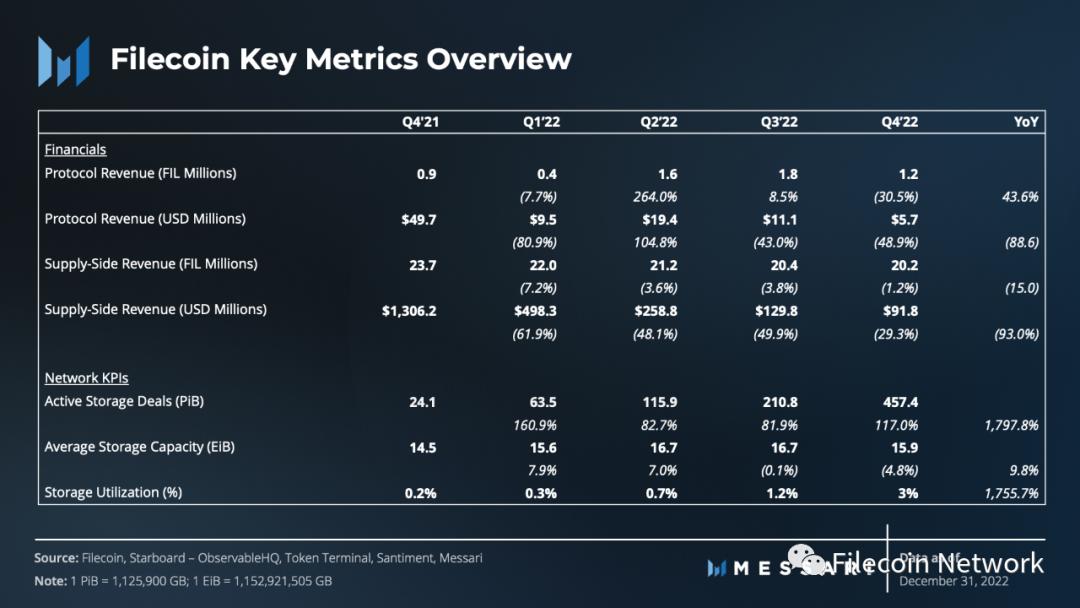
- The Filecoin storage market continued to grow in Q4 2022, with active storage deal proposals increasing by 117% compared to the previous quarter and by 1,798% year-over-year.
- Although storage capacity decreased by 5% from its peak, the data utilization rate grew 18 times faster than the growth rate of storage capacity compared to the same period last year.
- FIL fee revenue decreased by 31% in Q4 2022 (a 49% decrease in USD terms), primarily due to a 60% reduction in base fees compared to the previous quarter, despite a 10% increase in active storage deal proposals.
- The FIL reward issuance used a hybrid exponential decay model, resulting in a 1% decrease in network-distributed rewards in Q4 2022 (a 29% decrease in USD terms).
- The number of projects built on the Filecoin, IPFS, and Protocol Labs networks grew to 600 in Q4 2022, a significant increase from 500 in Q3 2022.
Understanding Filecoin
Relying on centralized data storage has a serious problem: it is difficult to systematically verify the integrity of stored data. Today, the Filecoin network has become a peer-to-peer version of Amazon S3 cloud services. It is built on top of the InterPlanetary File System (IPFS), which serves as the distributed data storage and sharing layer for the Filecoin network. Filecoin regularly verifies the validity of data storage and uses storage deal proposals based on dynamic supply and demand pricing (rather than fixed pricing strategies).
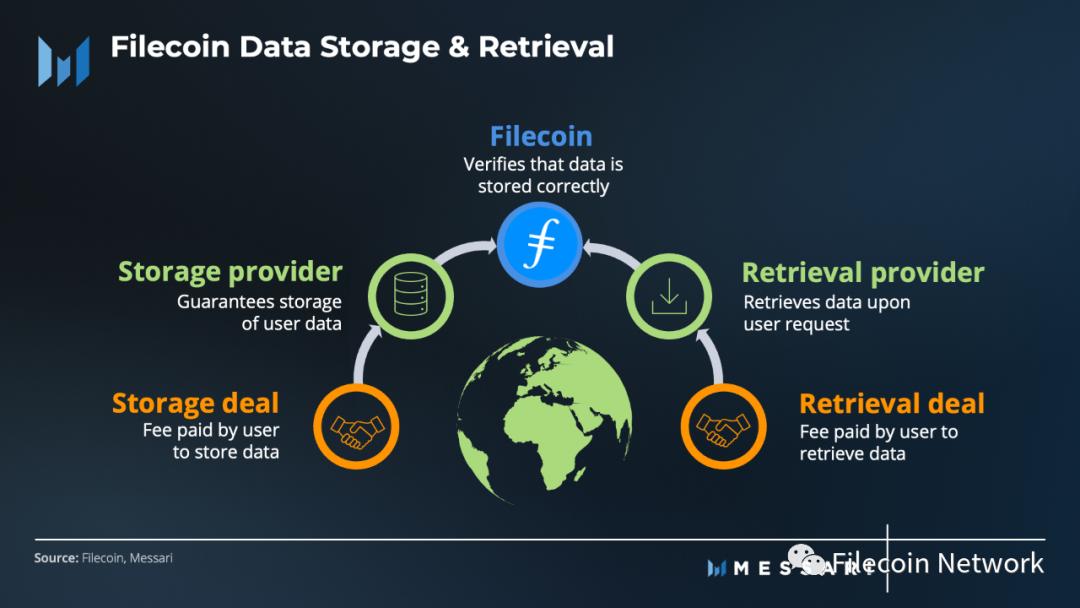
A storage deal proposal is like a contract with a service level guarantee—users pay storage providers to store data for a specific period. To ensure data security, Filecoin uses an incentive mechanism based on cryptoeconomics to regularly verify storage validity using zero-knowledge proof mechanisms. To incentivize storage providers to participate, Filecoin rewards them with the network's native token, FIL. If data cannot be retrieved or storage fails, storage providers will also be penalized.
To retrieve data, Filecoin users pay fees to retrieval service providers. Unlike storage deal proposals, retrieval deal proposals use payment channels to settle fees off-chain, enabling faster retrieval speeds.
Key Metrics
Performance Analysis
The Filecoin blockchain is utilized by demand-side users (such as storage users) and supply-side providers (such as storage providers). Both storage users and storage providers contribute to protocol revenue.
Revenue
Filecoin's revenue structure is similar to that of Ethereum, as its gas system is based on EIP-1559. This gas system consists of network fees that are burned as compensation for resource consumption.
Protocol Revenue
As shown in Messari's revenue data, Filecoin's protocol revenue is the sum of the following fees:
- Base fees—used for storage deal proposals or proofs. Base fees depend on the congestion level of messages.
- Batch fees—used to increase storage capacity.
- Excess fees—used to optimize gas usage.
- Penalty fees—charged when storage providers fail.
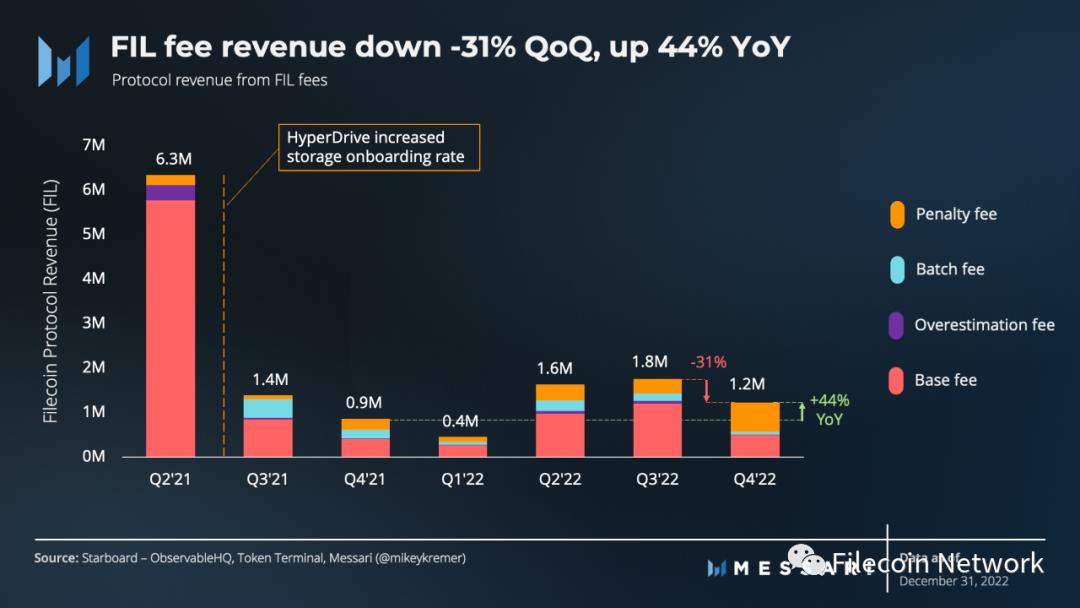
Protocol revenue decreased by 31% in Q4 2022, totaling 1.2 million FIL. Compared to the same period last year, it increased by 44% from 900,000 FIL in Q4 2021. Notably, there were two changes in the composition of fees collected in Q4 2022:
- Although active storage deal proposals increased by 10%, base fees decreased by 60% (according to the Filecoin key metrics overview).
- Penalty fees increased by 100%, reaching a new high, due to an increase in the number of days storage providers experienced sector offline conditions.
In Q4 2022, we continued to see relatively low FIL protocol revenue (compared to before the HyperDrive network upgrade in July 2021). By aggregating storage proofs, HyperDrive increased the rate of new storage by 10-25 times. While this upgrade benefited network participants (reducing congestion and freeing up block space), it also led to a decrease in overall transaction fees. Therefore, over the past four quarters, this upgrade has reduced protocol revenue.
The only fees that are not burned by the Filecoin protocol are the "tip" fees collected by block miners on the network supply side. Thus, "tip" fees can be seen as supply-side revenue. Filecoin's supply-side revenue includes token rewards paid to storage providers (which accounted for over 99.97% of supply-side revenue in Q4 2022), while "tips" fees constitute a small portion.
Supply-Side Revenue
Supply-side revenue includes block rewards distributed to supply-side participants by the network. The minting of new FIL relies on the following two factors:
- Exponential decay model: (30% of tokens): Block rewards are highest in the early stages to encourage participation and will exponentially decay later.
- Benchmark model: (70% of tokens): Block rewards increase with storage capacity.
The combination of these two models aims to avoid a decrease in participation after the early distribution of network rewards (exponential decay model) and to continuously reward the additional value brought to the network by new storage capacity (benchmark model).
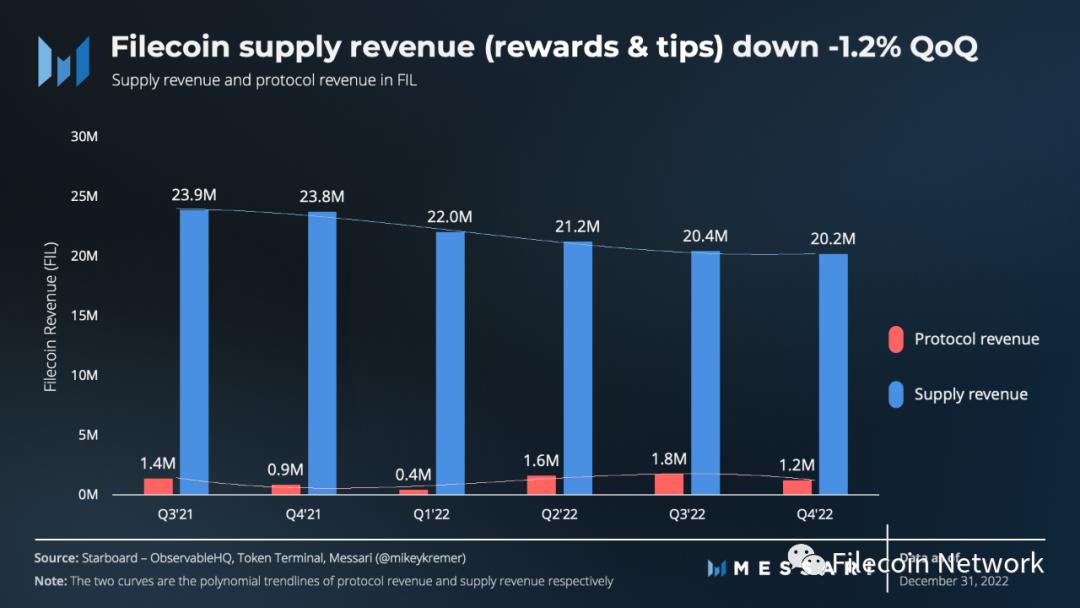
Supply-side revenue decreased by 1.2% in Q4 2022, totaling 20 million FIL, primarily due to a reduction in the overall reward rate of the network. Although Q4 2022 achieved benchmark growth targets, the overall FIL minting rate declined significantly due to the aforementioned exponential decay model. Notably, since Q4 2021, the growth rate of invested storage capacity has declined (according to the Filecoin key metrics overview), and so has supply-side revenue.
Utilization Rate
The amount of data achieved through active storage deal proposals between storage providers and storage users can measure the demand for Filecoin's services. Storage deal proposals from both Web2 and Web3 sectors have brought demand to Filecoin.
Storage Deal Proposals
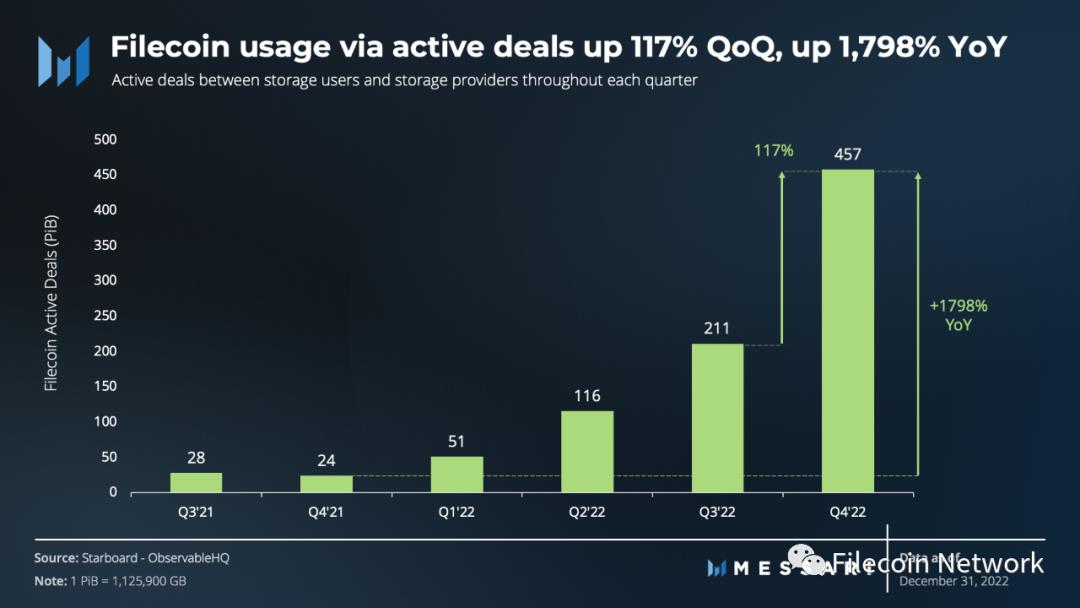
Almost zero storage fees may further promote the volume of data stored. At the end of Q4 2022, over 231 PiBs of data were stored on Filecoin through active storage deal proposals—an increase of 10% from the previous quarter. This positive growth trend has continued since Q4 2021, with active storage deal proposals increasing by 850% year-over-year.
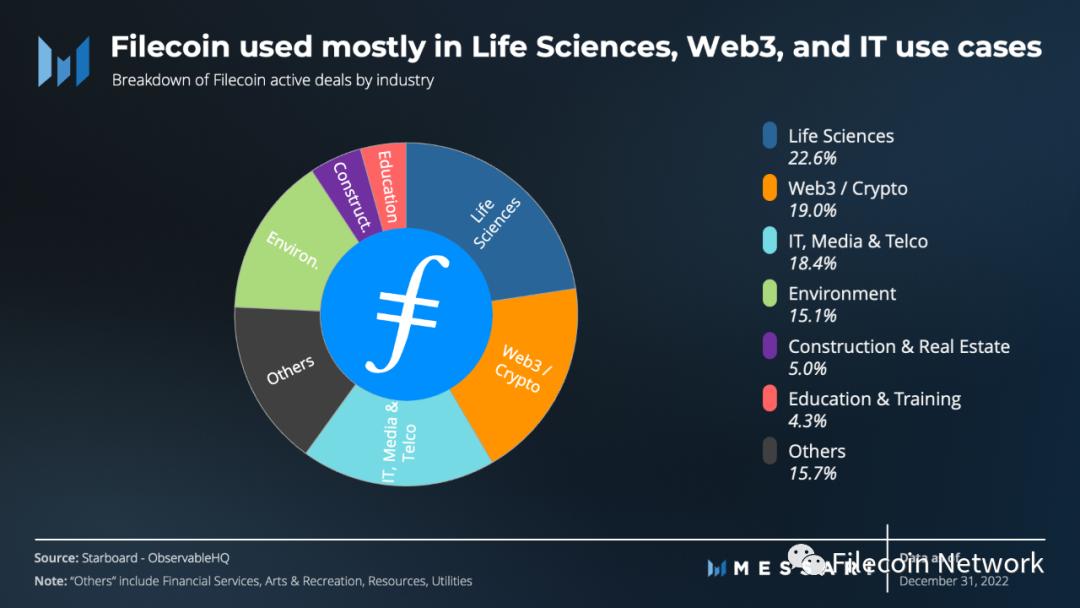
Breaking down the use case types of these storage deal proposals, we find that the following industries utilize Filecoin the most:
- Life Sciences (23%)
- Web3 / Crypto (19%)
- IT (18%)
To encourage these storage deal proposals to use real data and prevent cheating to obtain network rewards, Filecoin Plus (Fil+) was introduced. When participating in verified storage deals, Fil+ increases rewards for storage providers—i.e., increases their chances of obtaining block rewards. This allows storage providers to compete by lowering fees. As a result, in Q4 2022, the network's storage prices dropped to nearly zero.
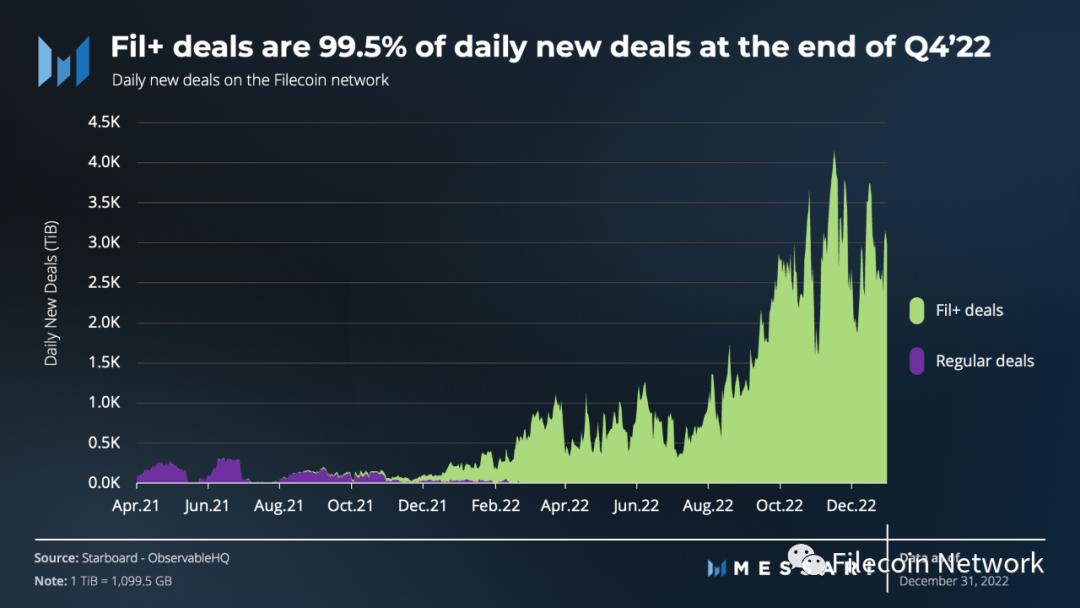
Since Q4 2021, the network has transitioned from regular storage deal proposals (unverified datasets) to primarily Fil+ storage deal proposals (verified datasets). This transition corresponds to the ongoing increase in Fil+ storage deal proposals, which accounted for 99.5% of new storage deal proposals in Q4 2022. This transition, combined with the increase in storage deals, indicates that the Fil+ incentive mechanism and introduction plan are effectively driving data utilization rates.
Users
According to Messari's recent guide on decentralized storage networks, Filecoin's main direction is to provide cold storage solutions for enterprises and developers. As Web2 users seek cost-effective solutions for large data archiving, its competitive pricing mechanism and ease of use make it a viable alternative.
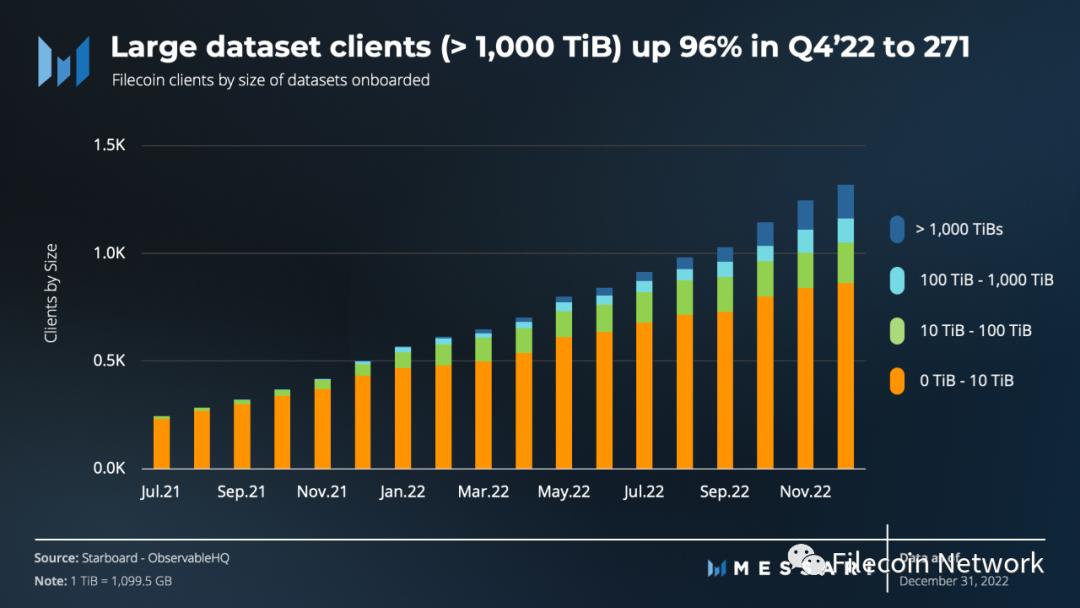
At the end of Q4 2022, a total of 1,320 users stored datasets on Filecoin, of which 271 stored large datasets (such as those exceeding 1,000 TiB), an increase of 96% from 138 users in Q3 2022. Filecoin's users include the City of New York and the USC Shoah Foundation, as well as Web3 platforms like OpenSea. Additionally, several notable projects are also storing data on the Filecoin network.
Utilization Rate vs. Capacity
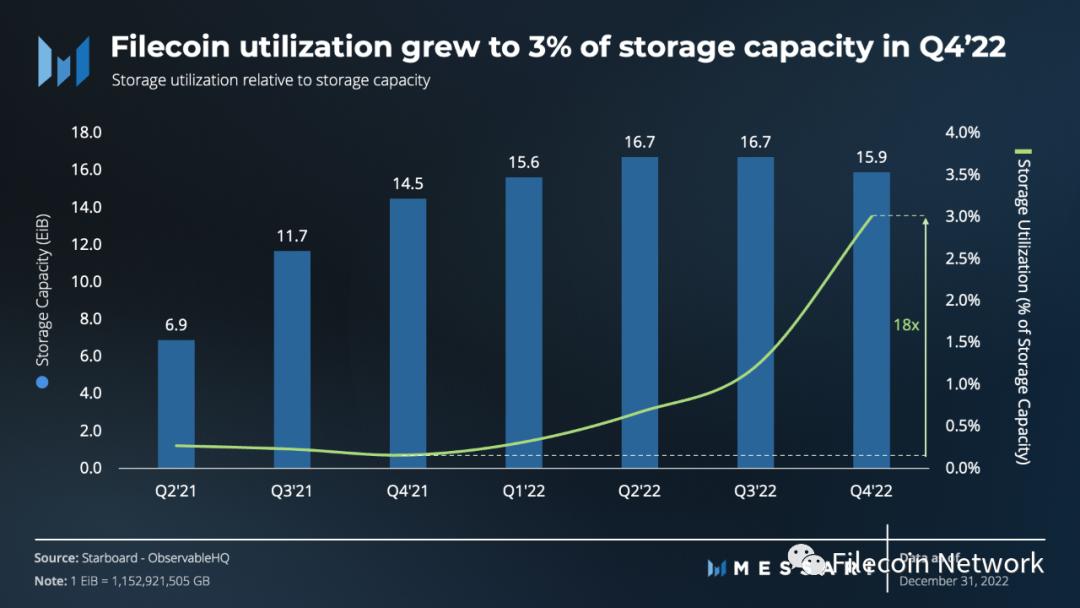
Although the overall market condition is declining, the storage capacity invested in the Filecoin network has grown to 16.7 EiB over the past five quarters. This is partly due to the increase in new storage providers. The number of Filecoin storage providers surged by 300%, reaching a total of 3,030, corresponding to the rapid growth of network capacity. However, in Q4 2022, the network's storage capacity began to decline from its peak in Q2 2022 and stabilized starting in Q3 2022.
Meanwhile, over the past three quarters, the network's storage utilization rate steadily increased to 3% in Q4 2022, compared to only 0.2% in Q4 2021, showing significant improvement. This means that while its starting point was low, the network's utilization rate grew 18 times faster than the growth rate of capacity last year.
With the customer acquisition support of the Fil+ program and the introduction of valuable datasets, it may play a foundational role in future data monetization use cases. This means that Filecoin's strategy is to introduce data at almost zero cost to profit in the future through data retrieval or computation.
Fil+ is beneficial for the growth of both supply and demand for storage resources, and additional coordinated actions are nurturing new businesses and use cases on Filecoin.
Retrieval
IPFS gateway requests can serve as proxies for Filecoin retrieval services, as most Filecoin developer storage tools can serve the entire IPFS network.
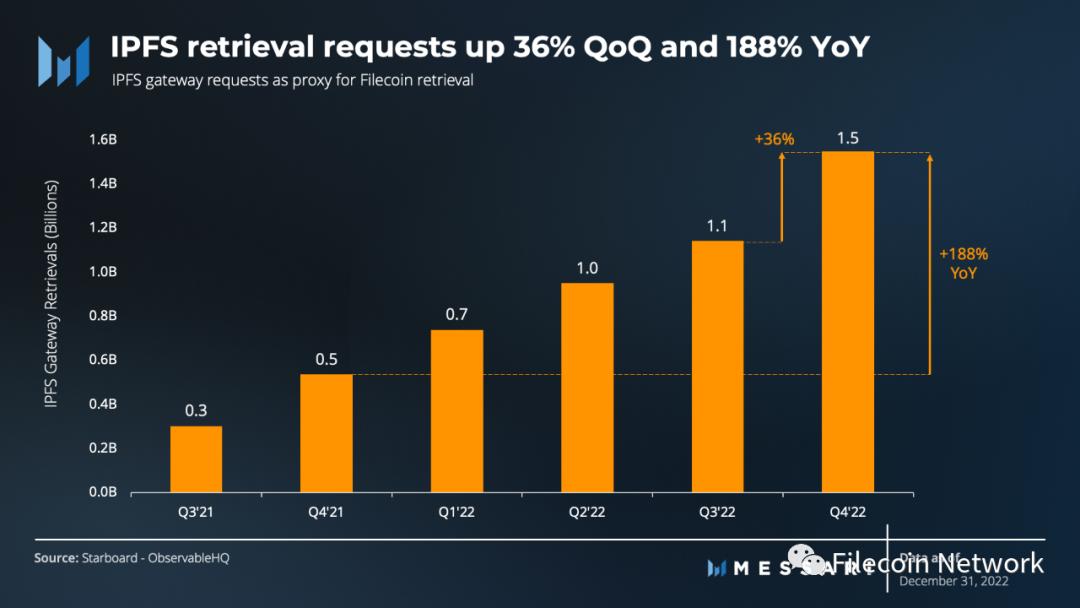
Compared to Q3 2022, the number of retrieval requests increased by 36% in Q4 2022. Compared to the same period last year, retrieval requests increased by 188%. This growth trend is reasonable, as the usage of popular storage developer tools (such as NFT.storage and Web3.storage, which rely on IPFS for storage and retrieval) has increased. As the retrieval market continues to develop, there will be new metrics to track this data beyond the IPFS gateway.
Ecosystem Overview
The Filecoin ecosystem has been building a community of developers and builders through hackathons, accelerators, sponsorships, mentorship programs, and growth support. This community aims to help early projects and teams grow until they can secure funding and investment support. Relevant funding comes from Protocol Labs or affiliated entities.
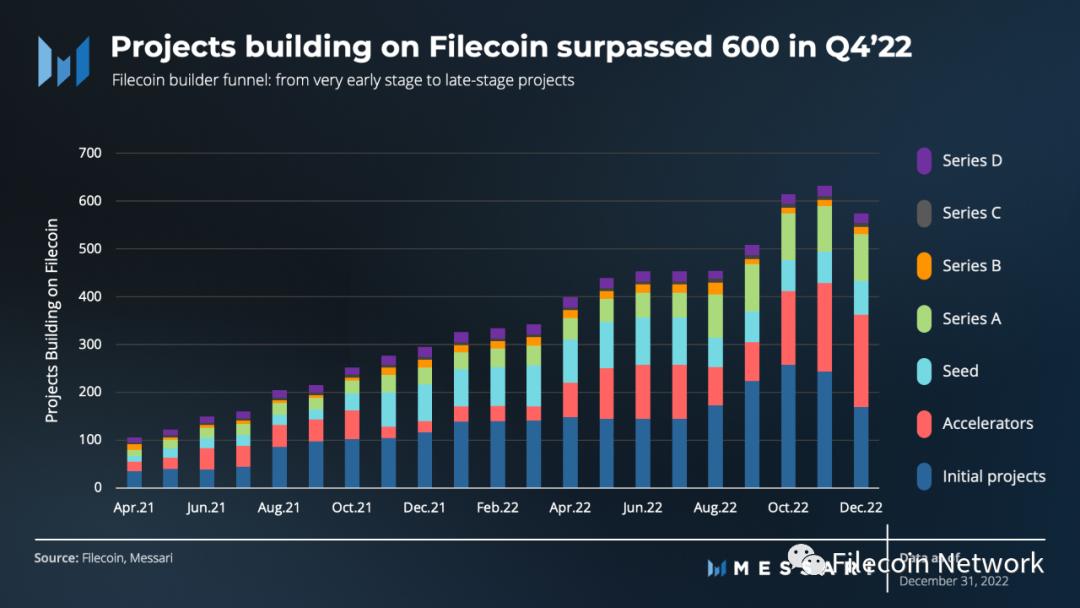
Currently, there are over 600 projects built on the Filecoin, IPFS, and Protocol Labs network ecosystem, a significant increase from 500 projects in Q3 2022. These projects utilize IPFS, Filecoin, and libp2p protocols (or services built on these protocols). A significant portion of this growth comes from accelerators, which increased from 82 in Q3 2022 to 194. Additionally, projects like NFT.Storage and Web3.Storage support other projects' attempts to utilize Filecoin/IPFS.
This ecosystem is interconnected and is attracting a wide range of use cases: such as data infrastructure, streaming, metaverse, and gaming. Most applications and protocols utilizing Filecoin primarily focus on data services:
- Ocean Protocol: Developer tools and platforms for data markets
- Lighthouse: Perpetual data storage service with a one-time payment pricing model
- Slate: Search engine for processing and sharing personal data
- Berty: Secure messaging and social media application
- Dether: Entry and exit of funds and various financial transactions
Another significant category is media and entertainment, with examples including:
- MoNA: 3D art gallery in the metaverse.
- NFTwitch: NFT minting platform designed for Twitch.
- Huddle01: Decentralized video conferencing
- Curio: NFT marketplace for serving intellectual property interests for entertainment brands
- OPGames: NFT minting mechanism designed for gaming.
- By introducing the Filecoin Virtual Machine (FVM), Filecoin aims to achieve external integration of smart contract applications. The ability to build native applications on Filecoin and integrate externally has the potential to expand network activity and application ecology.
Product Update Information
Saturn
Saturn (https://strn.network/#whatissaturn) is a fully decentralized content retrieval and distribution network designed for Filecoin, aimed at accelerating the efficiency of network content distribution. Saturn also hopes to enhance Filecoin's appeal to Web3 developers—this is achieved by lowering the operational costs of Filecoin nodes and accelerating decentralized data retrieval (https://www.theblock.co/post/180450/filecoin-releases-new-content-delivery-network-called-saturn). Saturn's long-term goal is to occupy a significant share of the information retrieval market for applications, thereby facilitating the long-awaited "Web3 killer app" (https://petkanics.medium.com/web3s-missing-killer-social-media-app-609292b3e882).
V17 Shark Upgrade
The v17 Shark upgrade (https://filecoin.io/blog/posts/filecoin-network-v17-shark-upgrade/) conducted by Filecoin in November 2022 included improvements in smart contract programmability for Fil+ storage deal proposals. This upgrade has been under research since March 2022, aiming to bring programmable storage capabilities. Its goal is to enhance the integration between on-chain smart contracts and off-chain data providers. However, since on-chain verification will increase gas consumption, the costs of on-chain storage deal proposals are expected to rise somewhat.
Enterprise-Level Partnerships
CME Incorporates Filecoin into Price Index
The CME began publishing FIL reference rates and price benchmarks in October 2022. While this does not directly lead to FIL-backed tradable futures contracts, it may increase Filecoin's visibility in traditional financial markets. It could also provide Filecoin with better financing and collaboration opportunities, strengthening its roadmap planning and achieving more effective collaboration.
Protocol Labs Collaborates with EY and Seagate
Protocol Labs, the founding organization of Filecoin, has partnered with EY and Seagate to support enterprise-level decentralized data storage solutions. If this collaboration succeeds and attracts institutions to use decentralized data storage, Filecoin could play an important role in the enterprise-level data (https://www.businesswire.com/news/home/20221031005042/en/Decentralized-Storage-Alliance-Launches-to-Bridge-Chasm-Between-Web2-and-Web3) storage and security sector.
Important Events
ETHBogota & ETHIndia
Filecoin and IPFS sponsored the ETHBogota (https://bogota.ethglobal.com/) event in October 2022 and the ETHIndia (https://ethindia.co/) event in early December (both based on Ethereum). Together, Filecoin and IPFS provided $20,000 in prizes for the ETHIndia event, which had a total prize pool of $350,000. For the ETHBogota event, which had a total prize pool of $500,000, they also provided $20,000 in prizes.
Sustainable Blockchain Summit
Filecoin Green (https://filecoin.energy/methodology) is a branch of Filecoin focused on improving data transparency in the energy sector. It participated in the Sustainable Blockchain Summit (https://sbs.tech/) held in October 2022. Several Filecoin energy experts delivered keynote speeches, including:
- Fundamental components of a renewable economy (https://www.youtube.com/watch?v=PcstT12G7MQ&list=PL_0VrY55uV1-mrfuGiZK4-rNTcYxURA5J&index=5)
- Unlocking interoperability in carbon markets (https://www.youtube.com/watch?v=YH9Vkuv8s20&list=PL_0VrY55uV1-mrfuGiZK4-rNTcYxURA5J&index=9)
FIL Lisbon
Filecoin held the FIL Lisbon (https://fil-lisbon.io/) event in November 2022, gathering over 65 speakers, including developers, storage providers, ecosystem participants, and users. The conference featured workshops, hackathons, learning sessions (such as IPFS Camp: https://2022.ipfs.camp/), off-site summits, and social events. One of the highlights of the event was a speech focusing on the value of data security and transparency.
FEVM Virtual Machine Hackathon
This hackathon (https://ethglobal.com/events/hackfevm) was held in December 2022, aiming to leverage Filecoin's infrastructure to drive specific and unique data needs, such as:
- Koios (https://ethglobal.com/showcase/koios-adm6x): No-code data DAO platform
- ZKsig NFTs (https://ethglobal.com/showcase/zksig-nfts-j597n): Access control mechanism for the market
- DataMarket (https://ethglobal.com/showcase/datamarket-instant-data-purchase-pages-zz5z0): Data purchasing and settlement functionality
Roadmap
2022 Review
In 2022, Filecoin launched a series of updates to enhance the network's storage capabilities. These additional capabilities made data retrieval easier, thereby bringing more real-world use cases to its core products. Even though some features have not yet been integrated into the main chain, these updates in 2022 laid the groundwork for the interaction between smart contracts and Filecoin's data capabilities.
2023 Outlook
Building on the transition from 2022 to 2023, Filecoin continues to improve its minimum viable product (MVP) for data computation. The first step in bringing the FVM virtual machine to Filecoin in Q1 2023 is to integrate EVM compatibility (https://messari.io/intel/event/fe4ff679-c281-4c54-a40a-f88611f3d593). Other improvements include L2 capabilities, hierarchical consensus (https://research.protocol.ai/blog/2022/scaling-blockchains-with-hierarchical-consensus/), and sealing as a service (https://github.com/filecoin-project/lotus/discussions/9079). Through the incentivized builder network (buildernet) and testnet brought by FVM, Filecoin aims to expand new partnerships and strengthen existing collaborations to better promote product growth within the data infrastructure community.
Conclusion
In Q4 2022, Filecoin's utilization rate improved, with active storage deal proposals increasing by 10% year-over-year. Although storage capacity decreased by 5% from its peak, the storage utilization rate grew 18 times faster than the growth rate of storage capacity compared to the same period last year. Decentralized storage is still in its early stages, but the Filecoin ecosystem community continues to develop, with 600 projects built on it.
If the Filecoin virtual machine is successfully launched, it could drive the next generation of applications beyond storage use cases. Some important examples include perpetual storage (similar to Arweave), low-collateral loans for storage providers, and decentralized computing.
If Filecoin can continue to drive demand, it has the opportunity to become a significant storage provider, offering decentralized storage and cloud services for Web3 and traditional applications. Filecoin must continuously prove its reliability as a storage provider and its potential to become a driver for a range of data-intensive services.
 Risk warning
 Risk warning



Popular articles





