








Interpreting the Optimism Ecosystem: Why Can We Look at the Future of OP with "Optimism"?

 Optimism, as one of the twin stars of Ethereum's Layer 2 op-rollup, has recently become a hot topic due to the sharp rise in Token prices and the Quest activities.
Original Title: “Understanding the OP Ecosystem and Future Vision in One Article”
Original Author: Louis Wang
Original Editor: Crush, Core Contributor of Biteye
01. Current Status of Optimism on Chain
As one of the twin stars of Ethereum's Layer 2 op-rollup, Optimism has recently become a hot topic due to the sharp rise in Token prices and Quest activities.
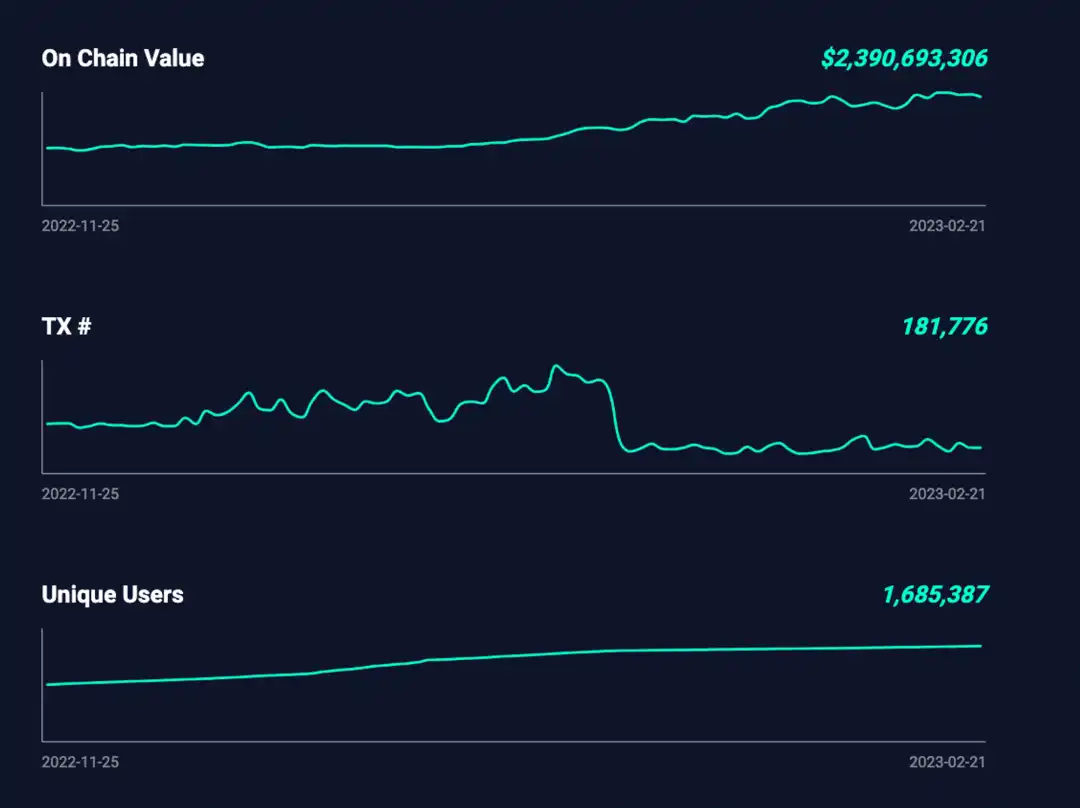
From on-chain data, OP's on-chain assets are steadily growing, with a total value approaching $2.4 B; daily trading volume has decreased somewhat after the Quest activities ended, but remains stable at around two hundred thousand transactions per day; the number of unique users exceeds 1.6 million; gas fees are on average 150 times lower than those on the Ethereum mainnet.
(https://chaineye.tools/optimism)
So how can the OP ecosystem attract and accommodate a rich variety of on-chain activities and an influx of funds?
02. OP Player's Handbook
Although OP is a Layer 2 of Ethereum, it is essentially a general-purpose public chain. This section, leveraging Chaineye's OP module, provides some guidance for crypto players exploring the OP ecosystem.
2.1 DeFi
DeFi is always the main attraction of public chains. The prosperity and innovation of DeFi projects can attract and accommodate a large amount of liquidity, just like injecting fuel into an engine, invigorating the entire public chain ecosystem. The DeFi ecosystem on OP is relatively complete, with decentralized trading platforms, lending, and more.
In addition to the migration of leading Ethereum projects, there are also some native projects, such as Velodrome, which receive support from OP and can earn additional OP token staking rewards when adding liquidity.
2.1.1 DEX
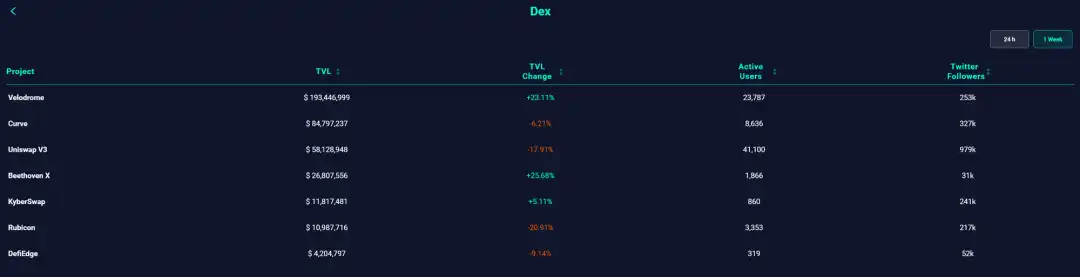
According to Chaineye, the largest DEX on OP is Velodrome, with a TVL that far exceeds all other DEX projects, even surpassing the second-place Curve by an order of magnitude.
Velodrome is one of the flagship projects on OP, positioned as a DEX modeled after Solidly, aiming to build a major trading and liquidity market on Optimism. It integrates features from Solidly, Curve, Olympus DAO, and Votium, such as veToken and game theory, while optimizing rules for token distribution, release, and incentives to help direct liquidity to the most valuable ecosystem liquidity pools.
Velodrome has two types of tokens: VELO, an ERC20 token, which can be staked to earn veVELO, an NFT governance token similar to veCRV.
In the past six months, nearly all newly issued VELO has been used for locking, demonstrating the effectiveness of the (3,3) mechanism. Various yield farming projects are actively accumulating more veVELO, with veVELO holders primarily earning from bribery, which enhances the efficiency of attracting liquidity for project teams.
The core function of Velodrome is to allow users to exchange digital assets with low fees and low slippage, with transaction fees only ranging from 0.02% to 0.05%. Even without the liquidity aggregation of Uniswap V3, users can enjoy a better experience due to the lower fees.

(https://defillama.com/protocol/velodrome)
Since the launch of OP token incentives in August last year, Velodrome's TVL has skyrocketed, surpassing Uniswap and Curve, and has maintained its position as the top OP TVL project for a long time. According to Defillama's data, Velodrome's current TVL is approximately $168 m, accounting for 21.6% of the total OP chain, making it undoubtedly one of the most noteworthy projects on OP.
As OP is an EVM-compatible chain, some leading Ethereum projects can smoothly migrate over, so major projects like Uniswap V3, Curve, and KyberSwap are also deployed on OP, allowing users accustomed to these platforms to maintain their preferences.
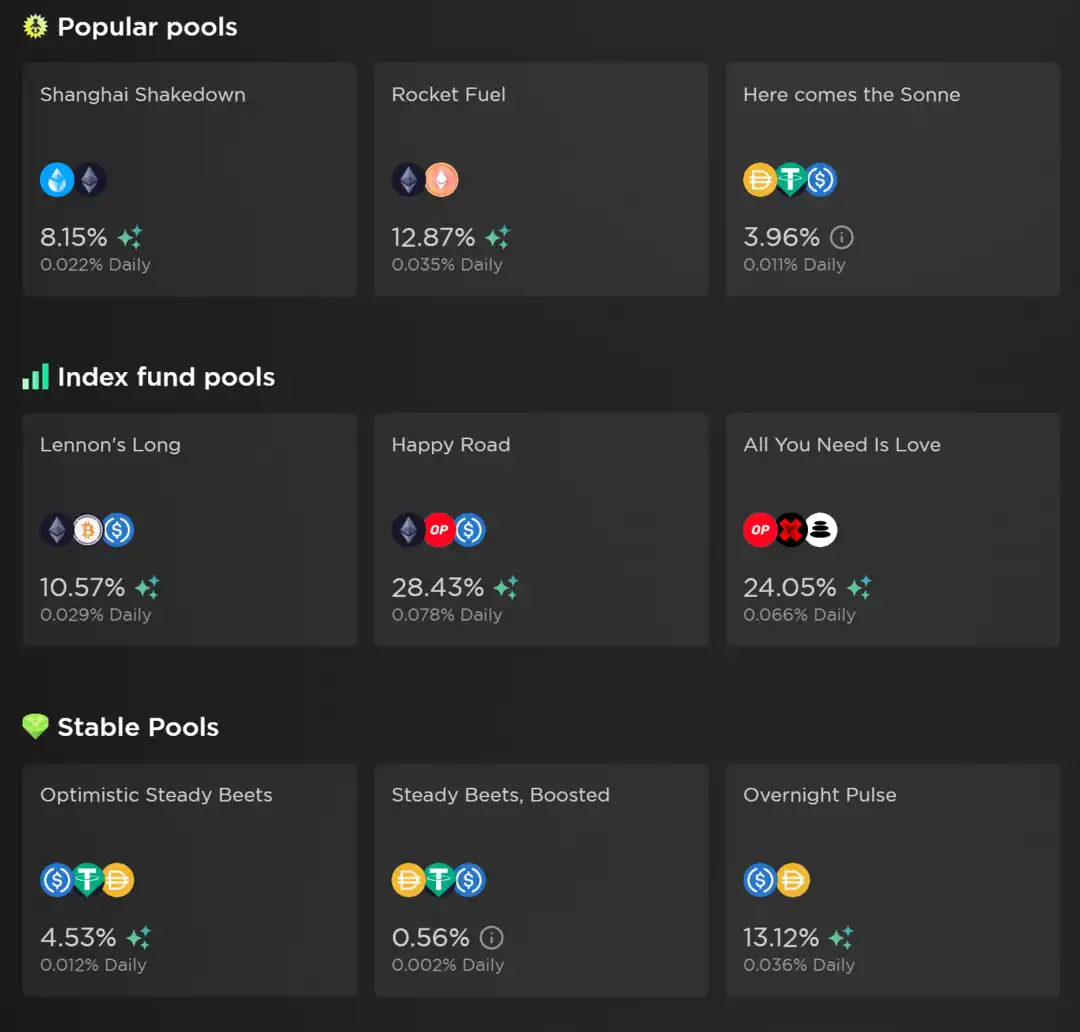
Other OP DEXs, such as Beethoven X and Rubicon, are also worth noting. Beethoven X aims to become a one-stop decentralized investment platform, providing portfolio suggestions based on hot sectors, allowing users to combine investments with one click, as shown in the image below.
(https://op.beets.fi/)
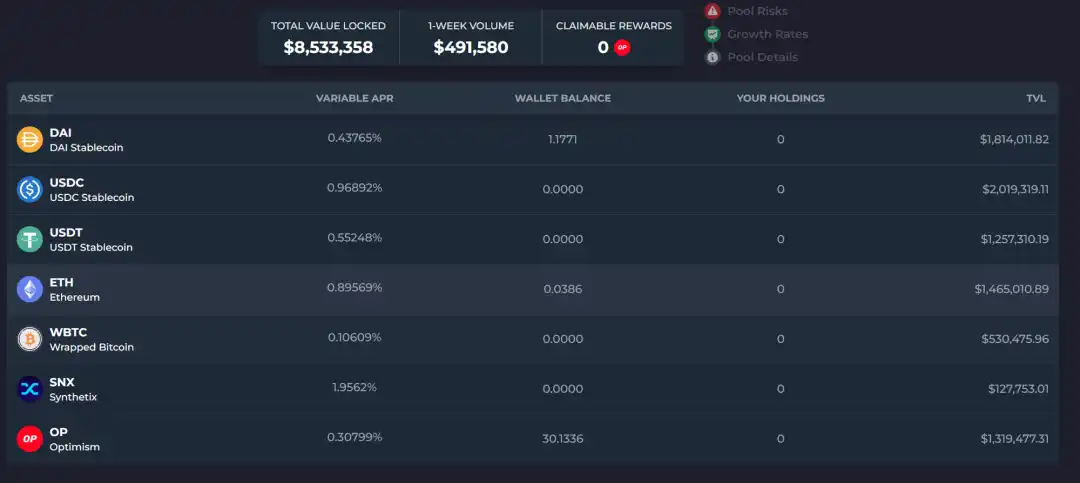
Rubicon is an order book model DEX aimed at developing and introducing equity and digital asset markets on the Ethereum blockchain. By staking a single token, users can also earn OP token rewards.
(https://rubicon.finance/)
2.1.2 Lending
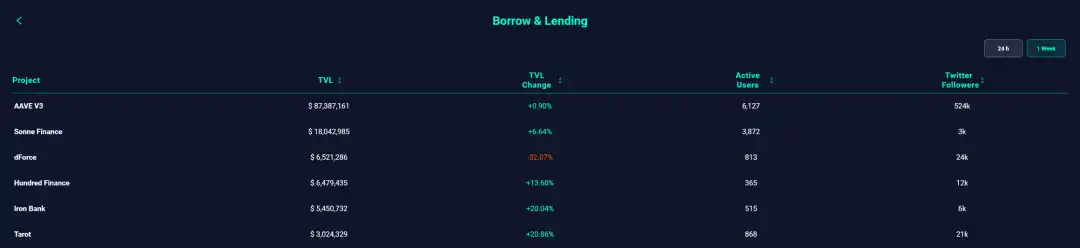
Ethereum's leading lending project AAVE has launched its V3 version on OP, featuring cross-chain asset flow, efficient modes, and an isolated mode supporting long-tail asset lending, with significant head effects.
(https://chaineye.tools/op-b\&l)
Sonne Finance is OP's native lending platform and the second-largest in terms of TVL among lending projects. This platform provides money markets for wETH, USDC, USDT, DAI, OP, sUSD, wBTC, and SNX. Sonne utilizes Velodrome in its token strategy, as it does not simply reward liquidity providers with SONNE tokens.
Instead, they bribe VELO holders with SONNE tokens to vote for the SONNE/USDC pair, while users staking SONNE tokens receive VELO rewards. OP has the opportunity to build its native DeFi Lego based on Velodrome, with Sonne focusing on lending.
Other lending platforms, such as dForce and Hundred Finance, are multi-chain deployed lending protocols, but their overall TVL and LTV are not particularly strong.
2.1.3 Derivative
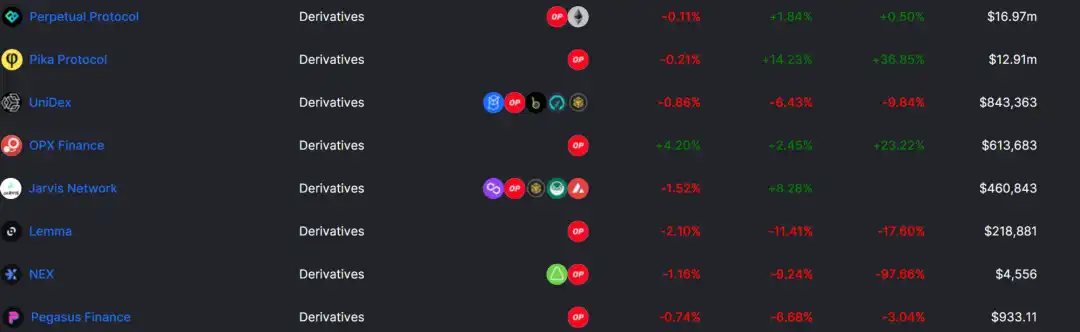
A complete DeFi ecosystem also includes on-chain financial derivatives, which can foster more innovation through composability and nurture more projects. The power of the flywheel initiated by GMX on Arbitrum is a testament to this.
(https://defillama.com/chain/Optimism)
On OP, financial derivatives include the migration of leading Ethereum product Perpetual and Pika Protocol. Pika is a stablecoin supported by decentralized derivatives. It consists of two parts: Pika Exchange and PIKA stablecoin.
Pika Exchange is a perpetual contract trading platform that supports leveraged trading. It allows for token-based inverse perpetual swaps. The foundation of the trading platform is a virtual automated market maker (vAMM). The PIKA stablecoin is supported by Pika Exchange and has the following characteristics: stability, as it uses perpetual swap positions to maintain its price stability around the $1 target.
PIKA is minted by opening a 1x inverse perpetual swap short position. Capital efficiency is achieved by depositing supported tokens worth one dollar (e.g., ETH, WBTC) to mint PIKA, resulting in better capital efficiency than over-collateralized stablecoins.
Pika also had OP token rewards at launch, with larger trading volumes yielding more rewards.
2.2 Farming
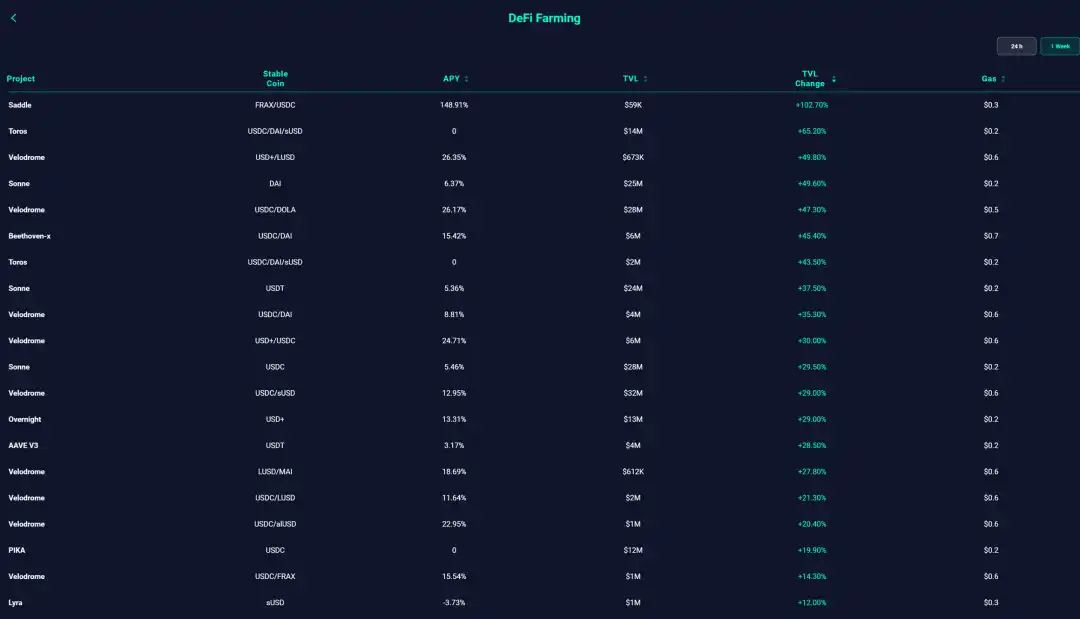
For stablecoin liquidity mining, you can refer to Chaineye's yield section, which clearly shows the composition, returns, and TVL of various pools.
(https://chaineye.tools/op-defi)
2.3 NFT Marketplace
Quix is the first native NFT marketplace platform on Optimism, where users can search, collect, and trade NFTs. Users can also launch their own NFT projects through the Launchpad, allowing for the deployment of code-agnostic NFT smart contracts and minting pages.
The low fees brought by Layer 2 have helped users save nearly $300,000 in costs. Due to funding issues, Quix has already shut down, and Quix Launchpad ceased operations on January 16 of this year.
Currently, this gap can be filled by NFTEarth, which has multiple rounds of airdrop plans, and OG cards can also be purchased on the secondary market.
2.4 Game
On-chain game developer Lattice has launched an on-chain voxel world called OPCraft, which is almost identical to Minecraft, on the OP Stack.
In this virtual world, every element from rivers to diamonds exists on-chain, and every action from mining to building occurs as a real on-chain transaction. The custom chain, relying on Optimism's modular Rollup architecture OP Stack, can support such high throughput on-chain.
(https://optimism.mirror.xyz/fLk5UGjZDiXFuvQh6R_HscMQuuY9ABYNF7PI76-qJYs)
Currently, the rollup test chain for this game has been frozen, but it serves as a very good experiment for the OP stack. Future developments of games built on the OP stack by Lattice should be closely monitored, as there will likely be better on-chain games and participation opportunities.
In summary, when exploring the OP ecosystem, it is best to pay more attention to projects that are native to OP, as these projects generally receive early support from OP, including OP token rewards.
03. Introduction to OP Stack Technology
Today, most chains are pursuing their own modular strategies. Optimism, Arbitrum, and Starknet differ in their execution layers, but they all share the same layers by outsourcing settlement, consensus, and data availability layers to the Ethereum mainnet.
Each chain operates its own independent strategy, with differences in the design of execution, settlement, and data availability layers. What if these chains shared a standardized open-source codebase instead of today's isolated chain/rollup systems?
This is the role of Optimism's OP Stack: a standardized open-source module for building more expressive and precise rollup chains on Ethereum.
3.1 Modular Technology
What is the role of modularity?
Simply put, modularity is like dressing up. Ethereum is currently like a jumpsuit; even if you feel the outfit is unsuitable or the color is unappealing, you can't change it. However, if we divide the outfit into three main modules: tops, pants, and shoes, we can create different looks through various materials and colors.
Modularization in blockchain means separating tasks like executing transactions, bookkeeping, and synchronizing ledgers, allowing different people to handle these tasks instead of one person doing everything from start to finish, which is both exhausting and slow.
OP Stack is an important step for OP's modular blockchain and a significant move from theory to practice in exploring modularization. OP divides the blockchain into three functional layers: consensus layer, execution layer, and settlement layer.
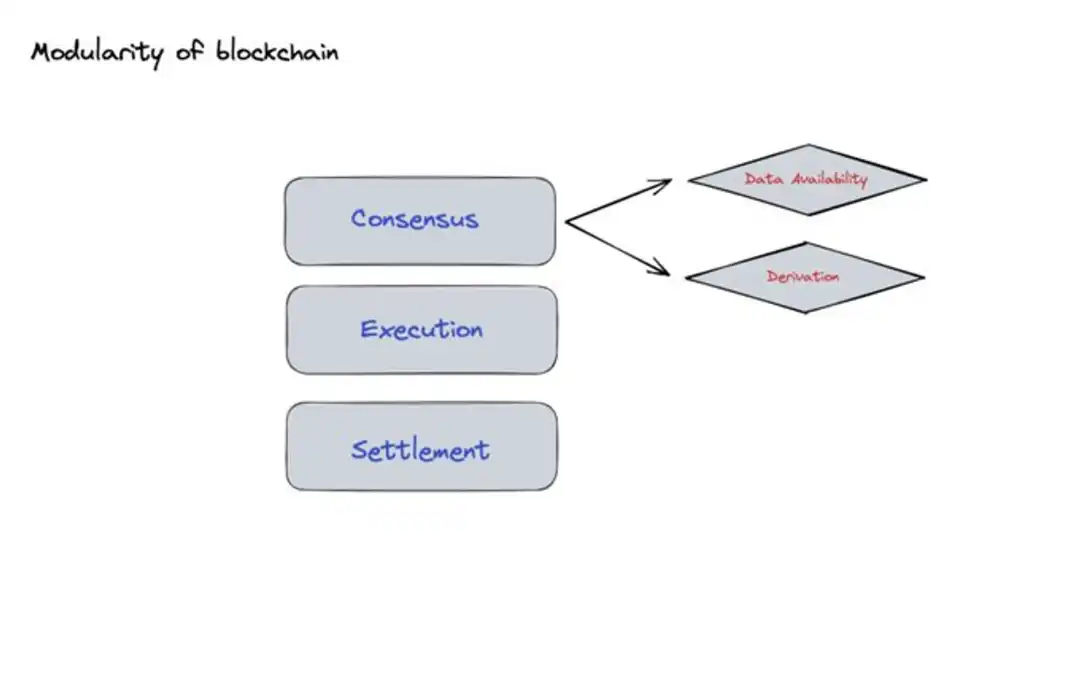
The functions of each layer can be referenced from Kelvin Fichter's speech at Devcon Bogota, https://www.youtube.com/watch?v=jnVjhp41pcc\&t=1302s. Here is a brief introduction:
3.1.1 Execution Layer
The execution layer, as the name suggests, is responsible for executing transactions. For example, if A transfers 2 ETH to B, it deducts 2 ETH from A's balance and adds 2 ETH to B's balance. Optimism, as a rollup of Ethereum, aims to execute transactions on behalf of Ethereum, returning only the results. Ethereum optimistically trusts the results returned by OP while leaving a challenge period to prevent malicious actions.
3.1.2 Settlement Layer
The settlement layer's role is to verify transactions, and if they are correct, it stamps them and generates a state root.
3.1.3 Consensus Layer
Blockchain is a public ledger, and the consensus layer synchronizes everyone's ledgers to ensure consistency. There is a concept called data availability, abbreviated as DA layer, which refers to the fact that the ledger records a result (state root), and to trace back and verify the calculation process, the data from that calculation is needed.
The DA layer is where this data is stored, ensuring that you can find it.
What are the benefits of modularization?
The benefit is that different "parts" can be replaced according to the project's needs, enhancing the composability of the blockchain.
04. Vision of OP Stack
OP Stack decouples different functional layers and combines all layers in the form of an API software stack, greatly simplifying the process of building modular blockchains.
Each layer of the OP Stack is described by defined APIs, filled by the modules of that layer. Theoretically, OP Stack can build any modular blockchain based on its APIs.
Developers do not need to build a blockchain from scratch; they can achieve rapid deployment of modular blockchains based on OP Stack's existing codebase, easily modifying existing modules or creating their own new modules to meet the needs of any application.
Each component of the OP stack implements a specific layer of the stack, powering the next generation of Optimism's architecture, as shown below:
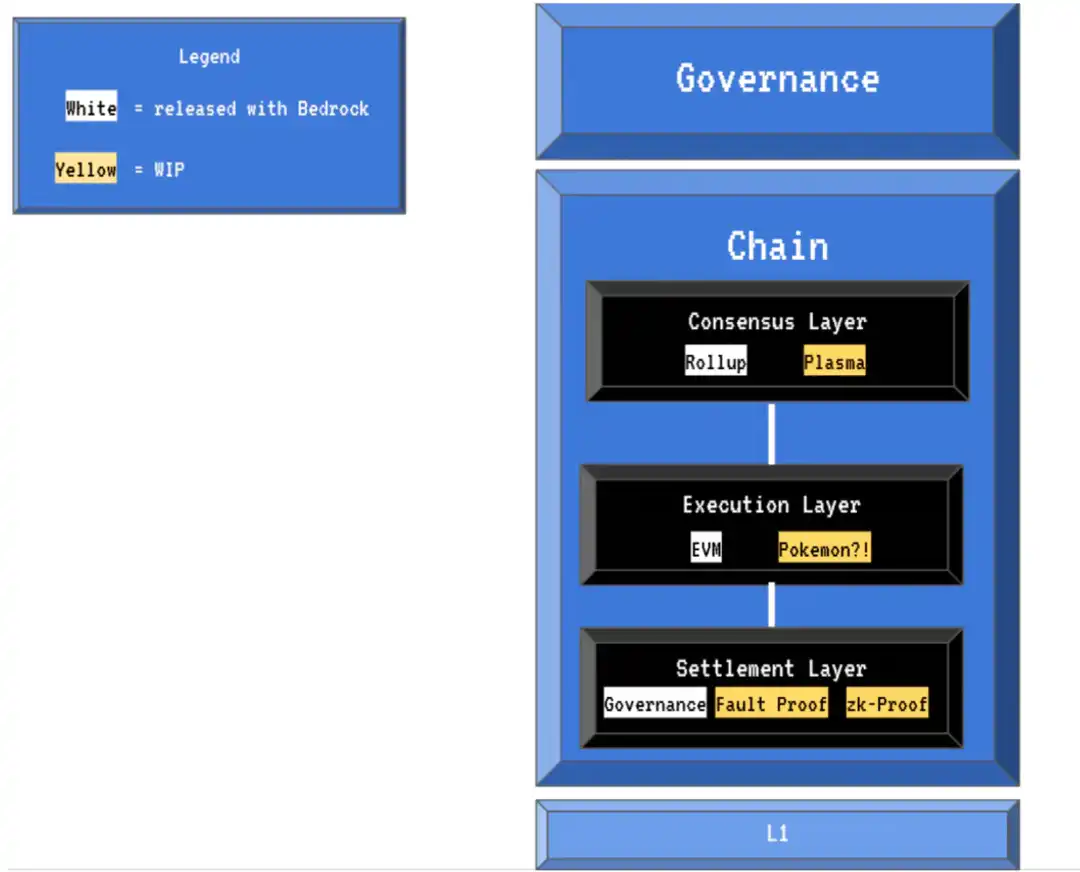
Specific applications include: a chain can replace the DA layer from Ethereum to Celestia to achieve DA layer separation, and switch the fraud proof module of the execution layer to validity proof, realizing the transition from OP rollup to zk Rollup.
The modular stack gives developers greater autonomy, allowing them to switch, replace, and modify different module layers, just like switching APIs.
In the future, by sharing message formats, chains based on OP Stack will be able to interoperate, realizing the vision of a "superchain." When multiple op-chains share a Sequencer Set, they gain a fantastic feature: atomic cross-chain composability.
Simultaneously, a sequencer generating blocks across multiple chains can ensure atomic interactions between these chains. Op-chains that join the shared Sequencer Set of the Optimism Collective become part of the system, blurring the boundaries between chains. Although it consists of multiple chains, the addition of atomic cross-chain interactions means that end users experience it as a single logical chain.
OP proposes that the ultimate structure of blockchain is neither a multi-chain nor a single-chain structure, but a "superchain" structure composed of a set of highly integrated OP Stack chains.
05. How OP Stack Will Change the OP Ecosystem
Currently, OP is focused on perfecting the first version of OP stack—the Bedrock upgrade. The ecosystem based on OP stack needs to further expand on the foundation of well-developed tools.
So what changes will OP Stack bring to the OP ecosystem?
First, we will no longer be confined to the concept of "projects on the OP chain," but will explore the concept of the "OP universe." As OP Stack matures, Optimism will come very close to achieving a Cosmos-like implementation, establishing the OP universe centered around OP.
"One-click chain creation" will become a hallmark of OP, with standardized L2 and L3 based on OP experiencing explosive growth. Appchains can play "blockchain Lego" on this basis, combining various unique VMs and technologies, leading to infinite innovation and possibilities.
At the same time, various modular blockchains built on OP stack can achieve interoperability within the OP universe, allowing chains to communicate easily using a shared message format.
How to participate in this OP modular reform?
As a developer, you can closely follow the release and updates of OP stack and issue application chains based on it; as a crypto user, you can participate early in various application chains. The OP team aims to promote the development of OP stack, and user incentives are essential.
Moreover, from OP's ecosystem incentives and recent retroactive airdrop operations, OP's stance is very clear: influence creates wealth. To benefit from the OP ecosystem, one must either create influence—by building innovative dapps based on OP stack—or become influential—by participating early in new dapps.
 Risk warning
 Risk warning

Popular articles





