








From data to application, Web3 is no longer just talk

 If we imagine along the narrative of Web3, after we obtain the on-chain data as the "ticket" to Web3, the next challenge is how to find the abundant "new continent"?
Author: Mu Mu, Metaverse Daily Explosion
After announcing a funding of 50 million Hong Kong dollars to accelerate the development of the Web3 ecosystem, Hong Kong has once again clarified its support for innovation in the Web3 industry. Recently, the Hong Kong Web3 Association was officially established, creating the Web3Hub fund, and the "Pearl of the Orient" is vigorously promoting the ecological construction of the third generation of the internet.
Not only are there policy dividends, but the rise of artificial intelligence, such as ChatGPT, has also injected efficient productivity into Web3. With the support of the "red and blue double Buff," Web3, which had cooled down for a year, is rejuvenating in Hong Kong.
On April 14, in Central Hong Kong, "Metaverse Daily Explosion" joined this wave with the "Confrontation" Digital Crypto Art Salon. When we interacted with leading companies in the blockchain industry, application developers, and DAO creators, we found that from data to culture, and from enterprise applications to Generation Z, Web3 is no longer limited to changing the way we think about the internet; a large number of effective applications and services are being born.
How to make good use of data as the Web3 "boarding pass"?
"Confrontation" starts from Web3 data, as it is the most visible productive material at the blockchain technology level.
The Economist once defined data as "the world's most valuable resource," but when we look back at the Web2 era, the internet resembled a closed garden of data controlled by a few gatekeepers. Users create data but do not own it, and the value brought by data is pocketed by tech companies.
Entering the Web3 era, things have changed. "Web3 is a data revolution driven by multiple technologies, and the core issue to be solved first is data." Jiang Zhaosheng, a senior researcher at OKLink Research Institute, pointed out the status of data in the Web3 network right from the start, "It is not just a carrier of rights; more importantly, it is a resource or asset."
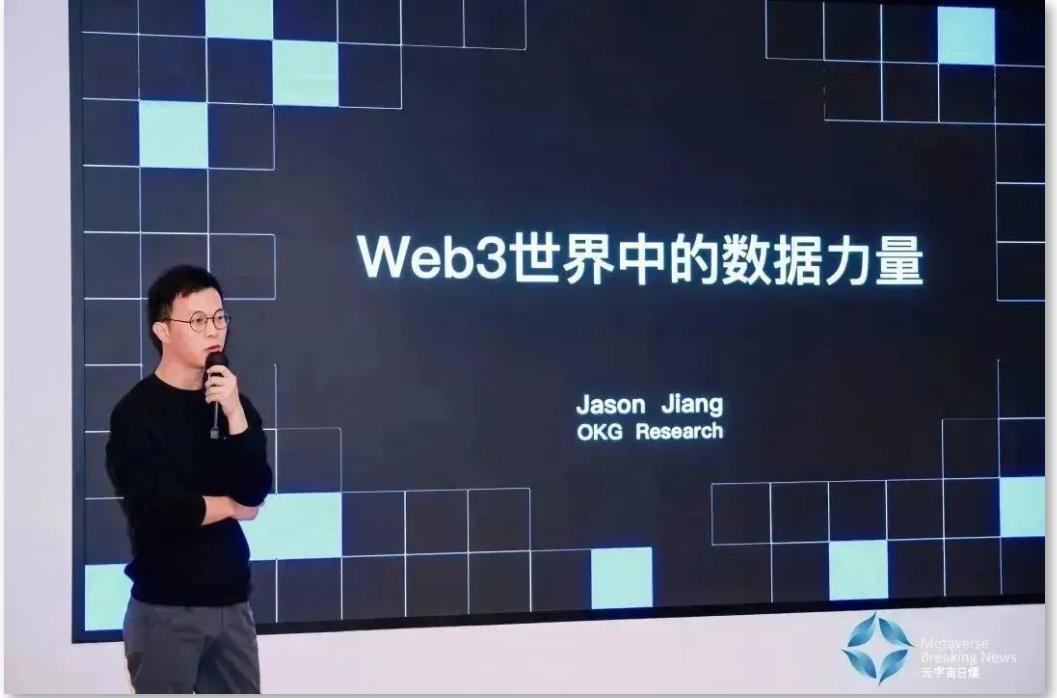
Jiang Zhaosheng, senior researcher at OKLink Research Institute, elaborates on the value of data in Web3
Through on-chain data, countless entities join the analysis team, gaining insights into the direction of asset flows, sensing market sentiment, searching for clues about popular applications, and even the evolutionary results of large blockchain networks. Jiang Zhaosheng cited the recent Ethereum Shanghai upgrade as an example, where users can infer the direction of ETH after the Shanghai upgrade based on data such as Ethereum price, deflation rate, staking rate trends, and supply rate trends, allowing them to deploy investment decisions and even entrepreneurial directions in advance.
When envisioning the value of on-chain data in Web3, Jiang Zhaosheng provided a vivid example: "In the Web2.0 era, finding a job was more about using traditional methods like resumes. In Web3, you only need to provide an address to know your past interaction experience, construction trajectory, etc., all of which can be clearly displayed on-chain."
A single piece of data may seem to have little value, but the vast amount of data behind it contains "rich mines." If we integrate these massive user data, behavioral data, and characteristic data, we can see the ecological landscape of the entire Web3 universe. Whether it is users, enterprises, or government departments, mastering on-chain data is the ticket to enter the Web3 door.
As we enter the Web3 era, with the large-scale influx of users and the widespread application of various DApps, the value of on-chain data becomes increasingly prominent. Jiang Zhaosheng pointed out, "Various DApps in the Web3 world, from creation, trading, pricing to reproduction, cannot be separated from on-chain data. Digital assets are the core objects of Web3, and on-chain data is the key productive material of Web3, as well as a core production factor in the future."
How to step onto the "new continent" of value?
If we follow the narrative of Web3, once we obtain the on-chain data as the Web3 "boarding pass," the next challenge is how to find the rich "new continent." Such land includes entrepreneurship and investment in Web3, development and application, upgrades, and transformations.
Google Cloud once compared Web3 to the internet of a decade ago, noting that its value lies in the fact that it is still an undeveloped wilderness, nurturing infinite possibilities. Today, the number of global internet users has reached 4.9 billion, while the real number of Web3 users is only in the tens of millions. According to Global Macro Investor's predictions, the number of global cryptocurrency users will reach 4.3 billion by 2030. For Web3, this means a vast blue ocean of migrating Web2 users.
Since the birth of the mobile internet, Web2 achieved global saturation in user penetration in just 10 years. However, so far, Web3 has been hindered by technical barriers and the lack of phenomenal applications, blocking the entry of Web2 users. If this continues, the outcome may very well be as Steven, the founder of TraditioNow, said: "When an industry no longer has a continuous influx of people, the development momentum of that industry will surely dry up."
TraditioNow, which has been deeply engaged in the Web2 industry for seven years, has found a bridge connecting the real world and Web3—culture. Steven explained that whether from the perspective of building consensus and economic models or from the perspective of attracting traffic, culture is a very fitting existing lever for the Web3 world. The culture, which condenses faith and tradition, itself is a form of consensus, and the IP re-created from culture has long formed a mature business model. The continuous extension and dissemination of culture is a portrayal of "sustainable traffic."
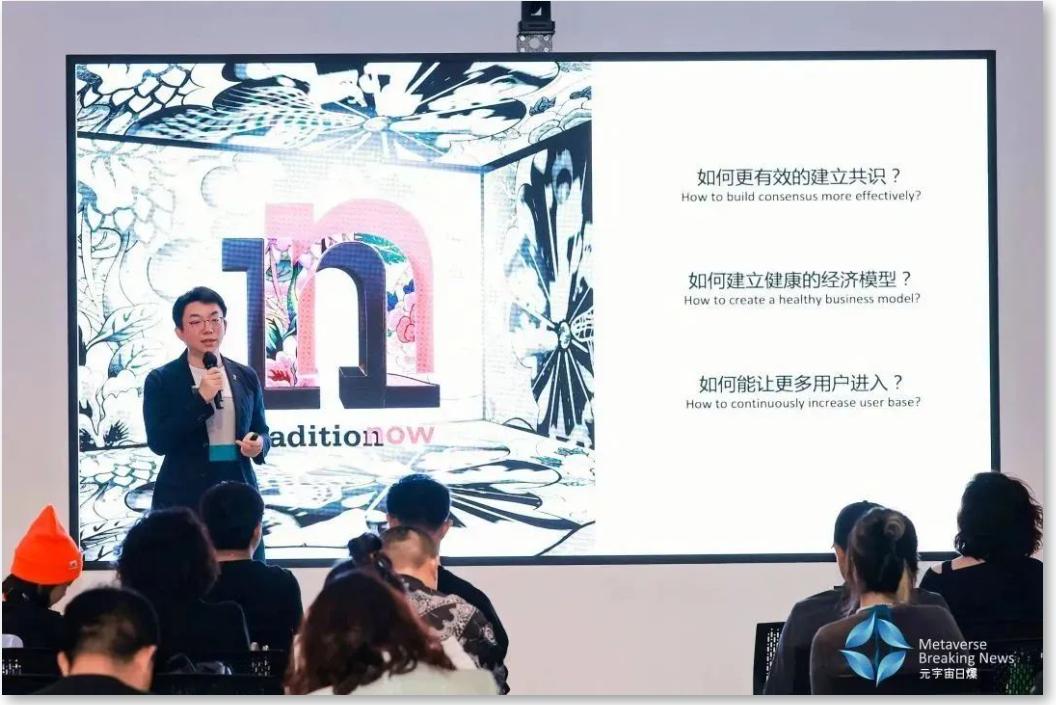
Steven, founder of TraditionNow, explains the fusion of culture and Web3
Using the first NFT IP "NUO" created by TraditioNow as an example, Steven shared the fusion of traditional culture and Web3. He introduced that they created the NUO series inspired by China's intangible cultural heritage "Nuo Opera," with works involving multiple artists quickly establishing collaborations with 16 different brands and platforms, generating active dissemination among Web2 users. "Creating IP in Web2 takes at least 10 months, but with the empowerment of Web3, we completed the entire IP creation in just one month."
In the NUO Web3 IP experiment, "about 1/3 of the participants were encountering Web3 for the first time from Web2," Steven said, noting that community participation played a crucial role in the NUO and subsequent experiments.
TraditioNow is a builder exploring Web3 on its own, while MetaScan Labs aims to pass on the experience and technical tools for transforming Web2 to Web3 to more practitioners.
Grace, co-founder of MetaScan Labs, discovered during her entrepreneurial journey that the entire Web3 ecosystem lacks entry points for users and applications. Meanwhile, social applications and gaming products in the Web2 world are actually huge pools of traffic and content, but there are no good tools to help them complete the upgrade to Web3.
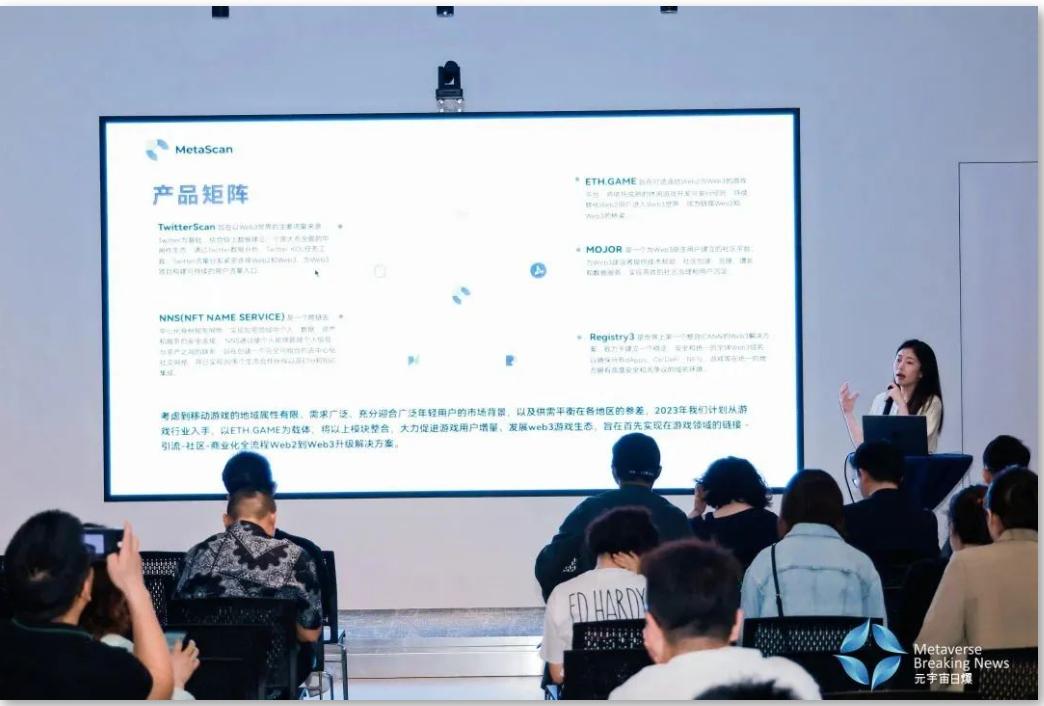
Grace, co-founder of MateScan Labs, presents a solution for upgrading from Web2 to Web3
At the "Confrontation" Digital Crypto Art Salon event, Grace brought a solution for Web2 enterprises and application developers to transition to Web3. She introduced that from the underlying layer to middleware and then to the application layer, MetaScan Labs can use five major tools—NNS+Registry3 domain system, GAME.SDK+Meta DID system, ETH.GAME, MOJOR traffic engine, and Twitterscan—to complete the full-process Web3 transformation for Web2 applications, from underlying data and application accounts to traffic attraction. "Helping Web2 products upgrade to Web3 is our important mission."
Where does Generation Z's interest in Web3 come from?
On the journey to Web3, there are not only the "big ships" of Web2 innovators but also the "speedboats" of Generation Z. Generation Z, also known as the "internet generation" or "digital natives," has been seamlessly connected to the information age since birth, living under the influence of digital information technology.
Web3 is becoming a new continent of the internet for Generation Z. Initially seen as the main consumer force for Web3 commercial applications, they are now becoming builders of Web3.
Thirteen-year-old Carry Zheng is the creator of SparkrDAO. On April 13, she stood on the stage of the "Confrontation" Digital Crypto Art Salon, calling for schools to abandon teaching students knowledge that they are not interested in and may never use, advocating for stimulating students' learning motivation through interest, practicality, and practice to create value for society.
When schools fail to do this, Carry Zheng decided to take action through a decentralized autonomous organization (DAO), stating, "I always believe that practice is the best way to learn." Under this philosophy, Carry founded SparkrDAO, where like-minded young people can learn about Web3, AI, and blockchain together and personally engage in meaningful projects. "If you lack the technology and resources, SparkrDAO can provide them."
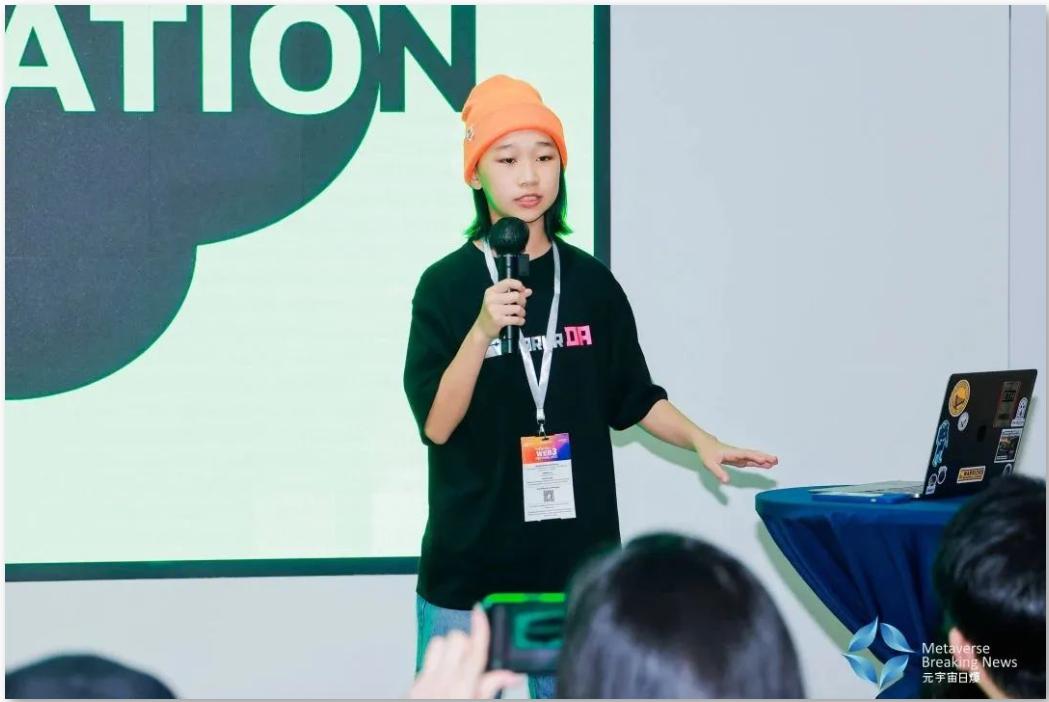
Carry, creator of SparkrDAO, shares the driving force of Web3 for young people
It is hard not to be moved by the courage and action of Generation Z. It can be predicted that this group of Web3 natives will not only be users of applications but will also become the most innovative and active builders of the Web3 ecosystem.
AI is refreshing the understanding of productivity enhancement through computing, while Web3, regarded as the third generation of the internet, is integrating various technological achievements such as AI, AR/VR, and blockchain, attempting to reshape the relationship between users and the internet. This is what is happening overseas.
At this moment, Hong Kong intends to position itself as the "capital of Web3," attracting more builders to come. This means that the distance between the Chinese-speaking world and Web3 will be shortened. So, are you ready to embrace this transformation?
 Risk warning Risk warning


Popular articles





