








The era of Bitcoin "Sats" has arrived: The Ordinals protocol and the Lightning Network may activate a Bitcoin ecosystem explosion

 Bitcoin is changing while it changes us. Innovations surrounding Bitcoin are continuously emerging: Bitcoin Layer 2 solutions, Ordinals protocol, BRC-20, Nostr protocol, etc.
Author: Gavin, LK Venture
Only on fertile land can good crops be cultivated. Bitcoin has successfully operated for 14 years, and by market capitalization, it is now the 10th largest asset in the world, following Nvidia.
LK Venture believes that Bitcoin has changed many people; it allows us to view the world from a new perspective and prompts us to think, "What is value?" Even though some still question Bitcoin, it cannot hide one fact: Bitcoin has become a mature and widely recognized asset.
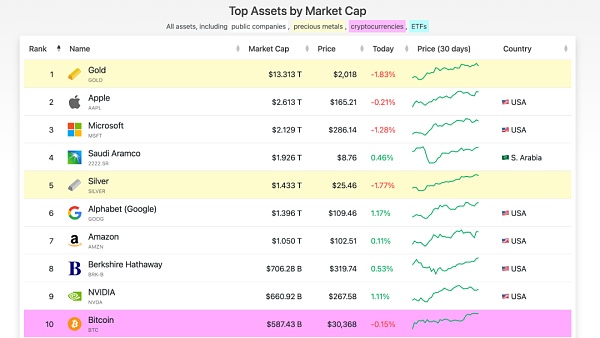
Top Assets by Market Cap
Data Source: Global ranking, https://companiesmarketcap.com/
As Bitcoin changes us, it is also undergoing changes itself, with innovations surrounding Bitcoin continuously emerging: Bitcoin Layer 2 solutions, Ordinals protocol, BRC-20, Nostr protocol, etc. These innovations can provide faster and more convenient transaction methods for Bitcoin, as well as greater possibilities and imaginative space.
Some may question these innovations, but hasn't Bitcoin grown amidst skepticism? Let's set aside our prejudices and first understand these new concepts surrounding Bitcoin, which is also the intention of this article. To repeat the first sentence from the beginning, a thought-provoking investment philosophy: only on fertile land can good crops be cultivated.
Ordinals Protocol - The Era of Bitcoin "Sats" Has Officially Arrived
Since Ethereum was designed from the beginning to support smart contracts and decentralized applications, it has a natural advantage in the NFT field. Based on Ethereum's ERC-721 standard, developers can easily create, issue, and trade NFTs.
At this point, you might wonder why the most consensus-driven Bitcoin cannot issue NFTs? The original intention of Bitcoin was to become a peer-to-peer digital currency, so its network focuses more on security, stability, and simplicity, which leads to relatively limited functionality in smart contract and dApp development.
This does not mean that the Bitcoin network cannot support NFTs; it can even issue "tokens." This brings us to the key point we want to discuss - Ordinals, a protocol created by Bitcoin's former developer Casey Rodarmor.
The Beginning of Ordinals: Bitcoin NFTs
In January 2023, Bitcoin core contributor Casey Rodarmor released the Ordinals protocol. The emergence of the Ordinals protocol reignited discussions about Bitcoin NFTs. How does the Ordinals protocol make NFTs possible on Bitcoin?
The total supply of Bitcoin is 21 million coins, and its smallest unit is sats (satoshis), where 1 BTC = 100 million sats.
The Ordinals protocol proposes an innovative design based on "sats," allowing various information to be embedded within "sats" - such as images, text, videos, etc. ("inscription," also known as engravings), linking the uploaded engravings to specific "sats" (the "ordinal"). This process is called inscribing, similar to minting NFTs on Ethereum. The result is a sat carrying the engraving, which is the so-called Bitcoin NFT.
When each sat has a unique mark and number, the corresponding content also possesses uniqueness, transforming the sat from merely a unit of account into an NFT unit.
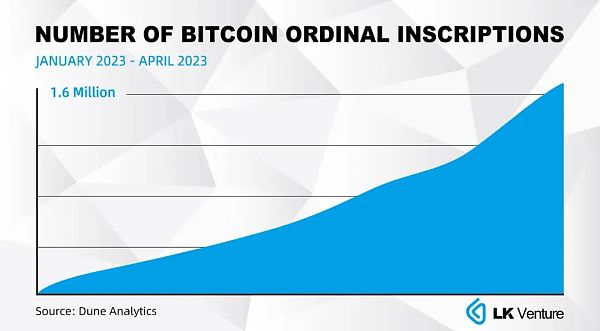
The number of Ordinals inscriptions has exceeded 1.6 million
Data Source: Dune Analytics
As of April 23, 2023, the number of Ordinals inscriptions has surpassed 1.6 million, which means that NFTs in the Bitcoin ecosystem are unlikely to disappear.
What value do Ordinals NFTs bring?
Permanently on-chain. Bitcoin Ordinals NFTs are fully inscribed on the Bitcoin chain, just like tattoos, forever becoming a part of Bitcoin. It is meaningful to have something you love permanently exist on the Bitcoin chain;
Will not go to zero. Ordinals NFTs will not go to zero; their base value is one sat (satoshi);
Historical value. The total supply of Bitcoin is limited, and the number of engravings that can be inscribed is also limited. Over time, early engravings become more precious due to their historical status. In the NFT field, uniqueness and scarcity can endow works with higher value, and earlier Bitcoin NFT engravings may become increasingly valuable.
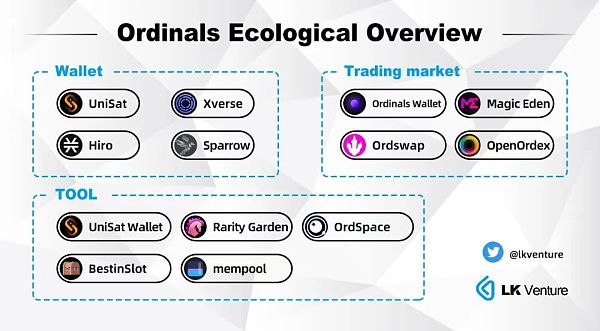
Some basic infrastructure of the Ordinals ecosystem, Source: LK Venture
Although the Ordinals protocol has only been around for three months, it has already spawned many ecological projects surrounding its infrastructure, including wallets, trading markets, and tools. Leading exchanges like OKX and Binance have also begun to support the Ordinals ecosystem.
Some Interesting Ordinals NFTs
1) TwelveFold
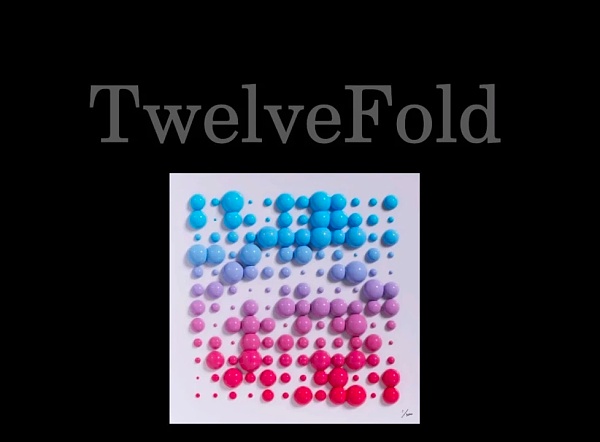
TwelveFold is a Bitcoin NFT project launched by Yuga Labs, consisting of a series of 300 unique generative art pieces.
2) Bitcoin Punks
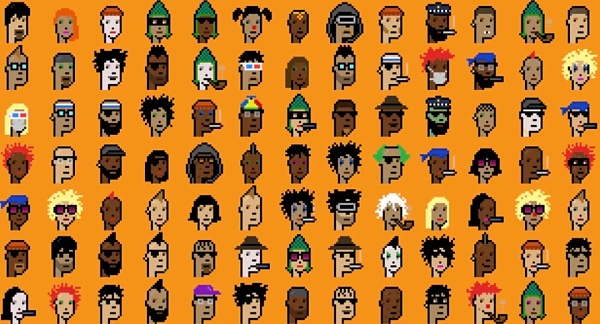
Bitcoin Punks is the first project to successfully upload original Ethereum CryptoPunks to the Bitcoin blockchain using Ordinals, with all assets minted for free by collectors.
3) Taproot Wizards
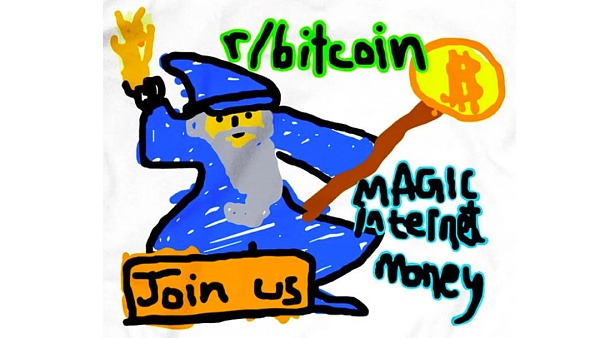
Why has Taproot Wizards received so much attention? It is said to be the largest block in Bitcoin history, with a capacity of an astonishing 4MB, four times the usual 1MB limit.
4) Pixel Pepes
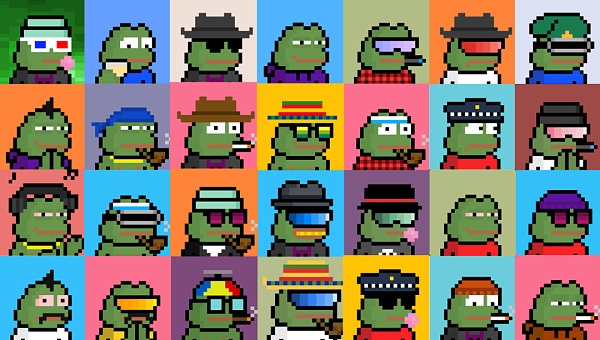
"Pepe the Frog" is the most viral meme on the internet, and Pixel Pepes were airdropped by the Ordinals Wallet, consisting of the most active KOLs and ecosystem developers.
Exploring Ordinals: BRC-20
LK Venture believes that the composability of the digital world has brought many interesting experiments to the industry. Two months after the release of the Ordinals protocol, Twitter user @domodata proposed a token standard on Bitcoin - the BRC-20 standard.
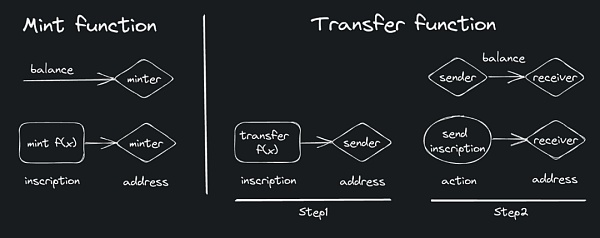
BRC-20's Mint and Transfer Functions
Source: https://domo-2.gitbook.io/brc-20-experiment/
BRC-20 utilizes JSON data to deploy token contracts, mint tokens, and transfer tokens. You can think of the BRC-20 standard as a type of application NFT for Ordinals, akin to a check; BRC-20 does not have smart contracts.
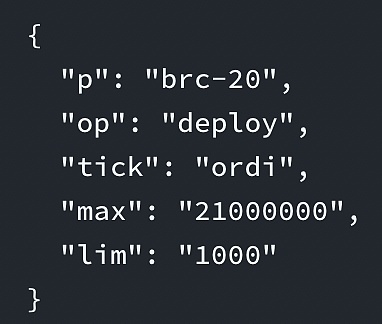
The first BRC-20 token "Ordi" deployed by @domodata
Source: https://domo-2.gitbook.io/brc-20-experiment/
Within 24 hours of the BRC-20 release, over 30,000 tokens were minted. @domodata also deployed the first BRC-20 token - $ordi, with a total supply of 21 million, and everyone could mint for free. In less than two days, all $ordi were minted.
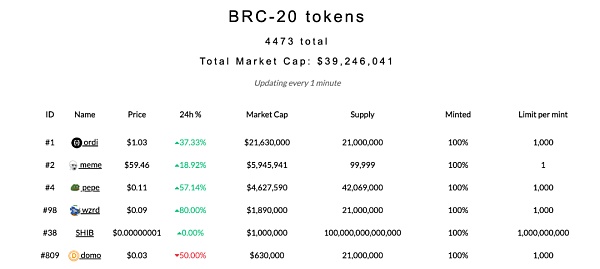
Some BRC-20 tokens
Source: https://brc-20.io/
Although @domodata has repeatedly stated that BRC-20 and $ordi are just experiments with no value, some people are still trading $ordi and minting more BRC-20 tokens. Currently, there are 4,473 BRC-20 tokens with a total market cap of nearly $40 million.
The Arrival of the "Sats" Pricing Era
Is it really necessary to issue tokens on Bitcoin ordinals? BRC-20 does not have smart contracts; inscriptions can be used as ledgers, but an immutable ledger is difficult to produce an efficient and stable system. Moreover, "writing" on the Bitcoin chain occupies very precious resources - this includes not only paying a certain amount of sats as miner fees but also the time cost incurred while waiting for transaction confirmations.
BRC-20 is built on top of Ordinals, creating instability on top of instability, which makes it very fragile. Since BRC-20 does not utilize Bitcoin UTXO, it can easily encounter issues during transactions. Recently, after Unisat launched the BRC-20 trading market, it was suspended due to related trading attacks.
BRC-20 is still an experiment; why do some people participate? Aside from the very FOMO-like speculative attributes, if you deploy and mint some tokens, you will find that releasing tokens under BRC-20 seems to fulfill the original idea of the crypto industry - anyone can easily release tokens, and the greatest value lies in its existence on Bitcoin. It occupies a portion of sats, and these BRC-20 tokens are like extensions of Bitcoin, with Bitcoin endowing them with value.
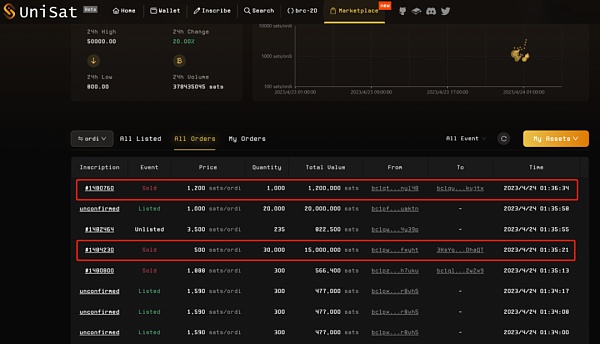
Unisat's BRC-20 token trading market, Source: Unisat
More importantly, in LK Venture's view, we see the arrival of the "sats" pricing era, where all NFTs on Ordinals trading platforms begin to be priced in Bitcoin. After Unisat launched BRC20-related tokens, they were directly priced in sats. This small detail indicates that the era of "sats" pricing has officially arrived.
Conclusion
Regardless of whether the Ordinals protocol and BRC-20 will succeed, their emergence has shown us new possibilities for Bitcoin, making the Bitcoin ecosystem more diverse and vibrant. Most importantly, they have transformed the smallest unit of Bitcoin, sats, from a concept into a practical unit.
Lightning Network - Making Bitcoin "Sats" Flow
The slow transaction speed, high fees, and difficulty in scaling Bitcoin have always plagued it, and these issues have constrained Bitcoin's performance and broad application scenarios.
How can these problems be solved? Many developers have attempted to build what is called a second-layer network (Layer 2) on top of Bitcoin. Bitcoin Layer 2 is a technical solution built on the Bitcoin main chain (Layer 1). By running protocols or platforms on top of the base layer, the second-layer network can fully utilize the security and decentralization features of the Bitcoin main chain while providing a more efficient transaction experience.
There are many second-layer solutions for Bitcoin, among which the Lightning Network and sidechains (like Liquid Network) are mainstream, with the Lightning Network being the most widely used. Next, let's talk about the Lightning Network.
What is the Lightning Network?
The Lightning Network is one of Bitcoin's Layer 2 solutions, primarily used in Bitcoin payment scenarios, helping users save costs and improve efficiency.
In the same peer-to-peer payment context, why can the Lightning Network complete payments at a lower cost and faster speed? Because the Lightning Network processes transaction steps off-chain, with only the final transaction result confirmed on the Bitcoin main chain.
Advantages of the Lightning Network
Convenient for small transactions. Through the Lightning Network, users can use the smallest unit of Bitcoin, "sats," for payments, meeting the needs of everyday small purchases.
Reduced transaction costs. Currently, Bitcoin transaction fees are around $2; during the market peak in 2021, fees exceeded $60.
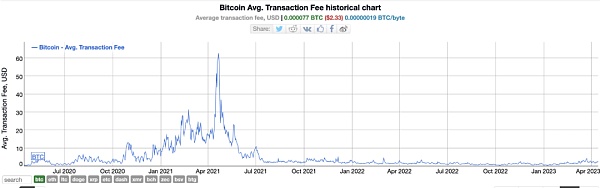
Bitcoin transaction fees
Data Source: https://bitinfocharts.com/comparison/bitcoin-transactionfees.html
If using the Lightning Network, a $100 transaction fee would be around 1 cent, making it very cost-effective for everyday small payments.
- Accelerated transaction processing speed. Currently, the Bitcoin network can process a maximum of 7 transactions per second, and network congestion may lead to delays in transaction confirmations, affecting user payment experiences. Theoretically, the Lightning Network can achieve processing speeds of up to millions of transactions per second.
Development of the Lightning Network
The technology of the Lightning Network is gradually maturing, and payment and social giants are also promoting its adoption. As of April 25, 2023, the Lightning Network has a total of 16,000 nodes, nearly 75,000 payment channels, with channel funds amounting to approximately 5,379 bitcoins (about $152 million).
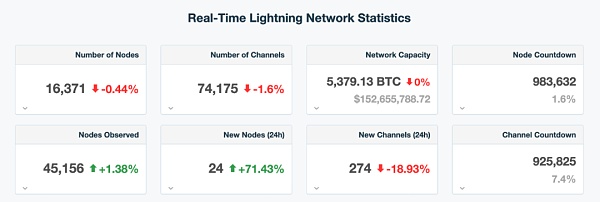
Real-Time Lightning Network Statistics
Source: 1ML
Let's take a look at the current use cases of the Lightning Network:
- Social platform payment tips
Many people use the Lightning Network because of the Nostr protocol and the Damus application built on it, as it supports payment and tipping functions via the Lightning Network.
- Cross-border remittances
In January 2023, the digital payment platform Strike announced a partnership with Send Globally to enable Lightning Network remittances between users in the U.S. and the Philippines. With Send Globally, dollars can be converted into Bitcoin, sent via the Lightning Network to a third-party partner in the recipient's country, then converted into local currency and directly deposited into the recipient's account.
- Merchant payments
Strike has partnered with Shopify, Blackhawk Network, and NCR to establish a Bitcoin payment system that allows merchants to quickly receive dollars after customers pay with cryptocurrency. Merchants currently supporting this payment system include McDonald's, CVS, Walgreens, Whole Foods, and Walmart.
The Lightning Network has been striving to realize Bitcoin's original intention - to become a peer-to-peer electronic cash system. In addition to large transactions, small transactions involving "sats" can also flow very conveniently through the Lightning Network.
Although the Lightning Network faces many challenges on the road to popularization, with the gradual maturation of technology and the continuous enrichment of use cases, the Lightning Network will undoubtedly become a powerful assistant for Bitcoin.
Final Thoughts
LK Venture believes that whether you are a developer or a speculator, as long as you participate in Bitcoin, you are contributing to the prosperity and development of the Bitcoin community and Bitcoin itself.
Whether it is the Ordinals protocol, the BRC-20 experiment, or the Lightning Network and other Layer 2 solutions, these have expanded the application scope of the Bitcoin network, allowing for transactions in "sats" and pricing in "sats," reducing the psychological pressure and entry barriers for newcomers. The open development of the Bitcoin network and multi-faceted attempts are entirely reasonable. As the wealth effect and user numbers increase, competition among ecological products will gradually promote overall improvement.
Currently, many projects surrounding Bitcoin are still in a chaotic state, with varying quality. The only thing you need to pay attention to is: be sure to protect your Bitcoin.
References
What Are Bitcoin Ordinals? (https://trustmachines.co/learn/what-are-bitcoin-ordinals-inscriptions/)
Ordinal Theory Overview (https://docs.ordinals.com/overview.html)
BRC-20 Experiment. (https://domo-2.gitbook.io/brc-20-experiment/)
Insights From the 4th Largest Lightning Network Node (https://river.com/learn/files/river-lightning-report.pdf)
 Risk warning
 Risk warning
Popular articles





