Will AI agents and authentication be the next explosive narrative in cryptocurrency?

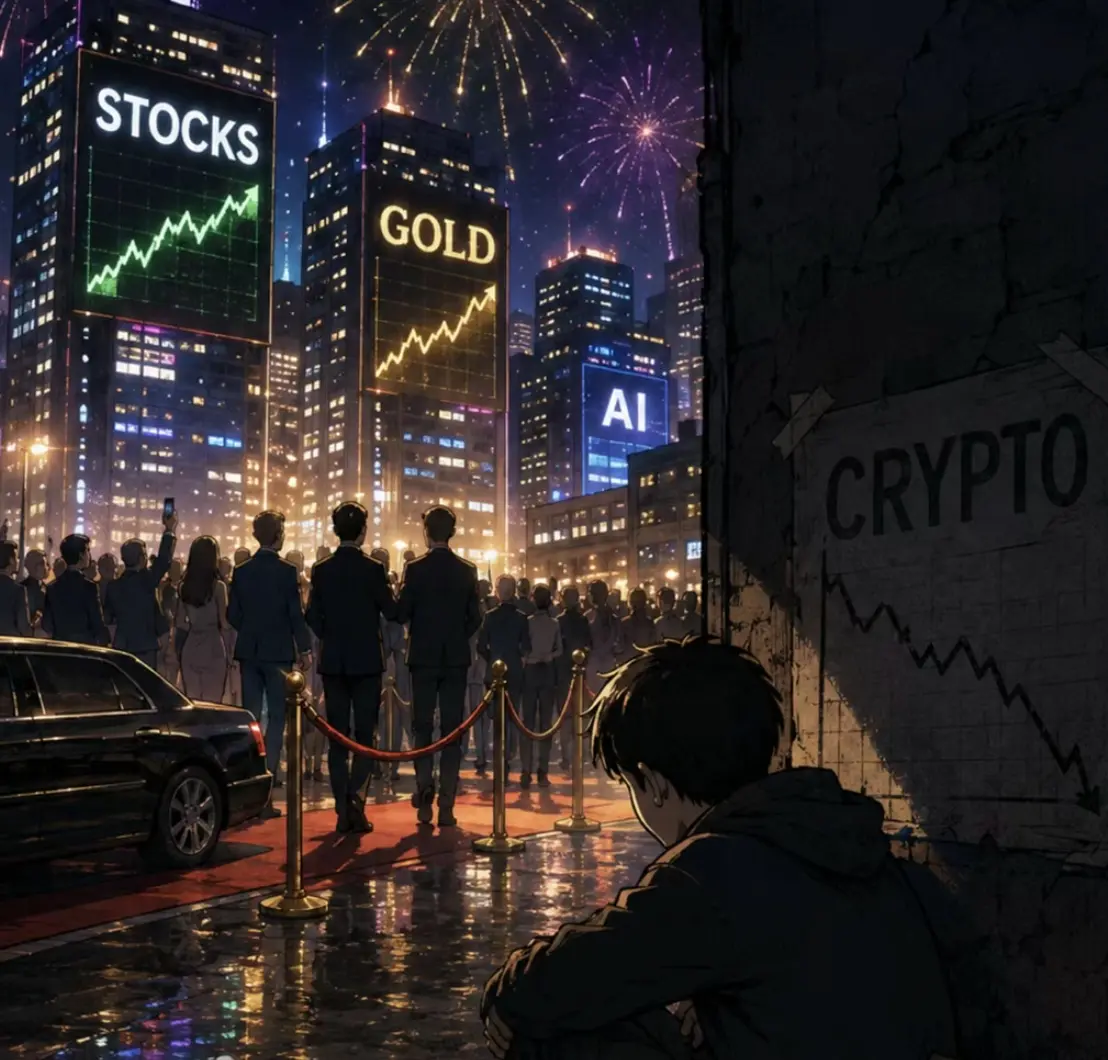
 AI is at an all-time high, while cryptocurrency is at an all-time low.
Original Title: 《The Next Major Crypto Narrative》
Original Author: KERMAN KOHLI
Translation: Deep Tide TechFlow

If there's one thing I've learned from my years in the cryptocurrency industry, it's that this market is highly driven by narratives. I break down its driving units as follows:
Stories that people can understand;
Beliefs formed around those stories;
Memes that encapsulate those beliefs.
Let’s look back and apply this framework:
2022
There was a massive yield market that only banks could exploit if:
Banks acted maliciously, and cryptocurrency represented an alternative, better system.
Cryptocurrency was a way to earn high-interest dollars.
2017
Governments prevented ordinary people from investing in great companies.
Wealth creation should not be limited to accredited investors.
ICOs were the new way to get rich.
The format is the same; only the characters, narratives, and personas differ. Each cycle also brings new heroes and villains. Just make sure you don’t become the protagonist. As you attract more attention, your chances of survival decrease.
We have experienced over a decade of cryptocurrency, and the question on everyone's mind is: what will happen next? You cannot reuse the same narratives because those stories have bad endings (Terra/Luna/FTX, ICO scams, etc.). This doesn’t mean they were bad! Each cycle has brought more talent, resources, and scale to the crypto economy. It’s just that ordinary people won’t return to the cryptocurrency space unless there’s a meme that resonates with them and aligns with their belief systems.
In the past, I had some regrets about not linking my beliefs with my reputation and then regretting it. Recently, I have become more aligned with my views and, unlike before, I intend to stick to them. At least when I look back in the future, I won’t regret being idle.
Without further ado, I present to you the bull market narrative for 2024 to 2026, remember, it’s now 2023.
Cryptocurrency + Artificial Intelligence
In the past few months, I’ve been amazed at how quickly the world has embraced artificial intelligence, especially large enterprises. I may not need to provide enough evidence for these events, as you can easily find information through Google searches and Twitter. I have two strong arguments about what this will entail, so I’ll explain them one by one.
Internet Currency
Now that we know global consciousness has been influenced by artificial intelligence, what will happen next? Now, you simply integrate AI into your tools.
The next step in this progression is the rise of AI agents. Trained by you, using your data, on your tools. AutoGPT, BabyGPT, and many other projects have been moving in this direction. While this technology is still somewhat basic, based on what we know today, it’s impossible for it not to reach this stage, and people hope so. AI agents will enable you to automate a larger portion of workflows. ChatGPT plugins are already a simplified version of agents, and you can:
Express your intent to the LLM;
It will find the appropriate course of action for you;
Execute the action.
If you disagree, please correct me, but the above logical reasoning seems relatively sound and unlikely to be wrong. So, what is the most powerful energy people want to express intent with? Money, the universal energy adapter. People will want to base their intentions on money. Here are some simple examples:
"Bet $100 that the Los Angeles Lakers will win their next game."
"Find the best article about Trump’s election and pay any paywalls encountered, up to $20 a month."
"Buy my usual grocery list and deliver it on Friday night, paying up to $30 in delivery fees."
All these intentions are impossible to realize within the existing banking system. Why? Again, think from the small things:
It’s not you actually executing the purchase, but an AI agent;
If the agent buys for you, it means you haven’t directly authorized the transaction (it’s authorized by your AI);
If someone buys on your behalf, your fraud/refund risk skyrockets;
No one wants to take on that risk.
The only solution is to set up a cumbersome checkout process in your chatbot, forcing you to input credit card information in the chat window. Or, people can easily say:
"I didn’t buy that! My AI went rogue and bought it for me! I demand a refund because I didn’t authorize that transaction!"
What will banks do? Refund the money. What will merchants do? Ensure they don’t allow AI-driven transactions to occur because they can’t verify whether it was indeed their operation. I thought of a similar analogy: a child quietly using your credit card.
LLMs are basically like that. The above article indicates that your child using your card is already a gray area. When the App Store launched, Apple invested heavily in infrastructure. In these cases, the bottom line seems to be: consumers always win. Merchants ultimately pay.
This is a regulatory and banking issue. To prevent this from happening, banks and payment processors will refuse to allow LLMs to act on your behalf, creating a more cumbersome user experience!
So, what’s the alternative? Well, if you’re reading this article, I think you might already know—cryptocurrency, the internet-native currency that requires no intermediaries and can be accessed via API.
Meanwhile, think about how you verify that you authorized a transaction when using a credit card? By entering the correct numbers on a plastic card? What a joke. It should be by signing the correct data with a private key. Everything else can be forged. Especially when it comes to money, LLMs (machine learning models) need cryptographic guarantees.
Suddenly, a whole new category of LLMs will emerge. One that uses cryptocurrency payment systems and another that uses traditional banking payment systems. Guess which one will provide a better user experience? That’s right, the one using cryptocurrency. Code needs guarantees, callbacks, and completions. And credit cards can’t provide these. Cryptocurrency can.
A complete industry will emerge around AI agents using cryptocurrency and cryptocurrency companies supporting AI agents. Autonomous computation will intertwine.
This is my view, and it may be the most compelling aspect. Now let’s look at the other side.
Internet Identity
For some, this point may not be so obvious, but the problems with existing systems are starting to become apparent. Let’s start from the following perspective: online identity verification has broken down.
Phishing scams are becoming increasingly difficult to detect (even for those with high complexity).
Deepfakes are becoming harder to distinguish from real photos.
Most digital content representing senses (visual/audio) is difficult to ascertain authenticity.
In a world of big data models, attributing ideas is becoming increasingly difficult.
All these issues fundamentally boil down to the following problem: proving your identity online in an unbreakable way is very difficult. Email addresses have issues (phishing), phone numbers are not the best option (SIM card swapping), and soon audio/video will also become more challenging. If there were a reliable method, it would be what we already know:
A public key representing your identity;
A private key ensuring you control that identity.
With the support of the cryptography and mathematics underpinning these structures, there’s no method that can compare.
So, how does this work? Essentially, by using private and public keys for identity verification online, everything becomes "web3-ified." Hardware, software, and users all need keys to create a series of provable identifiers for verification during information transmission. This will be harder to implement as it will stem from underlying hardware, but the narrative may push enough energy in this direction. iOS and Android already support PassKeys, so large tech companies are certainly considering this issue. The future I envision is as follows:
Your phone has a public key to confirm its identity;
You have your own public key to confirm your identity;
Any application you use has its own identity when transmitting photos/videos;
Any content on your phone will have a series of public keys to trace its origin in an encrypted verification manner.
I could elaborate more on this direction, but the path and timeline are not very clear to me, although I believe this will be a powerful story that people can support. Autonomous internet identity.
Conclusion
This was not possible to see before the emergence of artificial intelligence in the past few months. It opens up a unique new path for the possibilities of future realities. AI is at an all-time high, while cryptocurrency is at an all-time low. Imagine in the next 12-18 months, these two intersecting curves, with cryptocurrency rising and AI falling. I may be wrong about the timeline, but I’m confident that the logical chain I described above is reason enough to withstand the test of time.
We’ve always known that buying coffee or anything in the real world with cryptocurrency doesn’t make sense. However, it does for the internet-native economy. And AI has made the whole world understand this, as AI agents live on the internet.
 Risk warning Risk warning