The stablecoin from payment giant PayPal is expected to lead the cryptocurrency industry into the mainstream

 Current interest rates dominate everything. From a business perspective, it is understandable that Paypal is targeting the cryptocurrency business. From an industry perspective, it is also reasonable for technology companies leading the traditional payment industry to fully embrace the narrative of blockchain.
Written by: Will 阿望
On August 7, 2023, American payment giant PayPal announced the launch of its stablecoin PayPal USD (PYUSD), becoming the first tech giant to issue a stablecoin. While we are still mired in the political quagmire of the SEC's battles with Binance, Coinbase, and Ripple, traditional finance's PayPal has broken the deadlock in crypto regulation by launching the PYUSD stablecoin in partnership with Paxos, reigniting market dynamics.
This article will closely observe the PYUSD stablecoin to understand the logic behind PayPal's launch of the stablecoin at this time, analyze the advantages of the PYUSD stablecoin, and discuss the challenges it will face from decentralization or regulatory uncertainties.
1. PayPal's PYUSD Stablecoin
On August 7, 2023, American payment giant PayPal announced the launch of its stablecoin PayPal USD (PYUSD). The PYUSD stablecoin is 100% fully collateralized by dollar deposits, short-term U.S. Treasury bills, and similar cash equivalents, allowing qualified U.S. users to exchange 1:1 with dollars through PayPal. Thus, PayPal becomes the first tech giant to issue a stablecoin.
As the only supported stablecoin in the PayPal ecosystem, PYUSD leverages PayPal's over twenty years of experience in the global payments industry, combining the efficiency, low cost, and programmability of blockchain to connect PayPal's existing 431 million users, providing a seamless bridge between fiat and digital currencies for Web2 consumers, merchants, and developers.
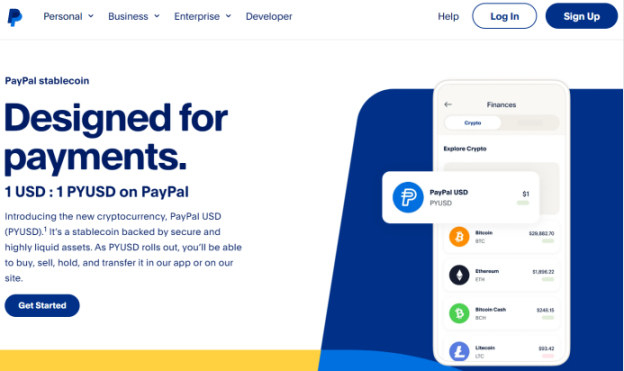
Additionally, as an ERC-20 token issued on the Ethereum blockchain, PYUSD can assist in expanding PayPal's ecosystem applications to external Web3 projects. Currently, most stablecoins are used in specific Web3 scenarios, but PYUSD is compatible with both Web2 and Web3 from day one.
PayPal CEO Dan Schulman stated: "The shift to digital currencies requires a stable tool that is both digital and easily pegged to fiat currencies like the dollar. PYUSD will provide the necessary foundation for the growth of digital payments."
Qualified U.S. customers can use PayPal to:
- Transfer: Move PYUSD between PayPal and compatible external wallets;
- Send: Make peer-to-peer payments using PYUSD;
- Fund Purchases: Choose PYUSD for payment at checkout;
- Convert: Convert to any cryptocurrency supported by PayPal.
The PYUSD stablecoin from a Web2 perspective could change the overall payment methods in Web3. Moreover, with over twenty years of experience communicating with regulators, PayPal is likely to be more cautious than other Web3 companies.
The issuer of PYUSD, Paxos Trust Company, was established in 2013 and primarily provides cash custody, cryptocurrency services, digital asset issuance, securities, and commodity settlement services. The company holds a Bitlicense for cryptocurrency operations in New York and is regulated by the New York State Department of Financial Services (NYDFS). Although Paxos faced regulatory requirements from NYDFS to delist the Binance-Peg BUSD stablecoin in February this year and received a Wells Notice from the SEC considering BUSD as a security, it is believed that the collaboration with PayPal is approached with caution from both parties in terms of market size and qualification review.
Starting in September 2023, Paxos will publish a monthly public PYUSD reserve report, along with a public third-party verification of the reserve asset value. The aforementioned certification will be issued by an independent third-party accounting firm and will be conducted according to the standards set by the American Institute of Certified Public Accountants (AICPA) to ensure the security and integrity of the assets.
In June 2022, PayPal also successfully obtained a Bitlicense from NYDFS, and it disclosed that it had engaged in extensive discussions with U.S. regulators and policymakers before the launch of PYUSD.
2. PayPal Aims to Profit from the Crypto Industry
It is well known that stablecoins are among the most profitable businesses in the crypto industry. Aside from basic income from transaction fees and service fees, the interest margin income similar to traditional bank deposit and loan businesses is particularly substantial in the current interest rate environment. It can be said that the current interest rates dominate everything.
From a business perspective, it is understandable that PayPal is targeting the crypto business. From an industry perspective, it is also reasonable for a tech company leading the traditional payment industry to fully embrace the narrative of blockchain, as Bitcoin and blockchain technology emerged to solve the problem of decentralized peer-to-peer electronic cash payment systems.
2.1 Yield from Reserve Assets
According to the Q2 2023 report released by Tether, the issuer of USDT, the total asset size of USDT has increased from $66 billion at the beginning of the year to $86 billion currently, with over $55 billion of dollar assets invested in risk-free assets like U.S. Treasury bonds, which accounts for most of its profits.
Reports indicate that Tether achieved over $1 billion in profit in Q2, and even $1.48 billion in profit in Q1, with Tether expected to earn $4 billion this year. This is more than the profits of global asset management giant BlackRock, which has only about 50 employees.
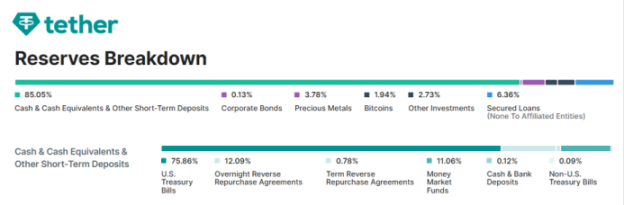
How to generate huge income?
Under the scale effect, the marginal issuance cost for stablecoin issuers is zero; they can issue dollar-denominated debt at zero cost to acquire fiat assets, and then invest those fiat assets into risk-free interest-bearing assets like U.S. Treasury bonds, retaining all the profits.
It is worth noting that Coinbase earned $374 million from exchange fees in Q2 2023 and $240 million from interest income with Circle. This reflects the current reality in the crypto industry—buying government bonds is more profitable than operating an exchange. The profitability of stablecoins, which can "make money daily," can already outshine 90% of publicly listed companies.
So how is zero-cost acquisition of fiat assets achieved?
The SEC provided Paxos, the stablecoin issuer, with a grand reason to avoid the risk of unregistered securities issuance previously charged against Paxos. As a centralized issuer, if it provides users with interest-bearing stablecoin assets, such stablecoins are likely to be deemed securities by the SEC.
Thus, we can see from the user terms of PayPal Cryptocurrency that Paxos, as the issuer, has the right to enjoy the fees generated from the custody of fiat assets, which will be shared with PayPal, and these profits have no relation to PYUSD stablecoin holders.

2.2 Monetization of Traditional Payment Business
PayPal SVP Jose stated in an interview: "In the past, the traditional profit mechanism for stablecoins has always been through the yield from reserve assets, which has been a considerable source of profit in the current interest rate environment. However, we do not believe this is the only profit mechanism; PayPal will achieve profitability through methods closer to traditional payment business, which means that when merchants want to accept stablecoin settlements, there will be a certain merchant discount rate, and individual users will incur certain related fees when exchanging different types of stablecoins."
Transaction exchanges have high-frequency application scenarios and stable fee deductions, which can sustainably contribute to revenue. PayPal will continuously integrate more cryptocurrencies and enrich the application scenarios of cryptocurrencies, making the trading and exchange (Convert/Swap) functions imminent. According to the listing documents disclosed by Coinbase to the SEC, Coinbase earned a staggering $1.5 billion from trading in Q1 2021, accounting for 86% of its total revenue of $1.8 billion at that time. For example, MetaMask has a fee rate of 0.875%, with its revenue reaching $250 million in 2021.
From the above analysis of PayPal's entry into the crypto industry, it is clear that the launch of PYUSD may not only change the current landscape of the stablecoin market but also alter the profit logic of traditional payment businesses, opening a new round of business model evolution in the traditional payment sector.
Clearly, compared to other stablecoin issuers, PayPal's various advantages are self-evident. It is believed that PayPal can leverage its massive traffic entry (Web2) combined with rich payment scenarios (Web2+Web3) and capitalize on its monetization advantages in traditional payment business to maximize the value of the PYUSD stablecoin.
3. What Are the Advantages of PayPal's Stablecoin?
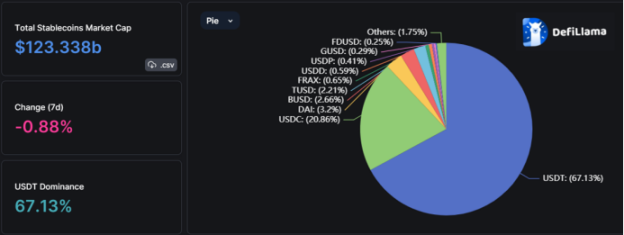 The PYUSD stablecoin issued by centralized PayPal is essentially no different from Tether's USDT or Circle's USDC. The only way to respond to direct competition is to attract new users through Web2 and increase market share, driving mass adoption in the crypto market.
In the current stablecoin market with a valuation of $120 billion, USDT and USDC account for approximately 68% and 21% of the market share, respectively. Currently, PYUSD is only available to eligible PayPal customers in the United States, and it will face direct competition from USDC and BUSD in the existing market, as these U.S. customers tend to prefer U.S.-regulated stablecoins.
As for offshore stablecoins, Tether CTO Paolo Ardoino stated that the launch of PayPal's stablecoin will not affect Tether, as the company does not provide services to U.S. users.

So, what exactly are the advantages of PayPal's stablecoin?
3.1 PayPal's Traffic and Scenario Entry
Former Paxos executive Austin Campbell stated: "One of the most underdeveloped scenarios in the crypto ecosystem is the inflow and outflow channels. From this perspective, it's hard to find a better choice than PayPal. I believe the biggest innovation here is the addition of a native stablecoin—PYUSD—directly on the PayPal platform."
The key to breaking the stablecoin barrier lies in gaining traffic entry, which is precisely what PayPal possesses. Regardless of how Web3 stablecoin products boast their advanced features and security, without the support of traffic entry and scenario participation, everything is just empty talk. With scenarios, there is traffic; with traffic, there is inflow.
If PYUSD becomes popular, it will once again prove that the growth path of Web2 payment business can also be applied to Web3, which requires strong commercial ecosystem support behind it. This is a competition of comprehensive strength in the company's ecosystem and the creation of sustainable business models, rather than the current Web3 projects' rapid advances through low-level stacks of cutting-edge technology and single business models.
3.2 PayPal's Blockchain-Based Advantages
In cross-border payments, the blockchain-based PYUSD can achieve simultaneous transfer of information flow and capital flow while transferring stablecoin funds, and "payment equals settlement," making transactions simple and secure.
In contrast, SWIFT only involves the transmission of international payment instructions between banks, which is not only more complex (requiring multiple steps and approvals from various banks) but also takes longer (often several days, while PYUSD typically takes seconds), with higher transaction costs. Additionally, PYUSD's public ledger accounting based on blockchain technology can maintain higher transparency compared to SWIFT's private ledger for payment settlement.
Theoretically, based on the blockchain technology architecture and PayPal's expanded business ecosystem, PYUSD can directly compete with Tether and Circle, potentially becoming a dark horse in the Web3 payment field.

PayPal SVP Jose also cited the advantages of PYUSD in an interview: "First, PYUSD is the only stablecoin accepted by the PayPal ecosystem, including Venmo and PayPal's bilateral network, which connects millions of consumers and merchants; second, PYUSD can fully utilize PayPal's complete global payment channels and convenient payment experience for inflow and outflow; third, compliance and regulation—PYUSD is issued by Paxos Trust Company, regulated by New York State, and draws on PayPal's over 20 years of experience in handling and preventing financial crimes online."
Despite the mutual praise in the business, overall, both traditional finance and the crypto industry view PayPal's launch of the stablecoin as a positive development, but there are also various concerns regarding PYUSD. These concerns stem from a departure from the spirit of decentralization and regulatory uncertainties.
4. Increasing Centralization of PYUSD
Although PayPal's stablecoin PYUSD is based on the Ethereum network, it is not a completely decentralized token. @Bitcoin's examination of the smart contracts deployed for PYUSD reveals that PayPal has the centralized authority to freeze wallet addresses it deems malicious and even forcibly remove PYUSD assets from those addresses on the Ethereum network, even if those addresses are not on the PayPal platform.
A similar example can be seen with Circle, which unilaterally froze $63 million of USDC due to security concerns with Multichain.

Centralized institutions can perform many operations that were previously impossible on the blockchain, which is inevitably a result of compromise with regulation. This compromised PYUSD resembles a central bank digital currency (CBDC) issued by a tech company. Although centralized institutions like PayPal and Circle can thereby avoid many scams and hacking incidents in the crypto industry, this is still viewed as a violation of the decentralization spirit of blockchain and the crypto industry in the traditional sense.
Although the centralized core of PYUSD may not satisfy the crypto industry, it could still serve as an important bridge for the blockchain and crypto industry to move towards mass adoption in the future.

Before PayPal launched PYUSD, MakerDAO had already returned to the center stage of the crypto world by leveraging the narrative of RWA. According to MakerDAO's Spark Protocol page, the DAI savings rate (DSR) has now increased to 8%, driven by the value capture of its RWA interest-bearing assets.
This change seems to revitalize DAI, with the latest data showing that the total locked value (TVL) of the DAI pool has exceeded $400 million, and DAI's market cap has surpassed that of BUSD. While the established DeFi project has the potential to lead a new round of DeFi Summer through the narrative of RWA, what we currently see is still a one-way rush from the crypto world to traditional finance, with much noise but little action.
The decentralized characteristics of DeFi projects and the magic of composability (such as decentralized stablecoins reflecting the value captured from RWA interest-bearing assets) are highly sought after by crypto enthusiasts, but for Web2 users, DeFi remains a dark forest filled with unease and uncertainty, akin to a maze. Web2's incremental users do not care whether you are decentralized; convenience, usability, and ease of operation are what truly matter.
5. PYUSD Will Accelerate Stablecoin Regulation
On July 27, 2023, the U.S. House Financial Services Committee introduced the "Clarity for Payment Stablecoins Act of 2023." The purpose of this bill is to provide a clear regulatory framework for stablecoins, establishing unified standards to protect U.S. investors and consumers.
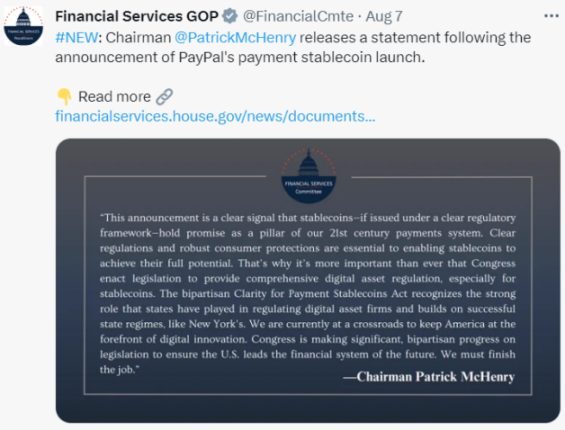
After PayPal announced its stablecoin plans, House Financial Services Committee Chairman Patrick McHenry immediately expressed support: "PayPal's announcement is a clear signal that stablecoins issued under a clear regulatory framework are expected to become a pillar of our 21st-century payment system. PayPal's stablecoin makes it more important than ever to continue pushing for legislation."
The launch of PYUSD also drew sharp criticism from Maxine Waters, the top Democrat on the House Financial Services Committee. Indeed, considering PayPal's massive audience at the federal level and globally (PayPal has 435 million customers worldwide, surpassing the total number of online accounts of all major banks), the corresponding regulation of stablecoins is only at the New York state level, and there is currently no clear regulatory framework for stablecoin oversight and enforcement at the federal level in the U.S., which is crucial for protecting consumer rights and maintaining financial stability.
Additionally, given the "currency" nature of stablecoins, which partially replaces some responsibilities of central bank fiat currencies, they are more likely to cause turmoil in the financial system. Therefore, the regulatory bodies for stablecoins will no longer be the SEC and CFTC; we may see the involvement of central banks and treasuries in other jurisdictions.
It is believed that PayPal's actions will create a sense of urgency for regulation, and the subsequent wave of stablecoins may soon drive Congress to legislate on stablecoins to balance innovation and risk.
6. Conclusion
PayPal's entry is just the beginning; more financial companies will follow suit, with notable names like Visa, Mastercard, and Square all exploring stablecoin applications. However, given the traditional finance sector's emphasis on compliance, this will likely start in the U.S. market and gradually expand overseas, and the pace will not be rapid.
While we have seen previous bull markets driven by internal factors in the crypto industry, such as the ICO boom, DeFi Summer, and the ups and downs of NFTs, this time may indeed be different. The stablecoin launched by PayPal could lead a new bull market, but this process will not happen overnight; it will take years, even decades.
And it is precisely at this moment that the snowball has just been pushed off the mountain top by PayPal.
REFERENCE:
[1] Is PayPal's Stablecoin a Lifeline for the Crypto Circle? https://foresightnews.pro/article/detail/40210 [2] PayPal Bets on Stablecoins: How Should China's Mobile Payment Leaders Respond? https://mp.weixin.qq.com/s/hBJ-upsQix7nlBqRHDKUZg [3] PayPal Steps On-Chain with PYUSD, Marking a Major Shift For Stablecoins https://flywheeldefi.com/article/paypal-steps-on-chain-with-pyusd [4] Will PayPal's PYUSD Steal Market Share From Tether and Circle? https://www.youtube.com/watch?v=KoqmqqJJNjY [5] PayPal's Stablecoin Is a Watershed Moment for Finance https://twitter.com/CoinDesk/status/1689326430641954834
 Risk warning
 Risk warning


Popular articles