








Detailed Explanation of the New Type of Stablecoin Flatcoin Proposed by Coinbase: How to Design an Inflation-Adjusted Stablecoin?

 Flatcoin, as its name suggests, is a token that maintains a "stable" purchasing power. When designing Flatcoin, careful consideration must be given to its intended scope and coverage before implementation.
Original Title: Flatcoins: Inflation-Adjusted Stablecoins
Original Authors: Jeff Emmett, Danilo Lessa Bernardineli, Jamsheed Shorish, Michael Zargham
Translated by: Leia, TEDAO
Introduction: What is a Flatcoin?
A Flatcoin is an emerging concept in token economics that can serve as a store of value token, adjusting its value in response to changes in inflation. The explicit goal of a Flatcoin is to maintain the purchasing power of token holders and/or specific interest groups (such as platform users).
A simple example is the fictional "i-DAI," which is DAI (an Inflation-Corrected DAI) excluding the inflation factor. The anchoring of i-DAI will be attached to a reference point in time, and its price will adjust in real-time with changes in inflation to maintain the purchasing power of i-DAI holders. The table below illustrates this typical behavior. As we will see in this article, although i-DAI is currently just a fictional concept, the idea of i-DAI can be realized through controller-based stablecoins (hereinafter referred to as "CBS"), with existing examples like RAI (a new algorithmic stablecoin launched by Reflexer Labs).
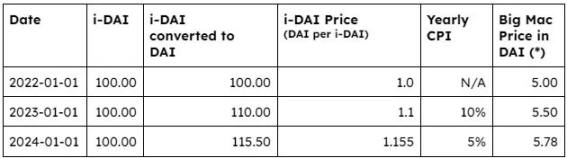
The table shows the value difference between DAI and the fictional i-DAI. () The behemoth price index in DAI is a fictional example used to illustrate the impact of CPI on goods.*
What is Inflation?
In economics, inflation refers to the general rise in prices, leading to a decrease in the purchasing power of money (used to express prices). In the web3 space, the definition of inflation is somewhat different, often (rather confusingly) used to describe the effects of token supply growth, although in traditional economic terms, this phenomenon should more accurately be referred to as "dilution." In this article, we will adhere to the traditional definition of inflation.
In an inflationary environment, currency holders may experience a decline in purchasing power, which can undermine trust in both the currency and the entire economic system. For this reason, inflation is considered a key indicator for measuring any economic system, and central banks around the world have a clear mandate to set a low annual inflation rate (typically between 2% and 4%) for the fiat currencies they manage. However, as recent experiences in the global economy have shown, this is not a simple task.
Given the recent high inflation pressures facing the global economy, Coinbase has proposed designing an inflation-adjusted "Flatcoin." The explicit goal of Flatcoin is to "maintain stable purchasing power while also being resilient to economic uncertainties caused by the traditional financial system." However, it must be emphasized again that this is no easy task—let's explore some of the inherent challenges in the design of Flatcoin.
Challenges in Flatcoin Design
Flatcoin presents a unique design proposition that encompasses several challenges that can be addressed independently or simultaneously. We will delve into the details of these challenges below. The core challenge lies in accurately perceiving inflation and creating appropriate incentive mechanisms.
Specifically, inflation, like many concepts in economics, operates within a complex adaptive system. This means there are numerous dynamic interactions among different factors and variables, including unpredictable human behavior, that can influence the causes and effects of inflation. This presents challenges in Flatcoin design, as any implementation of the design must consider and address many aspects, including but not limited to:
- Low temporal granularity of inflation indices
- Difficulties in spatial and temporal adjustments of sensor measurements
- Complexity of sensor fusion and effective controller design
- Challenges in achieving economic changes in Flatcoin through appropriate incentive mechanisms
A Viable Flatcoin Design: Controller-Based Semi-Stablecoins
A promising approach to constructing Flatcoin is to draw on and adopt the ideas and technologies of currently successful stablecoins—these successful stablecoins utilize the concept of controllers to "sense" price changes and adjust the incentives for participants, allowing the value of the held tokens to track a reference value.
These controller-based stablecoins are referred to as Controller-Based Stablecoins (CBS), with RAI being a practical example. RAI is inspired by similar theoretical and practical considerations. One reason RAI employs a controller is that the historical behavior of central banks in controlling inflation has been shown to be well described by a PID controller (composed of proportional unit P, integral unit I, and derivative unit D). This has been demonstrated in theoretical research by Hawkings et al. in 2014 and empirical research by Shepherd et al. in 2019.
Given the stability demonstrated by RAI as a CBS, we will use RAI as a case study and introduce a feasible CBS-based Flatcoin design structure.
RAI as a Case Study
RAI is a controller-based stablecoin that maintains its value in line with USD by using unsupervised PI controller-guided economic incentives and an oracle capable of "sensing" the RAI/USD price at any given time.
From a user experience perspective, RAI allows users to use ETH as collateral to obtain over-collateralized loans denominated in RAI. Outstanding debt is priced in RAI, and the interest rate (or redemption rate in the RAI ecosystem) is defined by the implemented PI controller. The amount of available loans is determined by the so-called redemption price, which is often closely related to the market price of RAI—the difference typically around 1%.
The logic of interest rate adjustments is based on the difference between the market price of RAI (priced in RAI/USD) and the redemption price of RAI (also priced in RAI/USD). When the redemption price is higher than the market price, interest rates tend to rise. When it is lower than the market price, interest rates tend to fall (even becoming negative!).
Why can RAI's price remain relatively stable? Even without anchoring, and even when using a volatile asset (ETH) as collateral, this is because RAI has a counter-cyclical incentive mechanism. The market price is determined by the secondary market of RAI buyers and sellers, thus exhibiting volatility; while the redemption price is determined by the PI controller, making it more controllable and stable. Therefore, when the difference between the two is significant, rational users will have the incentive to arbitrage.
Specifically, when the market price is higher than the redemption price, it is profitable to obtain RAI loans and sell them on the secondary market until the two prices converge, then purchase RAI from the secondary market to repay the debt and achieve a neutral position. This practice is particularly convenient when the market price remains above the redemption price for an extended period, as the redemption rate may become very low, generating arbitrage profits and interest rate profits. In any case, profiting from the system helps keep the market price of RAI tokens stable.
In the opposite scenario (i.e., when the redemption price is higher than the market price), the profitable action would be to buy as much RAI as possible from the secondary market and hold it until the prices converge, or to use it to close any outstanding RAI positions. The first action tends to reduce the number of RAI tokens circulating in the market, while the second action will burn RAI. Both actions will drive the system towards convergence with the market price.
The beauty of the controller behind RAI is that all these controller-guided incentives are driven by an external benchmark, namely the RAI/USD price obtained through external oracles. RAI does not directly rely on holding any USD reserves or liquidity pools to achieve price stability.
For designing Flatcoins, RAI's design represents a natural starting point for building an MVP (Minimum Viable Product), which requires two elements:
1) An inflation oracle;
2) A moderately regulated controller to measure inflation.
If you need more resources about RAI, you can check the following links:
- Reflexer Finance: https://reflexer.finance/
- https://medium.com/reflexer-labs/summoning-the-money-god-2a3f3564a5f2
- https://www.youtube.com/watch?v=dQRvDV5IILw
- https://github.com/BlockScience/reflexer
- https://github.com/BlockScience/reflexer-digital-twin
Challenges of Distributed Control
As mentioned earlier, building a Flatcoin requires a moderately regulated controller and an inflation oracle. Now, let's look at the challenges faced by both aspects.
Since inflation involves spatial, temporal, and compositional attributes (which will be elaborated on below), comprehensively measuring inflation is a fundamental challenge in the design of distributed control systems.
From the perspective of control theory, the design challenges of Flatcoin can be understood as:
(1) There is a geographically distributed "plant," i.e., the market for goods and services, which sends price signals for different goods at different times and locations.
(2) The first step is to design a set of sensors that capture relevant signals (at the correct frequency and appropriate locations) and merge them together at the appropriate temporal and spatial scales.
(3) These signals can then be input into a controller, processed into a sufficiently rich world model to estimate the market interventions needed for the Flatcoin's value to evolve as expected.
(4) Finally, this system needs actuators that can provide incentives to drive the secondary market to adjust the Flatcoin's value in line with inflation.
In the next section, we will explore some basic knowledge of control theory to further dissect the design issues.
Understanding Control Theory in Complex Adaptive Systems
Defining the Environment
In control theory, it is essential to clearly define the "boundaries" or environment of the system. A model can be established to sufficiently understand the world within that boundary, allowing for controllable decisions to be made within the system. Below, we will explore the various components of a control system.
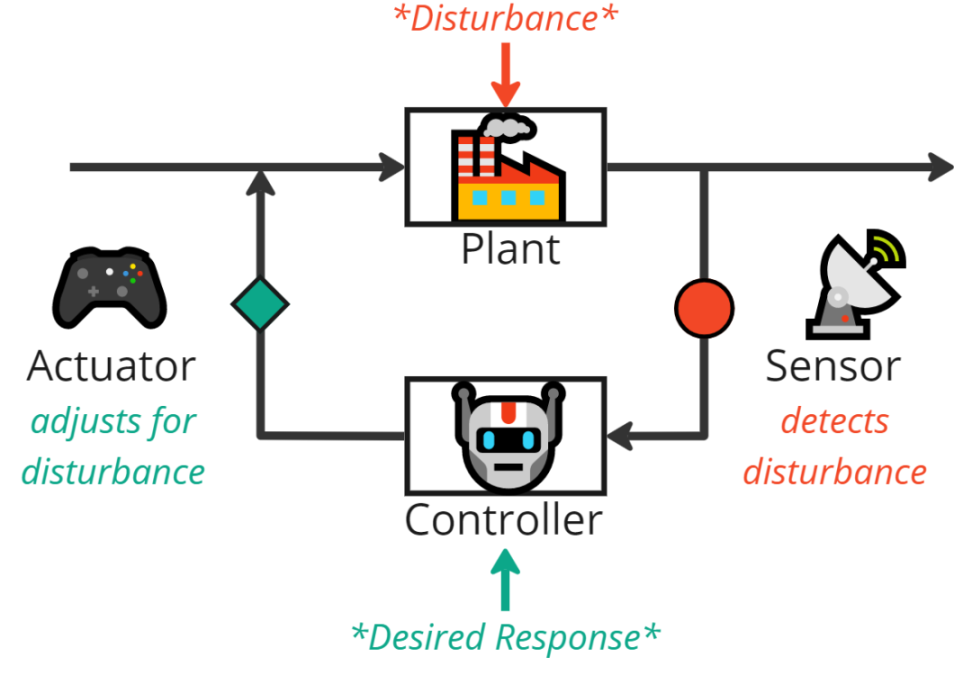
- Plants refer to the physical or mathematical systems being controlled. This can include mechanical systems, circuit systems, or even biological systems. Plants originally referred to factories and production plants equipped with thermostats and other sensors for temperature control.
- Sensors are devices that measure some aspect of system behavior or the environment, such as temperature, pressure, or component position. Here, sensors need to capture changes in the prices of relevant goods and services to calculate and adjust for changes in inflation.
- Actuators are devices that influence the future behavior of the system, such as motors, valves, heaters, or economic incentives, to ensure that the token's price adjusts appropriately with inflation.
- Controllers are the brains of the control system, processing information from sensors and using that information to adjust the behavior of actuators to achieve the desired outcomes. Controllers calculate appropriate actions based on the current state of the system and the desired outcomes, using algorithms and mathematical models to help manage the system's performance.
Sensors, actuators, and controllers together form the fundamental building blocks of a control system, which can be used to regulate and automate various processes, even in systems with unpredictable human interactions.
Delving Deeper into Flatcoin Challenges
The Difficulty of Inflation Adjustment
Any token designed to track inflation rates to mitigate their impact on purchasing power must address some tricky questions about which "sensors" and sources of information to use, such as: "Where does inflation occur?", "Who is affected?", and "Which goods and services are impacted?".
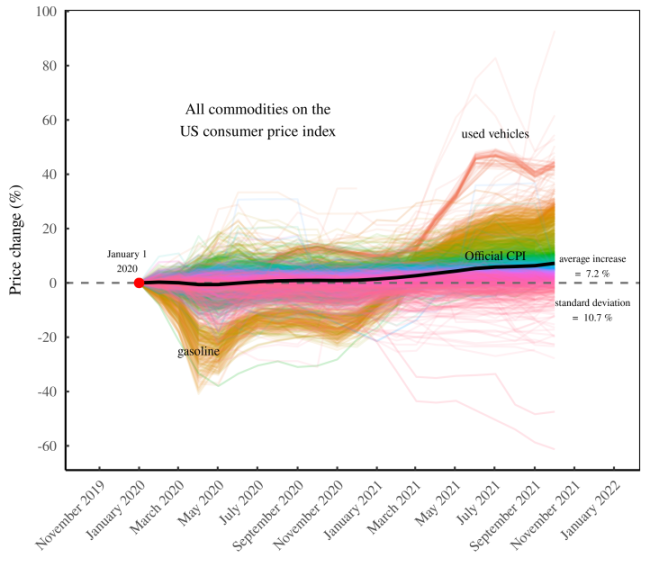
A schematic diagram of the price changes of different goods listed in the U.S. Consumer Price Index (CPI), compared to the official CPI index (black line) (Source: Blair Fix)
As economist Blair Fix vividly describes, inflation is not a "one-size-fits-all" phenomenon. Of course, there are inflation indices, such as the GDP deflator or CPI and PPI (Producer Price Index), but there are significant differences between these indicators and other standards (such as geography, industry, or sector). Additionally, these indices have low temporal granularity, with most being updated only monthly, while changes in purchasing power can have immediate effects in daily life (e.g., grocery shopping or gasoline purchases).
Flatcoin, as its name suggests, is a token that aims to keep purchasing power "flat," and careful consideration of its expected scope and coverage must be made in the design of Flatcoin before implementation. A token adjusted based on inflation rates may face high price volatility, as high inflation may occur in certain regions or industries and may persist for a long time. At the same time, this token also needs to adapt to situations where price volatility is low or even non-existent in other regions or industries.
Moreover, choosing which inflation measurement standard to use poses certain challenges, as inflation can vary significantly even at the national, regional, or metropolitan level. Standardized inflation measures, such as CPI, do not account for differences in purchasing power among different occupations, investments, and socio-economic or demographic groups.
Finally, from an implementation perspective, accurately and timely measuring inflation adds complexity to the design, as such tokens are susceptible to potential manipulation. Since the actuators of the Flatcoin system will rely on the reliability (and "trustworthiness") of the oracle subsystem, their design is also not straightforward.
Next Steps: How to Advance the Implementation of Flatcoin
The spatiotemporal challenges of this issue are quite daunting, and from the perspective of control theory methods, there are many interesting open design questions to tackle in order to create a token economy regulated by appropriate incentive algorithms.
In the spirit of agile methodology, we recommend adopting a minimally functional PoC (Proof of Concept) design and pilot implementation to meet the initial design goals. The PoC can be designed to be upgradable, allowing for iterative solutions to more specific and prioritized design challenges.
One starting point is to first limit the spatial component of inflation. A simple and recommended PoC design is to begin with a regional index Flatcoin and scalar price index within a single currency market, but this simple design may face various arbitrage challenges.
On a longer design timescale, a global composite index inflation token could address these arbitrage issues and thus have a more robust use case, but this clearly requires more conceptualization and design to tackle the various challenges presented in this article. As the first PoC is deployed and evaluated, additional requirements and feasibility can be proposed to gradually conduct research and development on sensors, controllers, and actuators, achieving a truly effective global-scale Flatcoin that encompasses diverse, multi-spatial indices.
 Risk warning Risk warning




Popular articles




