








2023 Q4 Outlook: Cancun Upgrade, RWA, and Gaming
 Xiusang believes that Chainlink holds the Smartcon conference every year on October 2nd, where significant announcements may be made.
Author: Yuzhong Kuangshui, Deep Tide TechFlow
Cancun Upgrade
The Cancun upgrade is the most important narrative recently. Large narratives often bring a lot of emotional aspects and traffic aggregation (not because of technical changes leading to price changes). However, Cancun has not announced a specific date yet, so there is no collective force. From the current progress, devnet9 is likely to be the last testnet, after which there will be a public testnet. But there is also a possibility that devnet9 is a short-term testnet, and devnet10 may be the final testnet.
During the public testnet phase, the likelihood of announcing a specific date (block time) for the Cancun upgrade will increase. However, this announcement is likely to come around mid-October or November.
The targets of the Cancun upgrade are mainly Layer2 solutions, such as Arbitrum, Optimism, and the recently announced potential benefits of Metis (Metis plans to become Ethereum's first decentralized L2 this year, allowing its community to take over key centralized components of the network), as well as some other Layer2 solutions. Additionally, Mantle is also promoting the growth of its own network, but currently, $MNT is performing average. The Cancun upgrade is also a positive factor for Coinbase's stock price.
Moreover, the sentiment will spread to protocols on Layer2. The preferred choice on Arbitrum is $GMX. On Optimism, $VELO may struggle due to its high inflation and the weakness of the Optimism ecosystem, while $SNX may perform better. However, if I had to choose only one target among these ecosystems, I would choose $GMX.
Why?
There are two main reasons:
First, I am optimistic about the future development of the Arbitrum ecosystem and the further development of GMX as a leading protocol (there are also GMX tasks in the Odyssey event);
Second, I am optimistic about future volatility (liquidity contraction is slowing down).
Let me explain the first point in detail.
Recently, Arbitrum passed a proposal to provide $50M in $ARB as a support fund for ecosystem protocols, and GMX will definitely receive a corresponding share. It mainly depends on whether GMX will use $ARB incentives to promote the development of v2. With GMX deploying additional incentives and the expectations/incentives of other protocols decreasing, there is a chance for a revival.
Additionally, I personally believe that the $50M in $ARB is not a concern; rather, this action will lighten the load, which is a good thing for $ARB (depending on how you interpret it).
The pros and cons of GMX v2 are quite clear. The downside is that it is not very friendly to large funds, liquidity is dispersed, and support for long-tail assets is not thorough enough. However, the advantages of v2 include being fee-friendly, better composability, and higher capital utilization, among others. Overall, I think that although market expectations for GMX v2 are low, the corresponding changes are addressing some previous issues, which is ultimately a good thing.
In summary, choosing $GMX is a bet on a reversal of expectations.
Let me say a few more words about Arbitrum. Recently, I am quite optimistic about what Arbitrum is doing, such as collaborating with Espresso Systems to explore shared sequencer solutions; launching XAI (Layer3) to promote the development of the gaming track (the gaming track may have a small explosion in the near future, which I will mention later), including Offchain co-founders stating that gaming is one of Arbitrum's growth areas; Arbitrum has launched Stylus, which allows developers to use traditional EVM tools and WASM-compatible languages (such as Rust, C, and C++) to build applications on the Arbitrum Nitro chain. Furthermore, Arbitrum has reopened the Odyssey event, which doesn't offer airdrops or rewards, only badges, and may need to be paired with the $50M $ARB reward.
However, ultimately, these are all technical changes, and whether they can trigger price changes remains to be seen based on market feedback.
RWA
FXS
$FXS is a coin with strong expectations, but it is also a difficult coin to trade. Although it previously gained widespread attention in the market through its Lend module mechanism, it has now returned to the price level seen when Curve had issues.
My personal judgment is that $FXS will not maintain a continuous rise; this round of price changes can only rely on the short-term expectations provided by new products. Its future expectations include but are not limited to: frxETH v2 (node operator lending model), Frax v3, FPI (Coinbase CEO believes Flatcoins, "stablecoins that can track inflation rates," will be the next generation of stablecoins), sFRAX (and FXB, RWA), Fraxchain, frxBTC (questionable, implementation will be more difficult, but it appears in the team's roadmap), etc.
From the perspective of fundamental changes in the project, perhaps only sFRAX (if FraxDAO's management model is more organized than MakerDAO's) can reverse the decline of $FXS and promote the growth of its stablecoin and positive income. I will closely monitor this matter.
Overall, Frax has too many products and complex lines, making it difficult to achieve sustainable price increases—especially in the current context of FRAX supply contraction, declining FraxBP TVL, and weak growth of frxETH.
In the RWA track, I am also paying attention to $MKR and $CFG. I believe $MKR has a chance to test $1600 (the price before the split may even exceed Ethereum). If thinking from the perspective of DeFi blue chips, I would also consider $AAVE. Currently, $AAVE is working hard to solve the $GHO de-pegging issue (de-pegging does not have a direct impact on the price of $AAVE).
Gaming
Web3 gaming will be the main area I focus on in Q4. I will mainly discuss a few coins related to gaming.
Gas Hero
The main reason for paying attention to Gas Hero is its developer, Stepn, who has put in some effort to create market buzz and generate early enthusiasm, so I personally think it is worth keeping an eye on this game.
From the white paper, Gas Hero does not have obvious advantages compared to other Web3 games, and the gameplay is not very innovative, being a combination of idle games and Ponzi. Since Gas Hero has not yet announced details about gold mining rewards, I cannot assert whether the game can maintain its popularity through a Ponzi model. Additionally, the trading dynamics of $GMT in the secondary market are quite complex. If one were to formulate a trading strategy solely based on the consumption of $GMT by Gas Hero, it would clearly be untenable.
Prime
Parallel is a chain game that I really like. Although there are some flaws in the balance of game design, the overall production quality (you can tell by how much money was spent and how many production staff there are) is quite good. It is a card battle game, similar in mode to Hearthstone, with card collection akin to Magic: The Gathering.
The most important aspect is that Parallel has deeply integrated $PRIME into its game economy. For example, in the game, each NFT card can accumulate prestige through gameplay, and the accumulation of prestige allows players to spend a certain amount of PRIME to mint Echo (phantom cards). The amount of PRIME consumed to mint phantom cards will be dynamically adjusted based on the demand for minting Echo (for instance, the amount of PRIME consumed for NFTs that are in high market demand will increase dynamically). Meanwhile, players do not need to purchase expensive cards; they can directly buy replicated Echo cards using PRIME/ETH. As the number of players onboarding the game continues to grow, the demand for $PRIME will be amplified, creating a flywheel effect.
However, the investment cycle for $PRIME is likely to be long, so finding the right "buy point" is crucial.
MC
Merit Circle's main move is to rename $MC to $BEAM and then perform a 1:100 split. Beam is built on the Avalanche subnet. Merit Circle claims that Beam has "a strong network of over 60 cooperative games, dozens of contributors, developers, tools, and investors."
GHST
The Aavegotchi chain is about to launch. Although the official announcement stated that the testnet would go live in September, September is almost over, and there is still no news. However, from the interactions between the official team and Polygon, they are working hard to push this forward (including launching a Game Center). The main issue is that the project's progress is too slow.
Others
LINK
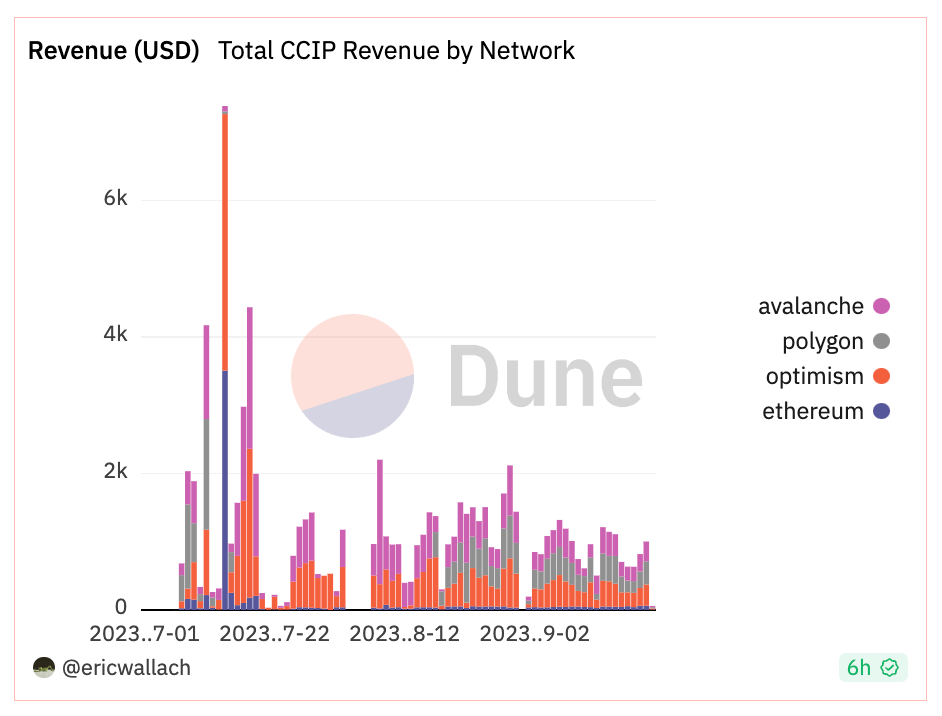
My views on $LINK are mainly based on the current price trends of LINK and @jyosamson's insights. Xiu Sang believes that Chainlink holds the Smartcon conference every year on October 2nd, which may lead to significant announcements. Additionally, the price of $LINK is closely related to the revenue from CCIP, and currently, there are no significant highlights in CCIP's revenue (which is also related to the overall market sluggishness).
SOL
The reason for paying attention to $SOL is that Solana has been very active in hackathons recently, and some KOLs/media in Europe and the US are also making a lot of noise. From the perspective of hackathon funding, the Solana Foundation is relatively wealthy. However, this does not have a direct relationship with the price of $SOL. The significant impact on the price of $SOL comes from the FTX sell-off. It has been confirmed that the $SOL held by FTX is not fully liquid; it is mostly investment shares, so its influence on the market is not as significant.
Finally, I would like to mention that in this article, the logic corresponding to tokens has varying strengths, so it is best to read carefully.
 Risk warning Risk warning


Popular articles





