








Has Layer 2 really scaled Ethereum?

Building a secure and user-friendly decentralized network relies on the development of key infrastructure. This vision is supported by a shared economic framework and embraced by billions of people. Layer 2 scaling solutions play a crucial role in establishing this foundation and enhancing Ethereum's capabilities. These projects collaborate to form a robust ecosystem that drives Ethereum to realize its full potential.
This article will delve into the innovations, narratives, challenges faced by Layer 2, and their transformative impact on the mass adoption of Ethereum. Our analysis will be based on data from Footprint Analytics' Layer 2 research page, providing valuable insights into this evolving ecosystem.
Why Do We Need Layer 2?
Blockchain technology has long been praised for its advantages such as decentralization, security, and scalability. However, the "blockchain trilemma" indicates that achieving all three within a simple architecture is highly challenging. Ethereum currently processes over 1 million transactions daily, but often faces network congestion and high transaction fees due to increasing demand. To address this issue, Layer 2 networks have emerged as an innovative solution.
The primary goal of Layer 2 is to increase transaction throughput by achieving higher transactions per second (TPS) while maintaining decentralization and security. These Layer 2 solutions aggregate multiple off-chain transactions into a single Layer 1 transaction to achieve this goal. As a result, transaction costs are significantly reduced, making Ethereum more user-friendly and inclusive for a broader audience.
Types of Layer 2
Currently, there are three main types of Layer 2: Rollups, State Channels, and Plasma.
Rollups
As a Layer 2 solution, Rollups aggregate multiple transactions into a single transaction on Layer 1, saving user costs by distributing transaction fees among participants within the Rollup. There are two main types of Rollups: Optimistic Rollups and Zero-knowledge Rollups (ZK-Rollups). Optimistic Rollups use fraud proofs to ensure the validity of off-chain transactions, while ZK-Rollups utilize zero-knowledge proofs to enhance privacy and security.
Examples of Optimistic Rollups include Arbitrum (Arbitrum One), Optimism (OP Mainnet), and Base.
- Arbitrum was launched by the Offchain Labs team in August 2021 and has become a leader in the industry, capturing over 50% of the market share. With the Nitro upgrade, Arbitrum achieved full EVM equivalence, allowing developers to seamlessly migrate smart contracts from Ethereum to Layer 2 with minimal or no modifications.

- Optimism is the second-largest Ethereum Layer 2 solution, soft-launched in January 2021 and fully opened to the public in December of the same year. Optimism employs an EVM-equivalent architecture, providing a seamless scaling solution for Ethereum applications.
- Base was launched on the mainnet in July 2023 in collaboration with Optimism, built on the OP Stack. In just a few months, it has achieved significant success, securing the third-largest market share in the Layer 2 space. Base is incubated by Coinbase, leveraging Coinbase's expertise in building crypto products.
On the other hand, ZK-rollup applications include zkSync Era, Starknet, Linea, and Polygon zkEVM.
- zkSync Era is the world's first zkEVM blockchain, launched on the mainnet in March 2023, quickly capturing the fourth market share in the Layer 2 space. In terms of user activity (including TPS and transaction count), zkSync Era has become the dominant Rollup solution.
- Starknet launched its mainnet in November 2021. It uses the STARK cryptographic proof system to achieve security, low cost, and high performance. Starknet employs Cairo as its development language, which is not EVM compatible. Efforts are underway to achieve compatibility between Solidity and Cairo through a translator called Warp.
- Linea, a Layer 2 solution under ConsenSys, launched its mainnet in July 2023. It offers EVM compatibility, allowing developers to easily migrate and build applications on its network.
- Polygon zkEVM launched its public beta in March 2023, aiming for EVM equivalence. Polygon (formerly Matic) is a blockchain platform offering diverse blockchain solutions. Polygon zkEVM is one of Polygon's products.
State Channels
State channels are a mechanism that allows participants to conduct fast and unlimited off-chain transactions, settling the final results on Ethereum. This approach can reduce network congestion, fees, and transaction delays.
Raiden Network is an off-chain scaling solution focused on researching State channel technology, defining protocols, and developing reference applications. It enables near real-time, low-cost, and scalable payment functionalities, compatible with ERC20 tokens on Ethereum. The network aims to enhance scalability and usability while maintaining compatibility with the Ethereum ecosystem.
Plasma
Plasma chains are independent blockchains anchored to the Ethereum main chain, utilizing fraud proofs (similar to Optimistic Rollups) to resolve disputes.
OMG Network leverages Layer 2 Plasma architecture, providing strong security guarantees and high throughput. It offers a scalable solution for third-party developers intending to build decentralized payment applications on Ethereum.
Data Insights
Consensus is forming: Ethereum will achieve mass adoption; it's just a matter of time. So, how is its progress?
Similar to the spread of other technologies, Ethereum's adoption trajectory can be described by a classic bell curve. It begins with a small group of innovators quickly adopting the technology, followed by the involvement of early adopters. As Ethereum continues to develop and mature, it gradually expands its reach, attracting most early and late adopters, eventually entering the mass adoption phase. Ultimately, in the final stage of adoption, the technology will benefit the remaining segment, known as the "laggards."
Let’s explore the impact of Layer 2 on Ethereum's mass adoption from the following aspects:
TVL (Total Value Locked)
Total Value Locked (TVL) is considered a leading indicator of adoption.
As of the end of October 2023, Arbitrum leads with a TVL of $6.004 billion and a market share of 61.03%, solidifying its position as a market leader. Optimism follows closely with a TVL of $2.598 billion and a market share of 26.41%, demonstrating its widespread adoption and user engagement.
Other chains make up the second tier but lag far behind with less than 5% market share. The newly launched Base on the mainnet on July 13, 2023, ranks third with a TVL of $463 million. zkSync Era ranks fourth with a locked value of $451 million, while Starknet ranks fifth with a TVL of $135 million.
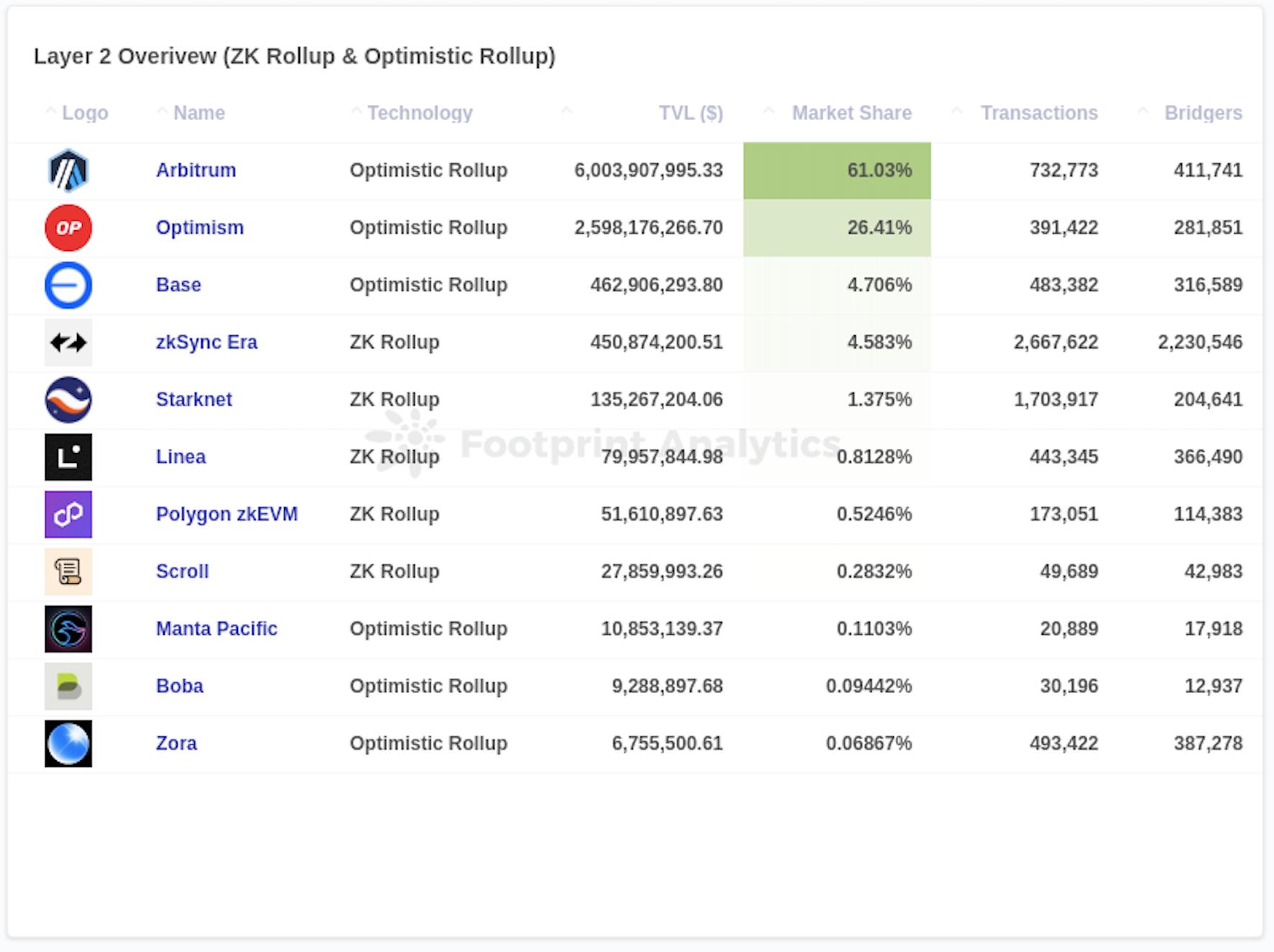
Data Source: Layer 2 Overview
User Count and Transaction Volume
User activity, such as the number of unique users (bridgers) interacting with Ethereum and transaction volume, is a key metric for measuring adoption.
Among various Layer 2 solutions, zkSync Era is far ahead, accumulating 2.67 million unique users, accounting for 37.10% of all Rollups, and facilitating 2.23 million transactions, representing 50.84% of Rollup activity. The initial airdrop campaign of zkSync Era attracted a large number of users, and it has maintained its leading position since. In terms of transaction volume, Starknet follows closely with 1.7 million transactions, accounting for 23.70% of Rollups.
Base and Linea, launched on the mainnet in July 2023, have gained popularity in the market. They have surpassed Optimism and Polygon zkEVM in both unique user engagement and transaction volume.
Transaction Throughput
Transaction throughput is one of the main scaling challenges frequently discussed in the blockchain community.
Currently, the Ethereum mainnet has a processing capacity of about 15 transactions per second (TPS). In contrast, Visa has the capacity to process approximately 24,000 TPS, while Mastercard can handle 5,000 TPS.
Layer 2 is narrowing this gap. In October, well-known Rollup solutions like Arbitrum and zkSync Era had an average TPS of around 9.5 to 10, making them the closest in performance to Ethereum among existing Rollups. Rollups collectively made significant contributions to scalability, with total transaction throughput in October exceeding Ethereum's mainnet by 321%, achieving a scalability factor of 4.21.
Although Rollup technology helps improve scalability, currently no single Rollup can exceed Ethereum in throughput. Attracting and retaining users during a bear market is challenging for both Layer 1 and Layer 2 networks. Establishing a thriving Layer 2 ecosystem requires not only robust solutions but also high-traffic applications. Additionally, the user experience has been affected due to the lack of seamless interaction between multiple Layer 2s and between Layer 1 and Layer 2, such as the need to switch wallets and incur liquidity costs.

Fees
Layer 2 plays a crucial role in reducing Ethereum network fees. By aggregating multiple off-chain transactions into a single Layer 1 transaction, Ethereum's transaction fees have significantly decreased.
According to data from Footprint Analytics, the average transaction fee for Rollups in October 2023 was 3% to 10% of Ethereum's fees.

Data Source: Average Gas Fee
These figures indicate that Layer 2 is becoming increasingly popular, with rising adoption rates, highlighting their potential in alleviating Ethereum's congestion and enhancing scalability.
Innovations in Layer 2
In the ever-evolving field of blockchain technology, leading Layer 2 solutions like Optimism, zkSync, and Arbitrum are actively pursuing innovative approaches to address ongoing challenges while maintaining a focus on interoperability. These well-known participants are keeping a rapid pace of innovation in technology and applications, continually striving to stay ahead and maintain a competitive edge in the market.
Superchain, proposed by the Optimism ecosystem, is a network composed of multiple networks that share a common codebase called OP Stack. This framework aims to establish an interoperable environment where various Layer 2 networks can communicate and transact with each other, similar to how the internet enables communication between devices. By providing horizontal scalability, Superchain addresses challenges associated with traditional multi-chain architectures. These challenges include different security architectures between parallel chains, which may increase systemic risks as more chains are added, and the costs of establishing new nodes for each additional chain.

Source: Superchain - OP Stack Docs
In June 2023, zkSync launched Hyperchains, a new type of network that operates as fractal instances of zkEVM. These Hyperchains run in parallel with Layer 1, sharing settlement, and can flexibly operate as Layer 2 networks alongside zkSync Era or as Layer 3 Validium. Hyperchains within the zkSync ecosystem can be developed and deployed by anyone without permission. To ensure trust and seamless interoperability, each Hyperchain must be powered by the same zkEVM engine on the ZK Stack. GRVT is the first Hyperchain in the zkSync ecosystem, a hybrid cryptocurrency exchange that combines the advantages of centralized and decentralized exchanges. Its internal Alpha version is expected to launch in November 2023, followed by the mainnet version in the first quarter of 2024.

Source: Architecture - GRVT
Arbitrum Stylus, launched by Arbitrum in August 2023, allows the development of smart contracts on its Layer 2 network using multiple programming languages such as Rust, C, and C++. In addition to Solidity, developers can now write smart contracts in languages compatible with WebAssembly (WASM). WASM can run code in languages like Rust and C++ on the web, and using Arbitrum Stylus allows these codes to run on the blockchain. Stylus introduces a second fully interoperable virtual machine with EVM equivalence, providing a new way to write smart contracts.
The Narrative of Layer 2
Since 2022, Layer 2 itself has become an important narrative in the cryptocurrency space. In the Layer 2 domain, narratives play a significant role in shaping public perception and influencing market trends. These narratives provide insights into the future of Layer 2 and Ethereum as a whole.
- Full-chain gaming. These games utilize blockchain to replace centralized game servers, putting all aspects of the game on-chain, including assets, logic, state, and storage. Starknet and COMBO (currently running on the testnet) have positioned themselves as significant supporters of full-chain gaming within the public chain space.
- Modular blockchains. Initially, blockchains adopted a monolithic design, with a single blockchain handling all tasks. However, the concept of modular blockchains has emerged, focusing on specific functionalities rather than attempting to cover all features. Celestia is the first modular blockchain network. It is ready and announced its airdrop and launch plans in October 2023.

- Zero Gas fees. Gas fees have long been a major barrier to the mass adoption of Ethereum. To address this pain point, GasZero (currently running on the testnet) has emerged as a Layer 2 network that offers a unique solution: no Gas fees for trusted end-users. On GasZero, users can interact with decentralized networks and smart contracts without preloading any tokens in their wallets.
- Layer 3. The concept of Layer 3 in the blockchain industry currently lacks a widely accepted definition. Ethereum co-founder Vitalik Buterin believes it is too early to define it clearly, as the architecture of the multi-Rollup ecosystem is still evolving, and most discussions remain theoretical. However, Vitalik shared three possible futures for Layer 3:
- Layer 2 for scaling, Layer 3 for customized features like privacy protection.
- Layer 2 for general scaling, Layer 3 for customized scaling.
- Layer 2 for trustless scaling (Rollups), Layer 3 for weakly trustless scaling (Validiums).
Challenges Faced by Layer 2
As an alternative to the congested Ethereum network, economically efficient Layer 2 networks are gaining increasing attention. It is crucial to maintain a robust foundational layer while cautiously scaling certain capabilities. The Ethereum community encourages the development of technologies and applications, but it is essential to strike a delicate balance between user-friendliness and the benefits of decentralization, as emphasized by Vitalik Buterin during the Ethereum Hong Kong hackathon in October 2023.
According to Vitalik, Layer 2 faces four key challenges:
- Security and decentralization of proof systems. Validity (zero-knowledge) proofs and fraud proofs are used to verify the legitimacy of transactions without processing them on the Ethereum chain. However, validity proofs face centralization issues due to their reliance on specific hardware.
- Decentralization of sequencers. These sequencers validate, order, and compress transactions before transmitting them to Layer 1. However, this centralized setup has been criticized for its potential to become a single point of failure, censorship vulnerabilities, or being easily shut down by authorities.
- Cross Layer 2 wallets. They enable seamless interaction between multiple Layer 2 solutions without the need to switch wallets.
- Data availability. This refers to the availability of on-chain data, the challenge of storing complete copies of blockchain data to verify transactions. Notably, solutions like Validiums and Optimiums are often not classified as Layer 2 because they do not publish data on Layer 1. Instead, they introduce additional trust assumptions above Layer 1.
Moreover, as previously mentioned, currently no Layer 2 network can exceed Ethereum in throughput. The urgent task is to develop the Layer 2 ecosystem.
- Ecosystem and applications. Currently, most applications in the Layer 2 ecosystem are DeFi applications. They need to introduce more types of phenomenal dApps for Layer 2 to expand its ecosystem, attract more users, and encourage them to stay.
Conclusion
In conclusion, by effectively addressing the scalability and cost challenges hindering Ethereum's development, Layer 2 networks are driving Ethereum towards mass adoption. These networks provide innovative solutions that enhance transaction throughput and reduce fees, making Ethereum more accessible and inclusive for a broader audience.
Additionally, beyond Ethereum's Layer 2 networks, opBNB has emerged as a response to scalability challenges on the BNB chain. In September 2023, opBNB successfully completed its mainnet launch. In fact, in the face of these challenges, the responses and future directions of other public chains are equally anticipated. The focus remains on ecosystem development and user attraction. Infinite possibilities unfold before us, and each public chain will embark on its unique path toward scalability and mass adoption.
The content of this article is for industry research and communication purposes only and does not constitute any investment advice. The market is risky, and investment should be cautious.
This article is contributed by the Footprint Analytics community.
The Footprint Community is a global mutual aid data community where members leverage visualized data to create shareable insights. In the Footprint community, you can get help, build connections, and exchange knowledge and research related to Web 3, the metaverse, GameFi, and DeFi. Many active, diverse, and highly engaged members inspire and support each other through the community, creating a worldwide user base to contribute data, share insights, and drive community growth.
Footprint Analytics Official Website: https://www.footprint.network
Discord: https://discord.gg/3HYaR6USM7
Twitter: https://twitter.com/Footprint_Data
 Risk warning
 Risk warning


Popular articles





