








PETGPT: Not just a game, but the AI pet that understands you best

 A new pet-raising experience in the era of AI intelligence.
Written by: PETGPT
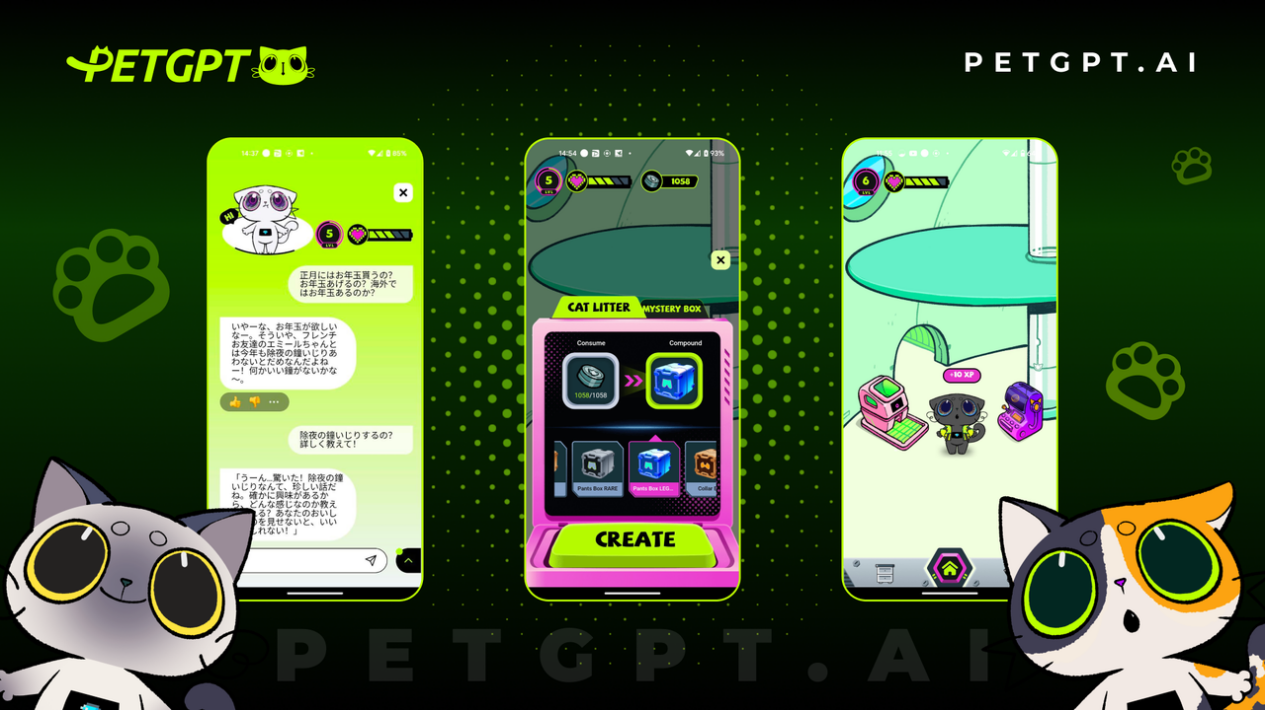
As ChatGPT sweeps across the globe, have you ever imagined a future accompanied by AI?
On a quiet evening in 2025, you sit in your study, furrowing your brow as you handle complex work. The sunset casts its glow on the floor, but you have no time to admire the scenery outside the window. At this moment, your AI pet Milo lazily lies beside your computer, quietly watching you, its blue eyes sparkling with warmth. Suddenly, Milo sweeps your hand with its fluffy tail and softly meows, reminding you to relax. You ease your brow, smile, and stroke its smooth, soft fur, feeling its attachment to you, and your mood suddenly lifts.
Then, Milo jumps off the table, looking back at you as it walks, signaling you to follow it to the little garden in the yard. Once you choose a comfortable spot to sit, Milo jumps into your lap and gazes into your eyes, prompting you to speak freely to it. Encouraged, you start venting to Milo about the terrible experiences of the day. Milo perks up its ears, listening intently to every word—when you mention the unpleasant moments, it emits a "mew mew" sound, echoing your complaints; when you talk about the good parts, it purrs and rolls around in your lap, celebrating with you. In that moment, accompanied by the gentle evening breeze and meowing sounds, your heart is filled with softness thanks to Milo.
The above scene embodies PETGPT's greatest vision: AI can not only assist humans in work but also generate emotions and accompany life.
Current AI technology has indeed made significant advancements. AI models launched by major companies like OpenAI, Google, and Amazon have shown potential in supporting intelligent characteristics in the fields of language processing and machine learning, achieving complex dialogues, contextual understanding, and even enabling ChatGPT to engage in voice communication, simulating emotional responses to some extent.
However, to further build intelligent AI entities, there are still some capabilities that are being iterated. First, hardware capabilities. Currently, data processors and storage technologies are extremely advanced globally, with millisecond-level speeds becoming the industry standard. However, in terms of AI simulating complex human cognition and emotional processing capabilities, such as synchronous processing of multi-sensory inputs and rapid responses, the marketization of these hardware conditions is still ongoing.
Second, after the emergence of ChatGPT, most AI application scenarios we discuss are primarily focused on work assistance, especially in generating content, such as data analysis, report generation, command painting, and daily task automation. These scenarios often revolve around data-driven work environments aimed at improving work efficiency rather than deep emotional and social interactions. Therefore, although AI theoretically can support more complex interactions, these advanced features have not been fully developed and utilized in practical applications.
Nevertheless, for humans, the emergence of AI should not be limited to enhancing work efficiency or even replacing jobs; it should meet broader human needs, such as:
- Social interaction, serving as a chat partner, providing companionship for those in need of social interaction;
- Emotional support, recognizing and responding to human emotions, offering support and comfort, especially in the field of mental health;
- Life companionship, providing convenience and companionship in daily life through smart home devices;
- Interpersonal assistance, helping people establish and maintain interpersonal relationships, and even assisting in finding potential social opportunities.
Against this backdrop and demand, PETGPT, based on relatively mature AI technology (OpenAI) and blockchain technology, deeply explores the potential possibilities and application scenarios of intelligent AI entities, innovatively combining the Web 3.0 concept with pet-raising games to provide players with a unique personalized AI pet interaction experience. This game is not just a simple pet-raising game; it features a carefully designed AI prompt system that gives each pet unique personality traits, becoming an AI entity with initial self-awareness.
In PETGPT, players can gradually shape and develop their pet's unique personality through daily communication, interaction, and games with their pet cat. This process not only provides players with a deep emotional connection but also creates a shared growth experience. Over time, these pet cats can learn and adapt to the players' more complex emotional needs, offering personalized feedback and companionship.
Imagine, when you confide your troubles to your cat, it immediately gives you a soft nuzzle to soothe your negative emotions; when you perform a song for your cat, it "dances" along with your singing; when you visit friends with your cat, it can remind you of common topics with your friends, easing any awkwardness in conversation and deepening your emotional connection with them.
Based on these features, PETGPT is not just a pet-raising game; it is actually leading a new interactive experience, heralding the arrival of the era of intelligent AI entities. With the development of technology, PETGPT has the potential to become a milestone marking the deep integration of AI into human life.
Currently, the PETGPT app has completed iterations of AI interaction and includes various gameplay modes such as Farm, Social, and Show. Players can earn corresponding rewards and experience points through daily interactions and games with their pets. Players can also add each other as friends and visit each other's pets, or team up with friends to complete games for more rewards and experience points. Additionally, the official website has launched the founding cat NFT, which cannot participate in the game but grants the holder more community rights and future token distribution.
If you are interested in intelligent AI entities, why not have a pet of your own in PETGPT and embark on a story of growth and companionship?
 Risk warning Risk warning




Popular articles





