








CPI plummets, whales buy the dip, BTC recovers the lost ground of $69,000

 Bitcoin whales "buy the dip" after the CPI announcement.
Author: Mary Liu, BitpushNews
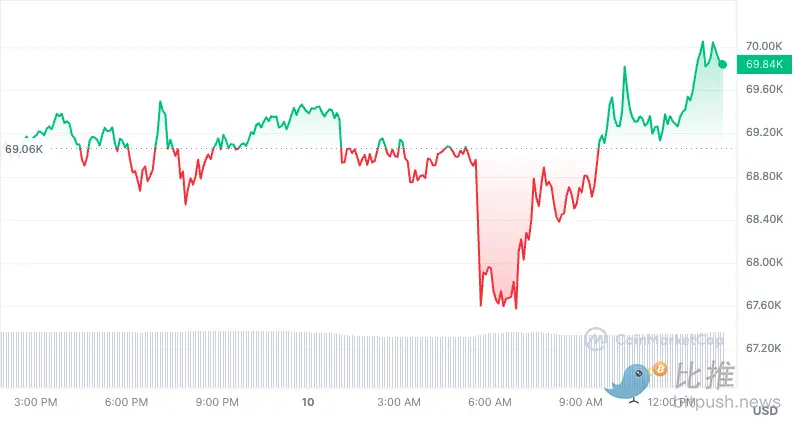
Higher-than-expected U.S. Consumer Price Index (CPI) puts pressure on the crypto market. In early trading on Wednesday, Bitcoin traded near the support level of $69,000 but fell to a low of $67,475 after the CPI release. Subsequently, BTC recovered the lost ground and returned to $69,861.99 at the time of writing, with a 24-hour increase of 1.03%.
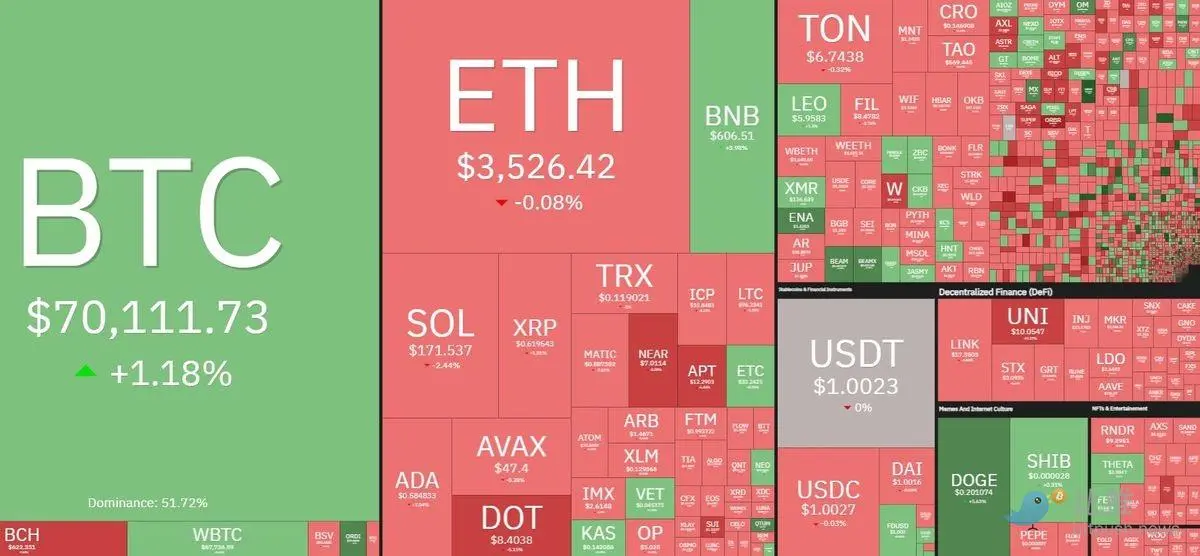
The altcoin market showed mixed results. Memecoin (MEME) led with a 15.7% increase, followed by Ethena (ENA) with a 14.4% rise.
After the U.S. Securities and Exchange Commission (SEC) issued a Wells notice to Uniswap Labs, Uniswap (UNI) saw the largest decline, dropping by 10%. Other tokens with significant declines include Theta Fuel (TFUEL), down 9%, and Axelar (AXL), down 8.5%.
Data shows that the CPI rose by 0.4% in March, compared to an expectation of 0.3%; year-on-year, it increased by 3.5%, against an expectation of 3.4%. This indicates that U.S. inflation is not well-controlled, and despite other indicators showing better-than-expected economic performance, it has dampened investor expectations for a rate cut by the Federal Reserve sometime this summer.
The yield on the U.S. 10-year Treasury bond reached its highest level since November, climbing nearly 20 basis points. Meanwhile, the U.S. Dollar Index (DXY) surged 1% to above 105, hitting its highest level since November 2023.
Traders are re-evaluating bets on a Fed rate cut. The CME FedWatch tool currently shows that the expectation for a rate cut in June has dropped to 19%, while the possibility for a cut in July is now at 44%. Yesterday, these figures were 57% and 74%, respectively.
The U.S. benchmark stock index hit its lowest level in nearly four weeks during trading. As of Wednesday's close, the Dow Jones Industrial Average was down 420 points or 1%, the S&P 500 fell 0.95%, and the Nasdaq dropped 0.84%.
Bitcoin Whales "Buy the Dip" After CPI
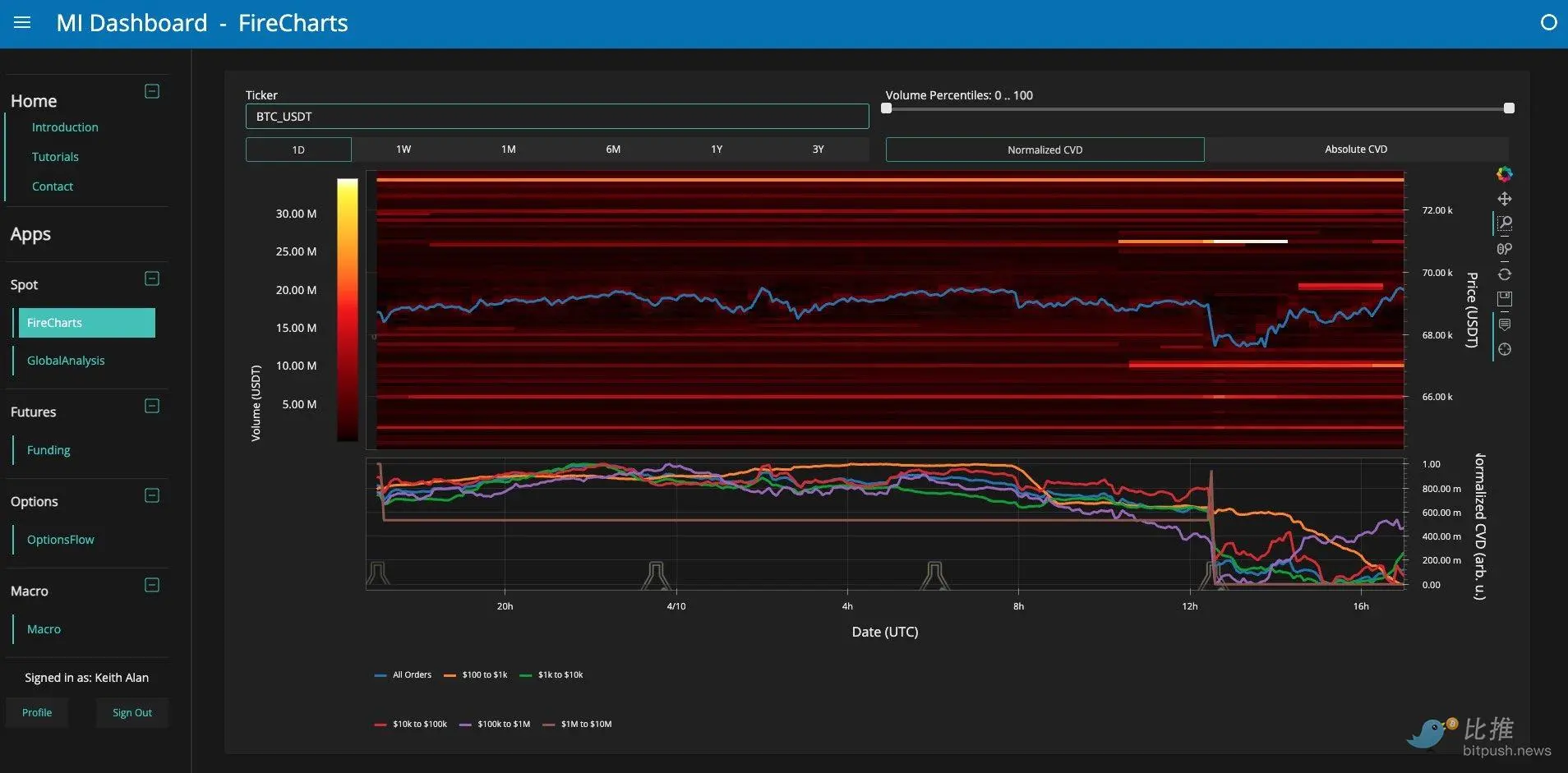
Despite the "hot" CPI data, BTC's price trend reversed upwards. Trading platform Material Indicators tracked an increase in buying volume on Binance, the world's largest exchange, indicating that whales may be buying the dip.
The company stated in a post on X: "FireCharts classified CVD (one of the proprietary trading indicators) shows that whales bought BTC on the dip, and thus Bitcoin returned above $69,000, with daily candlesticks turning green again."
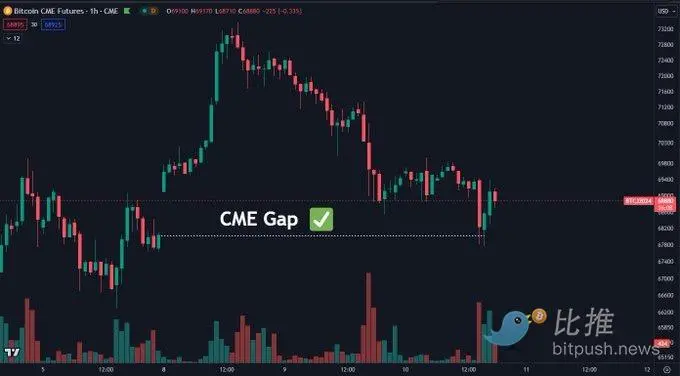
Meanwhile, trader Daan Crypto Trades pointed out that the CME gap created by the drop below $68,000 over the weekend has narrowed with the rise in the Consumer Price Index (CPI), rebounding from the gap closing level so far.
Short-Term Volatility
RAILGUN writer Alan Scott stated: "With the halving approaching, all eyes are on Bitcoin, but a major factor could make this cycle different from others. Bitcoin reached an all-time high before the halving, which is a first in cryptocurrency history, leading to greater selling pressure."
He added: "Short-term holders who bought Bitcoin at higher prices will continuously sell, sell, sell, altering their asset allocation and taking profits. It is also worth noting that the tax season from April 15 to May 1 will eliminate liquidity in the system, which often negatively impacts short-term price movements."
Scott warned: "This could lead to significant volatility for Bitcoin for quite some time after the halving. Macroeconomic events, such as the Fed's quantitative tightening, could cause Bitcoin to drop as more liquidity is withdrawn from the market. While cryptocurrency has indeed rebounded this year, it is important to note that many factors could lead Bitcoin into trouble."
However, one potential buffer against price drops after the halving is the supply of Bitcoin on exchanges, which has been steadily declining in recent months.
Julio Moreno, head of research at cryptocurrency analysis firm CryptoQuant, stated that while the new issuance will be halved after the halving, demand for Bitcoin is expected to continue to rise. Moreno wrote on the X platform: "Dollar inflation is accelerating, while Bitcoin's inflation rate will halve next week."
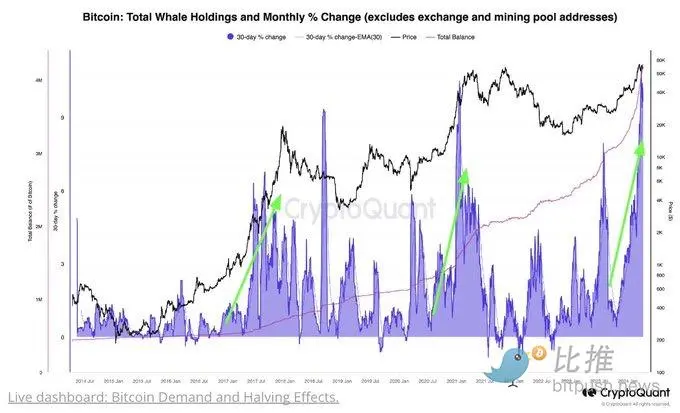
Data provided by CryptoQuant indicates that the growth in demand for Bitcoin is currently "around historical highs (11% month-over-month)," primarily driven by large holders and whales.
As banks like Morgan Stanley and UBS compete to offer clients spot Bitcoin exchange-traded funds (ETFs), demand is expected to continue to rise. Additionally, according to Tencent Finance's "First Line" report, Harvest and Huaxia have been approved for "crypto" asset management qualifications in Hong Kong, with Bitcoin spot ETFs expected to launch as early as the end of April.
Based on these factors, market analyst Rekt Capital believes that any price drop in Bitcoin from now until the halving could trigger a rapid rebound.
Another individual with a bearish outlook on the short-term trend is BitMEX co-founder Arthur Hayes, who believes that risk assets will be extremely weak before May 1. The halving and a "series of tricks" from the Fed and the Treasury are the reasons he decided to "give up trading before May." However, Hayes remains optimistic about the mid-term trend.
 Risk warning Risk warning



Popular articles





