








What impact will Bitcoin's fourth halving officially have?

 The daily reduction in supply accounts for only 0.6% of the trading volume, and its impact on prices is smaller than before. In addition, compared to supply, the demand related to spot ETFs will play a more critical role in determining prices.
Original Author: NYDIG
Original Compiler: Felix, PANews
Key Points:
- Bitcoin will undergo a halving on April 20 (Beijing time), reducing the block subsidy by 50%, marking the fourth halving since Bitcoin's launch 15 years ago.
- The halving is fundamental to Bitcoin's fixed supply, limiting the total supply to (almost) 21 million coins.
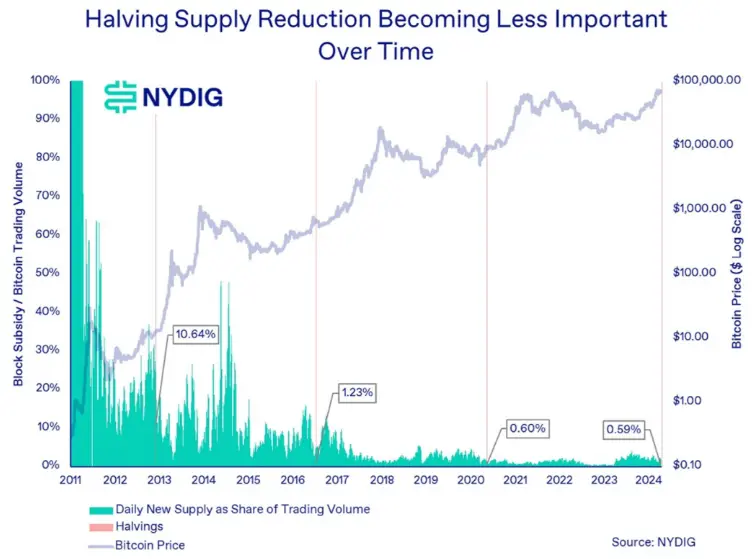
- The reduction in supply accounts for only 0.6% of daily trading volume, and its current impact on price is smaller than before.
- The economic impact of the halving is more significant for miners, as their primary source of income is reduced by 50%.
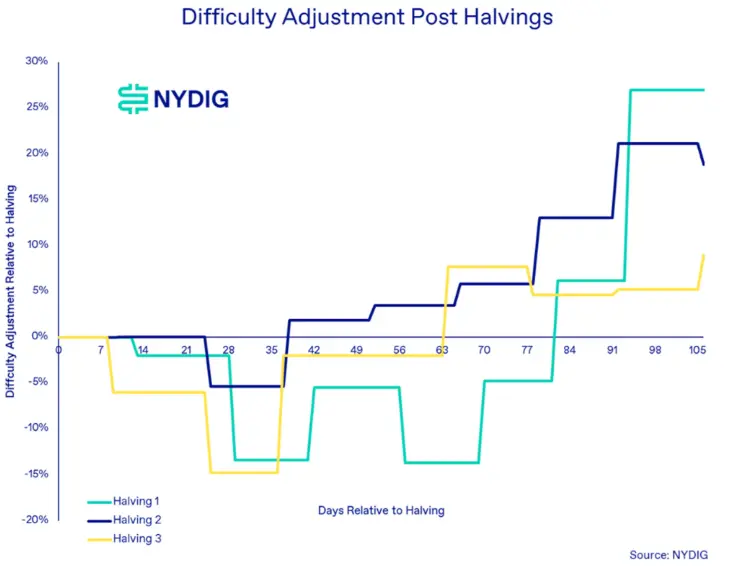
- Historically, after halvings, mining difficulty has decreased by 5.4% - 14.7% due to the exit of unprofitable hash rates. However, considering Bitcoin's price and miners' break-even points, it is unlikely that many hash rates will go offline (if any).
Introduction
On April 20, at block 840,000, Bitcoin will experience an event that has only occurred three times before: a block reward halving. This event, also known as the "halving," is crucial for the economic outlook of Bitcoin's scarcity. For some, this event is a significant price driver, as the daily supply of new Bitcoin is cut by 50%. For others, it is a technical milestone, serving as proof of the code advocated by Satoshi Nakamoto 15 years ago. For miners and others, this event may pose risks to business models and network security.
This report will focus on the halving's impact on price, network security, and miners. It will reference previous halvings and examine the current network and price, making informed predictions about potential future scenarios.
What is Halving?
Bitcoin block reward halving means that the reward for miners who create new blocks is reduced by 50%. Miners are incentivized to create blocks, adding new transactions to the growing database (known as the blockchain), and they receive two forms of rewards: transaction fees and block rewards (also known as block subsidies). Transaction fees are paid by the sender in a transaction as a form of "tip" to incentivize miners to choose their transaction from many. Transaction fees do not create new Bitcoin; they simply transfer existing Bitcoin from the sender to the miner.
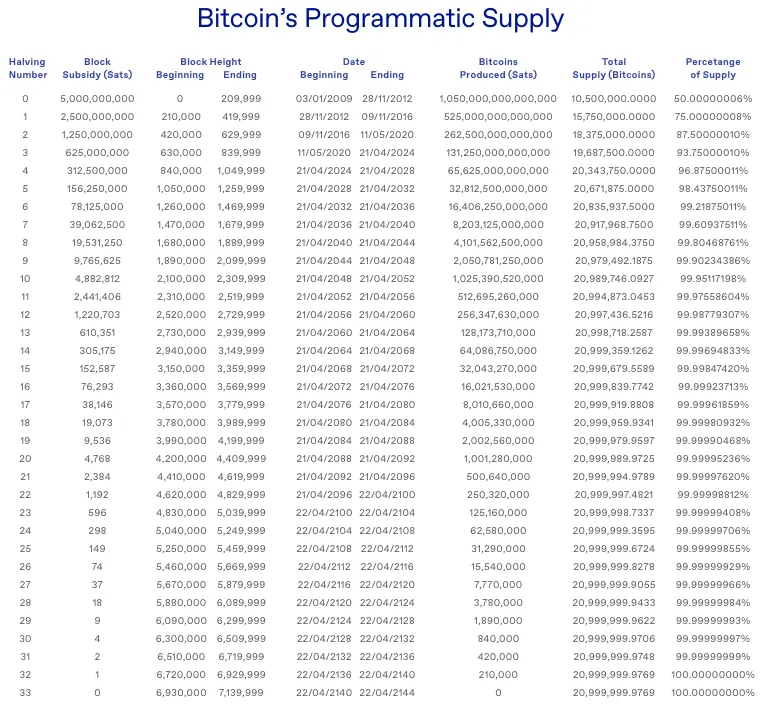
However, the block reward is how new Bitcoin is born. As an incentive for creating and propagating new blocks, the Bitcoin protocol mints new Bitcoin for miners. When the Bitcoin network launched in 2009, the block reward was set at 50 Bitcoin from the genesis block (block 0) to block 210,000. Every 210,000 blocks, approximately every four years, calculated based on an expected 10-minute block generation time, Bitcoin halves the block reward. After three halvings, the block reward is 6.25 Bitcoin, which will drop to 3.125 Bitcoin on April 20.
Bitcoin's reward halving is the foundation of its limited supply, a key economic feature. The supply cap, commonly known as 21 million Bitcoin, but more accurately 20,999,999.9769 (slightly lower due to unspendable Bitcoin), is achieved through subsidy halvings. As part of the Bitcoin code, the block subsidy measured in satoshis (0.00000001 Bitcoin) reaches a point where it can no longer be halved. This milestone will be reached at the 33rd halving, occurring at block 6,930,000 in 2140. Once this point is reached, no new Bitcoin will be created, and the final satoshi will be in circulation.
Economic Significance of Halving
Bitcoin halving has significant economic implications. Since block rewards are the way new Bitcoin is generated, halving will reduce the annual growth rate of new Bitcoin (often referred to as the "inflation rate") by 50%. In the short term, the growth of Bitcoin's supply will drop from 1.7% per year to 0.85% per year. The 21 million Bitcoin cap chosen by Satoshi Nakamoto is not particularly special; it is based on broad assumptions about acceptability and usability, but its scarcity is intended to confer value. While the declining supply function may abstractly mimic real-world commodities, in reality, the annual supply growth of commodities like gold is exponential.
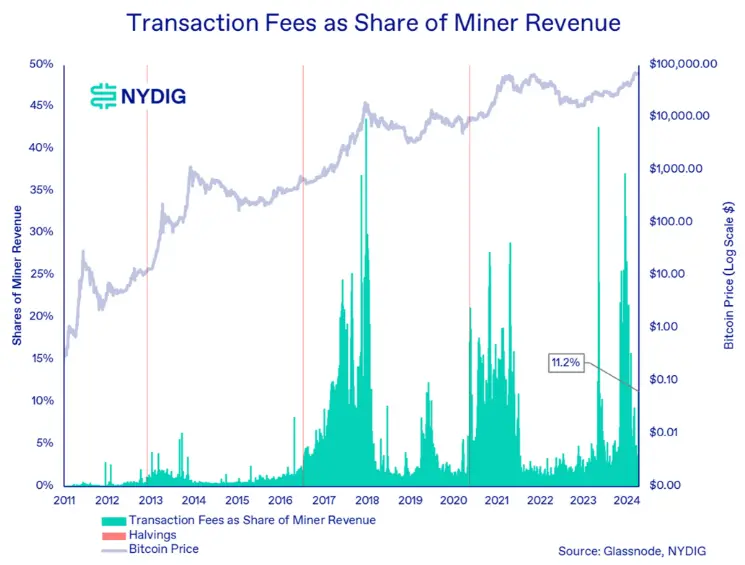
Another economic impact may be on the network itself. Bitcoin's block subsidy is the primary source of income for miners. Before the emergence of Ordinals over a year ago, the block subsidy accounted for 97-98% of miner income, with transaction fees contributing only 2-3%. Although this figure has recently jumped to 11.2%, the 50% reduction in miners' primary income source may still have significant implications for network security and the miners themselves.
Miners' Income Depends on Block Subsidy
Miners are the lifeblood of Bitcoin, generating new blocks every 10 minutes. They play a crucial role in aggregating transactions and adding them to the blockchain. In return, miners earn Bitcoin through block subsidies and transaction fees associated with transactions.
Throughout Bitcoin's history, miners' income has primarily come from block subsidies rather than transaction fees. Since its launch, block subsidies have accounted for 98.5% of miners' income, with only 1.5% coming from transaction fees. The importance of transaction fees has been rising, especially with the introduction of Ordinals and inscriptions. In March of this year, transaction fees accounted for about 5% of miners' income (this figure has recently jumped to 11.2%). In some recent blocks, transaction fees even exceeded block subsidies. Despite this shift, miners still heavily rely on block subsidies, making the halving a significant event for them. As the block subsidy decreases after the halving, miners will increasingly depend on transaction fees for income.
What Can We Learn from Previous Halvings?
This halving is the fourth for Bitcoin. Although the previous three halvings are not numerous enough to draw definitive conclusions, they are still enlightening, as the development patterns of cryptocurrencies often repeat. Based on this, the price of Bitcoin, network difficulty adjustments, hash rate changes, and hash price (the value of miner hash) before and after the halving provide some reference value for investors.
Price Performance
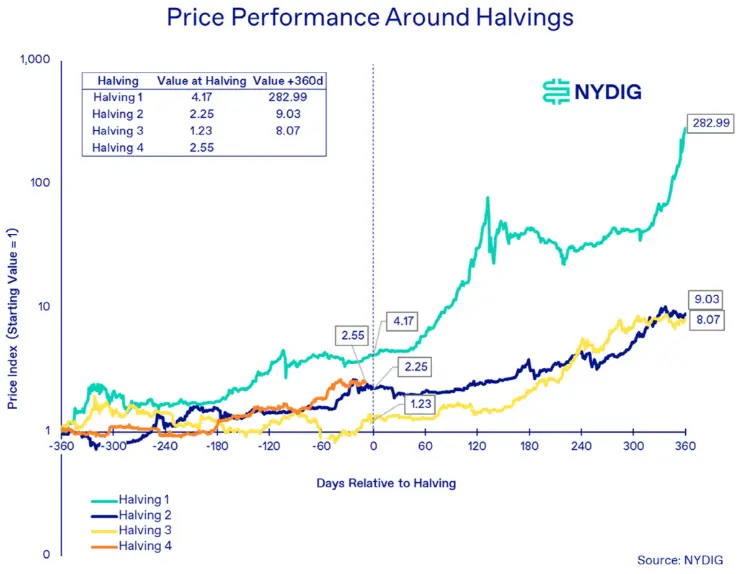
The impact of halving on Bitcoin's price is a frequently discussed topic, especially among investors. While past performance does not predict future results, there seems to be some repetition in past patterns. Looking back at previous halvings, Bitcoin has shown strong rebound momentum, and this halving is no exception, with Bitcoin rising 155% last year. In the 360 days leading up to the previous three halvings, Bitcoin rose by 317%, 125%, and 23%, respectively.
While Bitcoin has shown strong momentum before previous halvings, there has been even greater growth in the 360 days following the halving. The increases after the last three halvings were 2,819%, 803%, and 707%, respectively. An interesting distinction for this halving is that Bitcoin reached an all-time high before the halving, unlike previous cycles where new highs were reached after the halving.
Despite the optimistic outlook for Bitcoin cycles, the surge in demand for spot ETFs may accelerate the return cycle.
Difficulty Adjustments Reflect Hash Rate Going Offline
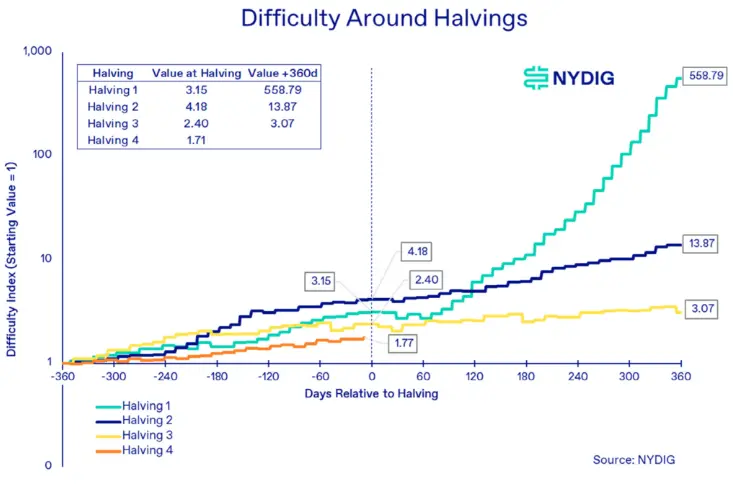
Bitcoin's difficulty is a key metric for network mining activity, playing a crucial role in the creation of new blocks. This metric is directly related to the network's hash rate, which fluctuates based on whether miners are online or offline. Every 2,016 blocks, approximately every two weeks, the difficulty level is adjusted. The impact of the halving event on miners' economics cannot be underestimated, as it directly affects the size of the hash rate, which in turn influences the difficulty level. When difficulty decreases, it indicates that less efficient miners are shutting down their machines. Historical data shows that miners increase hash rates before halving events, reflecting a significant rise in difficulty.
While difficulty may decrease shortly after the halving, the overall trend shows that difficulty levels typically rise significantly in the 360 days following the halving. This highlights the resilience and adaptability of the Bitcoin network in response to changes in mining activity.
An important factor to consider during the halving period, especially for miners, is the potential impact of reduced profitability leading to hash rates going offline. Since the halving essentially doubles the break-even price for miners (excluding transaction fees), there are speculations that mining machines operating above these costs may be forced to shut down.
However, NYDIG predicts that few hash rates (if any) will go offline after the halving, as some of the oldest mining machines remain profitable at current price levels. In previous halvings, the peak downward adjustments in difficulty were 13.7%, 5.4%, and 14.7%, respectively.
Hash Rate Halves, Corrects, but Then Continues to Grow
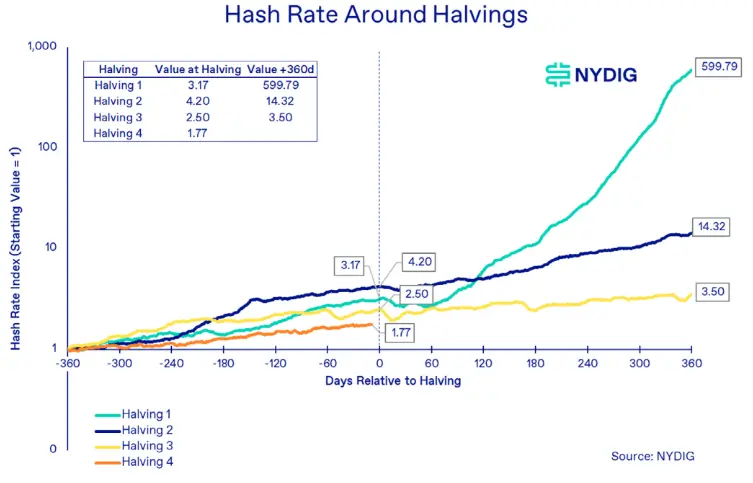
The network hash rate reflects the pattern of difficulty adjustments before and after the halving. As the halving approaches, there is often a surge in network hash rate as miners ramp up operations to maximize returns. After the halving, as less profitable mining operations go offline, the hash rate may temporarily decline. However, historical data indicates that as the network adapts to the new environment, the hash rate typically stabilizes and rebounds. Based on current market prices and miners' break-even points, most mining machines are unlikely to go offline or shut down during this halving.
High Variability of Hash Price
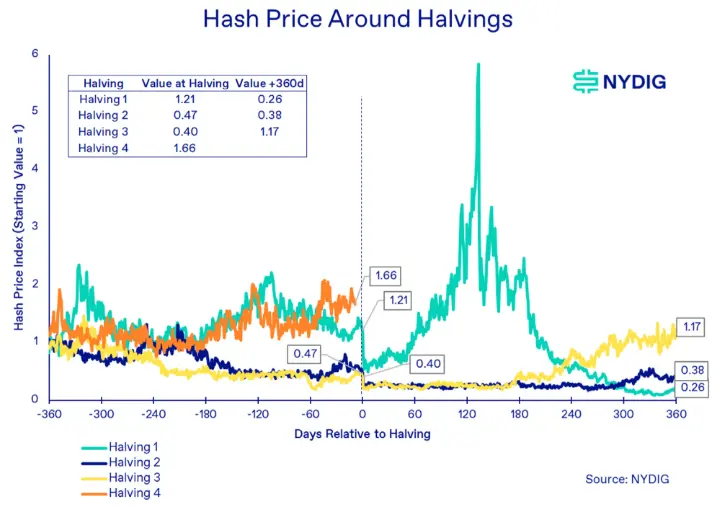
Hash price, which is the value of the hash rate, is a key factor for miners and is significantly influenced by block rewards and transaction fees, showing notable changes before and after the halving. In some cases, such as the current halving, hash prices soared before the halving, while in other cases, they declined. Typically, hash prices drop by about 50% after the halving, depending on the contribution of fees to miners' income. However, it has been shown that the outcomes 360 days after the halving are unpredictable, with some cases showing increases from initial levels, while others experience significant declines after substantial rises.
Supply Reduction is No Longer So Important
Given the reduction in new supply available to investors, a common viewpoint surrounding the halving event is its positive impact on price. This seems plausible, as Bitcoin's daily supply is expected to decrease by 450 coins on April 20, translating to approximately $31.5 million per day at a price of $70,000 per Bitcoin. However, in terms of global trading volume, this reduction accounts for only 59 basis points (about 0.6%) of daily trading volume, a relatively small proportion. Notably, this proportion was much higher in the past and may have had a more significant impact on trading volume and price. For example, the first halving saw a supply reduction that accounted for about 10.64% of trading volume, which was more pronounced compared to the current situation. NYDIG believes that, compared to supply, demand—especially demand related to spot ETFs—will play a more critical role in determining prices.
Conclusion
As the halving has just been completed, it is essential to recognize its significance in Bitcoin's history. This rare phenomenon has not only technical implications but also economic implications that affect the entire ecosystem. While the direct impact of the halving on Bitcoin's price may diminish over time, it remains a key factor in understanding Bitcoin's price cycles. Although this event will reduce miners' income, the halving and difficulty adjustments are fundamental characteristics of Bitcoin's programmability and fixed supply.
Related Reading: Exploring Bitcoin Halving: What Happened in the First Three?
 Risk warning Risk warning

Popular articles





