








Will the introduction of liquid staking make Bitcoin more capital efficient?

 Mikhil Pandey will lead everyone to understand the role of Bitcoin in cryptocurrency, the current landscape of Bitcoin, the role of BTC liquid staking, and his views on the direction of future developments.
Original Title: Bitcoin Capital Efficiency with Liquid Staking
Original Author: Mikhil Pandey, Co-founder of Persistence Labs
Original Compiler: Deep Tide TechFlow
Introduction
This article is the result of a deep dive into "the rabbit hole of today's Bitcoin landscape" written by Mikhil Pandey, co-founder and Chief Strategy Officer of Persistence Labs.
Through this article, Mikhil Pandey aims to guide readers in understanding Bitcoin's role in cryptocurrency, the current Bitcoin landscape, the role of BTC liquid staking, and his views on future developments.
Understanding Bitcoin
Is Bitcoin a store of value? The largest peer-to-peer payment network? A global remittance system? Digital gold? A hedge against traditional finance? The first proof-of-work blockchain in history?
What exactly is Bitcoin? Which of the above describes Bitcoin? In short, I believe all of them do, and more.
Bitcoin is a first-layer blockchain originally designed for the distrust of monetary value and transparent liquidity, with its concept emerging during the 2008 global financial crisis.
The native digital asset driving this network, BTC, has evolved from one of the boldest financial experiments of our time into the largest cryptocurrency.
Today, Bitcoin, both as a network and an asset, has become a paradise for finance, mechanism design, and hope.
The smartest people are pushing Bitcoin toward a more useful, capital-efficient, and programmable future.
The world's largest institutions are offering BTC ETFs to provide exposure to the general public.
A new generation of builders is finding unique ways to utilize Bitcoin's block space, including Ordinals, NFTs, BRC-20, Runes, staking, and more.
Bitcoin network activity has reached historical highs, generating more value (fees) for miners than ever before.
Bitcoin is for everyone. The best part is that the various perceptions of BTC are a feature, not a flaw.

Two Pillars Built on Bitcoin
For the public, Bitcoin is gradually transitioning from a "network" to an "ecosystem." Recently, the ecosystem built on Bitcoin has seen exponential growth.
This is not uncommon; aside from community network improvements, multiple stakeholders have attempted to build on top of Bitcoin. In fact, this is part of Satoshi Nakamoto's vision.
Satoshi once said, "This design supports various types of transactions that I envisioned years ago. Escrow transactions, margin contracts, third-party arbitration, multi-signature, etc. If Bitcoin becomes widely adopted, these are things we want to explore in the future, but they must be designed from the start to ensure they are possible later."
Since 2012, there have been continuous attempts to expand Bitcoin beyond payments into broader uses:
Decentralized domain name services (Namecoin)
Broader asset representation (Colored Coins, MasterCoin, Counterparty)
Extending the Bitcoin network through sidechains, Rollups, and L2 (Taproot, Stacks, Liquid Network, Merlin, Urbit, Lightning, bitVM, etc.)
Expanding BTC functionality (Memes, NFTs, BRC-20, BRC-420) and yield (Babylon, BounceBit, Stroom Network, Trustless Machines, etc.) through Ordinals and Runes.
But where are these developments leading Bitcoin? An article by Portal Ventures on Bitcoin's perspective summarizes it best:
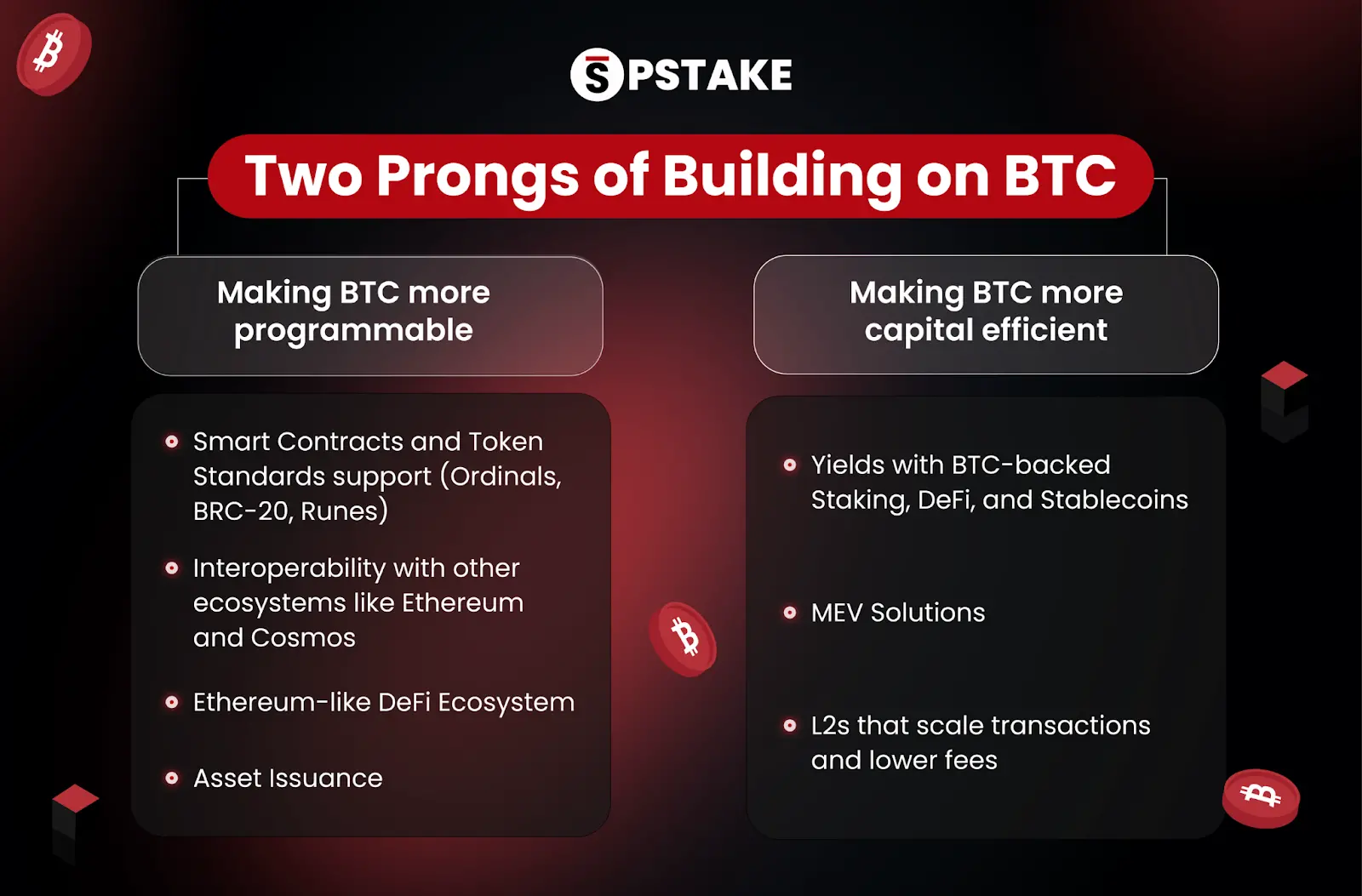
Making Bitcoin more programmable, addressing smart contract and scalability limitations for deployment on the Bitcoin network.
Making BTC more capital-efficient, building super-financialization with BTC.
Where is BTC Liquid Staking Applicable?
Bitcoin is a proof-of-work network where miners solve mathematical puzzles for block production by contributing computational power and receive new bitcoins as rewards.
So, how did staking appear in the market, let alone liquid staking? Let's understand some blockchain fundamentals.
Consensus involves a continuous agreement on the state of the network (data, transactions, balances, etc.). While PoW relies on computational power (mining) to achieve and maintain network consensus, PoS includes the concept of security guarantees. Staking involves locking tokens to participate in consensus, contributing to overall network security, and earning staking rewards.
When we need to trust others/counterparties to behave well, we often set up collateral to ensure good behavior. A typical example is a landlord collecting a deposit from a tenant.
In short, PoS is driven by trust in the economic security of assets. What could be better than having assets with billions of dollars in economic trust? What could be better than Bitcoin?
By "locking" BTC, its economic security can be exported to nearly any crypto application. Imagine a world where financial applications of all shapes and sizes can leverage BTC, adding vitality and security to every application.
Trustless BTC staking (and thus liquid staking) brings thriving possibilities for BTC-dominated DeFi, making BTC more capital-efficient. Money markets, stablecoins, economic security, insurance, and more. The applications are limitless.
What is the Future of Bitcoin?
One might argue that BTC already possesses capital efficiency in terms of market cap growth, adoption, and its primary status as a store of value in cryptocurrency.
This raises the question: what exactly is capital efficiency? Wall Street defines it as "how effectively a company uses funds to operate and grow." In this context, BTC is essentially idle most of the time among retail holders, miners, and institutions.
This can be attributed to several factors:
Lack of sustainable yield opportunities.
Friction for risk-averse holders to "move" BTC.
Lack of institution-friendly yield products.
Unknown security risks of removing BTC from the Bitcoin network.
Opposition from some OG Bitcoin holders.
Recently, the entire industry has been working to address the various obstacles BTC faces to unlock its liquidity and capital efficiency in the crypto world.
While the Bitcoin community may seem somewhat divided (which is always the best), it is essential to keep a close eye on significant developments in the Bitcoin ecosystem, such as Bitcoin L2, minimal trust BTC staking, Ordinals and Runes, VM, and more.
BTC liquid staking is not just a buzzword. It is here and may determine the yields in cryptocurrency. With simple BTC-led financial products expected to bring much-needed liquidity and utility to today's DeFi landscape, the future of Bitcoin has never been more exciting.
We have already seen exponential growth in Ethereum liquid staking and subsequent thriving progress in the on-chain finance space. When the same happens to the asset that first created the "crypto" asset class, the possibilities and doors opened can only be imagined.
 Risk warning
 Risk warning




Popular articles





