








RootData July cryptocurrency market data summary: Both financing amount and quantity rebounded, with institutions like OKX Ventures being the most active
 Core Viewpoint

 In July, the total amount of financing in the cryptocurrency sector was $1.01 billion, a month-on-month increase of 36% and a year-on-year increase of 83.6%. The number of financing rounds was 112, a month-on-month increase of 10.89% and a year-on-year increase of 36.6%.
Compiled by: Biscuit & Elvin, RootData
In July 2024, BTC dropped from a peak of $71,000 to around $53,000, but the investment and financing data in the crypto sector still maintained a stable upward trend, with total financing amount reaching $1.01 billion and the number of financing rounds exceeding 112, with month-on-month growth rates of 36% and 10.89%, respectively.
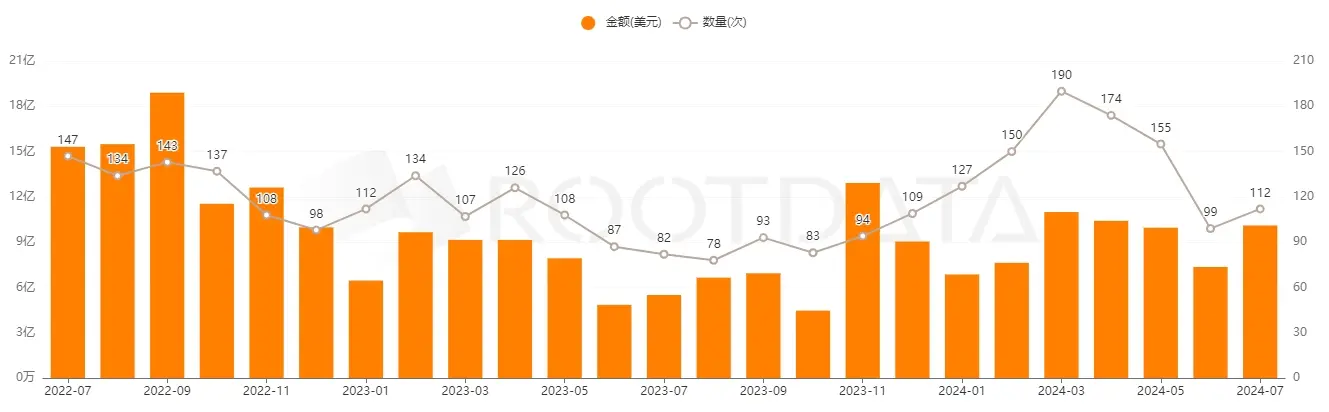
Financing trend in the crypto sector over the past 2 years
In this article, we will focus on specific financing data, active investors, trending projects, and other aspects to present the changing trends in the crypto market.
I. Financing Data
In July, the total financing amount in the cryptocurrency sector was $1.01 billion, with a month-on-month growth of 36% and a year-on-year growth of 83.6%. The number of financing rounds was 112, with a month-on-month growth of 10.89% and a year-on-year growth of 36.6%. The growth rates of total financing amount and rounds showed a slight upward trend compared to last month. Bitcoin mining company Iris Energy raised $413.4 million through stock issuance, becoming the largest financing event of the month, which was also a major factor for the significant increase in financing amount this month. Other popular projects that completed financing include open-source AI model Sentient, payment clearing and settlement blockchain platform Partior, Base gaming ecosystem B3, on-chain data infrastructure product Allium, and Bitcoin DeFi platform Lombard.

In terms of financing amount and rounds, the $1 million to $3 million range accounted for the majority of financing, with seed rounds remaining the most popular financing stage, as 35 projects completed seed round financing. Notable projects include Monad native MEV infrastructure aPriori, AI infrastructure OpenLedger, distributed cloud computing company Prodia, and decentralized AI infrastructure Mira.

In terms of sectors, infrastructure received approximately $365 million in financing in July, accounting for about one-third of the total venture capital of $1.01 billion. The DeFi sector followed with a financing amount of $67.15 million, and tools and information services received $48.9 million in financing. Additionally, the NFT and DAO sectors each completed only one financing round.
Moreover, there were 7 merger and acquisition events in July. Bitcoin mining company Riot Blockchain acquired Bitcoin mining infrastructure and hosting service company Block Mining for $92.5 million, ConsenSys acquired crypto account plugin Wallet Guard, and CoinDCX acquired UAE cryptocurrency platform BitOasis.
II. Active Investors
OKX Ventures and CMS Holdings were the most active venture capital firms in July, each making 7 investments. OKX Ventures invested in Web3 DePIN project Multiple Network, MEV infrastructure aPriori, and tokenized computing protocol Compute Labs, among others. CMS Holdings invested in peer-to-peer lending protocol Liquidium, Bitcoin stablecoin protocol Satoshi Protocol, and Monad token and NFT launch platform Monad Pad, among others.
Additionally, Robot Ventures made 6 investments in July, including Solana shared sequencer network Rome Protocol, EVM-compatible zero-knowledge rollup platform Zircuit, and multi-chain search engine Dora. Following closely were Folius Ventures, SNZ Holding, and Framework Ventures, each making 5 investments.
Web3 investor and advisor Paul Taylor also invested in 4 projects in July, becoming the most active individual investor of the month. Web3 investor Santiago Roel Santos and Movement co-founder Rushi Manche also had investment records.
In terms of new fundraisings in crypto, Galaxy Ventures completed a $113 million fundraising, focusing on early-stage startups in crypto software, infrastructure, and financial applications. The fund aims to raise $150 million next year, investing $3 million to $5 million in each project, and has already invested in projects such as Ethena, Monad, and Plume.
On July 19, Bitrue Ventures also announced the launch of a $40 million investment fund, focusing on areas such as GameFi, DePIN, and RWA. On July 8, cryptocurrency market maker Auros announced it would invest $50 million in crypto startups through its newly established Auros Ventures. Additionally, the TON ecosystem click game Notcoin announced the launch of the Telegram Gaming Accelerator, aiming to empower Telegram mini-apps through blockchain.
III. Trending Projects

Based on a large amount of user search data from RootData, we also summarized some of the projects with the highest user search volume in July, including:
Fuel is a UTXO-based modular execution layer that brings globally accessible scalability to Ethereum. As a modular execution layer, Fuel can achieve global throughput in ways that a monolithic chain cannot, while inheriting Ethereum's security.
Plume is a modular L2 blockchain designed for all real-world assets (RWA), integrating asset tokenization and compliance providers directly into the chain. Its mission is to simplify the complex process of deploying RWA projects and provide investors with a blockchain ecosystem to interact and invest in various RWAs. Additionally, Plume achieves RWA composability through its thriving DeFi applications and provides quality buyer channels to increase liquidity for all tokenized RWAs.
Movement is a modular framework for building and deploying Move-based infrastructure, applications, and blockchains in any distributed environment. The team is building a suite of products and services that allow non-Move protocols to leverage the power of the Move programming language without writing a line of Move code. The team's first version, M1, redefines L1 as a vertically composable and horizontally scalable first-layer framework that is compatible with Solidity, connects EVM and Move liquidity, and allows builders to customize modular and interoperable application chains out of the box with different user bases and liquidity.
Allora is a self-improving decentralized AI network. Allora aims to provide smarter and safer AI for applications through a network of self-improving machine learning models. By combining cutting-edge research from crowd-sourced mechanisms such as peer prediction, federated learning, and zkML, Allora unlocks a vast new design space for applications at the intersection of cryptocurrency and AI.
Usual is a stablecoin protocol that launched USD, a permissionless and fully compliant stablecoin backed 1:1 by real-world assets (RWA). USUAL is a governance token that allows the community to guide the future development of the network. Usual addresses current issues in the stablecoin market by redistributing profits to the community and rewarding token holders with actual earnings generated from RWAs.
Sonic is a gaming chain based on Solana that proposes the first scalability architecture, HyperGrid, which helps game developers efficiently handle and manage game states, logic, and events. Sonic is 100% compatible with all EVM smart contracts and features a native game engine, providing comprehensive on-chain game development components for game developers.
ORA is a verifiable oracle protocol that brings AI and complex computations on-chain. ORA breaks the limitations of smart contracts with richer data sources and computational capabilities, allowing developers to innovate freely. ORA has two main products: AI Oracle (OAO): bringing AI on-chain; ZK Oracle: bringing complex computations and historical data on-chain.
Aleo is a developer platform for building fully private, scalable, and cost-effective applications. Using zero-knowledge cryptography, Aleo moves smart contract execution off-chain to enable various decentralized applications that are both fully private and scalable to thousands of transactions per second.
Symbiotic is a universal re-staking system that enables decentralized networks to guide powerful, fully sovereign ecosystems. It will provide decentralized applications with a method called Active Validation Service (AVS) to mutually protect each other. Users will be able to re-stake assets they have deposited in other crypto protocols to help secure these AVS (whether aggregated, interoperability infrastructure, or oracles) in exchange for rewards.
Monad is building a high-performance first-layer blockchain for the next generation of decentralized applications, with a mission to accelerate the disruptive power of decentralization by building a blockchain that is 100 to 1000 times faster than its closest competitors, alleviating severe bottlenecks in existing blockchains, and enabling more complex applications and broader adoption.
11. Solv Protocol
Solv is a decentralized Bitcoin reserve protocol that unlocks the full potential of Bitcoin assets through liquidity consensus infrastructure. By addressing fragmentation, yield opportunities, and custody solutions for BTC assets, Solv provides Bitcoin holders with a gateway to BTCFi, continuously establishing pathways and confidence for traditional funds to enter the cryptocurrency world.
io.net is a decentralized computing network that supports the development, execution, and scaling of ML applications on the Solana blockchain, combining 1 million GPUs to form the world's largest GPU cluster and DePIN. io.net aggregates GPUs from underutilized resources (such as independent data centers, crypto miners, and crypto projects like Filecoin and Render) to solve this issue, allowing engineers to access vast computing power in an accessible, customizable, cost-effective, and easy-to-implement system.
Sunrise is a dedicated data availability (DA) layer for liquidity proof, allowing developers to build next-generation Web applications with enhanced liquidity and sovereignty.
Berachain is a high-performance EVM-compatible blockchain built on liquidity proof consensus. Liquidity proof is a novel consensus mechanism designed to coordinate network incentives, establishing strong synergies between Berachain validators and project ecosystems. Berachain's technology is built on Polaris, a high-performance blockchain framework for building EVM-compatible chains on top of the CometBFT consensus engine.
Babylon is a layer1 blockchain founded by Stanford University Professor David Tse. The project's mission is to bring Bitcoin's unparalleled security to all PoS blockchains without any additional energy costs. The team consists of researchers from Stanford University, experienced developers, and seasoned business advisors.
Conduit is a crypto-native infrastructure platform designed to enhance and accelerate builders in the crypto space. Its first product allows teams to launch production-grade Rollups based on OP Stack in a very short time, scaling their application performance by 100 times. Application-specific Rollups on Conduit are initiated, maintained, and scaled by infrastructure professionals, allowing teams to focus on what matters most: building products that users love.
Zircuit is an EVM-compatible zero-knowledge rollup, whose unique hybrid architecture combines optimistic infrastructure with zero-knowledge proofs, providing developers with the best of both worlds. With cutting-edge performance and security at the sequencer level, users can explore new realms with faster transactions, lower fees, and complete peace of mind. Zircuit will protect sequencer-level users by monitoring malicious transactions in the memory pool and preventing them from being packaged into blocks.
MapleStory Universe is a virtual world ecosystem that creates various tangible and intangible values centered around MapleStory NFTs.
Karak is a risk management infrastructure for digital assets, a secure, low-cost, risk-aware Ethereum L2 designed to protect the next billion users.
Nubit is a scalable Bitcoin-native data availability layer, protected by Bitcoin. Nubit can expand Bitcoin's data capacity without compromise, empowering applications such as Ordinals, Layer 2s, price oracles, and indexers, thereby broadening the scope and efficiency of the Bitcoin ecosystem. It utilizes innovative consensus algorithms and the Lightning Network, inheriting Bitcoin's fully censorship-resistant characteristics.
IV. Project Updates
In July, RootData also recorded many events such as mainnet launches and new token issuances, helping users understand important project dynamics in the market and grasp earlier alpha opportunities.
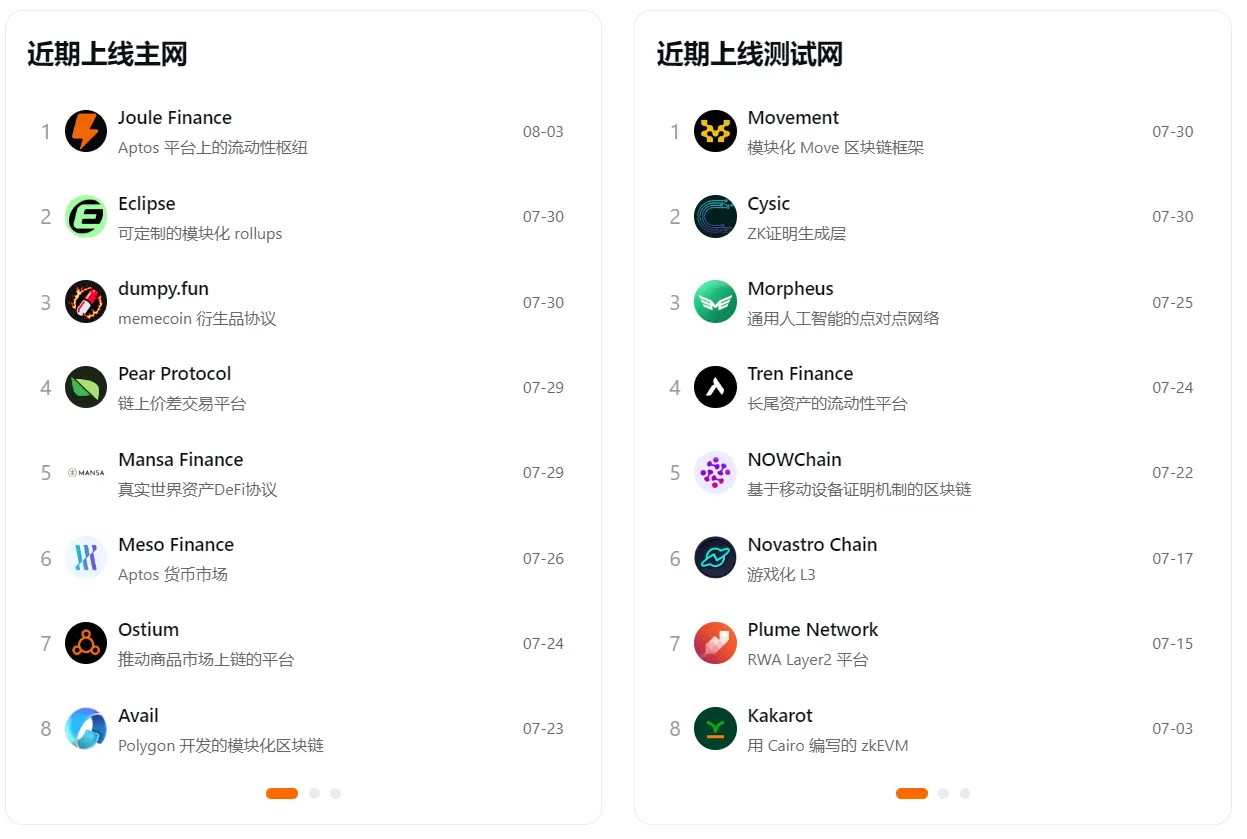
Projects that launched their mainnets in July include (sorted by date from recent to distant, not exhaustive):
Eclipse is a customizable rollup provider compatible with multiple layer 1 blockchains. The platform enables developers to deploy their own rollups powered by the Solana operating system, using any chain for security or data storage.
dumpy.fun allows users to short memecoins on Solana. Under the hood, dumpy.fun borrows on Save and then trades on Jupiter.
Pear Protocol is a decentralized arbitrage trading platform that allows users to create leveraged long and short positions on different assets. Arbitrage trading refers to investors being able to short one asset while going long on another.
Mansa Finance is a real-world asset (RWA) DeFi fixed income protocol that provides short-term liquidity for Africa's venture-backed fintech companies through invoice discounting, asset leasing, inventory financing, and payroll.
Ostium is a synthetic asset protocol that provides on-chain commodity exposure for institutional and retail traders as well as hedgers.
Avail is a modular blockchain focused on data availability: sorting and recording blockchain transactions without needing to download the entire block to prove block data availability. This allows it to scale in ways that a monolithic blockchain cannot. Off-chain scaling solutions can unleash their full potential by transferring data availability to Avail. Independent chains can enhance the security of validators to ensure data availability by using Avail.
Prerich is an application that simplifies on-chain trading, providing a user-friendly interface similar to Robinhood. It allows users to trade on-chain assets quickly and efficiently while maintaining full control over their assets. With Prerich, users can log in using email, log in with credit cards, and access tools built specifically for traders while fully controlling their private keys.
Deq.fi is the native liquidity staking platform for Avail tokens on Ethereum.
FILLiquid is a decentralized liquidity pool on Filecoin that optimizes staking, earning, and empowering storage through lending solutions.
FireUp Finance is a non-custodial, high-frequency options trading platform designed for trading short-term price fluctuations.
OpenLiquidity is a peer-to-peer decentralized protocol designed to unlock the potential of locked liquidity in the DeFi ecosystem. Through sales, auctions, and using locked liquidity as collateral for loans, OpenLiquidity provides new interaction opportunities for locked liquidity owners and investors.
Dropnest is a one-stop airdrop application that provides users with a one-click airdrop interaction experience. Dropnest transfers users' funds into a secure smart vault and then hands them over to Dropnest farmers. Dropnest handles all the heavy lifting by interacting with protocols on behalf of users. When a protocol releases an airdrop, Dropnest refunds the user's initial investment along with a share of the airdrop rewards.
Mind Network is an FHE re-staking layer for POS and AI networks. Its framework operates as an FHE verification network, bringing secure computation and consensus to AI, DePIN, EigenLayer AVS, Bittensor Subnet, and many key POS networks.
DUCATA is a programmatic form of currency based on the Reflexivity protocol, achieved through a triple-token economy that addresses the trilemma of stablecoins, aiming to become a global alternative to traditional currencies. DUCA provides a stable fiat currency alternative that is fully autonomous, on-chain, and decentralized, maintaining purchasing power and providing returns to holders.
15. Creator.Bid
Creator.Bid is a digital content monetization and ownership platform that supports content creators in building AI-driven digital assets for monetization and writing management. Additionally, Creator.bid provides tools to enhance creators' autonomy over their work and income management.
16. Usual
Usual is a stablecoin protocol that launched USD, a permissionless and fully compliant stablecoin backed 1:1 by real-world assets (RWA). USUAL is a governance token that allows the community to guide the future development of the network. Usual addresses current issues in the stablecoin market by redistributing profits to the community and rewarding token holders with actual earnings generated from RWAs.
17. PumpBTC
PumpBTC is a liquidity staking protocol on Babylon that allows BTC HODLERS to maximize their earnings.
18. Kernel Protocol
Karak Network is a re-staking protocol that allows users to deposit any asset into the platform to provide slashing-resistant security for various products and services built on Karak, such as data availability layers, blockchains, oracles, etc. Kernel Protocol proposes a solution to create liquidity re-staking tokens (LRT) composed of indices from each major asset class on Karak. This alleviates liquidity fragmentation while providing sufficient asset choice variation for end LRT users, reflecting the diversity of re-staking opportunities available on Karak.
Projects that launched testnets in July include (sorted by date from recent to distant, not exhaustive):
Movement is a modular framework for building and deploying Move-based infrastructure, applications, and blockchains in any distributed environment. The team is building a suite of products and services that allow non-Move protocols to leverage the power of the Move programming language without writing a line of Move code. The team's first version, M1, redefines L1 as a vertically composable and horizontally scalable first-layer framework that is compatible with Solidity, connects EVM and Move liquidity, and allows builders to customize modular and interoperable application chains out of the box with different user bases and liquidity.
Cysic is a ZK hardware acceleration project dedicated to designing advanced ASIC chips to help reduce ZK proof generation time, already having multiple ecosystem partners, including Scroll, Nil Foundation, and Hyper Oracle.
Morpheus aims to incentivize the first personal general AI peer-to-peer network that can execute smart contracts on behalf of users, called smart agents. Ultimately, ordinary users can converse with their smart agents in natural language, allowing it to understand questions and take actions based on their intentions/approvals.
Tren Finance is a liquidity platform for crypto long-tail assets. By supporting niche assets as collateral, Tren Finance aims to unlock higher capital efficiency for various crypto assets.
NOWChain is a blockchain ecosystem that combines blockchain technology with the inherent security of mobile devices, where $NOW is the fundamental value unit of the NOWChain ecosystem and its interconnected platforms and affiliates.
Novastro Chain is a gamified L3 that implements parallel re-staking with EigenLayer AVS, bringing Ethereum's security to RWA and DeFi projects. It enhances re-staking capabilities, allowing users to earn rewards and increase yields while protecting deposits. Novastro pioneers the integration of real-world assets, gamification, and crypto culture to inspire and innovate community rewards.
Plume is a modular L2 blockchain designed for all real-world assets (RWA), integrating asset tokenization and compliance providers directly into the chain. Its mission is to simplify the complex process of deploying RWA projects and provide investors with a blockchain ecosystem to interact and invest in various RWAs. Additionally, Plume achieves RWA composability through its thriving DeFi applications and provides quality buyer channels to increase liquidity for all tokenized RWAs.
Kakarot is a zkEVM written in Cairo. It aims to allow users to leverage the scaling advantages of validity rollups while maintaining compatibility with the Ethereum ecosystem. Therefore, Kakarot can be used to run Ethereum smart contracts on Starknet.
Highlayer is a sovereign rollup on Bitcoin with self-sustaining DA, parallel execution, and a Javascript VM, seamlessly connecting global developers to Web3.
Due to space limitations, the above is a partial list of mainnet and token information. For more complete and timely data, please visit the RootData official website (https://www.rootdata.com/zh/) for more information.
 Risk warning
 Risk warning




Popular articles





