








PicWe: Preventing Hacker Attacks Requires Relying on Full-Chain Infrastructure

 PicWe has aimed to better serve the Web3 world through a completely decentralized approach with full-chain assets since its inception.
1. The Harm of Hackers to the Cryptocurrency Market Has Never Stopped
The largest amount stolen in the history of the cryptocurrency world belongs to the "Mt. Gox" incident, which lost 850,000 BTC in 2014 (approximately $85 billion at current prices). Since 2017, the total amount of cryptocurrency assets stolen by hackers has exceeded $10 billion. The recent loss of $1.4 billion by Bybit has become the largest hacking incident in recent years.
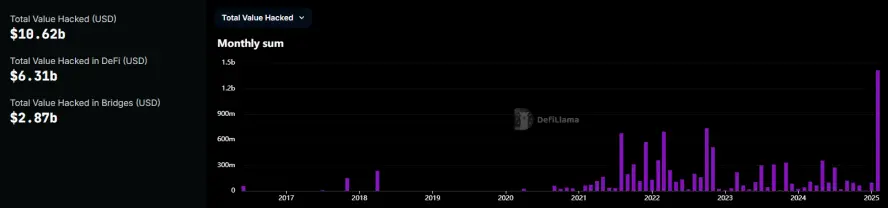
Amount stolen by hackers from 2017 to present (monthly)
Data source: https://defillama.com/hacks
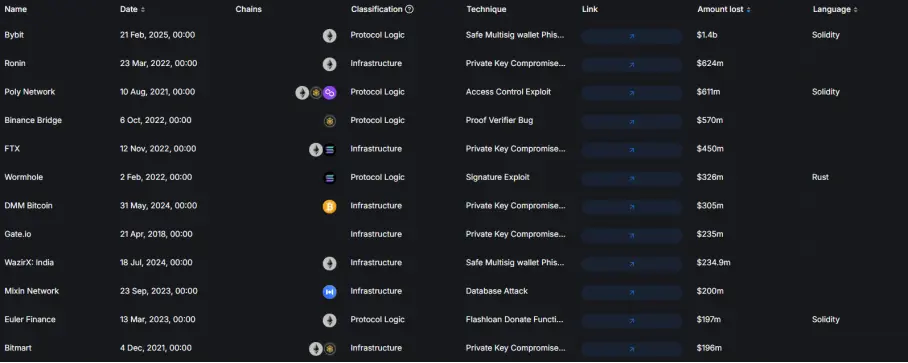
Major projects with significant amounts stolen by hackers from 2017 to present
Data source: https://defillama.com/hacks
2. Full-Chain Infrastructure Can Effectively Reduce the Risk of Hacker Attacks
Web3 urgently needs more secure and convenient liquidity infrastructure. This hacking incident originated from the asset rebalancing between the exchange's cold wallet and hot wallet. For exchanges and some liquidity protocols, asset rebalancing is a routine operation. The purpose of this operation is to ensure asset security and improve asset utilization efficiency. Similar to how traditional banks adjust the total amount of savings and loan funds based on the reserve requirement ratio, in the exchange scenario, if the amount of ETH users deposit and withdraw from the exchange is roughly the same, the amount of ETH in the exchange will remain at a certain level. However, if the amount of ETH withdrawn by users far exceeds the amount deposited in a short period, the amount of ETH in the exchange's hot wallet will decrease, and the exchange will need to transfer ETH from the cold wallet to the hot wallet to ensure there is enough ETH for users to withdraw. For example, if a bank branch has too much cash withdrawn, the head office needs to transport cash from the vault to that branch to avoid users being unable to withdraw money. Conversely, if a bank branch has too much cash, the head office will return the excess cash to the bank vault for security reasons. It is easy to understand that this is a very routine business, and besides exchanges, cross-chain bridges and multi-chain applications also frequently need to perform asset rebalancing. Therefore, secure and convenient liquidity infrastructure is extremely important.
Smart contracts control asset rebalancing. Both exchanges and cross-chain bridges can fully utilize smart contracts to achieve asset rebalancing. The total amount of liquidity pools is fixed; when the assets in a certain pool (hot wallet, on-chain liquidity) drop below a certain threshold, the smart contract can automatically complete the liquidity rebalancing operation. Of course, there may still be risks associated with cross-chain bridges and centralization. A reward mechanism can be introduced to make the rebalancing operation more decentralized and secure. For example, when a certain asset pool drops to 20% of its original amount, the smart contract can initiate an on-chain task, and any user who adds liquidity to this pool can receive a reward. This way, many users or bots will automatically balance the liquidity for the reward. This model can "outsource" the liquidity rebalancing business to third parties and "break it down," significantly reducing asset risk.
Full-chain asset settlement will leave hackers with nothing to steal. Of course, relying solely on third parties to balance liquidity essentially just transfers the risk of being attacked. For example, in the past, banks would send their own personnel to transport funds, but now they hire third-party security companies to transport funds with armored vehicles. Although this is more professional, it can still encounter robberies. So, is it possible to make it so that hackers cannot steal any money? The answer is yes. This can be achieved through a complete chain settlement currency system. The current interbank credit settlement system adopts such a model. Interbank transmission is no longer cash; what hackers steal is only an encrypted certificate, not assets. Without the user's signature authorization, they still cannot withdraw. For users, when one bank is short on cash, they can withdraw from another bank.
3. AI Agent + Full-Chain Infrastructure Can Avoid "Being Deceived"
From the live broadcast after the Bybit incident, it was learned that Ben Zhou had conducted a strict review of the multi-signature content and checked it twice before the final multi-signature. However, unfortunately, humans can only check the front-end displayed content, and there were no anomalies displayed on the front-end interface throughout the transaction process. Therefore, even the most cautious person can be deceived by the "facts before their eyes."
But what if it is handed over to a robot? An AI Agent can directly parse smart contract code or on-chain transaction data; it can conduct detailed comparisons using back-end and on-chain data to quickly identify anomalies.
This is not to suggest developing an AI Agent with a checking function specifically for risk alerts, as relying on humans for final execution can still lead to being deceived. Today, we can completely entrust the AI Agent with the responsibility of checking and executing.
4. The Full-Chain Asset Infrastructure Built by PicWe Can Reduce the Risk of Hacker Attacks
Currently deployed on Movement, PicWe has already achieved the following functions through its full-chain asset infrastructure:
1. Smart contracts control asset rebalancing (Rebalance)
2. Full-chain asset settlement (WEUSD)
3. Empowering AI Agents with on-chain execution layers
From its inception, PicWe aims to better serve the Web3 world through a completely decentralized approach with full-chain assets. It not only improves the efficiency of full-chain liquidity, allowing users across various chains and ecosystems to access simple, efficient, and low-cost liquidity services, but also enables AI Agents to execute on-chain operations, avoiding the difficulties of human learning and interacting with blockchain. At the same time, when AI Agents use full-chain assets to provide liquidity services to users, it can greatly reduce the occurrence of similar hacking incidents.
 Risk warning
 Risk warning




Popular articles





