








Optimum: A high-performance blockchain memory solution based on RLNC, created by the MIT-Harvard elite team | CryptoSeed
 What potential is hidden in this project gathered by big shots?
Author: Fairy, ChainCatcher
Editor: TB, ChainCatcher
In the wave of continuous development of blockchain infrastructure, Optimum has entered the field with high-performance memory technology, attracting the attention of top investors.
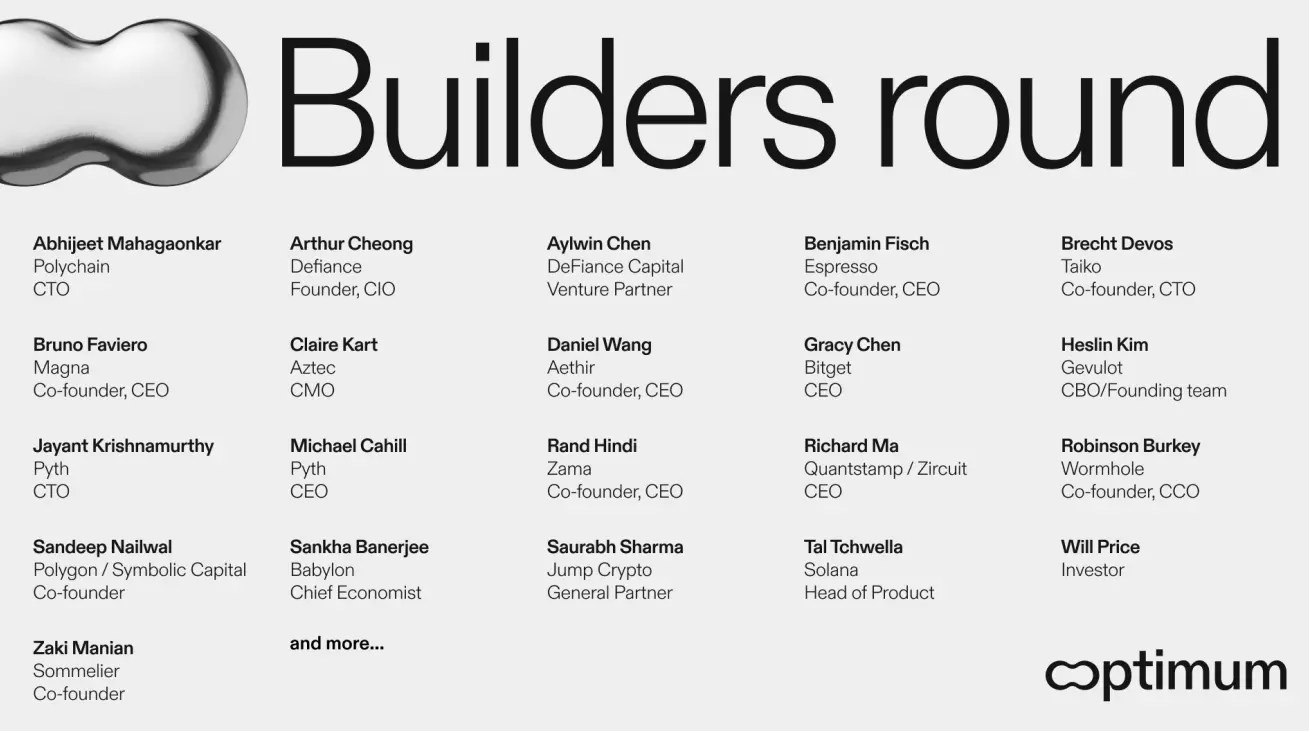
On February 28, the blockchain-focused high-performance memory infrastructure Optimum announced the completion of its angel round financing, with participation from several industry leaders, including Polychain CTO Abhijeet Mahagaonkar, DeFiance Capital founder Arthur Cheong, Bitget CEO Gracy Chen, Wormhole co-founder Robinson Burkey, and Polygon co-founder Sandeep Nailwal.
The first tweet from Optimum's official X account was published a month ago. Currently, the project has not publicly released a white paper or technical roadmap. Although the project is still in the ultra-early stages, the background of the founding team is already impressive: the NEC dean of the MIT Computer Science Department, the president of the Harvard Blockchain Association, and more. What potential lies hidden in this project filled with industry heavyweights?
Founders' Background
The project was co-founded by Professor Muriel Médard, NEC dean of the MIT Computer Science Department, Dr. Kishori Konwar, and Kent Lin, president of the Harvard Blockchain Association.
Professor Muriel Médard is the inventor of Random Linear Network Coding (RLNC) technology and is a member of the National Academies of Engineering and Sciences in both the U.S. and Germany.
She completed an interdisciplinary elite education at MIT, earning bachelor's degrees in electrical engineering and computer science, mathematics, and humanities, and continued her studies to obtain a master's and a Ph.D. in science. As a pioneer of technological innovation, Muriel holds over 60 U.S. and international patents, most of which have been successfully authorized or applied.
As a technology pioneer straddling academia and industry, Muriel Médard's research has not only transformed traditional communication methods but also laid an important foundation for the development of next-generation encrypted networks.

Kent Lin holds a bachelor's degree in aerospace engineering from Nanyang Technological University in Singapore and has studied for an MBA at Harvard University, making him a standout at the intersection of technology and business. He serves as the president of the Harvard Blockchain Association, is fluent in Chinese, English, and Minnan, and has a working knowledge of German.
Kent's career has focused on venture capital, liquidity investment, crypto research, strategic partnerships, and business development, particularly accumulating rich experience in startup financing, expansion, and corporate venture capital.
Kent Lin quickly rose to prominence at Plug and Play Tech Center, advancing from the head of corporate partnerships in the Asia-Pacific region to the regional head. He also served as a partner at GSRV, the cryptocurrency investment division of GSR Ventures. GSR Ventures is an early-stage venture capital firm that has managed 11 flagship funds with a total capital exceeding $4 billion since 2004.

Dr. Kishori Konwar is the co-founder and Chief Technology Officer (CTO) of the project. He is a postdoctoral researcher in network coding at MIT and has previously worked as a senior engineer and scientist at Meta and as a quantitative analyst at Goldman Sachs. Kishori Konwar has a deep technical background in distributed systems, coding theory, and artificial intelligence.
Project Overview
In the rapidly evolving landscape of blockchain technology, scalability bottlenecks remain a key challenge hindering industry progress. Optimum emerges as the first high-performance memory infrastructure suitable for any blockchain, aiming to achieve fast data propagation, efficient storage, and real-time access.
Optimum provides high-performance memory infrastructure for L1/L2 blockchains and node operators, including a P2P data communication layer and a decentralized memory layer (deRAM).
Technical Foundation RLNC
The core technology of Optimum is based on Random Linear Network Coding (RLNC), a cutting-edge technology widely used in 5G, IoT, and satellite communications. RLNC will significantly enhance network speed, throughput, and decentralization, thereby improving dApp performance and user experience.
This technology is based on 15 years of research results from the MIT Network Coding and Reliable Communication Research Institute. By converting data into encoded fragments, it enables nodes to efficiently recover information from partial data rather than relying on complete data reception.
Optimum provides RLNC-based high-performance memory infrastructure for any L1/L2 blockchain and node operators, with two core components:
- P2P Data Communication Layer: Optimizes data transmission between nodes, significantly enhancing network efficiency.
- Decentralized Memory Layer (deRAM): Provides efficient, real-time memory access capabilities for the blockchain ecosystem.
Optimum's technology not only addresses the scalability issues of blockchain but also brings multiple benefits to the entire ecosystem:
- For L1/L2 blockchains: Reduces bandwidth consumption and enhances overall performance through faster block propagation and optimized storage mechanisms.
- For validators: Accelerates data propagation, lowers operational costs, and increases staking APY and MEV income.
- For dApp developers: Improves transaction relaying and prioritization, providing strong support for latency, throughput, and cost-sensitive applications.
- For end users: Speeds up transaction times and enhances interface responsiveness, creating a smooth and seamless blockchain interaction experience.
Through RLNC technology and high-performance memory infrastructure, Optimum offers a new solution. In March, Optimum's private testnet will be open to L1/L2 blockchains and validators, marking an initial validation of its technical solution.
In the future, whether Optimum's technical solution can play a role in a broader ecosystem remains to be seen.
(This article only introduces an early-stage project and does not constitute investment advice.)
 Risk warning
 Risk warning





Popular articles





