








In the trillion-level competitive betting industry under a trust crisis, how does HashEpoch leverage Web3 thinking and technology systems to achieve reconstruction and breakthroughs?

 Why is it difficult to eradicate fraud and manipulation in the "prediction competition" market?
In people's lives, "prediction games" are everywhere— from participating in lottery activities on social media to buying blind boxes, scratch cards, and lottery tickets, which are filled with randomness and the fun of guessing. Almost everyone has participated to some extent.
This has also given rise to a massive market with billions of users. According to a UK-based prediction gaming company, the global compliant prediction gaming market exceeded $500 billion in 2023.
Unfortunately, "prediction games" have not improved with the development of technology and the internet.
For example, familiar lottery activities and other prediction games are often questioned for having "pre-determined lists," "sales-based draws," or even "pre-locked prizes," which are all forms of opaque operations. Centralized platforms control the entire process, leaving users unable to see the process or verify the results, leading to a norm of distrust. As long as the prediction system is opaque and tamperable, this crisis of trust is difficult to eradicate.
Therefore, ensuring transparency and fairness in all aspects, from prize settings to draw redemption, and instilling a sense of trust in users has always been a challenging pain point.
However, the emergence of Web3 technology offers new possibilities for addressing this pain point.
For instance, the Polymarket platform, which focuses solely on event prediction in the gaming market, has performed excellently in the U.S. elections, becoming the most popular product.
Yet, event prediction is just a small niche in the prediction gaming market, and there are even larger market gaps that require Web3 technology innovation.
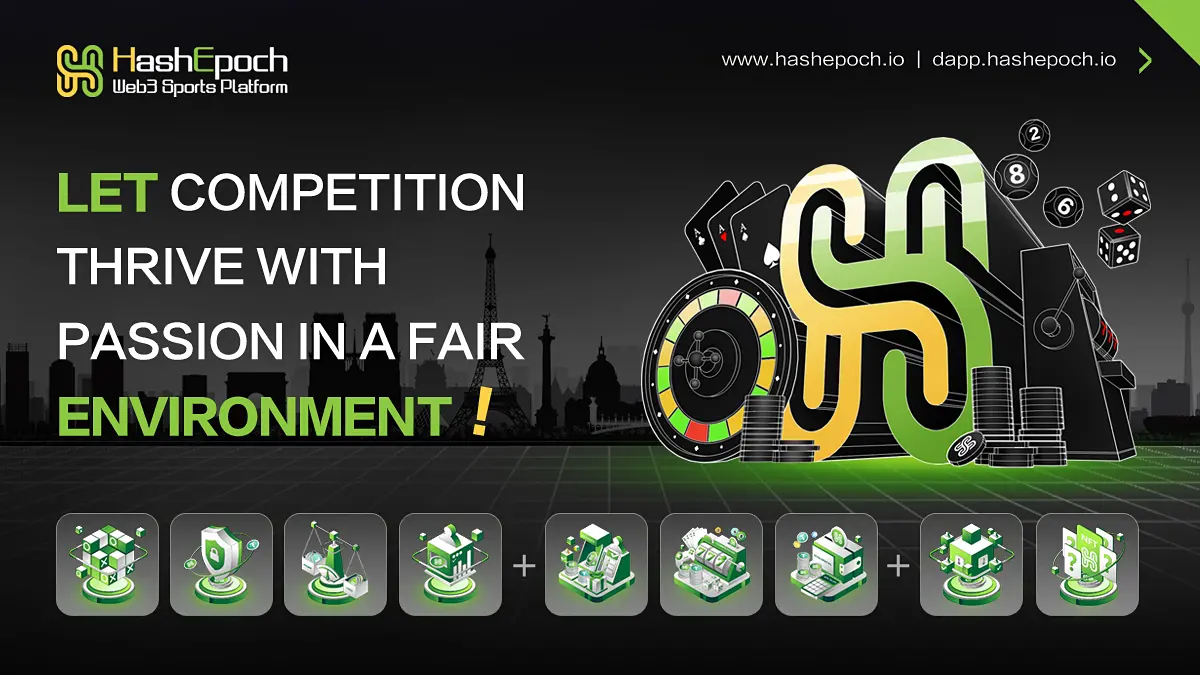
The decentralized prediction gaming platform HashEpoch on the BNB Chain ecosystem targets the pain points of this vast market and is building a decentralized prediction gaming world based on the characteristics of Web3 technology, such as decentralization, immutability, and transparency.
Why is fraud and manipulation in the "prediction gaming" market hard to eradicate?
The demand for prediction can be said to have existed since the dawn of human civilization. Activities like dice throwing, divination, and drawing lots appeared as early as 2000 BC and can be considered forms of prediction and entertainment.
Modern "prediction gaming" originated from the "Florentine lottery" in Italy in 1530, which quickly spread across Europe and became a tool for government fundraising.
Since then, through evolution in various regions around the world, "prediction" has gradually become a mode of entertainment in public life. As players enjoy the fun, the profits from "prediction" have also been gradually used for public construction (such as bridges and schools) and charitable causes.
Various countries and regions have also legalized sports lotteries and welfare lotteries.
With the development of the internet, "prediction gaming" has transitioned from offline to online, covering a much larger user base and touching all aspects of life.
However, this widespread "prediction" activity has been controversial due to fraud and manipulation.
For example, in 2009, the UK "Camelot" lottery terminal was exploited by retailers using the terminal's delayed printing function to commit fraud. When the terminal displayed a winning ticket, the retailer would immediately cancel the print and repurchase the ticket themselves. In 2015, Spain's "Christmas Lottery" live draw was exposed for using pre-recorded videos, raising suspicions of human manipulation.
When online "prediction gaming" emerged, trust issues could arise even more easily than offline. They can utilize algorithm changes, AI, and other technologies to manipulate outcomes more quickly and on a larger scale.
Despite the evolution of the market in terms of technological supervision and legal regulation to address various fraud and manipulation issues in "prediction," fundamentally, the traditional prediction gaming market cannot solve the problem as long as it relies on centralized organizations.
In addition to issues of fairness and transparency, the market has almost no real methods or innovations that serve users.
Overall, the traditional prediction gaming market has two layers of pain points.
One is the trust and security aspect, including the lack of fairness and transparency in the game, user fund security, and opaque core data.
The second is the service and incentive aspect, where the lack of incentive mechanisms leads to insufficient user retention, a lack of investment opportunities in ecological services, and insufficient diversity in types of prediction games.
However, with the development of Web3 technology driven by decentralized trust mechanisms, it can significantly reduce or even eliminate fraud and manipulation in the prediction field and provide solutions for user services.
The core technologies of Web3 rely on decentralized ledgers, smart contracts, and on-chain governance, ensuring data immutability and traceability, eliminating centralized institutions' control over data, and enhancing user information privacy.
Additionally, some token economies in Web3 introduce new incentive models, allowing players to earn diverse behavioral rewards through participation in on-chain data interactions, forming a revenue mechanism based on behavioral economics and consensus economics.
The transformation of traditional prediction gaming platforms to Web3 can be said to be an irreversible trend.
Targeting Pain Points: HashEpoch's Four Major Innovative Mechanisms
How specifically can Web3 technology characteristics be utilized to address the trust crisis and inefficiency in the prediction gaming market and create a fairer, next-generation prediction gaming platform? HashEpoch has implemented four major innovations:
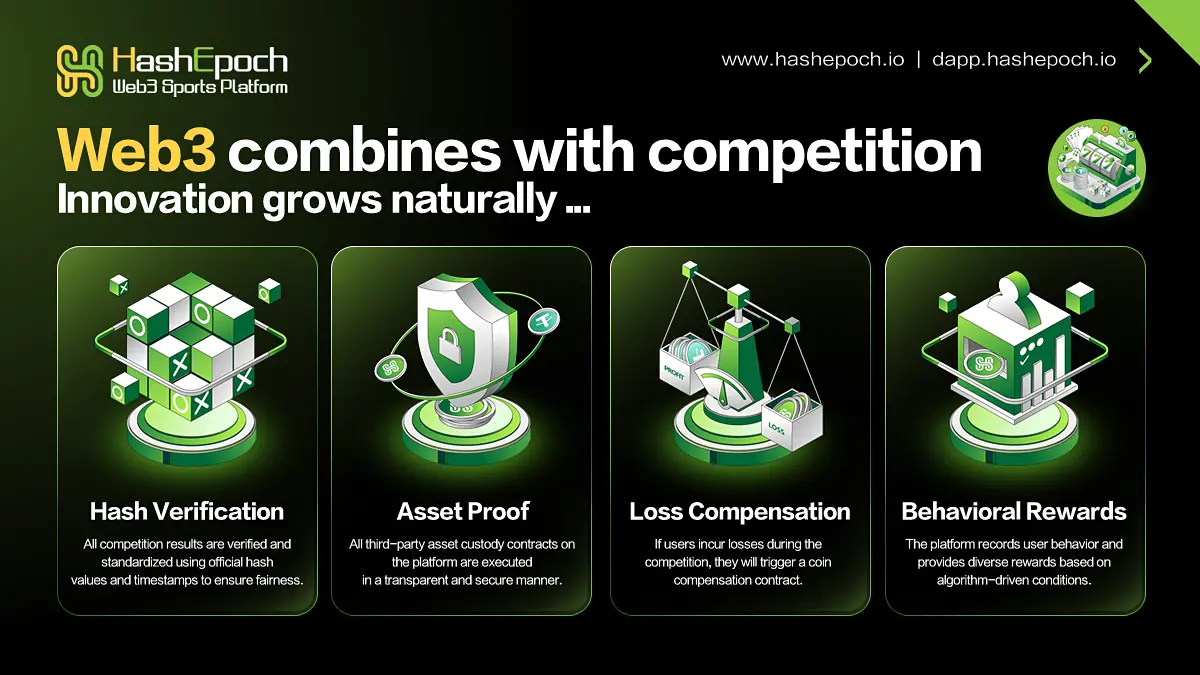
Through a hash verification mechanism, making competition results immutable and traceable. In traditional prediction gaming scenarios, competition results may be manipulated behind the scenes, affecting user trust and participation enthusiasm.
HashEpoch introduces a hash verification mechanism to prevent malicious tampering. Since data modification changes the hash value, the system can quickly detect anomalies. Moreover, the hash verification calculation is fast, generating hash values quickly regardless of data size, ensuring efficiency even when processing large amounts of data without significantly increasing system burden.
Utilizing smart contracts to ensure the security of platform asset custody and operation. When assets are controlled by smart contracts, they are automatically transferred when conditions are met, avoiding risks of human manipulation, and every transaction is clear and traceable. Additionally, contract code can be publicly audited to ensure the safety of user assets.
Loss compensation mechanism to protect user interests. Prediction gaming activities inherently carry certain risks, and users may face losses during participation.
Therefore, HashEpoch has launched a loss compensation mechanism, allowing users to apply for loss compensation when their funds incur losses (negative net value) during prediction gaming. This triggers a minting compensation contract, which releases minted tokens to compensate users based on their net loss within a specified period.
User behavior economic reward mechanism to enhance user participation enthusiasm. Traditional prediction gaming platforms rarely have sustained user incentive measures, while the designed economic reward mechanism records user behaviors such as participation, invitations, and content contributions, providing users with different rewards, such as platform tokens and NFTs, to boost their enthusiasm for participation.
In addition to ensuring fairness and efficiency in prediction gaming, in terms of compliance, HashEpoch holds multiple national online gaming licenses and qualifications.
From a Single Platform to an Open Prediction Gaming Ecosystem
HashEpoch is not just a single prediction gaming platform; it aims to become a continuously expanding and improving Web3 prediction gaming ecosystem.
The HashEpoch prediction gaming platform covers various types of prediction gaming projects, attempting to meet the diverse needs of different user groups. Its main product forms include three major content areas: the competition square, activity square, and ecological square.
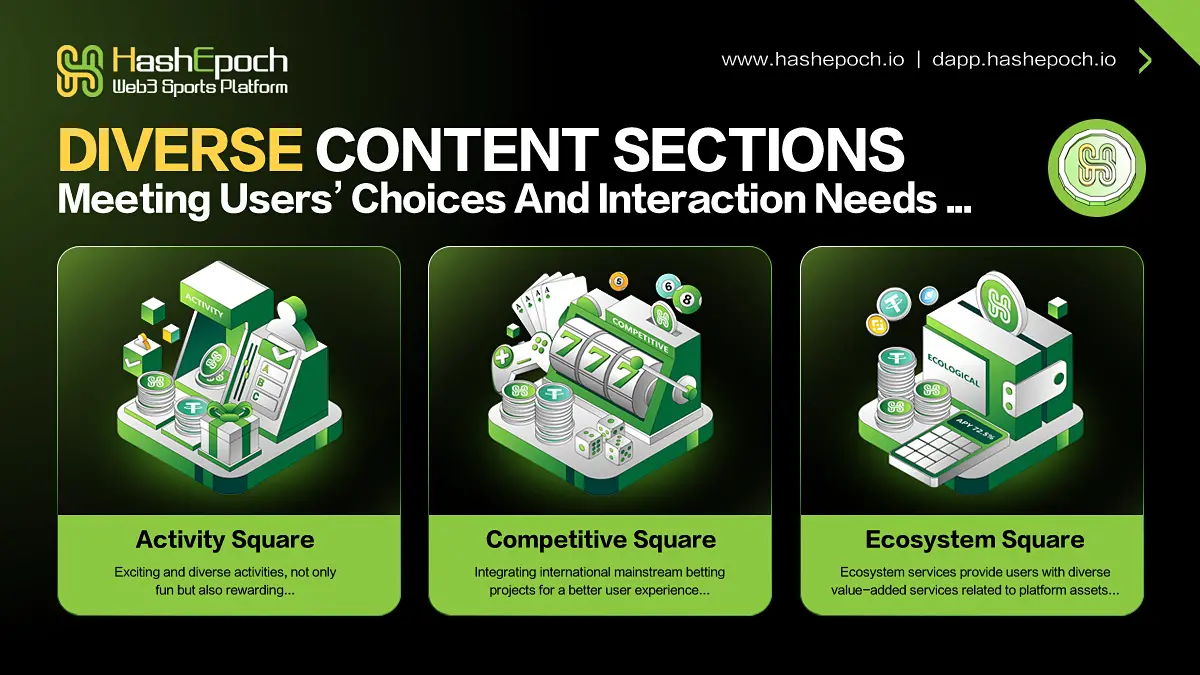
In the competition square, HashEpoch has collected and integrated the top 10 mainstream international prediction gaming projects, providing users with a better user experience and fair competition needs through a decentralized model and fair transparent mechanisms.
At the same time, HashEpoch will also list more excellent projects through incubation or voting methods, currently planning to participate in over 20 competition projects through incubation and investment.
By the end of February, the HashEpoch Foundation had injected $20 million into the HashEpoch platform to launch the prediction gaming section and establish a prize pool fund, ensuring the smooth release of projects and guaranteeing 100% prize payouts.
In the ecological square, HashEpoch mainly provides users with diversified value-added services related to assets and the prediction gaming process. For example, users can conduct asset trading, provide liquidity, manage earnings, and participate in dividends in the ecological square.
In the activity square, users can participate in various activities and tasks and earn rewards by completing them. Whether it’s knowledge contests, puzzle games, or sports event predictions and esports competitions, users can find suitable prediction gaming projects in the activity square.
In addition to the three core areas mentioned above, the HashEpoch platform is also actively integrating with fields such as NFTs and DeFi, aiming to build a diversified Web3 prediction gaming ecological network. For instance, the HashEpoch platform has launched NFT cards with unique attributes and exclusive rights, which users can mint and trade for free, and each card can also provide special privileges and hidden rewards.
Moreover, to improve fund utilization, HashEpoch will also introduce various DeFi usage scenarios for its native tokens, such as earning rewards and dividends through staking multiple tokens or providing LP (liquidity provider) liquidity to earn rewards and token dividends, achieving efficient asset utilization and diversified returns.
Aiming to Cover Over 100 Million Users and Become the Preferred New Generation Prediction Gaming Platform for Players
HashEpoch is committed to leveraging Web3 technology to drive innovation across the entire prediction gaming industry.
First, in promoting industry standardization, the mechanisms employed by HashEpoch, such as hash verification, smart contract custody, and user behavior rewards, may provide a set of reference standards for the operation and management of decentralized prediction gaming platforms.
Secondly, by deeply integrating Web3 technology with prediction gaming scenarios, HashEpoch is expected to attract more technology developers, enterprises, and investors to focus on and invest in the field of Web3 combined with prediction gaming.
Additionally, in enhancing user awareness of decentralized platforms, HashEpoch is dedicated to providing a better user experience, fair and transparent mechanisms, and diverse functions, allowing users to genuinely experience the advantages of decentralized platforms, gradually shifting their reliance on traditional platforms and cultivating trust and preference for decentralized platforms.
However, achieving Web3's innovation in the traditional prediction gaming industry presents significant challenges for the team. HashEpoch has currently assembled a team with a composite background in the traditional prediction gaming industry, Web3, and media channel resources.
The traditional prediction gaming industry background allows HashEpoch to better understand business logic while possessing top-tier project issuance background resources. HashEpoch's Web3 technology team provides the foundation for the platform's decentralization, fairness, and efficiency. Meanwhile, media channel resources offer certain advantages for the platform's cold start and subsequent liquidity.
HashEpoch's vision is to plan to cover over 100 million users in the future, becoming the preferred new generation comprehensive service platform for Web3 prediction gaming.
 Risk warning Risk warning





Popular articles





