








After evaporating 5.5 billion dollars in 15 minutes, why did OM suddenly plummet despite a fourfold surge?

 OM holder woke up to find the sky had fallen.
Author: shushu, BlockBeats
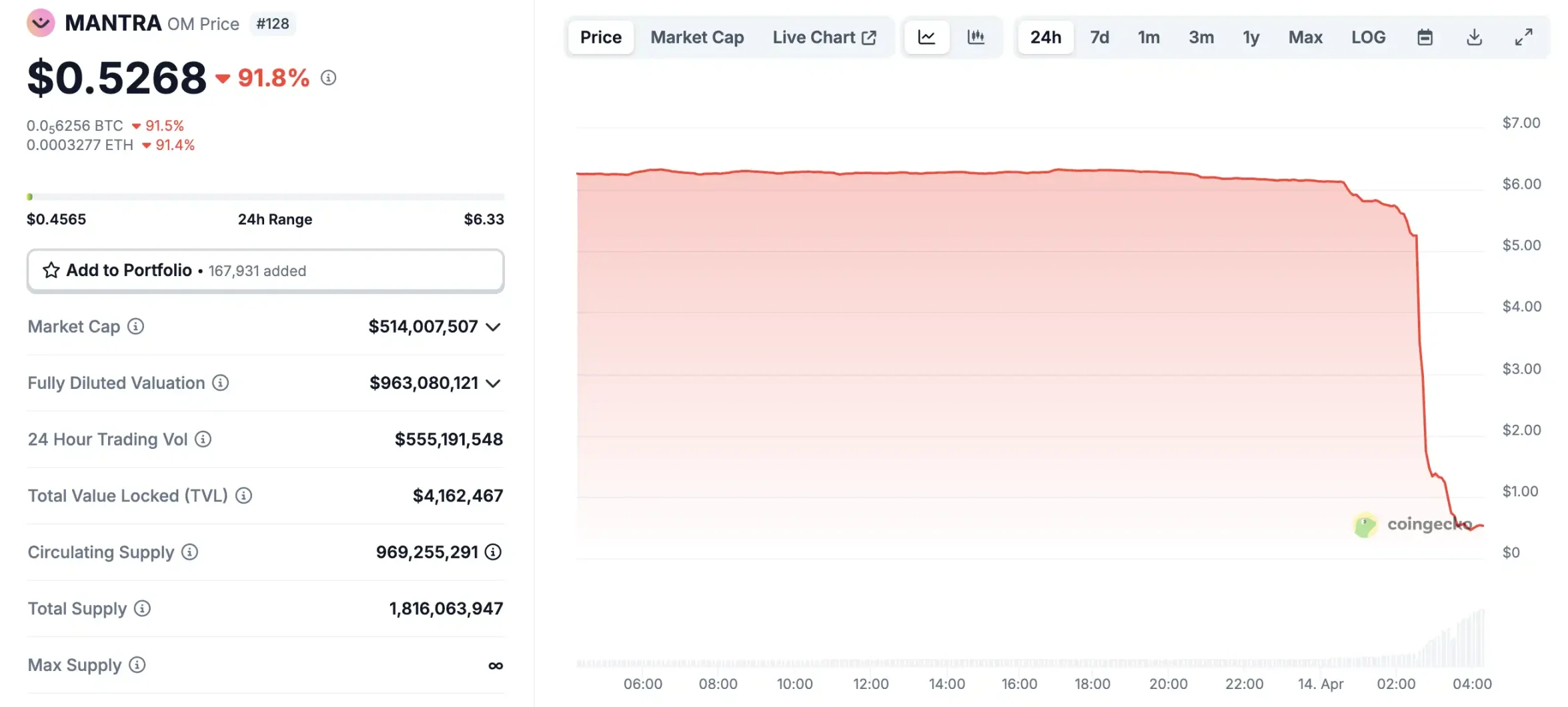
In the early morning, the RWA sector project MANTRA (OM) plummeted 90% in a short time, crashing from $6 to $0.5, with a market cap evaporating over $5.5 billion.
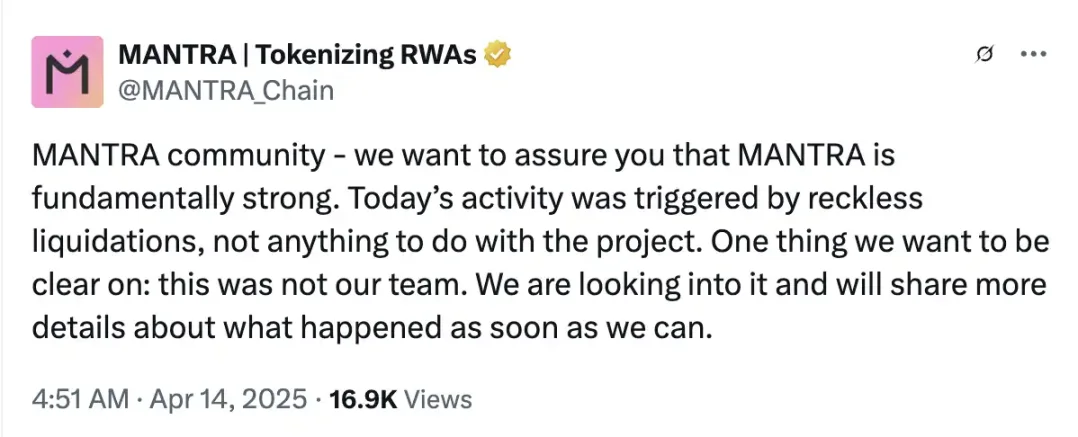
Three hours later, the MANTRA team released a statement claiming that the drop was caused by irrational liquidations and was unrelated to the project itself, asserting that it was not the team's doing.
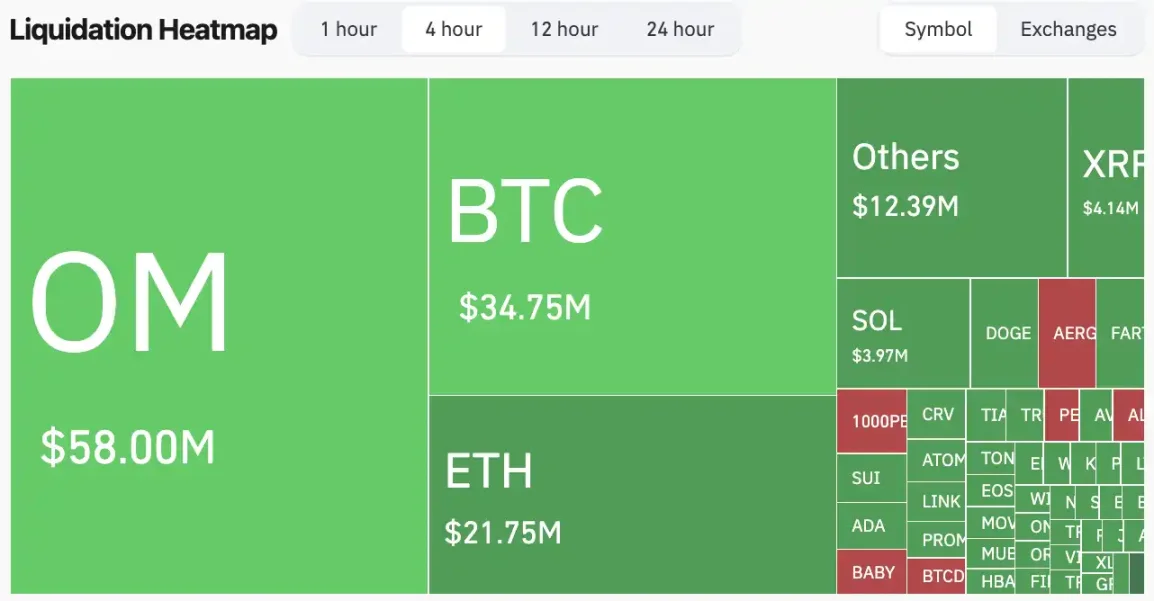
Subsequently, OM surged from around $0.5 to $1.2, briefly experiencing a short squeeze. According to Coinglass data, in just four hours, the liquidation volume of OM contracts reached $58 million.
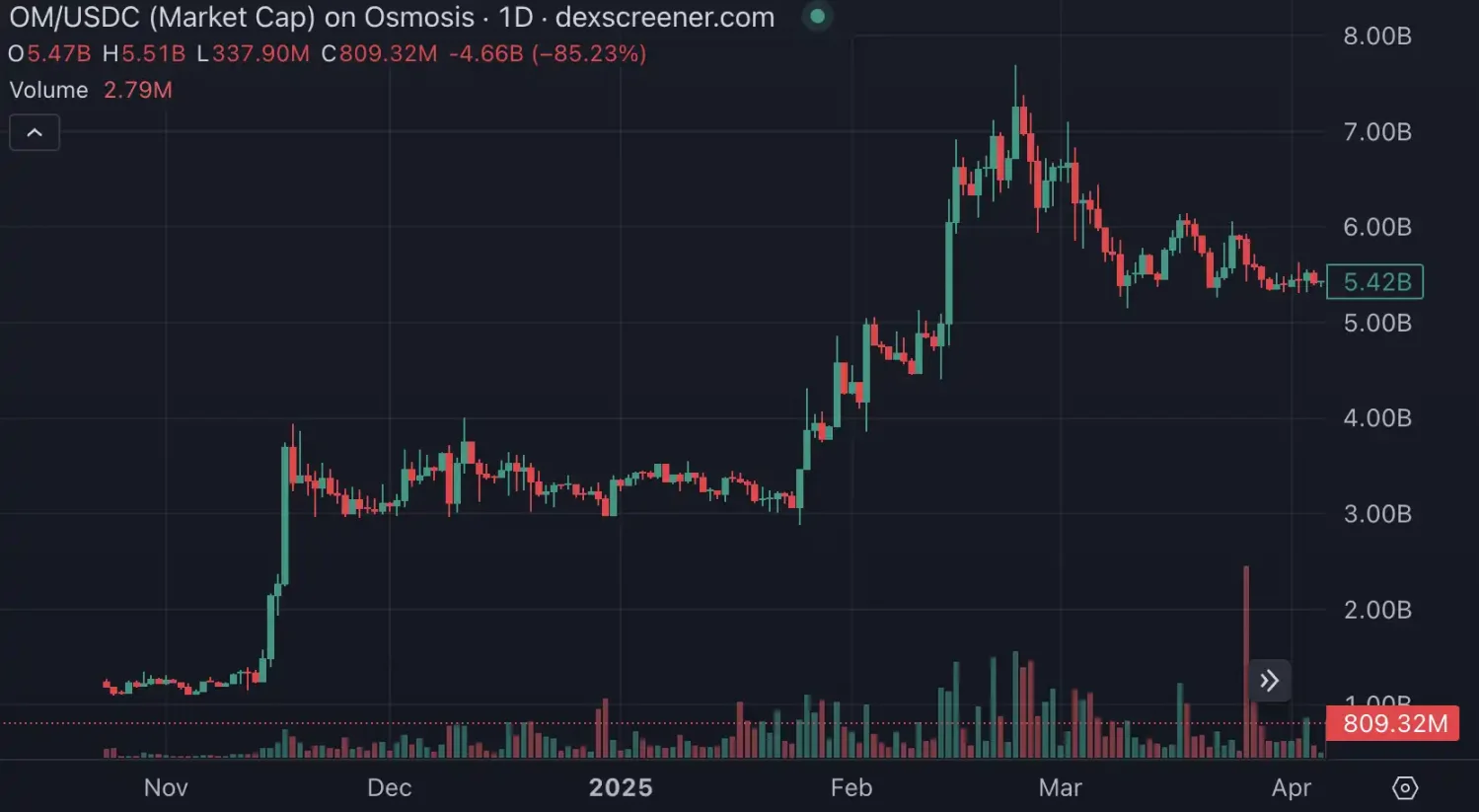
Before this crash, OM had undergone multiple violent surges since November last year, being referred to by the community as a "strong manipulation coin."
OTC Trading or Team Dumping? The Life of OM's High Control
Recently, the community and several data monitoring websites reported that large OM holders were withdrawing tokens and transferring them to exchanges. There were also rumors that OM had completed several over-the-counter trades at a discount of 50% or more, and when large holders began dumping, OTC buyers would panic sell.
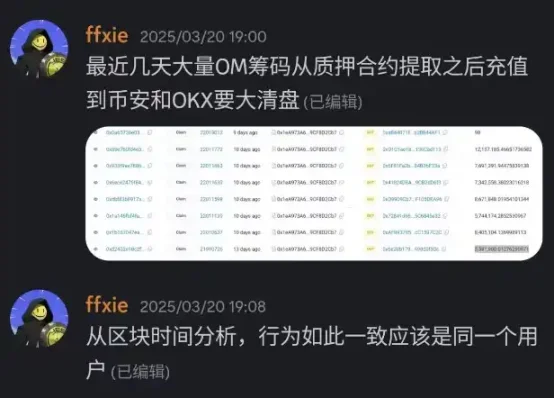
On March 25, according to TheDataNerd monitoring, the investment institution Laser Digital's address deposited 1.7 million OM into Binance, worth $11.49 million. Last year, this wallet accumulated a total of 27 million OM and currently still holds 6.756 million OM, worth $45.67 million.
Yesterday, according to Arkham monitoring, the address 0xA8…A84f withdrew 776,000 OM from the StakedOM contract on Polygon, valued at approximately $5.84 million.
Additionally, according to Genç Trader monitoring, the wallet address 0x9a…1a28 transferred about $20 million worth of OM to OKX 23 hours ago. From past records, this address had just withdrawn about $40 million worth of OM from Binance a month ago, making it one of the whales that previously drove up the token price.
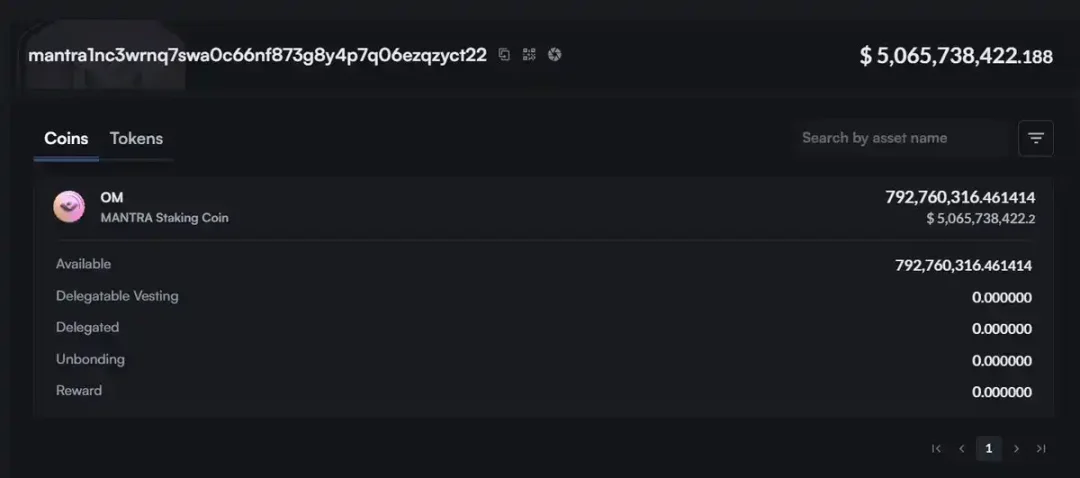
Multiple large OM holders dumping is considered the direct cause of this crash, but the community suspects that this may have been premeditated.
Airdrop PUA
Last November, MANTRA announced its airdrop rules, stating that the previous "3-month cliff period, followed by initial liquidity distribution and 9 months of linear unlocking" was changed to "shortening the cliff period to 1 month, followed by 11 months of linear unlocking," which sparked strong dissatisfaction within the community.
Initially, MANTRA stimulated user participation enthusiasm through high-profile expectation management, claiming to distribute 50 million OM tokens and promising to unlock 20% upon launch, with the airdrop to be completed within a month.
However, in practice, MANTRA continuously modified the airdrop rules, first changing "unlock upon launch" to "linear release starting one month later," and then further delaying it to "10% initial release, with the remaining vesting period lasting up to three years." Along with changes in the roadmap and token distribution structure, MANTRA effectively prolonged the fulfillment cycle, turning community traffic into a long-term locked asset.
When user sentiment rebounded, the project team introduced a governance voting mechanism to shift responsibility in the form of "community consensus," but in practice, voting rights were concentrated in the hands of the project team or related parties, resulting in a highly controllable outcome. Ultimately, some early participants were excluded from the airdrop list, with the project team freezing rights on the grounds of "Sybil attacks," without disclosing detailed evidence.
High Control
The reason OM has been continuously surging for nearly half a year is due to the team's high control. According to KOL @nihaovand, they usually coordinate three waves of buying from different price ranges to collectively drive up the token price. Meanwhile, the project team arranges exit channels for token holders. The funds obtained from these exits are then used to drive up the token price, paving the way for the next wave of external capital inflow.
Previously, multiple sources revealed that the MANTRA team controls 90% of the OM token supply. Crypto analyst Mosi wrote an analysis on how a project with only $4 million TVL could have an FDV exceeding $10 billion, concluding that the team controls most of the OM circulating supply. The MANTRA team holds 792 million OM (i.e., 90% of the supply) in a single wallet, showing a lack of effort to distribute this supply across multiple wallets.
What is the Real Circulating Supply of OM?
According to Mosi's analysis, the real circulating supply of OM = 980 million (circulating supply) - 792 million OM (controlled by the team) = 188 million OM.
However, this number may not be accurate either. The team still controls a significant portion of OM, using these tokens to perform witch attacks on their own airdrop, further extracting exit liquidity and continuing to control the circulating supply. They deployed about 100 million OM for witch attacks on their own airdrop, so this portion also needs to be deducted from the real circulating supply.
Ultimately, the real circulating supply of OM may only be 88 million OM, and the low real circulating supply makes it easy to manipulate the price of OM, while also allowing for easy liquidation of any short positions. Traders should be fearful of shorting OM, as the team controls most of the circulating supply and can easily drive up or crash the price at will.
Mosi believes that Tritaurian Capital may be involved behind OM—this company borrowed $1.5 million from @SOMAfinance (with @jpmullin888 being a co-founder of SOMA, and Tritaurian owned by Jim Preissler, who is the boss of JPM at Trade.io)—as well as some funds and market makers from the Middle East. These operations further compressed the real circulating supply, making its calculation more difficult.
This may also explain why they are reluctant to release the airdrop and decided to implement a lock-up period. If they really conducted an airdrop, the real circulating supply would significantly increase, potentially leading to a sharp price drop.
This is not a complex financial engineering scheme, but it appears to be an intentional plan aimed at reducing the real circulating supply of the tokens and easily pushing up or crashing the price of OM.
 Risk warning Risk warning



Popular articles





