








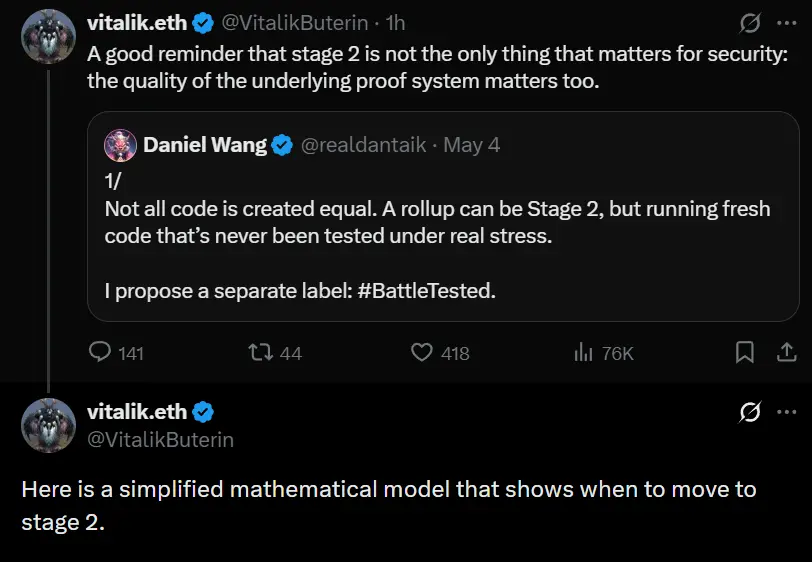
Vitalik: The quality of the underlying proof system of L2 networks is equally important and should gradually enter the second stage as it develops
ChainCatcher news, in response to community member Daniel Wang's proposed naming label #BattleTested for the L2 network Stage 2, Ethereum co-founder Vitalik posted on the X platform stating: "This is a good reminder: the second stage is not the only factor affecting security; the quality of the underlying proof system is equally important. This is a simplified mathematical model that shows when to enter the second stage:
Each security council member has a 10% independent 'break' chance; we consider activity failure (refusal to sign or key unavailability) and security failure (signing the wrong thing or key being hacked) as equally likely; the goal: to minimize the likelihood of protocol collapse under the above assumptions.
Stage 0 security council is 4/7, Stage 1 is 6/8; please note that these assumptions are very imperfect. In reality, council members have 'common mode failures': they may collude, or all be coerced or hacked in the same way, etc. This makes both Stage 0 and Stage 1 more insecure than shown in the model, so entering Stage 2 earlier than the model suggests is the best choice.
Additionally, note that by turning the proof system itself into multiple independent systems via multi-signature, the probability of proof system collapse can be greatly reduced (this is what I advocated in previous proposals). I suspect that all Stage 2 deployments in the past few years will be like this. Considering this, here is the chart. The X-axis is the probability of proof system collapse. The Y-axis is the probability of protocol collapse. As the quality of the proof system improves, the optimal stage shifts from Stage 0 to Stage 1, and then from Stage 1 to Stage 2. Using a proof system of Stage 0 quality for Stage 2 is the worst.
In short, @l2beat ideally should showcase proof system audits and maturity metrics (preferably proof system implementations rather than the entire aggregation, so we can reuse them) and stages."

 Risk warning Risk warning


