








Stablecoins have weathered 10 years of ups and downs, ultimately becoming the U.S. government's officially designated "peer-to-peer electronic cash."

 From geek technology to major asset classes, BTC paves the way for stablecoins, what will the vision for cryptocurrency be in the next decade?
Author: Wenser, Odaily
Editor: Hao Fangzhou
As the price of BTC approaches a new high of $112,000, the U.S. stablecoin regulatory bill, the "Genius Act," is also gearing up. The crypto industry is further deeply coupled with the global economic system, and at this moment, people realize: the payment system is the crown of the crypto industry, and BTC is the jewel on that crown. This is also one of the reasons why PayFi, U Cards, and RWA have become battlegrounds for exchanges and crypto projects as the mainstreaming of crypto assets accelerates. In the future, independent payment solutions based on segmented real-world industries may become possible.
The Great Change in Stablecoins: The Decade of Crypto Originating from USDT (2014-2024)
In 2008, an article titled "Bitcoin: A Peer-to-Peer Electronic Cash System" (https://bitcoin.org/bitcoin.pdf) appeared on the P2P Foundation website, authored by Satoshi Nakamoto, who would later be revered as the founding father of the crypto industry. At that time, the world economy was slowly rebuilding after the 2008 subprime mortgage crisis, which had erupted due to severe inflation of the dollar. Undoubtedly, the original intention behind the birth of BTC was to address the chronic ailments of the centralized currency supply system and the lengthy, rigid global financial payment system.
However, contrary to the expectations of many crypto OGs, including Nakamoto, it was not BTC, which championed decentralization, that ultimately fulfilled the "peer-to-peer payment wish of BTC," but rather various stablecoins that are strongly tied to the dollar and U.S. Treasury bonds.
The Rise of USDT: Rural Surrounding Urban, Use Cases Seizing the Market
Looking at the history of Tether, we can roughly categorize its development into a "three-step strategy":
(1) From Crypto Blood to Crypto Oil
In October 2014, Tether was founded, with its core product being the stablecoin USDT issued on the Bitcoin Omni protocol;
In February 2015, USDT was launched on Bitfinex, the trading platform with the largest Bitcoin trading volume at the time. Tether CEO Paolo Ardoino was also the CTO of Bitfinex, and the two companies have long been viewed as "brother companies" due to their highly overlapping team members;
In 2018, Tether issued USDT based on the ERC 20 standard on Ethereum. USDT under this standard was compatible with the original protocol, further enhancing its usability. Since then, Tether and USDT have gradually penetrated the crypto ecosystem like crypto blood, riding the wave of Ethereum's ecological development.
In 2019, TRON successfully partnered with Tether, and since then, TRON has been racing ahead in the stablecoin network's leading ecosystem, with the former becoming a heavyweight cooperative network accounting for over one-third of USDT's issuance. TRON founder Justin Sun also propelled TRON to become one of the infrastructures of cryptocurrency through early distribution strategies.
It can be said that after the early redemption fee profit model was successfully validated, Tether had established its competitive barrier and business model through USDT, gradually becoming a trading equivalent like crude oil in the crypto ecosystem.
(2) From Crypto to Beyond Crypto
As we entered 2020, with the explosion of DeFi Summer, the market capitalization of stablecoins soared, and naturally, Tether and USDT seized the first-mover advantage. Tether's ambitions also gradually expanded beyond the crypto world into a larger scope.
As mentioned in our previous article, "The Market Value of 'First Stablecoin' USDT Hits New High, Revealing the Billion-Dollar Business Empire Behind Tether" (https://www.odaily.news/post/5198855): The use cases of USDT include being a general equivalent for cryptocurrencies, an alternative currency in inflationary regions, and a primary payment tool for cross-border trade, among others. Additionally, after reaping massive profits, Tether extended its reach into the global economic system through various investments, acquisitions, U.S. Treasury reserves, gold reserves, and BTC reserves, strengthening its connections beyond the crypto world. This is also one of the key reasons why USDT has been criticized as a "money laundering accomplice." After all, money never sleeps, and neither does USDT.
(3) From Payment Means to Value Storage
In 2021, after reaching a settlement with the New York Attorney General's Office (NYAG) and paying a $41 million fine to the U.S. Commodity Futures Trading Commission, Tether cleared its biggest obstacle to development. Since then, the value of USDT began to transition from a means of payment to a store of value. After experiencing previous de-pegging controversies and reserve asset FUD, USDT issued by Tether became one of the few assets to hoard in the high-risk, high-volatility crypto market—another being BTC. Especially with the continuous buying of U.S. Treasury bonds, its market position and brand recognition, which are pegged 1:1 to the dollar, were ultimately recognized by the crypto community, and the annual profits of billions to even hundreds of billions of dollars provided the confidence to claim the title of "twin dollar."
From once wildly growing crypto projects to now the dominant stablecoin leader, Tether and USDT have staged a spectacular drama of "rural surrounding urban, use cases seizing the market."
USDC's Second Path: Centralized Development, Crypto IPO
Unlike USDT issued by Tether, Circle, backed by Coinbase, and its stablecoin USDC have taken a completely different path: everything is built for compliance.
Aside from the usual U.S. Treasury reserves, Circle's profit model is undoubtedly more fragile compared to Tether. After all, partners like Coinbase and Binance can consume a large portion of its profits, which is also one of the key reasons for its push for crypto IPOs after Trump took office—only by leveraging existing compliance advantages and timely expanding its foundation from the cryptocurrency sector to traditional financial markets can it gain stronger bargaining power and secure more robust funding, resources, and policy support in subsequent market competition.
Apart from the two market giants, USDT and USDC, competition for this lucrative "cake" has undoubtedly intensified, with early market players like TrueUSD (TUSD), Circle Coin (USDC), Gemini Dollar (GUSD), Paxos (PAX), and now still relevant projects like DAI (MakerDAO), USDS (Sky), USDe (Ethena), PYUSD (PayPal), RLUSD (Ripple), and USD1 (WLFI). Who can truly remain undefeated or become the ultimate winner still awaits the test of regulatory policies and the validation of time.
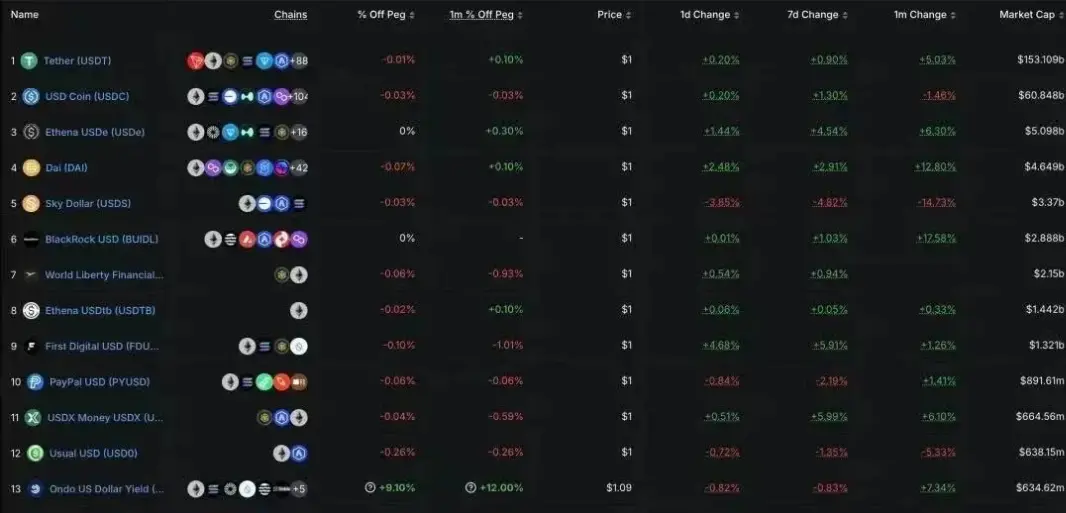
https://defillama.com/stablecoins
The U.S. "Genius Act" Sparks a Wave of Stablecoin Regulation: Completing the Last Piece of the Crypto Regulatory Puzzle
For all stablecoin projects, the recent Senate vote to "release" the stablecoin regulatory bill, the "Genius Act," is undoubtedly the sword of Damocles hanging over their heads. With Bitcoin spot ETFs and Ethereum spot ETFs becoming part of traditional institutional investment portfolios, this bill will undoubtedly complete the last piece of the Trump administration's crypto regulatory landscape.
Specifically, in my personal view, the main objectives of the Genius Act are:
1. Ensure Dollar Hegemony. As a staunch advocate of "America First," Trump's core goal, along with his government members and even Democratic members, remains to ensure America's political and economic hegemony, and the primary medium to achieve this is the dollar. Stablecoins pegged 1:1 to the dollar are undoubtedly one of the best tools.
2. Ensure the Stablecoin System Operates Within U.S. Jurisdiction. In an environment that has become crypto-friendly, the U.S. is re-emerging as a crypto hotspot, which will help the U.S. gain the initiative in the operation of the stablecoin system and the formulation of regulatory policies. At that time, similar to past foreign trade regulations, the U.S. will achieve comprehensive suppression of the global crypto economy and even cross-border trade through the stablecoin system.
3. Ensure Partial Security of the Crypto Financial System. This is also one of the key reasons why the Genius Act has received positive affirmation from many industry insiders and representatives of the traditional financial sector. Mandatory 1:1 full asset reserves, strict prohibitions on misappropriation and re-pledging, monthly reserve reports with external audits, banking-level regulatory licenses for circulating market values exceeding $10 billion, and the introduction of custodial institutions will add layer upon layer of insurance locks to the stablecoin sector. Of course, whether the door behind those locks is sturdy is another question.
4. Greatly Expand the Imagination Space of the RWA Sector, Creating a Closer Connection Between On-Chain and Off-Chain Worlds. It can be said that stablecoins are the earliest RWA products, and the real-world asset they are pegged to is the dollar. With the gradual implementation of the Genius Act, the introduction and implementation of RWA-related legislation is also believed to be just around the corner. Compared to the current cryptocurrency market of over $30 trillion, this could represent an asset market worth hundreds of trillions of dollars.
Thus, the Genius Act will provide policy dividends for the U.S. government and the development of the digital economy, tapping into the potential of digital assets and encouraging the growth of crypto projects and their underlying teams. The geniuses carrying the future of crypto may be hidden within.
The New Decade of Crypto: Finance Remains the Main Line, Crypto Concept Stocks and Stock Tokenization Have Great Potential
Looking ahead to 2025, the proportion of the crypto population in the global population has reached a temporary peak, and cryptocurrency investment remains a game for a minority; however, on the other hand, in the business society, everyone has a natural demand for commodity exchange, where commodities can be tangible products, items, or intangible labor, virtual assets, digital IP, etc. Therefore, based on this demand, more convenient, lower-cost, and safer crypto payments will eventually permeate everyone's daily life.
In the next decade (2025-2035), the main line of the cryptocurrency industry may gradually shrink from multiple sectors and fields that have been disproven by the market to the financial sector. Consequently, crypto concept stocks generated from crypto IPOs and stock tokenization will become a new battleground for the crypto industry.
In certain respects, companies like Strategy, Sol Strategy, and Metaplanet have already become "dual-symbol carriers" of crypto concept stocks and stock tokenization. As the value of BTC receives broader recognition and potentially higher prices, their latent value will also be further released.
Of course, within the visible range, the ETH ecosystem and Solana ecosystem remain the mainstream choices in the industry today.
Conclusion: Nakamoto's "Will" Finally Realized, But the Means of Realization is Contradictory
In conclusion, we still cannot avoid the crypto giant Satoshi Nakamoto, who has disappeared from the market's view, and the ultimate embodiment of his "BTC peer-to-peer payment system" is undoubtedly stablecoins.
However, it is somewhat ironic that he, with the spirit of crypto punk, may not have anticipated that BTC, born to combat the unchecked and ever-expanding minting power of authoritarian governments, would instead give rise to a more "dollar-centric, U.S. Treasury-backed" stablecoin system.
 Risk warning
 Risk warning



Popular articles





