








After James Wynn's over $100 million liquidation, why does Zhao Changpeng strongly support Web3 dark pool trading?

 Former Binance CEO Zhao Changpeng proposed the need to build a dark pool perpetual contract DEX to address MEV attacks and large position exposure issues caused by DEX transparency, sparking a wave of market interest in the dark pool sector.
Original Title: : : [Issue] Darker than Black: Web3 Needs Dark Pools
Original Author: c4lvin : : FP, Researcher at Four Pillars
Original Compiler: Tim, PANews
Key Points:
- Binance's former CEO Zhao Changpeng proposed the need to build a dark pool-style perpetual contract DEX to address MEV attacks and large position exposure issues caused by DEX transparency, sparking a wave of market interest in the dark pool sector.
- Dark pools have long existed in traditional financial markets as private trading venues, allowing institutions to handle large positions without causing market volatility, but they have also faced controversy due to their centralized operating model.
- Dark pools built in the decentralized environment of Web3 can address key flaws in both Web3 and the existing financial system, and are assessed to play an important role in the future Web3 privacy market.

Source: "The Black Contractor"
Today (June 1, 2025), a post by Binance's former CEO Zhao Changpeng on Twitter has caused a huge stir in the community. He proposed the potential need for a "dark pool-style perpetual contract DEX," pointing out that the current transparency of real-time public orders on DEXs is actually detrimental to traders. This post has sparked a debate about the privacy and efficiency of cryptocurrency trading, particularly bringing attention to the concept of dark pools. This article aims to analyze what dark pools are and what they mean in Web3.
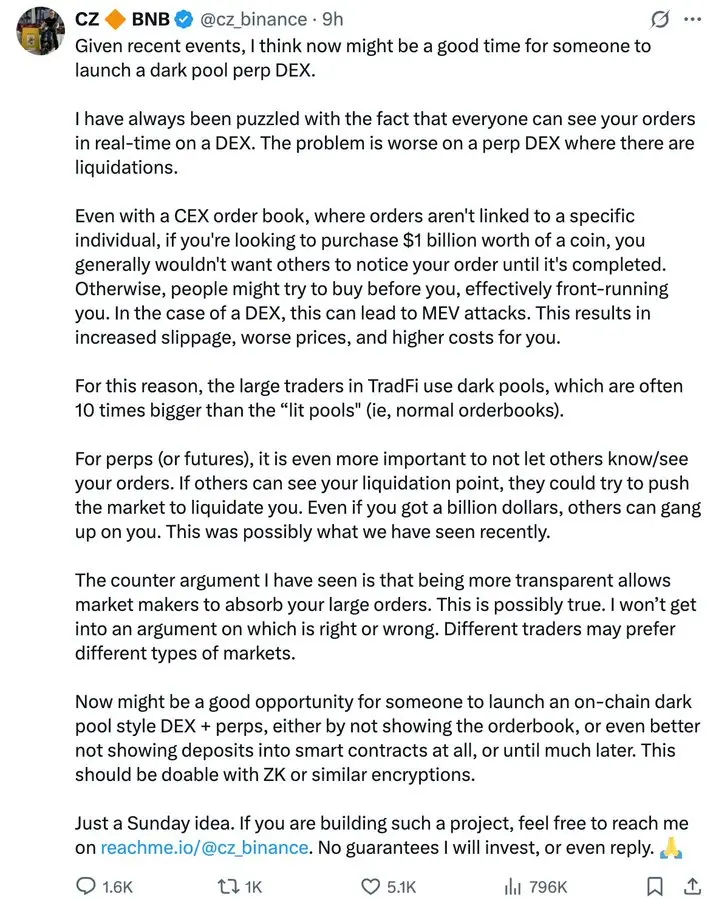
Source: CZ Twitter
1. What is a Dark Pool?
1.1 Dark Pools in Traditional Fields
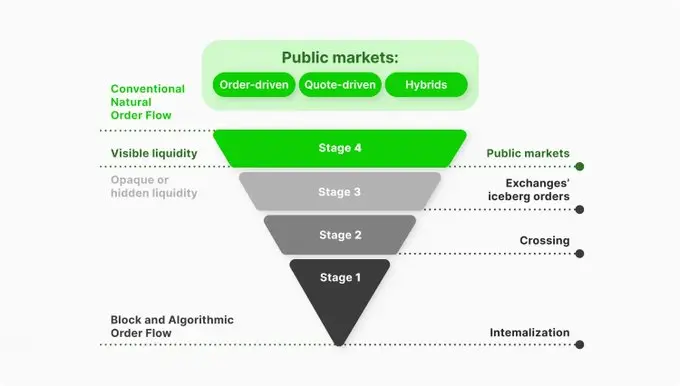
Source: b2broker
Although CZ's remarks may lead people to mistakenly believe that dark pool trading is a Web3-exclusive innovation, in fact, this financial tool has existed in traditional markets for decades. The history of dark pools can be traced back to 1979 when the U.S. Securities and Exchange Commission passed Regulation 19c-3, allowing securities listed on certain exchanges to be traded on other platforms. With the rise of electronic high-frequency trading in the 1980s, the transparency of order book information far exceeded previous levels, prompting institutional investors who were unwilling to expose large positions to seek private trading venues.
Typically, we encounter public exchanges like the New York Stock Exchange or NASDAQ, but opening large buy or sell positions on these public exchanges can significantly impact market prices and even cause unexpected losses for ordinary traders. A dark pool refers to an independent trading system that allows institutions or large investment banks to execute large trades privately.
In traditional exchanges, all buy and sell orders are publicly displayed on the order book for market participants to view, while dark pool trading platforms do not disclose order prices or quantities before execution. Due to this characteristic, large institutional investors can hide their trading intentions while minimizing market impact. As of 2025, up to 51.8% of U.S. stock trading is completed through dark pools, indicating that dark pools have transcended mere alternative trading methods to become a mainstream trading approach.
This dark pool trading differs from over-the-counter trading in cryptocurrencies. Dark pool operators accumulate chips by shorting stocks to provide buying volume to buyers. Since they must disclose short trading details to financial regulators like the Financial Industry Regulatory Authority, the trading data and volumes of dark pools are, in fact, publicly transparent. However, the identities of the institutions initiating trades are not disclosed. Currently, dark pool trading volumes are publicly available in the form of the DIX index, which traders often use to infer institutional fund movements.
1.2 Criticism of Traditional Dark Pool Trading
However, dark pool trading in traditional finance has faced significant criticism. Because dark pool trading is controlled by centralized operators, it is prone to abuse when the profits from corruption far exceed the costs of penalties, leading to numerous criminal cases in reality.
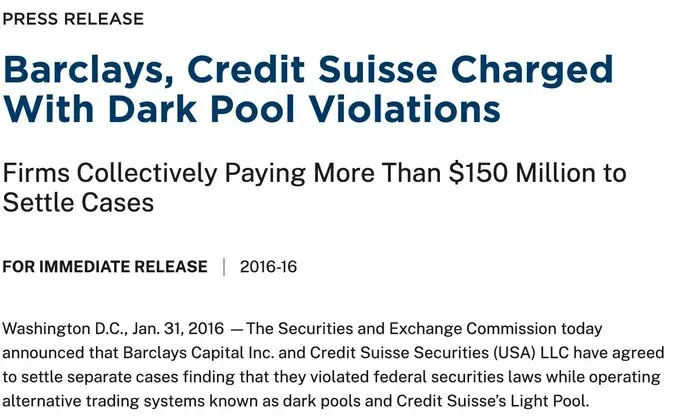
Source: SEC
In 2016, several major financial institutions were fined over $150 million for violating federal laws in dark pool operations, with Barclays and Credit Suisse being sued by the SEC for breaching dark pool regulations. These institutions were accused of providing clients with false information about the composition of dark pool participants and failing to transparently disclose their preferential treatment of high-frequency trading firms.
In 2018, the SEC fined Citigroup $12 million for misleading investors in its dark pool trading business. Citigroup leaked confidential order information to high-frequency trading firms, allowing these firms to execute over $9 billion in trades against Citigroup's clients and profit easily.
These issues stem from a reliance on trust in centralized operators and conflicts of interest, which the decentralized dark pool solutions in Web3 can effectively address.
1.3 Dark Pools in Web3
The concept of dark pools in Web3 is also gaining attention, with its implementation being more complex and transparent than traditional financial market dark pools. Although all transactions on the blockchain are publicly recorded, seemingly presenting a contradiction, Web3 dark pools utilize advanced cryptographic techniques such as zero-knowledge proofs and multi-party computation to effectively ensure transaction privacy. The inherent transparency of the blockchain actually becomes a technical advantage for achieving more advanced privacy protection.
The core advantage of Web3 dark pools lies in their ability to circumvent operational risks, unlike traditional Web2 model dark pools. Since transactions are executed automatically through smart contracts without the need for intermediaries, traders can always maintain complete control over their assets. Additionally, unlike traditional dark pools, there is no risk of operators abusing customer information in this model, as all transaction processes can be verified through cryptographic techniques.
Web3 dark pools also introduce a new concept called "programmable privacy." This feature allows developers to flexibly set which parts of the application should remain private and which parts need to be public. For example, under the premise of meeting regulatory compliance requirements, trading instructions can be kept confidential throughout the process, while the final transaction results are only disclosed to specific participants. Although traditional software technology is not incapable of achieving similar functionality, Web3 technology has significant advantages in flexibility and verifiability of protocols at the implementation level of programmable privacy protocols.
2. The Demand for Dark Pool-style Perpetual Contract DEX
CZ proposed the need for a dark pool model perpetual contract DEX and pointed out that the transparency of current DEXs has led to many issues. His core arguments and basis are as follows:
2.1 Avoiding MEV Attacks
The transparency of DEXs is one of the main reasons for MEV attacks. As mentioned earlier, when DEX orders are publicly available in the blockchain memory pool, MEV bots can detect this trading information and implement front-running, back-running, or sandwich attacks. This results in traders ultimately receiving execution prices far below expectations, especially for large orders where slippage can significantly increase. CZ has stated, "If you want to complete a $1 billion order, you would want to do it before others notice," advocating for a dark pool mechanism to address such issues.
2.2 Potential Huge Demand
CZ mentioned that dark pools have been widely used in traditional financial markets, noting that the liquidity scale that dark pools can provide may be ten times that of public exchanges. He believes that the crypto market also needs such solutions, particularly emphasizing the importance of privacy protection for traders in high-risk products like perpetual contracts.
Beyond CZ's viewpoint, the demand for dark pools has recently been recognized as growing not only in the Web2 market but also in the Web3 market. According to research by Blocknative, private memory pool transactions on Ethereum accounted for only 4.5% of the total in 2022, but have recently risen to over 50% of total gas fees. Although the Solana network does not have a memory pool environment, various trading bots and wallet solutions have now made MEV prevention features standard configurations, indicating that users' awareness of MEV has significantly increased. This clearly demonstrates that the Web3 community is now fully aware of the operational behaviors that affect trading outcomes and has a strong demand to actively avoid these impacts.
2.3 Potential Damage from DEX Transparency
CZ stated, "All orders on DEXs are publicly available in real-time," emphasizing that this poses significant risks in perpetual contract trading. In perpetual contract DEXs, traders' positions and liquidation points are directly exposed on the blockchain, allowing malicious participants to potentially manipulate the market using this information. For example, when other traders discover the liquidation price of a large position holder, they could deliberately push the market price to trigger forced liquidations. CZ also mentioned that this is related to "recent events," seemingly alluding to the HLP liquidation event on the Hyperliquid platform or James Wynn's large liquidation incident.

Source: @simonkim_nft
A more detailed explanation of CZ's tweet can be found in a recent article written by Simon Kim, founder of Hashed. The article points out that while Web3 can achieve decentralization and privacy protection, it has actually created the most transparent monitoring system in history, emphasizing a reality where all transactions are permanently recorded, visible to anyone, and analyzed by AI.
The article focuses on the case of MicroStrategy, proving that even enterprises cannot escape tracking. Despite Michael Saylor's repeated warnings about the risks of publicly disclosing wallet addresses, the blockchain analysis platform Arkham Intelligence has gradually succeeded in tracking the Bitcoin held by the company, pinpointing 87.5% of its total holdings.
The article also highlights James Wynn's $100 million liquidation incident on the Hyperliquid exchange, which underscores the necessity of dark pool trading. Wynn had established a $1.25 billion long position in Bitcoin with 40x leverage, but because his liquidation price was publicly accessible, market participants were able to exploit this loophole, with traders continuously taking opposite positions against him, profiting $17 million within a week. This incident reveals the drawbacks of position information transparency in perpetual contract DEXs and confirms the genuine demand for a trading environment where position information is not transparent.
3. Different Ways to Implement Dark Pools On-Chain
While many people may have encountered the concept of dark pool trading for the first time due to CZ's tweet, numerous projects have been continuously advancing dark pool development. To achieve the core goal of "trader privacy" in dark pools, various technical paths exist, with different projects adopting differentiated cryptographic solutions. Below are the mainstream implementation methods and their representative projects:
3.1 Renegade
Source: Renegade
Renegade is currently one of the most representative on-chain dark pool projects on the Arbitrum mainnet of Ethereum's Layer 2. This project constructs its privacy protection solution by combining multi-party computation with zero-knowledge proof technology.
In the Renegade protocol, all state data (balances, order books, etc.) is managed locally by traders without relying on centralized or distributed servers. When traders execute a trade, they must simultaneously know the old and new wallet states and submit three key pieces of information to the smart contract: commitment, nullifier, and validity proof. This structural design is also common in zero-knowledge proof-based projects like Zcash.
Renegade's core feature is to ensure complete privacy before and after the transaction. Before the transaction, order details (price, quantity, direction, etc.) are completely hidden; after the transaction is completed, only the counterparty knows the type of assets exchanged. All trades are executed at Binance's real-time mid-price, with no slippage or price impact, making it an attractive Web2-style project.
The architectural feature of Renegade is that whenever a new order enters the system, numerous independent relayer nodes continuously execute multi-party computation through peer-to-peer communication. During the execution of multi-party computation, Renegade proves a special NP proposition called "VALID MATCH MPC." This proof indicates that given the publicly committed order information and the publicly committed matching tuple, both trading parties actually know the valid input orders. Through this collaborative zero-knowledge proof structure, Renegade provides users with complete anonymity, privacy, and security.
3.2 Arcium
Arcium is a privacy project built on the Solana ecosystem, with its core technology utilizing additive secret sharing for MPC to achieve encrypted shared states. This solution allows developers to store encrypted states on-chain and perform data computations while ensuring that the underlying raw data remains confidential throughout the process. Notably, Arcium's innovative architecture enables local non-interactive additive operations and completes multiplicative operations through a single round of communication, significantly enhancing computational efficiency while providing strong security guarantees.
Additionally, Arcium incorporates programmable privacy capabilities, allowing developers to specify which states should be stored in encrypted form and which functions should perform calculations on specific encrypted states within Solana programs. In Arcium, multi-party computation tasks are managed by a virtual execution environment called the Multi-Party eXecution Environment (MXE). MXE is responsible for setting task parameters, such as the data used, the programs executed, and the nodes responsible for computation. With this framework, Arcium can support large-scale, parallelized transaction execution similar to Solana.
Source: Arcium
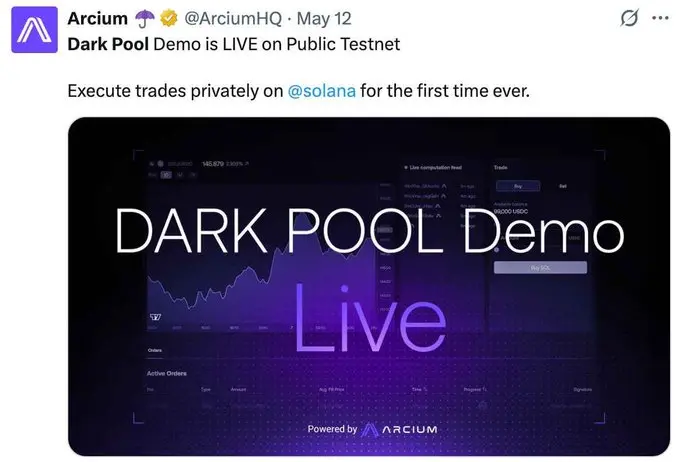
Recently, Arcium successfully launched a dark pool demo on the Solana public testnet, achieving the first on-chain confidential trading venue on the Solana blockchain. Any existing Solana DeFi project can collaborate with Arcium to deploy dark pool mechanisms on Solana, providing users with confidential trading services.
3.3 Aztec
Aztec is a zero-knowledge rollup solution focused on privacy protection, completing a $100 million Series B funding round led by a16z crypto in 2022, becoming one of the largest investment cases in the privacy technology field.
Similar to the Arcium solution, Aztec allows developers to mark private functions, with marked private functions executed and verified on user devices, while only publicly marked functions run on the Aztec network. The state values of private functions are stored in UTXO form that only users can decrypt, making it unreadable to anyone else.
Source: Aztec
Aztec has collaborated with Ren Protocol to jointly develop a privacy-protecting trading protocol based on dark pool technology. The trading system built by Aztec allows users to trade using zero-knowledge proof tokens called "Aztec Notes," with transaction information and amounts not publicly disclosed on the order book. When users deposit funds into Aztec, the system generates cash-like encrypted vouchers through an off-chain UTXO state mechanism. As transactions are submitted and executed, the state tree continuously updates encrypted information, with only the voucher holder able to view the content, fully ensuring the confidentiality of user identities and account balances.
4. If Technology Succeeds, Dark Pools Will Flourish
The biggest technical challenge facing Web3 dark pools is scalability and performance issues. Current secure multi-party computation and zero-knowledge proof technologies have high computational requirements and still face limitations when processing large transaction volumes. Taking the Renegade project as an example, the peer-to-peer network structure leads to exponential growth in system complexity as the number of network participants increases.
There exists a trade-off between the privacy and scalability of dark pools. Aztec co-founder Zac Williamson once pointed out, "Completely private transactions require transmitting more data due to complete information encryption, which consumes more resources and reduces scalability." To overcome these fundamental constraints, more efficient cryptographic libraries need to be developed.
Source: Arcium
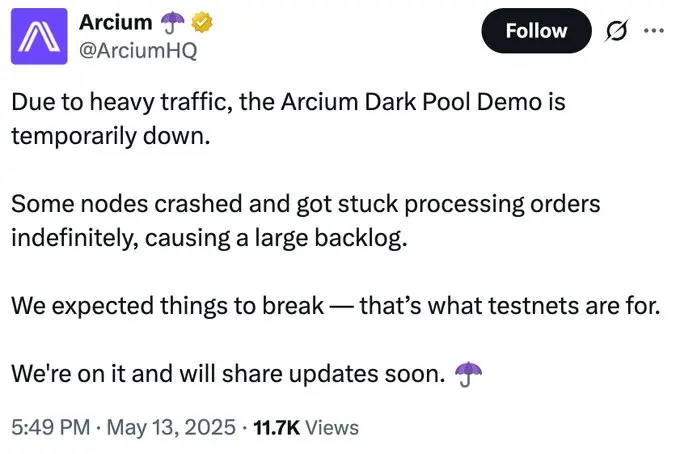
Network stability is also a significant challenge. Recently, Arcium tested a dark pool demo application based on the Arcium testnet on Solana's Devnet. During the testing period, some nodes crashed due to high traffic, leading to order queue backlogs. This test aimed to verify infrastructure stability and resolve such potential issues before going live on the mainnet, and the issue was indeed quickly resolved. This proves that implementing dark pools requires cutting-edge technology and thorough testing to handle high-demand loads.
In the long run, dark pools are expected to become an important part of the cryptocurrency trading ecosystem. As Binance founder CZ pointed out, dark pools account for over 50% of trading volume in traditional finance, and this trading model is likely to occupy a similar proportion in the crypto market. As institutional investors increase their participation in the crypto market, this trend will accelerate further.
However, this does not mean that existing DEXs will be completely replaced; rather, the two are more likely to form a complementary relationship to meet different needs. The market is expected to show a trend of differentiation in the future: small trades that emphasize price discovery will still be conducted on existing DEXs, while large trades that prioritize privacy will take place in dark pools.
The development of dark pools will expand from the privacy domain to broader application scenarios. As Arcium continues to advance, the demand for privacy protection technology in various fields such as AI, DePIN, and supply chain management is increasing day by day. As a starting point for privacy technology deployment, dark pools are expected to develop into an important part of the privacy ecosystem.
 Risk warning
 Risk warning




Popular articles





