








Singapore's crackdown on Web3 is in full swing, the era of regulatory arbitrage is over, and a major Web3 "retreat" is on the horizon

 In Singapore, the era of regulatory arbitrage has officially ended, and the era of big fish eating small fish has arrived.
Author: Spinach Spinach Talks Web3
On May 30, 2025, the Monetary Authority of Singapore (MAS) released a response document regarding the new regulations for Digital Token Service Providers (DTSP), and many have yet to realize that this will actually impact the entire landscape of the Web3 industry in Asia.
The new regulations will officially take effect on June 30, 2025, and MAS has made it clear that there will be no grace period! A large-scale "Singapore Web3 exodus" may have quietly begun.
"We will be extremely cautious." When MAS expressed this attitude unabashedly in this stern consultation document, Singapore, once hailed by global Web3 practitioners as the "crypto-friendly paradise of Asia," is bidding farewell to the past in a surprising way— not through gradual policy adjustments, but through an almost "cliff-like" tightening of regulations.
For those projects and institutions still on the sidelines, it may no longer be a question of "whether to leave," but rather "when to leave" and "where to go."
Past Glory: The Golden Age of Regulatory Arbitrage
Do you remember Singapore in 2021? When China completely banned cryptocurrency trading and the U.S. SEC waved its regulatory stick everywhere, this small island nation opened its arms to welcome Web3 entrepreneurs. Three Arrows Capital, Alameda Research, FTX Asia headquarters… one prominent name after another chose to settle here, not just because of the 0% capital gains tax, but also due to the "embracing innovation" stance exhibited by MAS at that time.
Back then, Singapore was known as the "holy land of regulatory arbitrage" for the Web3 industry. Registering a company here allowed for the legal and compliant provision of digital asset services to global users outside of Singapore, while enjoying the reputation of being a financial hub. This "based in Singapore, connected to the world" business model once attracted countless Web3 practitioners.
Now, the new DTSP regulations mean that Singapore has completely closed the door on regulatory friendliness, and the attitude can be summed up in one sentence: drive out all those in the Web3 industry without a license from Singapore.
What is DTSP? A Definition That Is "Chilling to Contemplate"
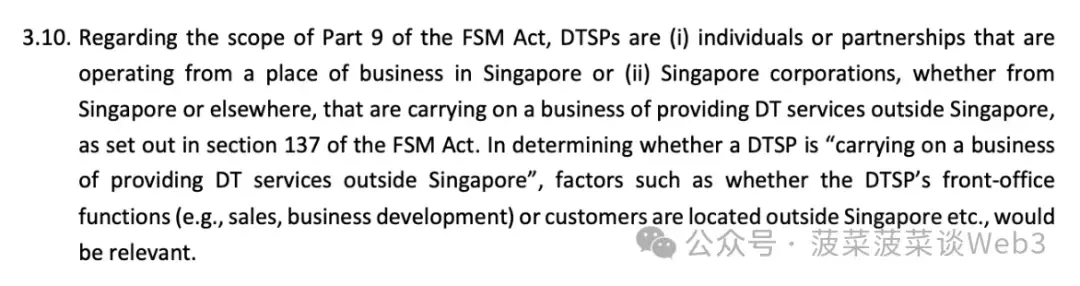
DTSP stands for Digital Token Service Provider. According to the definition in Section 137 of the FSM Act and the content of Document 3.10, DTSP includes two types of entities:
Individuals or partnerships operating at a business location in Singapore;
Singapore companies conducting digital token service business outside of Singapore (regardless of whether the company is from Singapore or elsewhere)
This definition seems simple but is fraught with hidden dangers.
First, what is the definition of "business location" in Singapore? MAS defines "business location" as "any place in Singapore used by a licensee to conduct business (including a stall that can move from one location to another)."
Note several key points in this definition:
"Any place": There is no restriction that it must be a formal business location.
"Including stalls": Even mobile stalls are included, indicating the broad scope of regulation.
"Used to conduct business": The key lies in whether business activities are conducted at that location.
In simple terms, as long as you are unlicensed in Singapore, engaging in any business involving digital assets at any location carries the risk of legal violation, whether you are a local Singapore company or an overseas company, whether you are targeting local or overseas clients.
So, will working from home be illegal?
In response to this question, Baker McKenzie law firm submitted feedback to MAS in the document.
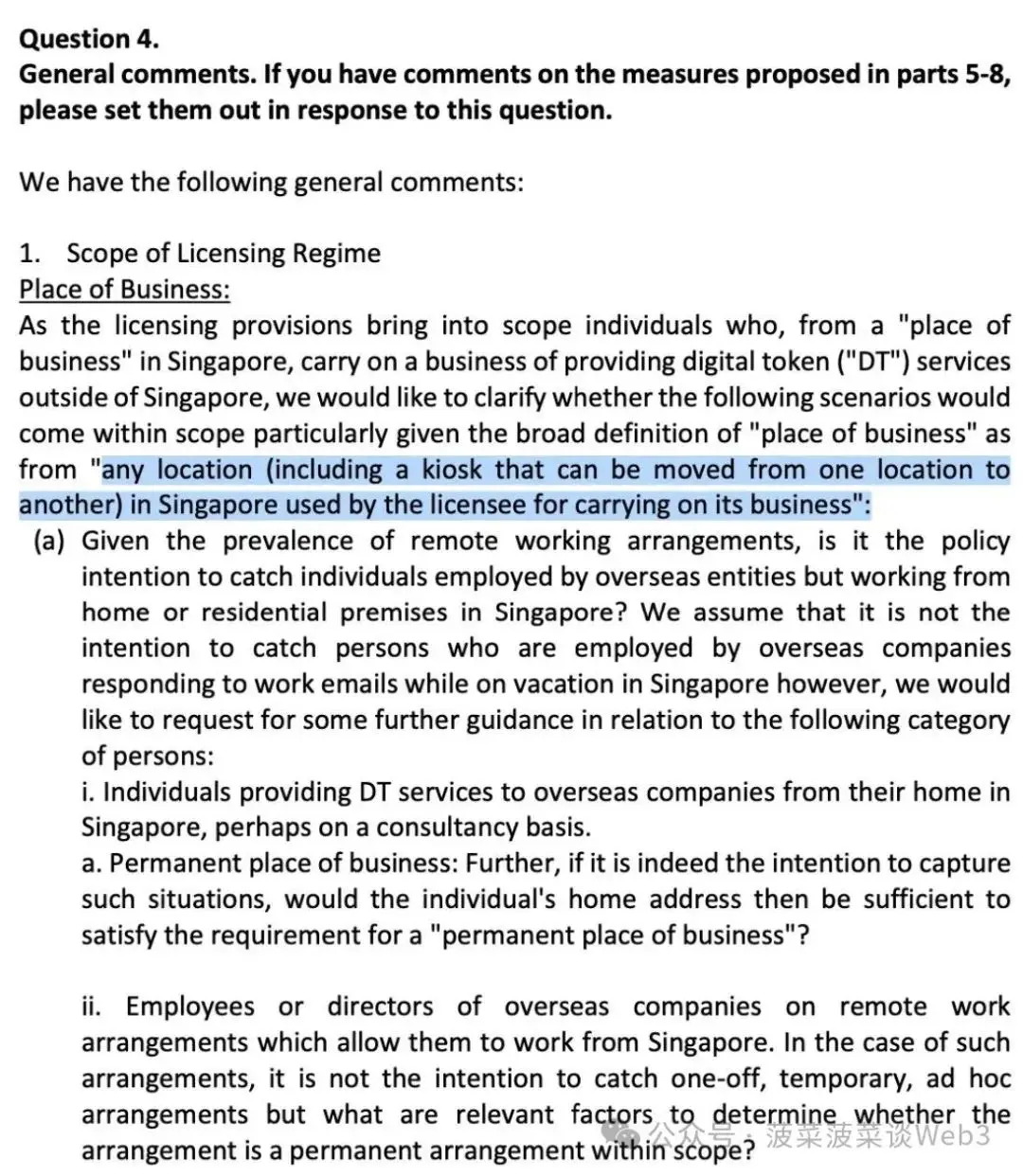
Baker McKenzie specifically sought clarification from MAS on this issue:
"Given the prevalence of remote work, does MAS intend for its policy to cover individuals employed by overseas entities but working from home or residential locations in Singapore?"
The law firm's concerns are very real. They listed several potential pitfalls:
Individuals providing DT services from home for overseas companies (possibly of a consulting nature).
Employees or directors of overseas companies working in Singapore under remote work arrangements.
However, the law firm also attempted to provide some "protection" for remote workers:
"Based on the drafting of current legislation, it can be argued that home or residential locations should not be included, as these locations are generally not understood as places where licensees conduct business."
Nevertheless, MAS poured cold water on this issue:
"According to Section 137(1) of the Financial Services and Markets Act, all individuals engaging in digital token service business to persons outside of Singapore at a business location in Singapore are required to obtain a DTSP license, unless the individual falls under a category specified in Section 137(5) of the Financial Services and Markets Act. In this regard, if an individual is located in Singapore and engages in providing digital token services to persons outside of Singapore (i.e., individuals and non-individuals), that individual is required to apply for a license under Section 137(1) of the Financial Services and Markets Act. However, if the individual is an employee of a foreign-registered company providing digital token services to persons outside of Singapore, the work that the individual engages in as part of their employment with the foreign-registered company will not trigger the licensing requirements under Section 137(1) of the Financial Services and Markets Act."
And
"However, if these individuals work in shared office spaces or in the offices of associated companies of overseas entities, they are clearly more likely to fall within the scope."
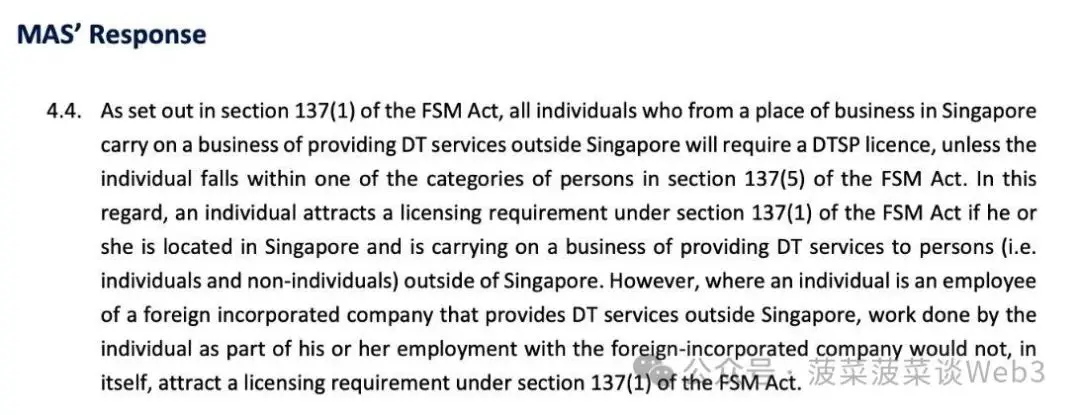
To summarize the new regulations:
No license, whether individual or company, is allowed to conduct business targeting local or overseas clients at any business location in Singapore.
If you are an employee of an overseas company, working from home is acceptable.
However, the new regulations also have many ambiguous areas:
MAS's definition of employees is very vague; whether project founders count as employees, and whether holding shares counts as being an employee, is up to MAS to decide.
If you are a BD or sales representative of an overseas company and you go to someone else's shared office to conduct business, does that count as conducting business at a business location? MAS decides.
Ambiguous Definition of Digital Token Services, KOLs May Also Be Affected?
MAS's definition of digital token services is astonishingly broad, almost covering all relevant types of tokens and services. Even publishing research reports is included?
According to item (j) of the First Schedule of the FSM Act, the regulatory scope includes:
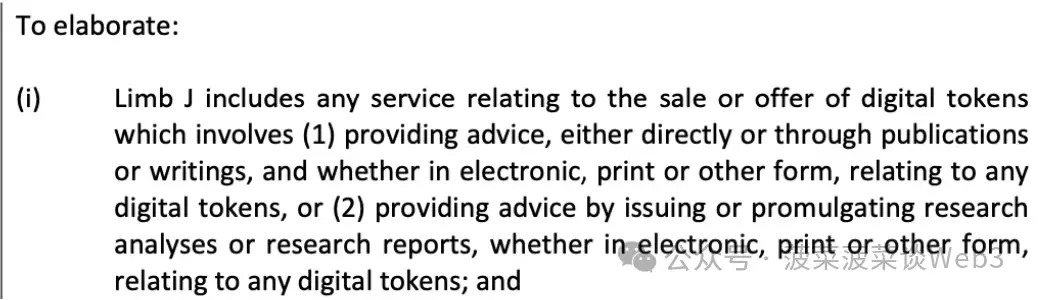
"Any services related to the sale or offer of digital tokens, including: (1) providing advice related to digital tokens directly or through any form (electronic, printed, or otherwise) such as publications or articles, or (2) providing advice related to digital tokens through the publication or dissemination of research analysis or research reports (electronic, printed, or otherwise)."
This may mean that if you, as a KOL or institution, publish a report analyzing the investment value of a certain token in Singapore, theoretically, you may need a DTSP license; otherwise, you could be deemed illegal.
The Blockchain Association of Singapore posed a soul-searching question to MAS regarding this issue:
"Will traditional research reports be deemed related to the sale or offer of tokens? How should participants distinguish research reports related to the sale or offer of tokens?"
MAS did not provide a clear answer, and this ambiguity leaves all content creators walking on thin ice.
Which Groups May Be Affected?
Individual Identity Types (High Risk)
Independent practitioners: including developers, project consultants, market makers, miners, etc.
Content creators and KOLs: including analysts, KOLs, community operators, etc.
Core project personnel: including founders, BD, sales, and other core business personnel.
Institution Types (High Risk)
Unlicensed exchanges: CEX, DEX.
Project parties: DeFi, wallets, NFTs, etc.
Conclusion: The End of the Regulatory Arbitrage Era in Singapore
A terrifying reality emerges: Singapore is serious this time, aiming to drive out all non-compliant individuals from Singapore. As long as you are non-compliant, almost any activity related to digital tokens may fall under regulatory scrutiny. Whether you are in a luxurious office building or on your home sofa, whether you are the CEO of a large company or a freelancer, as long as it involves digital token services.
Due to the numerous gray areas and vague definitions surrounding "business location" and "conducting business," MAS is likely to adopt a "case-oriented" enforcement strategy—first take down a few individuals to warn others.
Thinking of temporarily seeking compliance? Sorry, MAS has made it clear that it will review DTSP license applications with "extreme caution," and approvals will only be granted in "extremely limited circumstances."
In Singapore, the era of regulatory arbitrage has officially ended, and the era of big fish eating small fish has arrived.
 Risk warning
 Risk warning



Popular articles





