








4E Insights: BTC shows resilience in consolidation, with policy and capital resonance boosting market confidence recovery

 The current market is still in a phase of high-level fluctuations combined with sensitivity to news. Although there is a lack of explosive positive news, stable on-chain data, no outflow of mainstream funds, and continuous policy support have built a foundation of confidence for the mid-term market.
The past week saw the cryptocurrency market at the intersection of technical consolidation and macroeconomic games. On one hand, the Federal Reserve's policy remains unclear, with fluctuating expectations for short-term interest rate cuts; on the other hand, the advancement of stablecoin legislation and continuous inflow of funds into Ethereum ETFs have injected moderate confidence into the market. Overall, despite the lack of clear upward momentum, the market structure is becoming more robust.
1. BTC High-Position Fluctuation, On-Chain Structure Stable
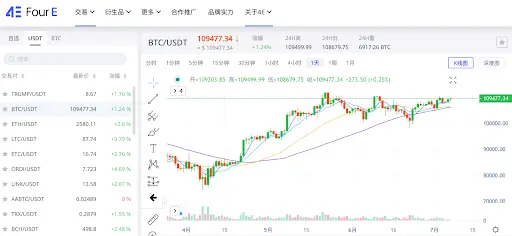
Bitcoin has maintained high-position fluctuations over the past few days, with prices testing the range of $108,000 to $110,000 multiple times. As of July 7, Bitcoin is reported at $109,500, with a slight increase of about 2% over the week, still within the technical consolidation range.
On-chain data shows that large wallet addresses continue to accumulate, and the BTC balance on exchanges continues to decline, indicating that there has been no panic selling in the market. MicroStrategy announced an increase of 4,900 BTC at the end of June, further boosting the confidence of medium to long-term investors.
Ethereum (ETH) showed slightly stronger performance, benefiting from ETF inflows and improvements in on-chain indicators, rising to $2,550 at one point. The cumulative holding addresses for ETH reached 22.74 million, with over 6 million added in June alone. The scale of on-chain staking (Liquid Staking) surpassed 35.56 million, both hitting historical highs. Overall, mainstream funds have not exited, and some investors are beginning to position for mid-term opportunities.
2. Easing Macroeconomic and Policy Environment, Market Risk Appetite Repaired
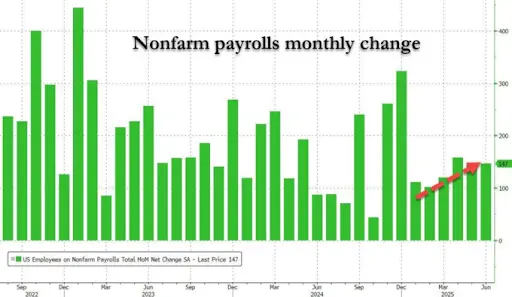
The U.S. non-farm payrolls added 147,000 jobs in June, exceeding the expected 110,000. This result alleviated market concerns about a weakening labor market and also reduced the likelihood of the Federal Reserve taking aggressive rate cuts in the short term.
Federal Reserve Chairman Jerome Powell maintained a "data-dependent" policy stance, without providing a clear timeline for rate cuts. The market currently generally expects September or November to be potential policy turning points. Meanwhile, the U.S. Treasury Secretary stated that a new round of trade agreements is expected to be reached with several countries before the "Liberation Day" tariffs expire on July 9.
In terms of regulation, the GENIUS stablecoin bill is progressing between the Senate and the House of Representatives. The bill focuses on issuance mechanisms, reserve audits, KYC compliance, and is seen as an important milestone in the U.S. push for stablecoin legalization. Trump's public call for the swift passage of a "clean version" of the bill also reflects a positive change in the political stance towards the crypto industry.
3. Platform Security and Asset Innovation Progressing Together, U.S. Stock Tokenization Concept Heating Up
Although prices remain resilient, industry security issues still need to be monitored. According to SlowMist data, over 120 security incidents occurred in the Ethereum ecosystem in the first half of 2025, mainly concentrated on smart contract defects and permission setting errors. Some platforms have introduced on-chain insurance and risk control contracts to enhance their risk resistance capabilities.
At the same time, the field of asset innovation is also advancing rapidly, with "U.S. Stock Tokenization" trading recently attracting industry attention. Robinhood announced support for tokenized contract trading for companies like OpenAI and SpaceX, but clarified that these assets are not actual equity, but rather based on on-chain derivative contracts, with prices anchored to the actual stock market value. Although OpenAI has publicly denied any authorized cooperation with Robinhood, market interest in such products has not diminished.
While these tokenized stocks face legal and regulatory controversies, they also reveal that the trend of integration between traditional and crypto finance is accelerating. If relevant financial instruments can be improved under a compliant framework in the future, it may open up more digital investment channels for retail and institutional investors.
On the other hand, Bitwise Chief Investment Officer Matt Hougan stated that the inflow of funds into spot ETH ETFs is expected to accelerate significantly in the second half of 2025. The net inflow in June reached $1.17 billion, indicating that traditional institutions are gradually building confidence in the ETH ecosystem.
4E Summary: Cautious Strategy, Positive Structure
The current market is still in a phase of high-position fluctuations and sensitivity to news. Although there is a lack of explosive positive news, stable on-chain data, no outflow of mainstream funds, and continuous policy promotion have laid a foundation of confidence for the mid-term market.
BTC and ETH showed relative resilience over the past week, with mainstream platforms and on-chain protocols continuously optimizing security mechanisms. The stablecoin bill, U.S. stock tokenization innovations, Ethereum ETFs, and tax reforms are all progressing on multiple fronts, reshaping the structure of the entire crypto financial system.

About 4E: As the official partner of the Argentina national team, the 4E platform supports assets such as cryptocurrencies, gold, U.S. stocks, indices, and foreign exchange, with one-stop trading for USDT. Recently, it launched a new user registration gift of 88U, providing trading benefits for investors. With 4E, investors can keep up with market dynamics, flexibly adjust strategies, and seize every potential opportunity.
 Risk warning
 Risk warning




Popular articles





