








Tokenized Stocks: A Financial Efficiency Revolution in a New Bottle

 Can this financial "skin-changing" game replicate the reversal myth of the S&P 500 ETF?
Original Title: New Skin, Old Instincts
Original Author: PRATHIK DESAI
Original Compilation: Saoirse, Foresight News
In the late 1980s, Nathan Most worked at the American Stock Exchange. However, he was neither a banker nor a trader, but a physicist with years of experience in the logistics industry, previously involved in the transportation of metals and commodities. His focus was not on financial instruments, but on practical systems.
At that time, mutual funds were the mainstream way for investors to gain broad market exposure. While these products provided opportunities for diversified investment, they had issues with trading delays: investors could not buy or sell at any time during the trading day and had to wait until the market closed to know the execution price (notably, this trading model is still in use today). For investors accustomed to real-time trading of individual stocks, this delayed trading experience was already outdated.
To address this, Nathan Most proposed a solution: to develop a product that tracks the S&P 500 index but can be traded like a single stock. Specifically, this involved structuring the entire index into a new form that could be listed on the exchange. This idea was initially met with skepticism, as the design logic of mutual funds was fundamentally different from stock trading, the relevant legal framework was still a blank slate, and the market seemed to lack such demand.
Nevertheless, he insisted on pushing forward with the plan.
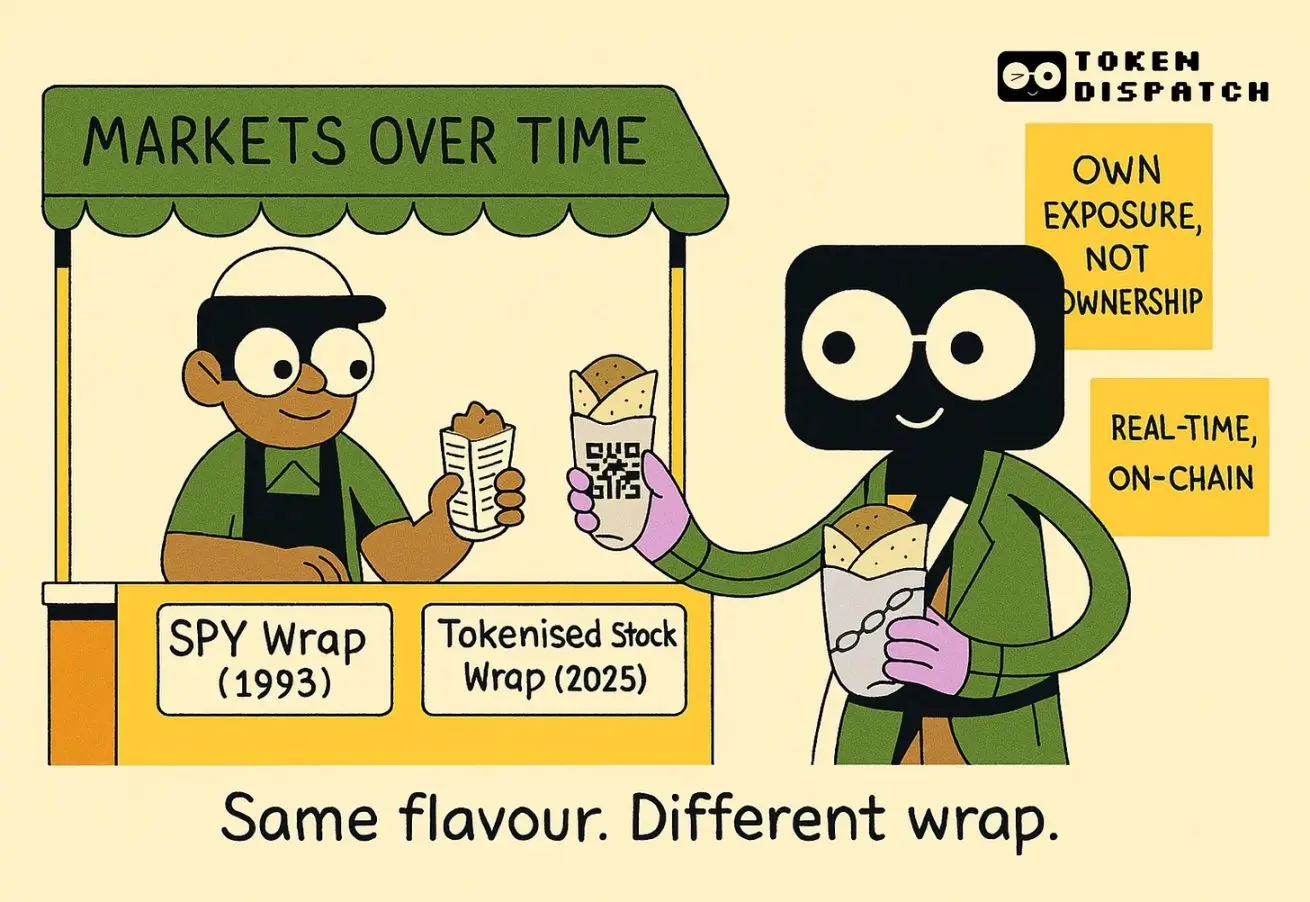
In 1993, the Standard & Poor's Depositary Receipts (SPDR) debuted under the trading code SPY, essentially becoming the first exchange-traded fund (ETF): an investment tool representing hundreds of stocks. Initially viewed as a niche product, it gradually became one of the most actively traded securities globally. On most trading days, SPY's trading volume even surpassed that of the underlying component stocks. The liquidity of this synthetic product surprisingly exceeded that of its underlying assets.
Today, this history is once again enlightening. The reason is not the emergence of a new fund, but the ongoing transformation on the blockchain.
Investment platforms like Robinhood, Backed Finance, Dinari, and Republic are successively launching tokenized stocks. These blockchain-based assets aim to mirror the stock prices of private companies like Tesla, Nvidia, and even OpenAI.
These tokens are positioned as "risk exposure tools" rather than ownership certificates; holders are neither shareholders nor do they have voting rights. This is not a traditional equity purchase but rather holding a token linked to the stock price. This distinction is crucial and has sparked controversy, with OpenAI and Elon Musk expressing concerns about the tokenized stocks offered by Robinhood.
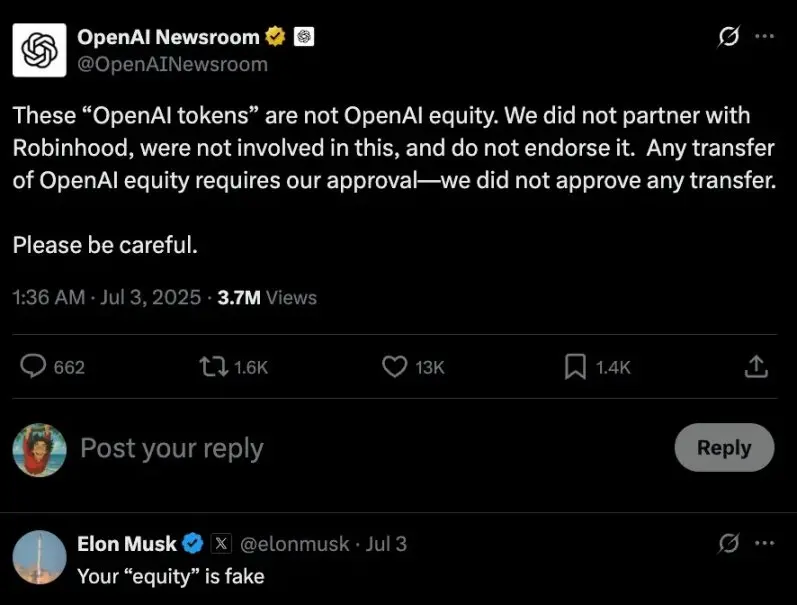
Robinhood CEO Vlad Tenev later had to clarify that these tokens are actually a means for retail investors to access these private assets.
Unlike traditional stocks issued by companies, these tokens are created by third parties. Some platforms claim to provide a 1:1 backing by holding real stocks, while others are entirely synthetic assets. Although the trading experience feels familiar, with price movements aligning with stocks and interfaces resembling brokerage applications, the underlying legal and financial substance is often weaker.
Even so, they still attract a specific type of investor, particularly non-U.S. investors who cannot directly access U.S. stocks. For instance, if you live in Lagos, Manila, or Mumbai and want to invest in Nvidia, you typically need to open an offshore brokerage account, meet high minimum deposit requirements, and endure a lengthy settlement period. Tokenized stocks, as tokens traded on-chain that track the movements of the underlying exchange stocks, eliminate these trading barriers. No wire transfers, no forms to fill out, no access restrictions—just a wallet and a trading market.
This investment channel may seem novel, but its operational mechanism shares commonalities with traditional financial instruments. However, real issues remain: most platforms like Robinhood, Kraken, and Dinari do not operate in emerging markets outside of U.S. stocks. For Indian users, for example, whether they can legally or practically purchase tokenized stocks through these channels remains unclear. If tokenized stocks are to genuinely broaden global market participation, the challenges they face will not only be technical but also regulatory, geographical, and infrastructural.
Derivative Operation Logic
Futures contracts have long provided a way to trade based on expectations without directly holding the underlying asset; options allow investors to bet on the magnitude of stock price fluctuations, timing of increases or decreases, or direction of movement without actually buying the stock. In either case, these tools have become "alternative channels" for investing in underlying assets.
The emergence of tokenized stocks follows a similar logic. They do not claim to replace the traditional stock market but rather offer another avenue for those long excluded from public investment.
The development of new derivatives often follows a traceable pattern: the early market is filled with confusion, investors are uncertain about pricing, traders shy away from risk, and regulators take a wait-and-see approach; then speculators enter the scene, testing product boundaries and exploiting market inefficiencies for arbitrage; if the product proves useful, it will gradually be accepted by mainstream participants and ultimately become market infrastructure. Index futures, ETFs, and even Bitcoin derivatives from CME (Chicago Mercantile Exchange) and Binance have all followed this trajectory. They were not initially designed for ordinary investors but rather served as playgrounds for speculators: faster trading, higher risks, but also greater flexibility.
Tokenized stocks may follow the same path: first, retail investors use them to speculate on hard-to-buy assets like OpenAI or companies that are not publicly listed; then arbitrageurs discover that the price difference between tokens and stocks can be profitable and join in; if trading volume stabilizes and infrastructure keeps pace, institutional players may also join, especially in jurisdictions with robust compliance frameworks.
The early market may appear chaotic: insufficient liquidity, wide bid-ask spreads, and sudden price jumps over the weekend. But derivative markets have always started this way; they are never perfect replicas but rather stress tests—allowing the market to gauge demand before the assets themselves adjust.
An interesting aspect of this model, which can be seen as both an advantage and a disadvantage depending on perspective, is the issue of time lag.
Traditional stock markets have opening and closing times, and most stock derivatives trade according to stock market hours, but tokenized stocks do not adhere to this rule. For example, if a U.S. stock closes at $130 on Friday and suddenly a big news story breaks on Saturday (like an earnings report leak or a geopolitical event), the stock is not open for trading, but the token may already start to fluctuate. This allows investors to factor in the impact of news during the stock market's off-hours into their trades.
Only when the trading volume of tokenized stocks significantly exceeds that of traditional stocks will the time lag become an issue. The futures market addresses such problems through funding rates and margin adjustments, while ETFs rely on designated market makers and arbitrage mechanisms to stabilize prices, but tokenized stocks have yet to establish these mechanisms, so prices may deviate, liquidity may be insufficient, and whether they can keep pace with stock prices depends entirely on the reliability of the issuer.
However, this trust is quite unreliable. For instance, when Robinhood launched tokenized stocks for OpenAI and SpaceX in the EU, both companies denied involvement, stating they had no collaboration or formal relationship with the business.
This does not mean that tokenized stocks themselves are problematic; it simply requires you to think clearly: what you are purchasing at this moment is essentially price exposure, or a synthetic derivative with ambiguous rights and recourse?
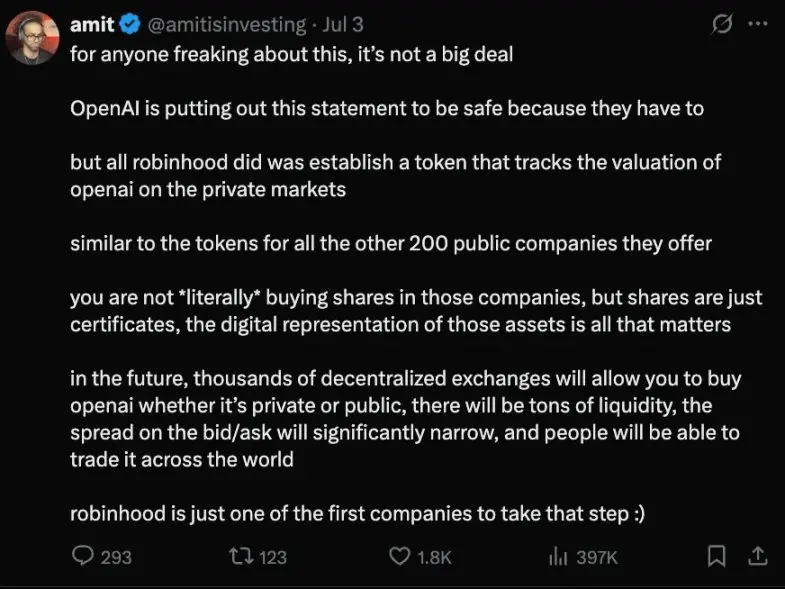
For those feeling anxious about this, there is really nothing to worry about. OpenAI's statement was merely a precaution; after all, they had to do it. As for Robinhood, they simply launched a token to track OpenAI's valuation in the private market, just like the tokens for over 200 other companies on their platform. You are not actually buying stocks of these companies; the stocks themselves are merely certificates, and the digital form of these assets is what matters. In the future, there will be thousands of decentralized exchanges, allowing you to trade OpenAI whether it is private or public. By then, liquidity will be abundant, and bid-ask spreads will narrow significantly, enabling people worldwide to trade. Robinhood just took the first step.
The underlying architecture of these products is also diverse. Some are issued under European regulatory frameworks, while others rely on smart contracts and offshore custodians. A few platforms like Dinari are attempting more compliant operational models, while most platforms are still testing the boundaries of legality.
U.S. securities regulators have yet to clarify their stance. Although the SEC has expressed views on token issuance and digital assets, traditional stock tokenization products remain in a gray area. Platforms are very cautious; for example, Robinhood launched products in the EU first and has not dared to go live in the U.S. market.
However, demand is already evident.
The Republic platform provides synthetic investment channels for private companies like SpaceX, while Backed Finance packages public stocks and issues them on the Solana blockchain. These attempts are still in their early stages but have never ceased, with the underlying model promising to address the issue of participation barriers rather than the logic of finance itself. Tokenized stocks may not increase the returns on holding shares because they never intended to do so; perhaps they simply aim to make it easier for ordinary people to participate.
For retail investors, the ability to participate is often the most important factor. From this perspective, tokenized stocks do not compete with traditional stocks but rather compete on "ease of participation." If investors can click a few times on an application holding stablecoins to gain exposure to Nvidia's stock price fluctuations, they may not care whether this is a synthetic product.
This preference has precedents. The SPY exchange-traded fund has proven that packaged products can become mainstream trading markets, as have other derivatives like contracts for difference (CFD), futures, and options. Initially, they were merely tools for traders but ultimately served a broader user base.
These derivatives often lead the movements of the underlying assets; in market volatility, they capture sentiment faster than the sluggish traditional markets, amplifying fear or greed.
Tokenized stocks may follow a similar path.
Current infrastructure is still in its early stages, with liquidity fluctuating and regulatory frameworks ambiguous. But the underlying logic is clear: create something that reflects asset prices, is easy to acquire, and is appealing to ordinary people. If this "alternative" can stabilize, more trading volume will flow into it. Ultimately, it will no longer be a shadow of the underlying asset but will become a market barometer.
Nathan Most did not initially intend to reshape the stock market; he simply saw an efficiency gap and sought a smoother interaction method. Today's token issuers are doing the same thing, only replacing the "packaging" of funds from back then with smart contracts.
It remains to be seen whether these new tools can maintain trust during market downturns. After all, they are not real stocks, nor are they regulated; they are merely "tools close to stocks." But for many who are distant from traditional finance or live in remote areas, being "close" is already sufficient.
Recommended Reading:
OpenAI "Debunks" Robinhood: Unveiling the Four Major Controversies Behind Stock Tokenization
Entering the Crypto Stock Battlefield, Robinhood Aims to Become the Nasdaq of the Crypto World
 Risk warning
 Risk warning



Popular articles





