Why did Pump.fun attract so much capital with a $500 million quota sold out in 12 minutes?

 The official website's pre-sale has reached 202 addresses with a subscription amount of 1 million USD, 138 addresses with 500,000 to 1 million USD, and 445 addresses with 100,000 to 500,000 USD.
Author: 1912212.eth, Foresight News
On July 12, the PUMP token public offering raised $500 million and sold out in just 12 minutes. The pre-trading price on Binance's perpetual contract market is currently reported at $0.006, an increase of nearly $2 billion compared to the initial $4 billion FDV. According to on-chain analyst Yu Jin's monitoring, based on the current PUMP on-chain holdings, six CEXs that participated in the PUMP public offering may have already received PUMP. The on-chain addresses of these exchanges currently hold: Kraken: 7.5 billion, Bitget: 7.5 billion, Gate: 6.4 billion, Bybit: 5 billion, MEXC: 5 billion, Kucoin: 4.1 billion.
Pump.fun has rapidly become a phenomenal presence in the cryptocurrency ecosystem since 2024. The platform allows anyone to create and launch Meme coins with a very low threshold, using a unique "fair launch" mechanism to push tokens directly to the market without complex smart contracts or pre-sale phases.
The scale of this sale is considered the third-largest token sale event in crypto history, second only to certain mainstream public chain ICOs. The Pump.fun team stated that the funds will be used to expand the platform, including launching its own DEX (PumpSwap) and establishing PUMP as the base pairing currency for Meme coins.
However, the success of Pump.fun has also sparked much controversy. Critics view it as a breeding ground for "retail gambling," accusing it of siphoning liquidity through an infinitely fragmented market, leading to massive losses for countless retail investors after a brief surge. The platform's founders and their team have been accused of extracting about $800 million in fees without providing any returns to users, such as airdrops or profit-sharing.
$500 Million Raised, Sold Out in 12 Minutes
The official sale of PUMP was scheduled for July 12, and after the public sale officially began at 22:00 Beijing time, it was completed in just 12 minutes.
According to data from @Adam_Tehc's Dune panel, the number of wallet addresses that participated in the pre-sale on the Pump.fun official website and completed KYC was 23,959, with 10,145 wallet addresses successfully purchasing, averaging a subscription amount of $44,209. 89.7% of the PUMP token pre-sale was completed through the official website, while sales from various CEXs accounted for only 10.3%.
In the official pre-sale, the number of addresses with subscription amounts reaching $1 million was 202, 138 for $500,000 to $1 million, 445 for $100,000 to $500,000, and 1,030 for $10,000 to $100,000. The largest number of users subscribed for amounts below $1,000, totaling 5,758.
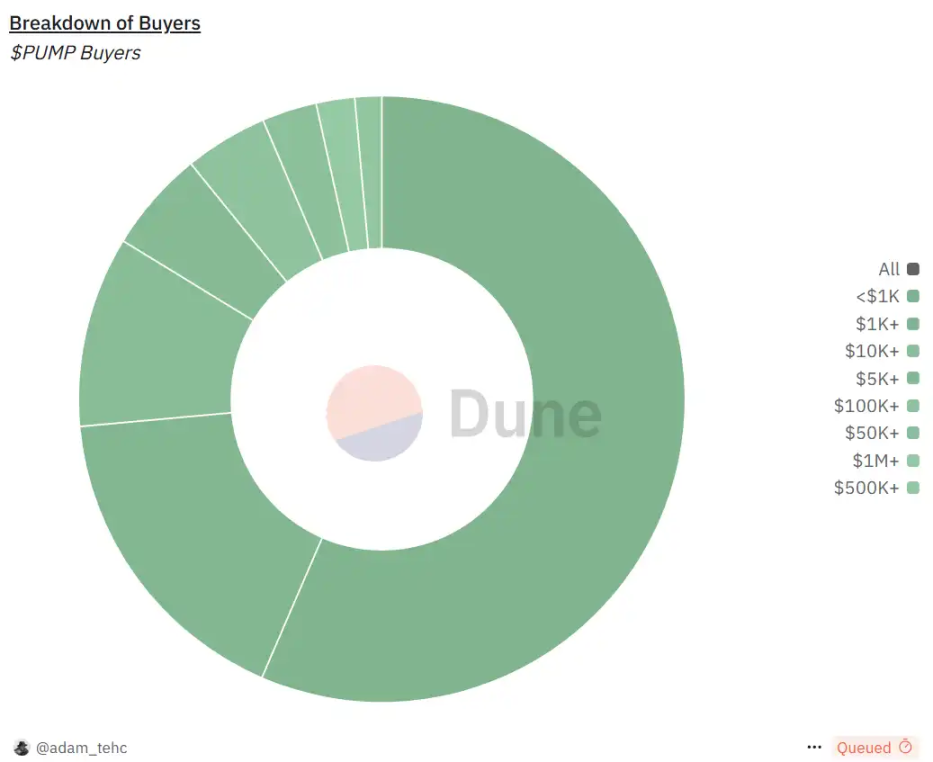
Players who participated in the public sale through the official website successfully purchased, but those who bought through exchanges and other channels became the big losers. From the above data, it is clear that sales from various CEXs accounted for only 10%.
Some users complained, "I couldn't find the entry on Bitget, there was a network error on Gate, and Bybit was quickly sold out." The pre-sale mechanism seemed simple: users submitted orders via API, and the platform allocated based on timestamps. However, the actual process was chaotic.
Within seconds of the sale starting, Bybit reported API delay issues, leading to order backlogs. The result was severe overselling: the system received orders exceeding the available supply, with some users successfully receiving allocations while others were rejected. Bybit officially admitted on X, "Due to unexpected API delays, the sale was oversubscribed, resulting in some users successfully receiving allocations while others did not."
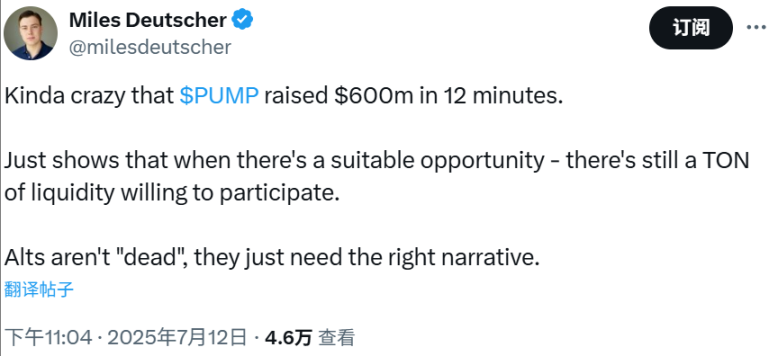
Setting aside the various issues during the public offering process, this public offering still indicates that the community has strong capital willing to chase popular projects. Crypto KOL Miles Deutscher commented on the $500 million in sales in 12 minutes, stating that it shows there is still a large amount of liquidity willing to participate when the right opportunity arises. Altcoins are not "dead"; they just need the right narrative.
Exchange Overselling, Whale On-chain Games
Subsequently, Bybit conducted a comprehensive review of all users' order statuses. To ensure fairness and transparency, token allocations strictly followed the "first come, first served" principle. Within 10 minutes of Bybit confirming the final status of the PUMP token sale, all oversubscribed funds were fully refunded. After the sale ended, Bybit confirmed on July 13 that all oversold funds had been refunded, and users could check their status through the platform.
Bitget also responded to the issues, with Xie Jiayin issuing a statement regarding the PUMP public offering allocation issue, stating that a total of 10,144 users participated in the public offering through Bitget. Additionally, the Bitget team ultimately decided to allocate PUMP tokens proportionally.
"Today, several sources said that Pump.fun has delayed the fundraising from exchanges, leading to failures across all six. Some of these exchanges plan to compensate users through OTC shares, while others are still negotiating," said Twitter KOLAB.
The pre-sale price was based on a $4 billion FDV, with each PUMP priced at about $0.004. On the first day after the sale, many players chose to hedge, such as well-known trader 0xSun, who tweeted that he hedged $1 million at a price of $0.0054.
According to the latest Binance contract data, on July 12, the PUMP contract price once dropped to around $0.004589, then surged to $0.007189 on July 13, and has since fallen back to around $0.006. According to Lookonchain monitoring, on that day, a trader made over $1.5 million in profit by going long on PUMP. Trader 0x6b78 opened a 3x leveraged long position on PUMP a day earlier and began taking profits when the price broke above $0.007.
Pump.fun users have long suffered heavy losses on the platform. Historical data shows that over 90% of Meme coins on the platform collapsed after binding curves, with snipers bundling at the last moment (8-12 SOL supply) and selling on Raydium, making millions in profit. The PUMP sale is seen as a continuation: the team extracts fees and sells tokens, with retail investors becoming "exit liquidity." X user @beaniemaxi stated, "Pump.fun extracted $500 million in fees, locking billions of SOL in dead pools; this is the largest extraction scam in crypto history."
Buyers' losses also involve opportunity costs: Solana's price dropped by 10% due to the $PUMP base pairing mechanism, affecting the entire ecosystem. Some analysts predict that PUMP may have short-term upside like TRUMP, but will struggle in the long term.
Pre-sale: Community Attitudes Polarized
The preparation phase before the sale began in early June 2025, when Pump.fun announced the PUMP token plan through official channels. PUMP is the utility token for the Pump.fun token launch platform and exchange platform, and will later consider utility mechanisms such as fee rebates, token buybacks, or other incentives. The maximum supply of PUMP is 1 trillion tokens, with the following specific allocations:
- 33% will be sold in the initial token offering
- 24% allocated to community and ecosystem plans
- 20% allocated to the team
- 2.4% for the ecosystem fund
- 2% for the foundation
- 13% for existing investors
- 3% allocated for live broadcasts
- 2.6% for liquidity + exchanges
According to the PUMP release schedule, tokens allocated to the team (20%) and existing investors (13%) will gradually unlock starting in July 2026; the portion allocated to community and ecosystem plans (24%) will gradually unlock from the first day of the token issuance and be fully allocated by July 2026; other allocations for ICO, liquidity + exchanges, and the foundation will be fully unlocked on the first day of the token issuance.
Market reactions are polarized. On one hand, loyal users of Pump.fun and Meme coin enthusiasts view it as the "Max Extraction Event," looking forward to sharing the platform's future profits through purchases. The platform has proven its profitability: it generated $50 million in fees in May 2025 alone, with cumulative fees reaching $800 million.
Meme trader Ansem publicly announced on Twitter that he would buy more PUMP tokens.

On the other hand, there is a surge of skepticism.
Well-known crypto analysts and KOLs (such as @hodlstrong and @RuneCrypto) openly criticized this sale as an "exit scam." They pointed out that Pump.fun has extracted over $1 billion in fees from the market but chose not to reward users through airdrops, instead directly selling tokens. This is seen as a betrayal of the community, especially in light of past experiences with platforms like OpenSea (which failed to launch tokens in a timely manner, leading to a 90% revenue drop). Additionally, the team's anonymity and lack of transparency have heightened concerns: the use of funds is unclear—are they for development or personal cashing out? IOSG founding partner bluntly stated that the Pump.fun public offering resembles a team seeking exit liquidity, with the project's and market's fundamentals unable to support the inflated valuation.
Trader Eugene also expressed his views in his personal community, stating, "My view on pump.fun is simple: just forget it. It has been over-analyzed to the point of being unoriginal, and no matter what price it starts trading at, a $4 billion market cap feels like a heavy anchor weighing down the token price. There are now too many other opportunities in the market that are more promising and offer nonlinear returns, far more worthy of attention. Don't waste brain cells on something everyone is pondering."
 Risk warning
 Risk warning