








Trump is anxious. Why does the U.S. dislike central bank digital currencies so much?

 Trump: The president is very angry, it must pass tomorrow!
Author: Bright, Foresight News
On the morning of July 16, Beijing time, according to Politico reporters, the procedural vote in the U.S. House of Representatives on cryptocurrency-related bills failed to pass. According to Fox News, the House plans to attempt another vote on the rules for cryptocurrency-related bills around 5:00 PM Eastern Time (5:00 AM Beijing time) on the 17th.
Reports indicate that President Trump was very "angry" after being slapped in the face. Following the House's voting failure, Trump immediately posted that the GENIUS Act would pass tomorrow, stating that he had met with 11 dissenting congressmen in the Oval Office today to discuss passing the "GENIUS Act" and received unanimous agreement to support the rules the following morning.
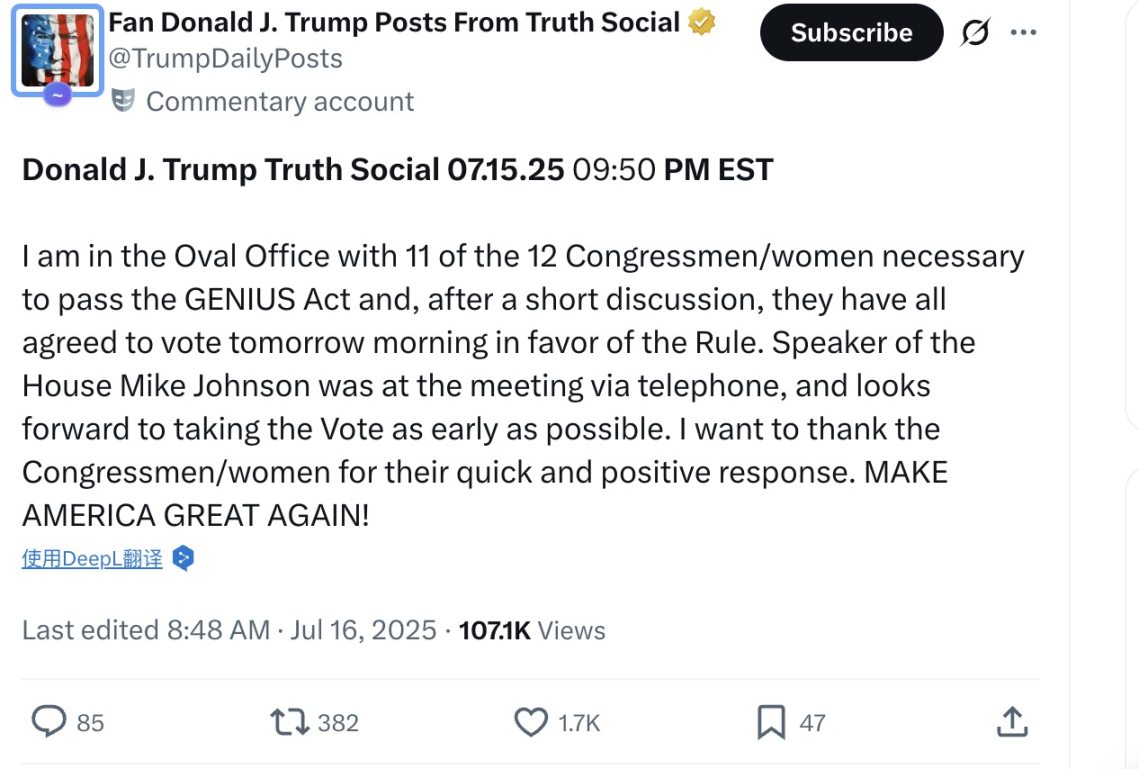
However, the Democratic whip in the House later stated that there were no additional plans for voting on cryptocurrency bills today. The vote concluded with 196 votes in favor vs. 222 votes against, preventing three cryptocurrency bills, including stablecoin regulations, and the defense spending bill from entering the formal deliberation stage. The main cryptocurrency bills included:
GENIUS Act (Stablecoin Regulations)
CLARITY Act (Digital Asset Market Structure Regulation)
Anti‑CBDC Surveillance State Act (Anti-CBDC Surveillance State Act)
House Speaker Johnson could only awkwardly express hope that the House would attempt procedural voting on cryptocurrency bills again on Wednesday.
The Trump Administration's Aggressive Stance
Since the GENIUS Act passed the Senate on June 18, Trump immediately expressed hope to see the bill on his desk before Congress adjourns in August. Market news also unanimously believed that the House's vote on the GENIUS Act was merely a "formality," with its formal passage being a foregone conclusion.
Before the House's "procedural vote" on the GENIUS Act, Trump had already posted on social media to "pop the champagne," stating: "Happy Crypto Week. The House is about to vote on a major bill, the GENIUS Act, aimed at making the U.S. the undisputed number one leader in the digital asset space. Digital assets represent the future, and the U.S. is far ahead. Let's complete the first vote this afternoon (all Republicans should vote in favor). This is our moment. It's all about making America great again, stronger and more exceptional than ever. We are leading the world and will work with the Senate and House to push for more relevant legislation to be passed."
Why the "Slap in the Face"? CBDC is the Original Sin
However, the reason the House did not follow the script to complete a series of cryptocurrency bill voting plans may not be solely due to the GENIUS stablecoin bill. Before the meeting, the White House's AI and cryptocurrency director, "Crypto Czar" David Sacks, made a sudden statement that was quite thought-provoking. He explicitly stated that the Trump administration intends to ban the issuance of central bank digital currencies (CBDCs).
It can be seen that the Anti‑CBDC Surveillance State Act may be the real battleground for both parties.
The Republican and Democratic parties have long been at odds over the issue of CBDCs, with the Biden administration being very committed to promoting CBDCs. In March 2022, Biden signed Executive Order 14067: "Ensuring Responsible Development of Digital Assets," placing the design and deployment of CBDCs at the highest priority. In March 2023, Nellie Liang, the Deputy Secretary of the Treasury for Domestic Finance, announced during a speech at the Atlantic Council that the Treasury would convene a cross-departmental working group to explore the development of CBDCs, allowing the U.S. to "move forward quickly in determining that CBDCs align with national interests."
To elevate the status of CBDCs, the Biden administration did not hesitate to suppress cryptocurrencies. In March of the same year, the White House Council of Economic Advisers released its annual report, devoting an entire chapter to discussing digital assets. The report presented CBDCs and the Fed's FedNow payment system as more promising avenues for enhancing currency and finance, expressing the view that cryptocurrencies are nearly worthless aside from speculation risks. This report subsequently became the ideological cornerstone of the Biden administration's sustained pressure on the cryptocurrency industry.
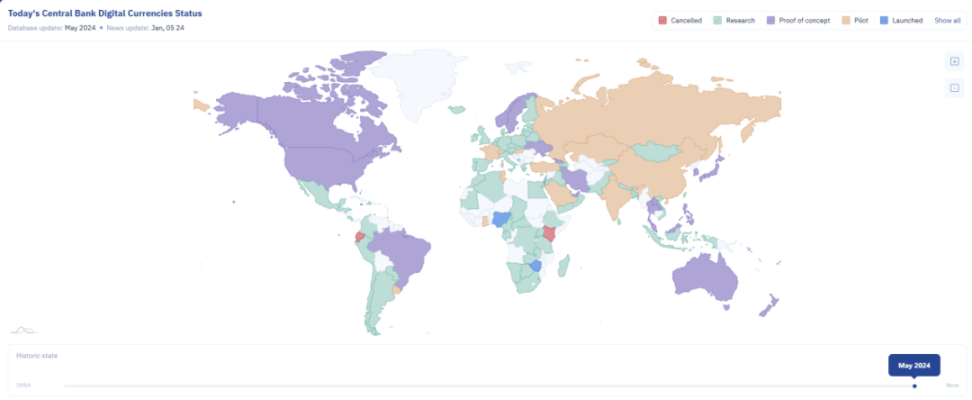
On the other hand, the camp vehemently opposing CBDCs is filled with mainstream Republicans, Silicon Valley libertarians, anti-establishment leftists, and cryptocurrency practitioners, all of whom uniformly oppose CBDCs citing concerns over privacy and government control. By the end of the Biden administration, the Democratic-led vision for CBDCs had essentially collapsed. The Anti-CBDC Surveillance State Act passed the House in May 2024, while the Senate had yet to vote. The bill explicitly prohibits the Federal Reserve from issuing retail central bank digital currencies (CBDCs) directly or indirectly to the public, from using them for open market operations or any monetary policy tools, and bans any form of CBDC testing.

As expected, on January 23, 2025, upon taking office as the new president, Trump immediately signed an executive order banning any institution from issuing or using central bank digital currencies (CBDCs) within or outside the U.S., while relaxing regulations on privately issued digital currencies. He also established a digital asset market working group led by the President of the United States, which later became the White House AI and Cryptocurrency Working Group chaired by David Sacks.
Thus, the Anti-CBDC Act is essentially the pre-legal basis for the Trump administration's promotion of the GENIUS and other cryptocurrency bills. The failure of these three substantial cryptocurrency bills to pass is fundamentally a struggle between the mainstream CBDC establishment of the Democrats and the mainstream cryptocurrency faction of the Republicans.
However, from a societal perspective, there is a lack of actual public support for CBDCs in the U.S. Previous polls showed that only about 16% of Americans supported CBDCs, while 78% indicated they were "unlikely to use" them, with more than half stating they were "extremely unlikely to use" them.
In this regard, CICC previously published a research report indicating that the Anti-CBDC Surveillance State Act, along with the CLARITY Act and GENIUS Act, forms a logical closed loop for the regulatory path of digital currencies in the U.S. It reflects America's strategic choice: to abandon government-led CBDCs and instead support privately issued dollar stablecoins, implementing policy guidance and regulation on them. Amid the global wave of central banks exploring CBDCs, this move also highlights the differentiated path of traditional Republicans based on the "small government, big market" philosophy. In the long run, dollar stablecoins and CBDCs issued by various countries' central banks will form a competitive relationship, representing, to some extent, another competition between the market and the government in the innovation arena.
 Risk warning Risk warning




Popular articles





