








Contract Algorithm Scythe (III): Forging the Blade in the Dark — The Algorithm Breakthrough Path of BYBIT and BITGET

 As a derivatives exchange that follows closely behind Binance, how do Bybit and Bitget stand out in the highly competitive and volatile battlefield of perpetual contracts?
Author: danny (@agintender)
Bybit has chosen a path of extreme capital efficiency, striving to build a "financial engine" that serves institutional-level strategies; on the other hand, Bitget embraces high volatility sensitivity, leveraging a more open, transparent, and responsive mechanism to compete for the minds of discretionary traders and arbitrage quantitative teams.
Seemingly similar top-level algorithms can evolve into completely different candlestick behaviors—true differences lie in every detail.
Under the "algorithmic order" of Binance, the industry leader, Bybit and Bitget have not merely imitated but have explored different survival paths and strategic spaces through their unique trading philosophies and financial mechanisms in the structural gray areas of funding rates, mark prices, and liquidation processes.
I. Index Price Algorithm: Whose Price is More "Real"?
Both Bybit and Bitget follow industry best practices, adopting quotes from multiple mainstream spot exchanges and calculating the index price using the volume-weighted average price (VWAP) method. The goal is to create a fair price that can reflect the broad market value of the assets, effectively resisting price anomalies caused by insufficient liquidity or malicious manipulation from a single exchange.
Bybit Mechanism
Bybit obtains spot prices from multiple mainstream exchanges and calculates the index based on a volume-weighted approach. However, its specific data sources are not fully disclosed, and the platform reserves the right to adjust data sources and their weights without prior notice during extreme market conditions. This mechanism provides operational flexibility while also posing a certain "information black box" to traders.
Bitget Mechanism
Bitget also uses the VWAP method, but its significant advantage lies in fully disclosing all index component exchanges (such as Binance, Coinbase, OKX, etc.), providing traders, especially quantitative teams, with a high-transparency data source that facilitates model validation and risk assessment.
Core Differences
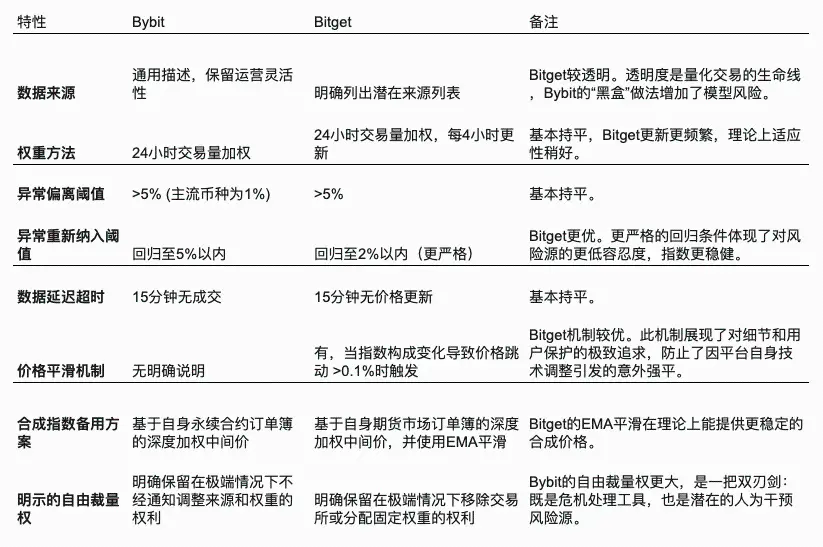
Transparency: Bitget provides a complete disclosure of data sources, reducing the "black box" risk, making it easier for traders to model and backtest; Bybit sacrifices some transparency while maintaining platform flexibility, resulting in a "trust cost."
Anomaly Data Handling Mechanism: Bitget has stricter anomaly handling for data sources, allowing a data source to be reintegrated into index calculations only when its price returns to the median ±2% range; in contrast, Bybit sets a tolerance of ±5%, which is more lenient.
Price Smoothing Mechanism (Unique to Bitget): When adjustments to index components could cause price increases or decreases of more than 0.1%, Bitget activates a "smooth transition mechanism," gradually substituting components to avoid price jumps caused by technical changes, thereby reducing the risk of forced liquidation due to non-market factors. (However, this can become an issue during extreme volatility of altcoins.)
II. Mark Price Algorithm: How to Resist Market Manipulation?
Both Bybit and Bitget use the widely recognized "Median-of-Three" method to calculate contract mark prices. This method effectively guards against distortion from a single data source by taking the median of three independent price sources, fundamentally reducing the risk of "liquidation triggered by price manipulation."
Bybit Mechanism
Bybit selects three prices:
Price 1 and Price 2: Derived from index prices, funding rates, and short-term basis, etc.;
Price 3: The latest transaction price within the platform.
The system takes the median of the three as the mark price, effectively filtering extreme price fluctuations.
Bitget Mechanism
Similar to Bybit, Bitget also uses the median-of-three method and introduces three prices with structurally similar definitions. Although their naming and arrangement differ slightly, the essential logic remains consistent.
Substantial Differences Lies Not in the Algorithm, but in the Quality of Underlying Data
Although both have highly consistent formula structures, the key to the final mark price performance does not lie in the top-level algorithm design itself, but in how input parameters are generated, especially including: whether the index price source is transparent, the frequency and logic of funding rate calculation, and whether basic data updates experience delays.
These underlying factors are crucial in determining whether a platform is "easily manipulable" or whether the "reasonableness of liquidation" is robust. To elaborate: the phenomenon of "Phantom P&L" that follows deviations of exchange mark prices.
During extreme market conditions, especially with small-cap altcoins, traders often encounter a perplexing phenomenon:
Just after opening a position at market price, the system immediately displays "unrealized losses" or "near liquidation."
This is not a system flaw but a result of the structural characteristics of the dual price system:
The opening price is based on the latest transaction price;
Unrealized profit and loss is calculated based on the mark price.
If the mark price is lower than the latest transaction price at the time of opening a position, the long position instantly shows a loss; conversely, a short position may immediately enter a "false profit" state.
This "Phantom P&L" phenomenon is especially evident during extreme price fluctuations, shallow exchange order books, and short-term deviations between indices and spot prices, leading inexperienced traders to mistakenly believe that the system has a "malicious liquidation."
III. Funding Rate Algorithm: Static Stability vs. Dynamic Feedback
The funding rate is the core mechanism anchoring perpetual contract prices to spot prices. Although Bybit and Bitget adopt the same top-level funding rate calculation formula, one key parameter's definition differs drastically, revealing their fundamental philosophical differences in market adjustment mechanisms.
Bybit Mechanism:
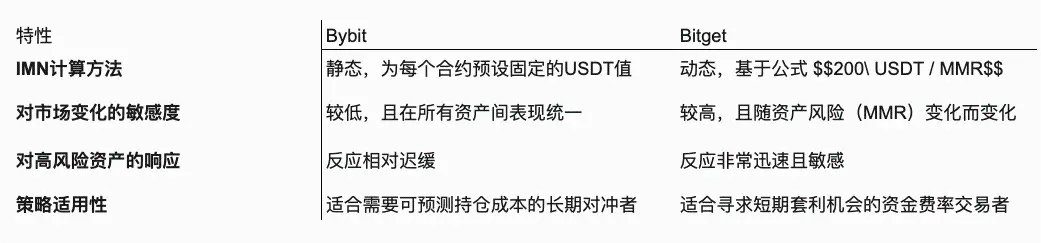
Bybit uses the standard "premium index + interest rate" formula. Here, the key parameter "Impact Margin Amount" (IMN), which measures market depth, is a fixed USDT value statically configured for each contract. This value remains unchanged regardless of market conditions.
Bitget Mechanism:
Bitget employs the same top-level formula as Bybit, but IMN calculation is entirely different.
Core Differences:
The calculation method for the Impact Margin Amount (IMN) represents a fundamental difference in the funding rate mechanisms between the two. Bitget's IMN is dynamically calculated and directly linked to the contract's risk parameters—the minimum maintenance margin rate (MMR). This means that for riskier assets, the IMN is smaller, increasing the sensitivity of funding rates to short-term order book imbalances.
Bybit: Adopts static IMN settings, providing a unified and predictable market depth measurement for all contracts. Regardless of market volatility, the order book depth used for premium index calculations remains consistent. The main advantage of this design is model reproducibility and behavioral stability. Particularly for major cryptocurrencies, Bybit's funding rate performance is relatively smooth and easy to model, overall considered a "stable but sluggish" architecture.
Bitget: Utilizes a dynamic IMN mechanism, explicitly incorporating market risks into the funding rate calculation logic. Its IMN value is directly linked to the contract's minimum maintenance margin rate (MMR). According to its formula, riskier and more volatile assets typically set higher MMRs, while higher MMRs inversely translate to smaller IMNs.
For example, the MMR for major cryptocurrencies is usually around 0.5%, while high volatility altcoins may reach as high as 2%. This means that on Bitget, riskier assets have smaller IMN values, and the calculation for the premium index will rely more on shallower order book data, thus being more sensitive to short-term liquidity imbalances.
Therefore, in high-risk altcoin trading, Bitget's funding rates exhibit extreme sensitivity to even minor imbalances at the top of the order book (such as brief buying or selling pressures). This "sensitive but more responsive" design makes Bitget's funding rate fluctuations more dramatic in high-volatility contracts.
This also creates a robust, adaptive risk adjustment feedback mechanism:
When the market sentiment for a particular altcoin becomes skewed (e.g., favoring longs or shorts), Bitget's funding rate rises or falls more rapidly and dramatically than Bybit's. This sharp change quickly generates strong arbitrage incentives, guiding counter traders to enter the market, thus more effectively pulling contract prices back to index price levels.
IV. Liquidation Mechanism: Black Box Intelligence vs. White Box Empowerment
Bybit and Bitget's underlying liquidation models are largely similar, both adopting the "Systemic Absorption Liquidation Model." That is, when a user's position triggers liquidation conditions, the exchange's "liquidation engine" takes over and processes it. However, the execution process, user control, and associated risk management tools reveal starkly different risk control philosophies between the two.
The basic logic of such a liquidation mechanism is as follows:
When the liquidation price is triggered, a user's position is taken over by the system and settled internally at the "bankruptcy price" (i.e., liquidation price). This means the user's maximum loss is theoretically locked in, mitigating exposure to subsequent slippage risks.
It is important to note that the bankruptcy price is usually worse than the liquidation price: the system always triggers liquidation at the liquidation price, but the execution price is the bankruptcy price. For example, if the liquidation price is 1000 and the bankruptcy price is 980, once the position is liquidated, it will settle at 980.
Key Reminder: Since liquidation occurs at the bankruptcy price, it's essential to set a reasonable stop-loss point when opening positions to avoid losses.
The liquidation engine will hold the "internalized" position and bear the obligation to truly liquidate it in the market. If the liquidation execution price is worse than the bankruptcy price, the difference will be supplemented by the insurance fund; if it is better than the bankruptcy price, the surplus will be injected into the insurance fund.
Bybit Mechanism:
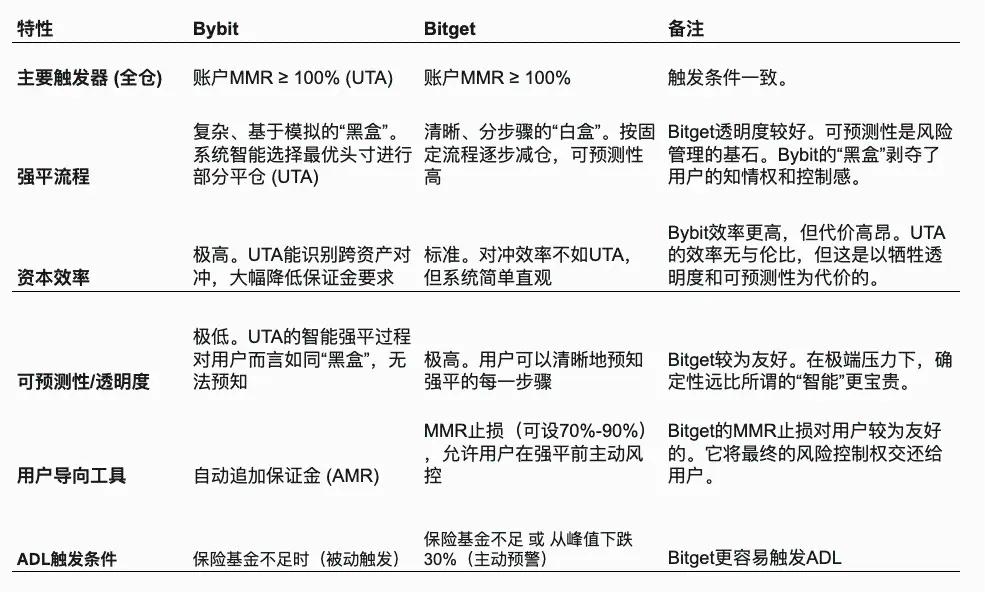
Bybit's Unified Trading Account (UTA) system, especially under the Portfolio Margin model, exhibits high complexity and technological advancement. The system can automatically recognize and assess the overall net risk exposure of multiple assets within the account, such as identifying the hedging structure between a long spot BTC position and a short perpetual position, thus lowering margin requirements and releasing available funds. This design significantly enhances capital utilization efficiency, especially meeting the high capital efficiency demands of traders employing multiple positions and strategies.
However, this complexity also means that once the account approaches the liquidation edge, the system will execute an "optimal solution" strategy based on its internal algorithmic model. Bybit's system logic embodies a "parental" risk management philosophy.
Bitget Mechanism:
Bitget's liquidation mechanism centers around the principles of "predictability and control." The system also uses the minimum maintenance margin rate (MMR) of the account reaching 100% as the trigger standard for liquidation. However, its liquidation process features clear execution steps, such as: first, cancel all pending orders; then, partially reduce positions; and finally, completely liquidate, allowing users to clearly understand each operational step.
Whether in isolated or cross-margin mode, Bitget explicitly states that when the MMR reaches 100%, liquidation is triggered. Meanwhile, the platform offers a complete set of fixed-order processing procedures, allowing traders to establish clear risk expectations and risk control models.
Additionally, Bitget provides a tool called "MMR Stop-Loss," allowing users to set risk thresholds (e.g., 75%, 80%) to automatically reduce positions or stop-loss before liquidation occurs, thus proactively managing their own risks.
Core Differences:
Predictability: Bitget's liquidation mechanism is a "white box model," with defined processes and fixed sequences, making it easy to model and predict; Bybit's UTA liquidation mechanism is a "black box model," where users cannot know in advance which assets the system will prioritize for processing, sacrificing predictability for an optimal solution at the system level.
User Control: Bitget's "MMR Stop-Loss" tool returns risk control to users, embodying an "empowerment" risk management philosophy; Bybit's liquidation mechanism emphasizes system algorithm dominance, representing a "parental" design.
Capital Efficiency: Bybit's UTA, particularly the portfolio margin system, can recognize cross-asset hedging structures, significantly reducing margin requirements, thus achieving higher capital efficiency than Bitget, making it suitable for institutions and high-frequency teams.
ADL Trigger Conditions: Bitget's Automatic Decrease in Positions (ADL) mechanism is more sensitive—aside from the depletion of insurance funds, if its insurance fund declines more than 30% relative to historical peaks, ADL will also be triggered. Bybit initiates ADL only after the insurance fund is exhausted.
Final Note: Strategy Choices Under Different Mechanisms
There is no absolute superiority or inferiority in the mechanism designs of Bybit and Bitget; rather, they are each tailored to completely different trader profiles and strategic needs.
Bybit focuses its efforts on building an efficient, powerful, yet relatively opaque system, designed for complex strategies and high-frequency capital; while Bitget has chosen an entirely different path, creating a more open, predictable, volatility-sensitive "empowerment platform" that respects users' autonomy in decision-making.
Understanding the underlying financial philosophies and institutional logics behind each platform is key for every trader, arbitrager, and institution to make optimal strategic choices.
Knowing the why, beyond just understanding the what.
Let us always move forward with a sense of reverence for the market.
 Risk warning Risk warning



Popular articles





