








The Agentic Finance Ecosystem in 2025

 It is expected that the overall ecosystem will continue to mature, and the use of agents will ultimately become the mainstream method of financial participation.
The writing team includes Lincoln Murr (Coinbase), Stefano Bury (Virtuals), Rishin Sharma (Solana), Pilar Rodriguez (The Graph), David Mehi (Google Cloud), and Cambrian members Ariel, Brian, Doug, Jason, Ricky, and Tumay.
Agentic Finance is reaching a critical tipping point, holding immense economic potential for those who enhance their financial behaviors through smart agents. AI agents are a class of autonomous tools equipped with data analysis, decision-making, and trade execution capabilities, operating with varying degrees of human involvement. Currently, these agent tools are being opened up to the public, gradually impacting a financial system long dominated by Wall Street and its high-frequency algorithms.
This article focuses on the retail applications of agentic finance in "Decentralized Finance (DeFi)," comprehensively reviewing automated agent projects that are already online and dedicated to serving individual users. To this end, the project team conducted extensive research and interviews with dozens of teams in the industry, ultimately compiling a rigorously selected list of active projects categorized by product type, with representative products annotated for each category.
Agentic finance is driving the maturation of the crypto industry, providing real-time information, professional-level advice, and optimizing user experience, making participation for ordinary users in DeFi more efficient and reliable. Below is a structured overview of the current ecosystem:
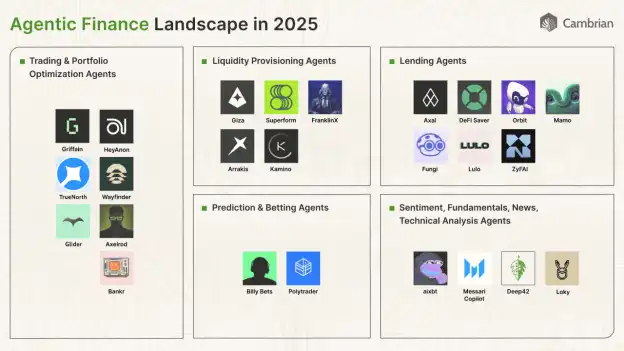
What is Agentic Finance (AgentFi)?
Agentic Finance refers to an emerging category of financial products centered on the active management of user funds using AI or machine learning, or providing personalized financial advice. Some products leverage large language models (LLMs) for interaction and analysis, while others rely on rule engines or traditional machine learning algorithms. Despite differing underlying technological paths, they commonly refer to themselves as "agentic" products.
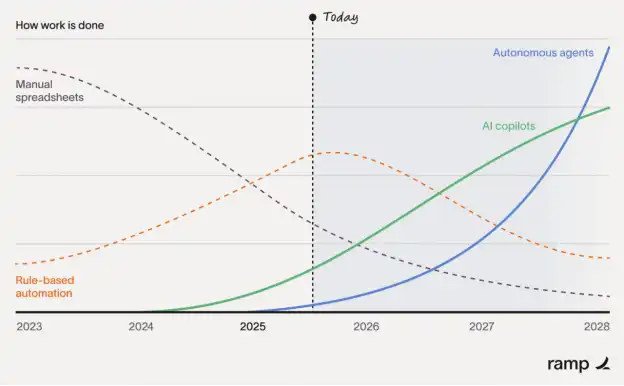
Currently, Agentic Finance is in the innovator stage, still at the starting point of the early adoption curve. Soon, various agents and AI assistants will dominate financial activities. Source: Ramp
However, it is foreseeable that in the near future, traders, asset managers, financial analysts, and other professionals will enhance their efficiency with dedicated smart agent tools, while automated agent versions aimed at ordinary users will also be launched simultaneously. This trend has already begun to manifest: for example, on the Solana network, automated trading bots now account for over half of the trading volume¹.
Autonomy vs Intelligence: The Capability Coordinate System of AgentFi
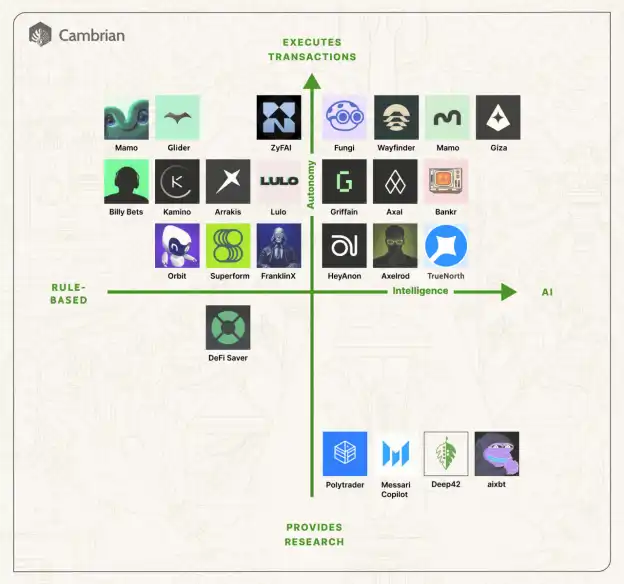
Different agentic projects are distributed along the "autonomy - intelligence" coordinate system based on their service scenarios and technical capabilities.
The horizontal axis represents the level of intelligence: on the left are tools based on rules and statistical models, in the middle are traditional machine learning models, and on the right are advanced agents based on large language models (LLMs) or subsequent technologies;
The vertical axis represents the level of autonomy: at the bottom are "advisory agents" that only provide suggestions and analysis, at the top are "fully automated agents" with complete decision-making and execution authority, and in the middle are hybrid architectures with "human-in-the-loop."
When mentioning Agentic Finance, many people think of "invisible robots" or advanced LLM systems that can trade automatically and manage portfolios independently. However, in reality, such systems have not yet been deployed on a large scale due to the instability issues still present in LLMs. For example, LLMs can still "hallucinate" false information and only recently gained basic counting abilities (such as counting how many letter 'r's are in "strawberry"). Currently, most agents only use LLMs for human-computer interaction interfaces or data analysis layers, while the fund management part still mainly relies on mature statistical models or machine learning algorithms, which have been used in traditional finance (TradFi) for decades.
From the development path of LLMs, their weaknesses in handling numbers and logical reasoning have historical reasons—they were originally designed for language prediction. But this situation is changing rapidly. For example, Anthropic has launched financial products adopted by institutions, and OpenAI has trained models competitive in the International Mathematical Olympiad.
2025 Overview of Agentic Finance Projects
Below is a list of currently online Agentic projects with fund management capabilities open to users. Projects in development or internal testing phases are not included, and products that only use LLMs as interfaces but require manual decision-making by users are also excluded, so many projects are not included in this round-up.
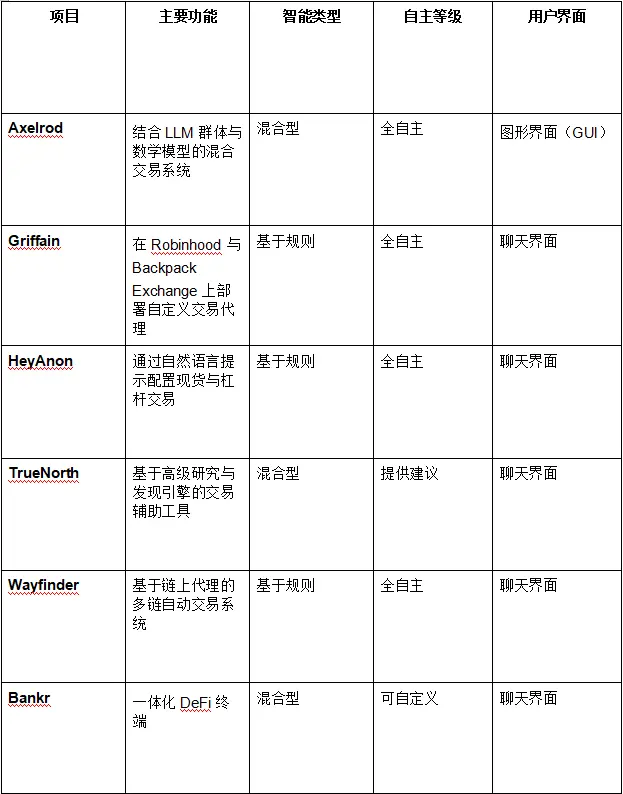
Trading and Asset Allocation Agents
Trading agents are the most commonly thought-of agentic finance products by the public. These agents manage user funds by automatically rebalancing or selecting buy/sell assets. To achieve automated trading, agent systems typically need components such as trading permissions, asset access, budget management, preset strategies, and high-quality data. Below is a list of current projects supporting one or more of these functions:
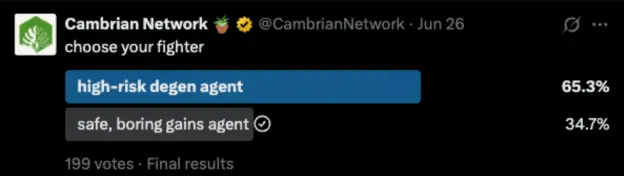
According to a recent poll initiated by Cambrian on platform X, most users show high interest in high-risk trading agents.

Liquidity Providing (LP) Agents
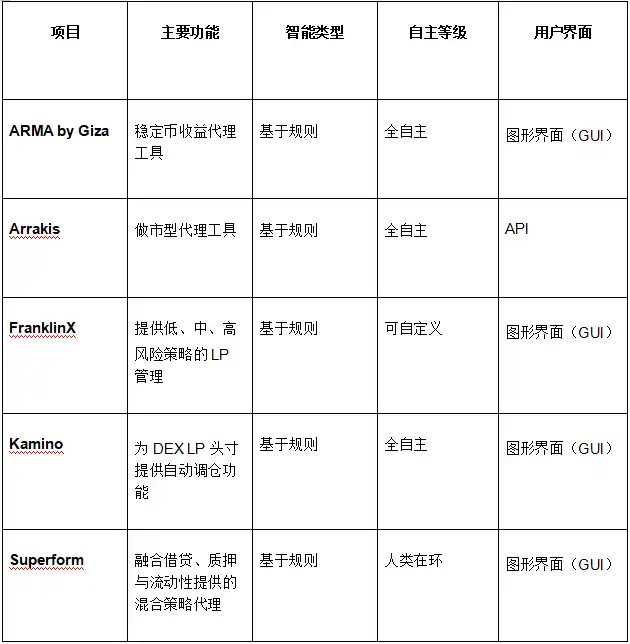
Decentralized exchanges (DEXs) rely on third-party liquidity providers (LPs) to provide tradable assets, and the fees paid by traders are earned by LPs. LP earnings depend on various factors, including impermanent loss, trading volume, DEX protocol incentives, etc. The following agent tools can help LPs identify optimal liquidity allocation paths:
Lending Agents
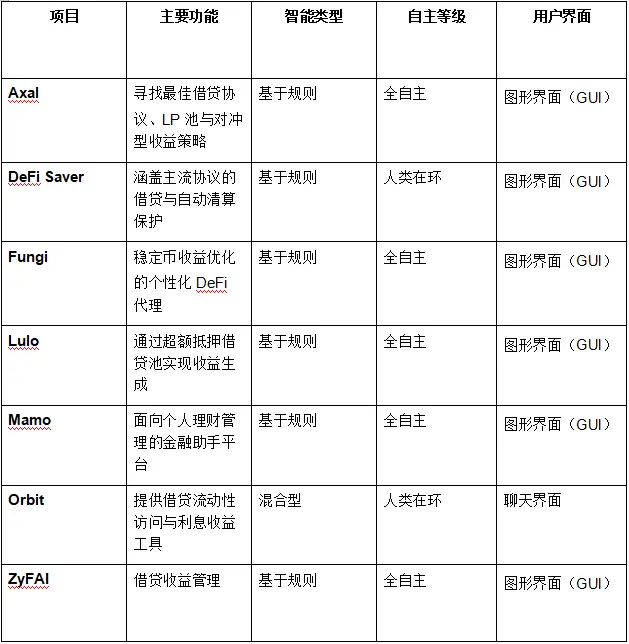
In the crypto market, users can earn interest by providing assets to borrowers. Lending agents typically need to assess factors such as yield, risk exposure, and opportunity cost when deciding whether to participate in lending protocols. Below are some of the launched lending agent projects:
Prediction and Betting Agents
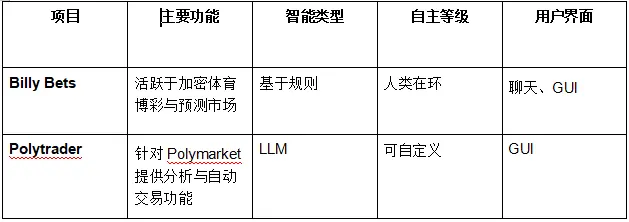
Prediction markets allow users to bet on the outcomes of future events, such as elections or sports events. These markets typically rely on real-time tracking of news or real-world information, which may change at any time. Prediction markets naturally fit the agentic participation mechanism, which was also emphasized by Vitalik Buterin in his proposed concept of information finance (InfoFi) here.
Sentiment, Fundamental, News, and Technical Analysis Agents
Investors typically rely on market analysis to determine "what to buy" and use sentiment analysis to judge "when to buy or sell." LLMs demonstrate transformative value in such analyses: they not only significantly expand the scale and speed of analyzable data but also enhance contextual understanding, providing more comprehensive insights by identifying correlations between data sources.
Unlike the aforementioned executable trading agents, analysis agents only provide informational support and do not execute operations directly. Below are some representative projects among them:
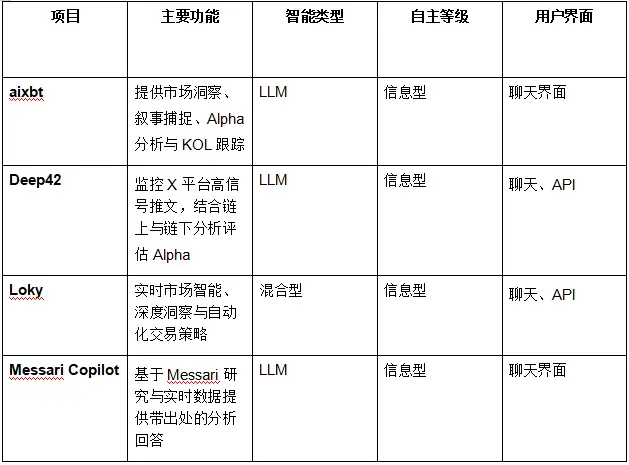
It is worth noting that the Agentic Finance ecosystem is rapidly evolving, and existing projects are continuously expanding their business boundaries. For example, products currently classified as lending agents may expand into liquidity management and other areas in the future.
Future Trends of Agentic Finance
On-chain assets continue to grow, and on-chain stablecoin trading volumes have reached new highs, with traditional fintech companies also connecting to on-chain infrastructure. For instance, Robinhood recently launched tokenization services for U.S. stocks, enabling 24/7 on-chain trading accessible to global investors.
The crypto industry is gradually moving beyond the narrative of "speculative trading" towards a broader application scenario that includes investment functions.
However, for many users, successfully participating in DeFi still presents significant barriers. This is precisely where agentic products come in: they are expected to significantly enhance usability and profitability, becoming key drivers for the popularization of DeFi.
Agentic Finance is a brand new market segment, and the tools mentioned above represent the first attempts in both TradFi and DeFi. We anticipate that some of the early projects may not achieve their visions, but the overall ecosystem will continue to mature. Ultimately, using agents will become the mainstream way of financial participation, and those users who take the first step into "agentic finance" early on will be more likely to reap long-term rewards.
Additionally, as developers continue to deliver stable returns, users' attention to the details of agent strategies will decrease, and in the future, agents may further integrate multiple capabilities (such as managing both trading and LP positions simultaneously) to enhance complexity and efficiency.
Future Areas of Focus
Future discussions may delve into the following related topics:
- Agent-to-Agent (A2A) communication and payment mechanisms
- Agent infrastructure and development frameworks
- Data infrastructure and on-chain indexers
- On-chain identity management
- Agent issuance platforms and markets
- Privacy and verifiability
- Financial modeling and simulation systems
 Risk warning
 Risk warning



Popular articles





