








Vietnam's Cryptocurrency Legislation Fundamental Shift: Officially Recognized as Legal Property under Civil Law

 For a long time, Vietnam's legal classification of cryptocurrencies has been ambiguous, and the tax policy has also fallen into a "gray area," leaving market participants shrouded in uncertainty.
Author: FinTax
Introduction
For a long time, Vietnam's legal classification of cryptocurrencies has been ambiguous, and its tax policies have fallen into a "gray area," leaving market participants shrouded in uncertainty. However, this situation underwent a significant change on June 14, 2025, when the National Assembly of Vietnam passed the Law on Digital Technology Industry, which for the first time incorporated crypto assets into the national legal framework and implemented clear classification regulations, officially granting them legal status, marking a milestone in the country's crypto asset regulatory process.
The new law categorizes digital assets into "virtual assets" and "crypto assets," excluding financial instruments such as securities and digital fiat currencies, and grants the government the authority to formulate implementation details while emphasizing the strengthening of cybersecurity, anti-money laundering, and counter-terrorism financing requirements. The law is set to take effect on January 1, 2026, with the core objective of improving the relevant legal system, aligning with international regulatory standards, and helping Vietnam exit the FATF gray list as soon as possible.
This article will attempt to analyze the restructuring effect of this legislative breakthrough on Vietnam's digital economy landscape, interpret the latest dynamics and future trends of its tax system. By tracing the evolution of the Vietnamese government's policies from cautious observation to actively building a regulatory framework over the past few years, a comparative analysis will be conducted in conjunction with the practices of other representative countries in Southeast Asia and globally in the field of cryptocurrency taxation and regulation. Additionally, it will look ahead to Vietnam's strategies in balancing risk prevention and innovative development, predicting specific policies that may be introduced in the coming years, and the potential impacts of these policies on Vietnam as an emerging digital economy.
1 Vietnam Clarifies the Legal Status of Crypto Assets
Before the enactment of the Law on Digital Technology Industry, Vietnam's legal classification of cryptocurrencies had been in a state of ambiguity and constant evolution. Initially, the Vietnamese government's attitude towards cryptocurrencies was mainly reflected in strict restrictions on their use as a means of payment and risk warnings. For example, in a circular issued by the State Bank of Vietnam (SBV) in July 2017, it was clearly stated that cryptocurrencies such as Bitcoin and Litecoin are not recognized as legal tender or means of payment in Vietnam, and their issuance, supply, and use are explicitly prohibited, with violators facing administrative or criminal sanctions. Subsequently, in April 2018, the Prime Minister issued Directive 10/CT-TTg, requiring relevant departments such as the General Statistics Office, Ministry of Finance, and Ministry of Public Security to strengthen the management of cryptocurrency-related activities to enhance control over related transactions and prevent potential harm.
Although the Ministry of Finance announced in its circular 4356/BTC-TCT in April 2016 that it did not prohibit cryptocurrency trading and defined it as "property" and "liquid goods," the lack of clear legislative support left this directive in an ambiguous position in practice, making compliance and enforcement related to crypto trading relatively complex. Furthermore, according to Article 105.1 of Vietnam's 2015 Civil Code, which defines assets to include various items, currency, monetary instruments, and property rights, digital assets such as cryptocurrencies clearly do not fall under any of these categories, thus not being considered tangible assets under current Vietnamese law. This lack of classification created a significant legal void, directly affecting the handling and regulation of these assets within the legal framework.
However, this ambiguous state underwent a fundamental change on June 14, 2025. The National Assembly of Vietnam passed the landmark Law on Digital Technology Industry, which will officially take effect on January 1, 2026. This law for the first time clearly defines "digital assets" within the Vietnamese legal system and further categorizes them into "crypto assets" (secured by cryptography and blockchain technology) and "virtual assets" (primarily used for trading and investment, excluding securities, stablecoins, and central bank digital currencies). This legislative breakthrough ended years of uncertainty regarding the legal status of crypto assets in Vietnam, officially recognizing crypto assets as legal property under civil law, thereby providing a solid legal foundation for individuals and organizations to establish and exercise property rights legally.
This strategic shift from "non-recognition" to "legalization" is not coincidental, as the Vietnamese government has recognized the immense potential of the crypto economy. Despite regulatory obstacles, Vietnam has one of the highest cryptocurrency ownership rates globally, ranking fifth in the world, with approximately 20.95% of the population holding crypto assets and annual inflows exceeding $10 billion. At the same time, Vietnam faces the need to respond to international anti-money laundering (AML) and counter-terrorism financing (CTF) pressures, as it has been placed on the gray list by the Financial Action Task Force (FATF), requiring it to strengthen virtual asset management. Therefore, legalization is a necessary prerequisite for attracting investment, promoting digital economic development, and effectively regulating this emerging industry. This indicates that the Vietnamese government has shifted from merely risk prevention to actively embracing the opportunities brought by the digital economy and is attempting to guide and regulate this emerging industry through the establishment of a sound legal framework rather than merely suppressing it.
2 Vietnam's Shift in Cryptocurrency Regulatory System
The shift in Vietnam's official attitude towards the classification of cryptocurrencies reflects a significant change in its regulatory system. In the past, Vietnam's crypto regulatory framework was characterized by inadequacies and passive responses, often employing a one-size-fits-all regulatory approach; however, with the rise of the global cryptocurrency wave and changes in Vietnam's leadership, the current cryptocurrency regulatory system is rapidly improving, having formed a preliminary division of regulatory responsibilities and actively advancing discussions and implementations of multiple regulatory pilot projects, striving to effectively address challenges such as AML and CTF while embracing new technologies.
2.1 Evolution of the Regulatory Framework
Vietnam's cryptocurrency regulatory framework has undergone a significant evolution from non-existence to existence, from passive response to active guidance.
From 2016 to 2022, Vietnam's cryptocurrency regulatory framework transitioned from non-existence to existence, moving from a one-size-fits-all approach to exploratory research.
In April 2016, the Ministry of Finance announced that it did not prohibit cryptocurrency trading, but its classification remained vague. Subsequently, in July 2017, the State Bank of Vietnam (SBV) explicitly prohibited cryptocurrencies like Bitcoin as means of payment and emphasized their illegality. In April 2018, the Prime Minister issued directives to strengthen the management of cryptocurrency-related activities, while the SBV also instructed financial institutions to enhance measures related to crypto trading, reflecting the government's early cautious and risk-averse stance.
In May 2020, the Prime Minister instructed the SBV to initiate pilot projects exploring the use of blockchain in cryptocurrencies and required it to study and assess the pros and cons of cryptocurrencies. In March 2022, the Vietnam Blockchain Association (VBA) was established, becoming the first legal entity in Vietnam focused on crypto assets, tasked with creating and nurturing a framework for cryptocurrency development. In the same year, Vietnam passed anti-money laundering (AML) legislation, which took effect in 2023, requiring payment service providers to implement Know Your Customer (KYC) measures, marking an important step in its international compliance efforts. In October 2022, the Prime Minister again called for the regulation of cryptocurrencies, indicating the government's urgent need for standardization in this field.
After 2023, particularly following changes in Vietnam's leadership in 2024, the government's regulatory attitude towards cryptocurrencies gradually softened.
In February 2024, the Prime Minister issued Decision 194/QD-TTg, instructing the Ministry of Finance to draft a legal framework for virtual assets, clearly demonstrating the government's legislative determination. In October of the same year, the Prime Minister signed Decision 1236/QD-TTg, promulgating the National Strategy for the Development and Application of Blockchain Technology in Vietnam by 2025, looking ahead to 2030, aiming to position Vietnam as a regional leader in blockchain innovation. This strategy clearly identifies blockchain as a core pillar of digital transformation and emphasizes "Vietnam-made" blockchain platforms, indicating that the government views blockchain and digital assets as important driving forces for the country's digital economic development.
In June 2025, the Law on Digital Technology Industry was passed, establishing a tolerant and prudent regulatory framework from multiple aspects, including clear classification of digital assets (crypto assets, virtual assets), mandatory implementation of AML and CTF measures, the introduction of a licensing system, and incentives for emerging technologies such as artificial intelligence, semiconductors, and advanced computing, promoting broader digital economic development.
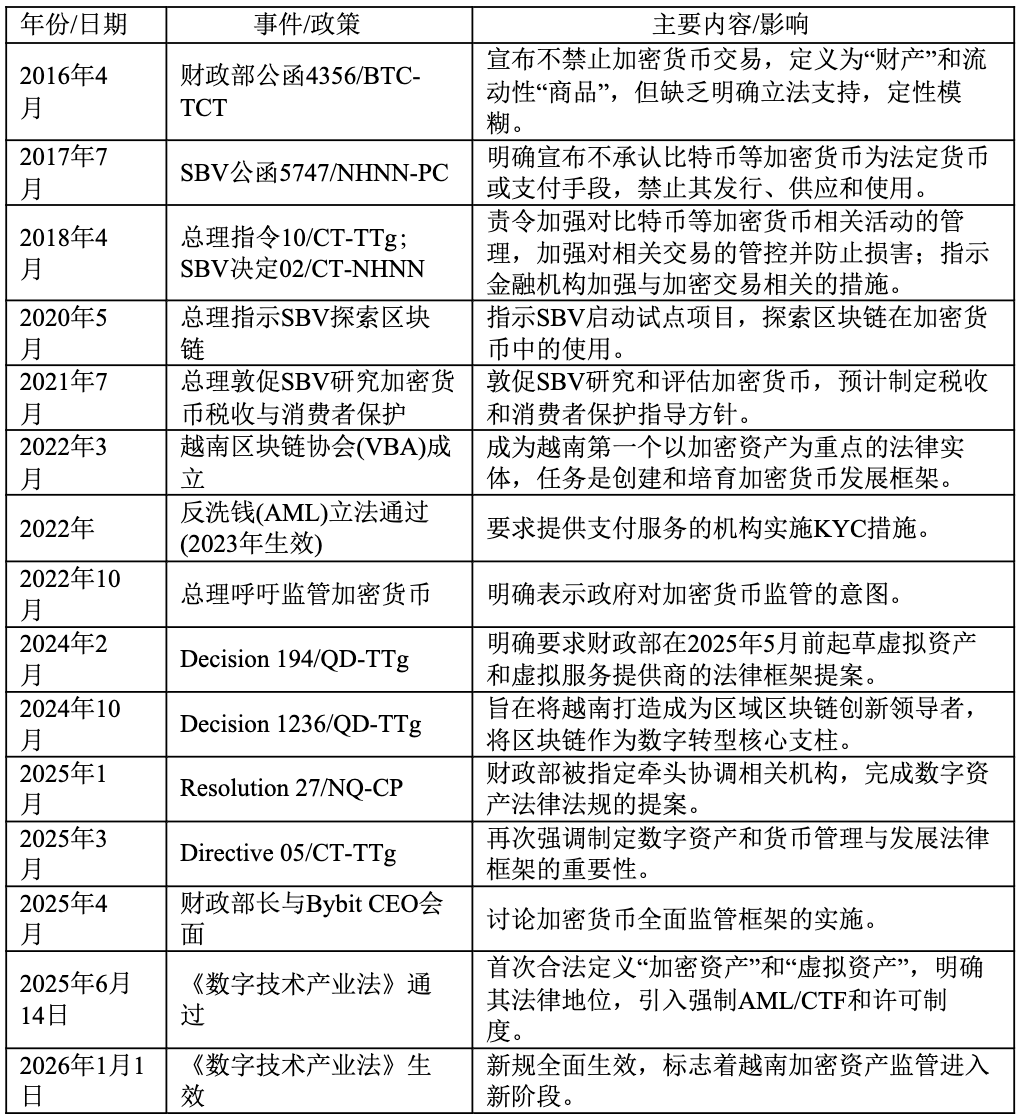
The maturation of the regulatory framework from "passive response" to "active guidance" is a key feature of Vietnam's policy evolution in the digital asset sector. Early on, Vietnam's regulation of cryptocurrencies was primarily characterized by "prohibition as a means of payment" and "risk warnings," which was a passive and preventive stance. However, in the past two years, from the Prime Minister's directives for research, the establishment of the Blockchain Association, to the promulgation of the Law on Digital Technology Industry and the national blockchain strategy, the regulatory focus has clearly shifted towards actively constructing a framework that incorporates crypto assets into the national digital economic development strategy. This marks Vietnam's entry into a more mature and pragmatic stage in digital asset regulation, where the goal is no longer merely to control risks but to unleash innovation potential, attract domestic and foreign investment, and enhance its position in the global digital economy by establishing a clear and predictable legal environment.
2.2 Overview of Vietnam's Current Regulatory Structure and Division of Responsibilities
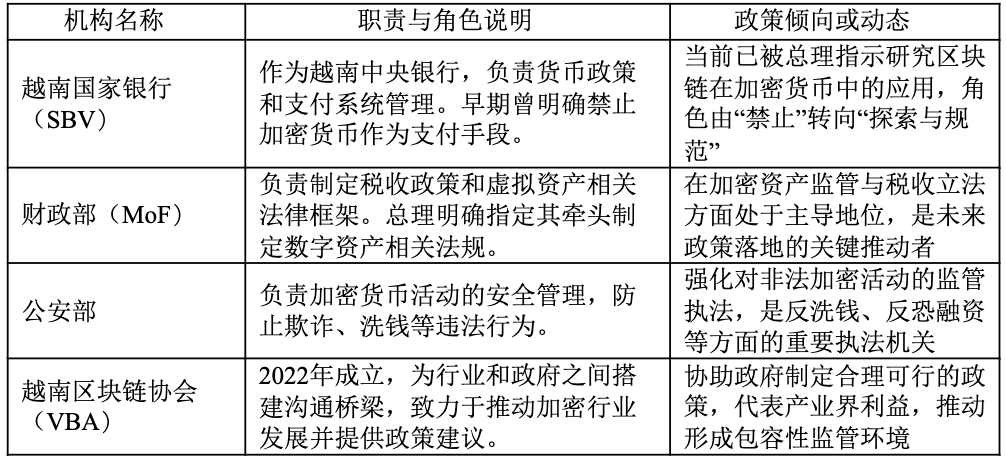
Vietnam's current cryptocurrency regulatory framework is mainly divided among various ministries, forming a pattern of "loose regulation." Several key institutions, including the State Bank of Vietnam (SBV), the Ministry of Finance (MoF), the Ministry of Public Security, and the Vietnam Blockchain Association (VBA), collaborate to build and improve the regulatory framework, with specific divisions of responsibilities outlined in the table below.
2.3 Regulatory Sandbox Pilot and Risk Compliance Construction in the New Normal
To explore innovative applications of digital assets under controllable risks, the Vietnamese government has actively introduced regulatory sandbox mechanisms and pilot projects.
The Vietnamese government is discussing the establishment of regional and international financial centers, one key aspect of which is the introduction of controlled testing policies (sandbox) for financial technology (Fintech), particularly for business models involving crypto assets and cryptocurrencies. This sandbox mechanism allows for small-scale testing of new financial technologies and business models in a controlled environment, thereby assessing their potential risks and benefits before full-scale promotion. For example, Da Nang has been authorized to pilot special mechanisms, including a project using stablecoins (USDT) for payments by international tourists, seen as an important attempt to explore the application of digital payments in the tourism sector. These pilot projects aim to accumulate practical experience to provide data and basis for a more comprehensive regulatory framework in the future.
Additionally, Vietnam is actively exploring the development of a central bank digital currency (CBDC) — the digital dong. The Prime Minister has repeatedly called for the SBV to study the pros and cons of digital currency and to initiate pilot projects for blockchain-based cryptocurrencies. Although the issuance of the digital dong is still in the evaluation stage, its potential legal status and complementary role to the traditional financial system are important components of Vietnam's digital economic development.
Of course, while promoting innovation in the regulatory framework, compliance with anti-money laundering (AML) and counter-terrorism financing (CTF) remains a core focus for Vietnamese authorities, especially after being placed on the gray list by the Financial Action Task Force (FATF).
Vietnam is currently still on the "enhanced scrutiny list" (gray list) of the Financial Action Task Force (FATF), primarily due to its shortcomings in anti-money laundering practices related to cryptocurrencies. Being on the gray list means that the country has strategic deficiencies in combating money laundering and terrorist financing, which could affect its international financial reputation and ability to attract foreign investment. To be removed from the gray list, Vietnam must formulate virtual asset management policies and strengthen relevant law enforcement.
The passage of the Law on Digital Technology Industry is an important measure for Vietnam to respond to FATF pressures. The law explicitly requires all digital asset activities to strictly implement AML and CTF measures to enhance security and transparency. This means that future cryptocurrency exchanges and related service providers must comply with global standards such as KYC and AML and may be required to maintain compensation funds to protect users from cyberattacks, thereby reducing the risk of financial crimes.
3 Vietnam's Cryptocurrency Tax Policy and Recent Developments
The evolution of Vietnam's cryptocurrency tax policy has occurred almost simultaneously with its regulatory policies regarding cryptocurrencies. Initially, due to the ambiguity and contradictions in the Vietnamese authorities' classification of cryptocurrencies, the regulatory policies were rough and one-size-fits-all, making taxation on cryptocurrencies unrealistic. However, the rapid expansion of cryptocurrency trading volumes forced the government to confront its legal status, compelling Vietnamese authorities to study cryptocurrencies. Particularly entering 2024, the government has shown a stronger urgency in establishing a clear legal framework.
3.1 Current Tax Ambiguity in Vietnam's Cryptocurrency Trading
For a long time, due to the lack of clear legal definitions and regulatory frameworks, cryptocurrency trading in Vietnam has remained in a tax ambiguity. As mentioned above, the Ministry of Finance's circular 4356/BTC-TCT in 2016, while not prohibiting cryptocurrency trading and defining it as "property" and "goods," did not address specific tax regulations. The State Bank of Vietnam (SBV) also explicitly stated in its circular 5747/NHNN-PC in 2017 that it does not recognize cryptocurrencies like Bitcoin as means of payment, further exacerbating legal uncertainty, making it difficult for tax authorities to effectively tax cryptocurrency activities. Additionally, Vietnam's 2015 Civil Code did not include digital assets in its definition of property, which posed significant obstacles for the taxation of cryptocurrencies.
In contrast to Vietnam's clear stock trading tax system, activities in the crypto sector have long been exempt from tax obligations. This situation has made Vietnam a de facto "tax haven" in the crypto space, attracting a large number of crypto investors but also leading to a significant revenue gap for the government.
3.2 New Regulations Outline a Legal Framework for Cryptocurrency Taxation
The Law on Digital Technology Industry, which will officially take effect on January 1, 2026, marks a key step for Vietnam in its cryptocurrency tax policy, although it does not directly enact a cryptocurrency tax law, it lays the legal foundation for future taxation. Although it excludes securities, stablecoins, and central bank digital currencies (CBDCs), this new law for the first time clearly defines "crypto assets" and "virtual assets" at the legal level. This milestone definition changes the previously ambiguous legal status of cryptocurrencies in Vietnam, making it likely to be regarded as legal property.
Against this backdrop, the Ministry of Finance is finalizing a draft resolution on a pilot plan for the issuance and trading of cryptocurrencies. This pilot will assess the possibility of applying value-added tax (VAT), corporate income tax (CIT), and personal income tax (PIT) to crypto asset trading. The pilot plan will be conducted on a small scale and closely monitored by national regulatory authorities to study how to determine the income from crypto assets, thereby establishing transparent regulations to avoid budget losses and protect investor rights.
Regarding the proposed tax rates, various discussions are ongoing. One suggestion proposes a 0.1% transaction tax on crypto trading, similar to stock trading, which is seen as generating considerable revenue without overly suppressing market vitality. If cryptocurrencies are classified as investment assets, trading profits may be subject to capital gains tax like stocks or real estate. For businesses engaged in cryptocurrency trading, a standard 20% corporate income tax may be required. Additionally, there are suggestions to impose a 5-10% personal income tax on profits from non-fungible tokens and a 1-5% withdrawal fee on profits from foreign investors, considering a 10% corporate income tax incentive for pilot exchanges (for the first five years), as well as exempting digital asset trading from VAT to promote liquidity.
4 Outlook on Vietnam's Cryptocurrency Policies
Vietnamese authorities have undergone a significant shift in their attitude towards crypto assets, moving from early caution and restrictions to active exploration and regulation. This shift reflects a pragmatic balance between controlling financial risks (such as money laundering and fraud) and seizing opportunities for digital economic development. Authorities may have recognized that simply banning or ignoring crypto assets would lead to a brain drain and capital flight, missing the opportunity to secure a place in the global digital economy wave. In fact, the Vietnamese authorities have included blockchain technology, digital assets, and cryptocurrencies in the national strategic technology list, alongside cloud computing and artificial intelligence. This indirectly indicates that Vietnam views digital assets as key elements in driving national digital transformation and economic growth.
Based on current development trends and clear signals from the government, it is reasonable to believe that the future direction of Vietnam's crypto asset policies will continue to exhibit characteristics of "inclusive prudence." Specifically, the following predictions can be made regarding the future direction of Vietnam's crypto asset policies:
First, more regulatory details will be introduced and implemented. With the enactment of the Law on Digital Technology Industry, more supporting regulations and guidelines will be issued, clarifying licensing requirements, operational standards, consumer protection measures, etc., for crypto asset service providers. The regulatory sandbox will continue to play a role, providing a controlled testing environment for new business models and technologies to accumulate experience and improve the long-term regulatory framework, ensuring innovation occurs under controllable risks.
Second, the tax framework will gradually improve and be implemented. It is expected that after the Law on Digital Technology Industry takes effect, the Ministry of Finance will accelerate the issuance of specific tax details, clarifying the taxation methods, rates, and collection processes for various crypto activities. The successful experience of the e-commerce platform tax system is likely to be introduced to crypto trading platforms to improve tax efficiency and compliance. Vietnam may also develop differentiated tax policies for different types of crypto activities and consider a combination of capital gains tax and turnover tax to achieve fairness and effectiveness in taxation.
Third, digital assets will gradually integrate with the traditional financial system. The Vietnamese government will continue to promote the integration of digital assets with the traditional financial system, such as exploring the development of crypto banks, national crypto exchanges, and stablecoins to build a more modern financial infrastructure.
In summary, Vietnam may become a model of "compliance innovation" in Southeast Asia's crypto economy, competing with Thailand and Malaysia in the Southeast Asian crypto market. With a large crypto user base and a relatively clear digital economic development strategy, the recently passed Law on Digital Technology Industry and the ongoing tax pilot and sandbox mechanisms indicate that it is transitioning from a "gray area" to "clear regulation." This transformation will enable it to stand out in the Southeast Asian region as a market that embraces innovation while ensuring compliance. Vietnam's experience may provide a viable template for other emerging markets and developing countries on how to gradually establish a sound regulatory and tax system for crypto assets without stifling innovation, thereby transforming the potential of the crypto market into a driving force for national economic growth.
Click to learn about ChainCatcher's job openings
Recommended Reading:
 Risk warning
 Risk warning




Popular articles





