








U.S. regulators ease restrictions again, can mainstream crypto exchanges return to the U.S.?

 CFTC's "crypto sprint" is a real sprint.
Author: kkk, BLOCKBEATS
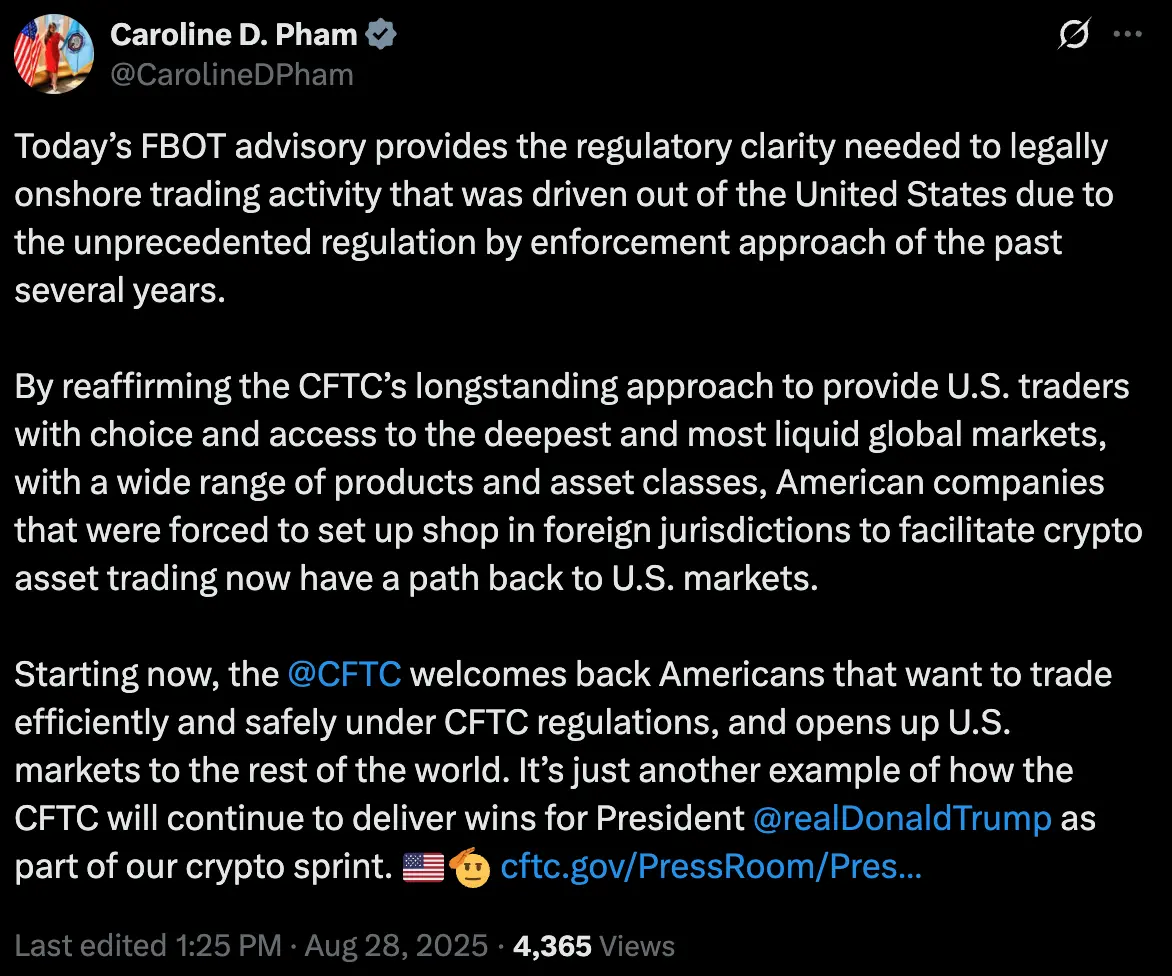
On August 28, the U.S. Commodity Futures Trading Commission (CFTC) dropped a significant signal: the Foreign Board of Trade (FBOT) consultation provides the necessary regulatory clarity for legitimate onshore trading activities. This means that overseas exchanges, long shut out of the U.S. market, now have a legitimate path to return.
In recent years, giants like Binance and Bybit have been forced to limit access for U.S. users or even exit the market entirely due to regulatory pressure. Countless American traders have either been stuck on local platforms with limited products or have taken risks by accessing overseas exchanges. Now, the CFTC has made it clear: as long as these platforms register through FBOT, they can serve Americans without having to become "Designated Contract Markets" (DCM).
Acting Chair Caroline D. Pham stated in a press release that this is to "bring back trading activities that have been pushed out of the U.S." Against the backdrop of the "Crypto Sprint" initiative pushed by the Trump administration, this document acts like a clarion call, signaling a complete shift in the regulatory landscape in the U.S.
Why Now?
In recent years, the U.S. attitude towards the crypto industry can almost be described as "enforcement-driven." During Biden's administration, former SEC Chair Gary Gensler raised the banner of "regulation equals punishment," targeting everyone from Binance to countless project teams. In 2023, Binance was heavily fined $4.3 billion and "completely exited" the U.S. market, sending shockwaves throughout the industry.
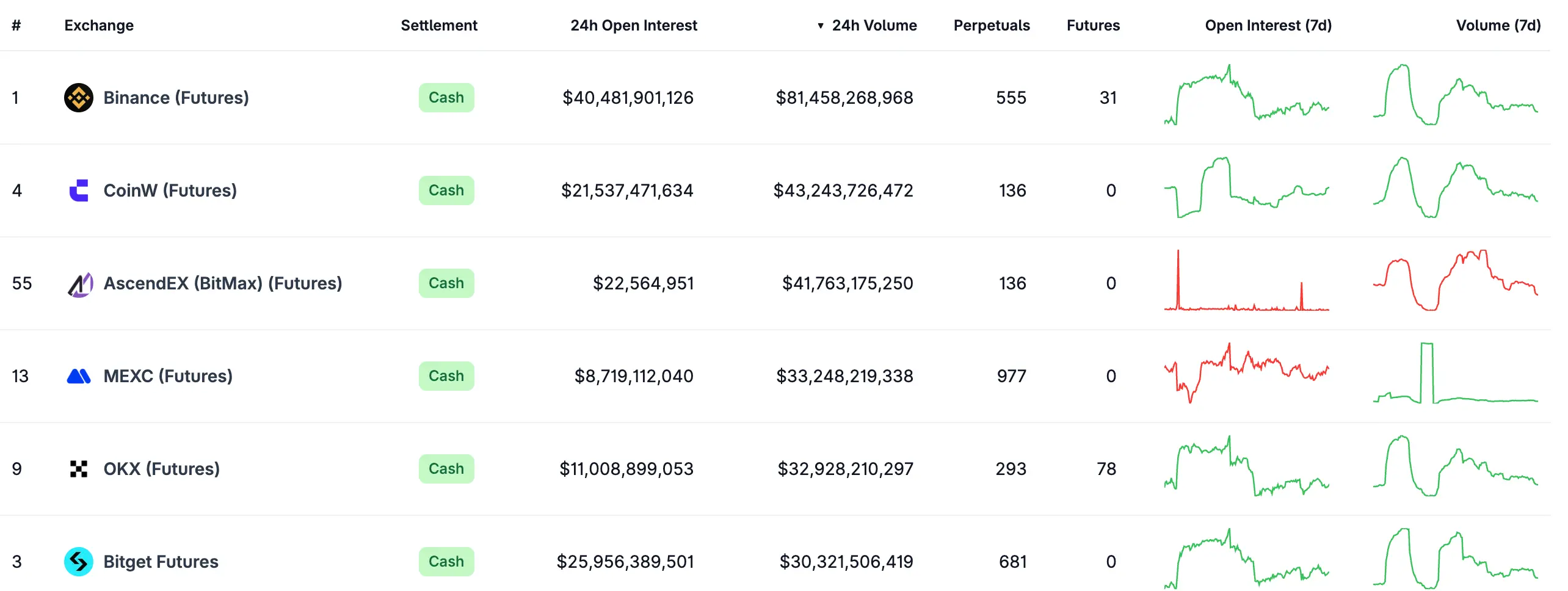
What the U.S. lost was not just a few exchanges, but an entire market landscape: local users were forced to move overseas, and capital followed suit; overseas platforms solidified their dominance in the derivatives market, with Binance, OKX, and Bitget often seeing daily trading volumes in the hundreds of billions, while U.S. exchanges were relegated to the second tier, with Coinbase's daily derivatives trading volume at only $6 billion. This lag was also due to the previous SEC's restrictions on perpetual futures trading, staking, and leverage. Meanwhile, Singapore, Hong Kong, and the EU have been rapidly introducing more flexible frameworks, and the original "regulatory dividend" of the U.S. is being eroded inch by inch.
It is precisely for this reason that the CFTC's move is particularly timely. At the beginning of August, the CFTC had just launched the "Crypto Sprint" initiative and publicly sought opinions on whether "spot crypto assets can be listed on registered exchanges (DCM)." Within just a few weeks, the regulatory body received a large number of inquiries about "how foreign exchanges can return to the U.S.," and the pressure from public opinion and the industry forced the CFTC to provide a clear answer.
The acceptance of overseas exchanges is not only a correction of the "over-regulation" of the past few years but also the starting point for the U.S. to reclaim its share of the global market. In the broader context of the "Crypto Sprint," this guideline is not just a procedural clarification but more like an invitation: American traders should stand alongside global users, enjoying the deepest liquidity and the most diverse products.
New Compliance Landscape: Return, Expansion, and Competition
The CFTC's FBOT consultation has the most direct significance in that it brings American traders back into the main pool of the global market. In the past, local exchanges were constrained by regulations, offering limited products and liquidity, forcing many users to either accept a mediocre experience or take risks by accessing overseas platforms. Now, with a clear compliance path, American traders can finally enjoy the deepest liquidity and the richest products, just like their counterparts in Asia and Europe. This not only enhances market efficiency but also means that the U.S. can once again connect with the global financial stage. Some even predict that this could promote liquidity growth for Bitcoin and Ethereum in the coming months.
For overseas exchanges that have long been shut out, this is also a long-awaited "pass." Giants like Binance, Bybit, and OKX had previously cut off U.S. users due to compliance pressures, but now they have a legitimate path to return. The vast user base and strong trading demand in the U.S. market have long made these platforms eager to enter, and the FBOT registration framework undoubtedly provides them with the key to legal expansion. For them, this represents new growth space; for users, it means more competitors entering the market, leading to lower fees, better products, and services.
The significance of this consultation also lies in creating a fairer competitive environment for local exchanges. In recent years, the U.S. crypto market has almost become a "one-man show" for a few local platforms. Now, with the opening of the FBOT registration path, overseas giants finally have a legal and compliant way to return. This means that the market is no longer a "reserved area" for a few local exchanges but has truly entered a stage of multi-party competition. The entry of more competitors will bring about more intense price competition, faster product iteration, and higher service standards. For American investors, this is a rare boon: they no longer have to endure "passive choices" but can enjoy the liquidity and innovation offered by top global platforms in a more open and fair market.
Conclusion
This guideline not only clarifies a set of procedures but also repairs the image of U.S. regulation. In recent years, the impression left by the U.S. on the market has been "rigid, with punishment first," characterized by vague policies and frequent enforcement, forcing capital and projects to flee. Now, the CFTC is adopting a stance of "willing to listen to opinions and correct in a timely manner," which is not only a correction of over-regulation but also a message to the global market: the U.S. is moving towards a transparent and open regulatory era. Once this signal is received by the market, it will undoubtedly rebuild the confidence of investors and developers, attracting capital and innovation back to the U.S. And this is the true essence of the "Crypto Sprint"—not just a slogan, but a concrete institutional action.
 Risk warning
 Risk warning




Popular articles





