Hyperliquid stablecoin USDH becomes a "hot commodity" in the industry, giants engage in a chaotic battle for distribution rights

 USDH, as a high-demand standard code, will be used to build compliant, Hyperliquid-prioritized native stablecoins.
Original | Odaily Planet Daily
Author | Wenser
Benefiting from the pre-market, launch, and market fluctuations of XPL and WLFI, Hyperliquid achieved a revenue of $106 million in August, a month-on-month increase of 23%; the monthly contract trading volume approached $400 billion, with a market share of approximately 70% in the DEX Perp market. As the undisputed "cash cow" in the industry today, the official concept of a "high-performance L1 public chain" has also brought infinite imagination space to Hyperliquid's stablecoin landscape.
On September 5, Hyperliquid officially announced that the stablecoin code USDH reserved by the protocol will be released through an on-chain validator voting process, with voting conducted entirely on Hyperliquid L1. The process is similar to the delisting voting, and the selected team must participate in the regular spot deployment Gas auction. The official stated, "USDH, as a highly demanded standard code, will be used to build a compliant, Hyperliquid-prioritized native stablecoin." Following this news, major stablecoin issuers have presented their own "USDH issuance plans," and Odaily Planet Daily will briefly analyze the different plans for Hyperliquid's native stablecoin USDH and the competition among issuers behind them in this article.
USDH Becomes a Battleground for Stablecoin Issuers, Giants Like Paxos and Agora Enter the Fray
On September 5, Hyperliquid officially released an announcement in the Discord community stating that:
The spot market structure will be optimized in the next network upgrade. The fees for spot trading pairs between two spot quoted assets, order rebates, and user trading volume contributions will be uniformly reduced by 80% to enhance liquidity and reduce user friction.
The USDH stablecoin code currently reserved by the protocol will be released through a transparent on-chain validator voting process. Voting will be conducted entirely on-chain through ultra-liquid L1 transactions, similar to the delisting voting process. Since USDH is a highly demanded standard token code, validators will vote to select the most capable teams to build locally minted, Hyperliquid-prioritized stablecoins. Teams interested in using this code can submit proposals in the new "usdh forum sub-channel," which should include the user addresses of the selected validator quorum that will be used to deploy USDH. Please note that approved teams must still participate in the usual spot deployment Gas auction. Additionally, the official emphasized: "The USDH code is very suitable for Hyperliquid-prioritized, Hyperliquid-consistent, and compliant USD stablecoins; after the next network upgrade, validators will be able to vote to allow user addresses to purchase the USDH stablecoin code."
In context, starting from the testnet, spot quoted assets will become permissionless in the future. Subsequent announcements will disclose staking requirements and reduction standards.
The official further added: "This voting is only for the USDH code. USDH will not gain any special privileges due to its code nature; Hyperliquid's native financial primitives and general programmability constitute a chain uniquely optimized for stablecoin issuance and payments. There will continue to be multiple stablecoins on the Hyperliquid blockchain, with new stablecoin teams joining the Hyperliquid ecosystem. USDH is just one of many stablecoins. As mentioned earlier, before the technical implementation, becoming a quoted asset will become permissionless.
Regarding the timeline: Proposals should be submitted by September 10 at 10:00 UTC; validators should indicate who they will vote for by September 11 at 10:00 UTC; validators should vote between September 14 at 10:00 and 11:00 UTC to allow users time to stake to match the validators they vote for.
Voting is based on staking shares. Validators will vote by submitting addresses corresponding to the teams they support. Foundation validators will vote to select the non-foundation team with the most votes based on the validator commitments made on September 11 (weighted by equity on September 14), effectively abstaining."
Contestants: 3 Major Stablecoin Issuers + 2 Project Teams Show Their Skills
As of now, there are 5 stablecoin issuance proposals in the Hyperliquid community USDH sub-channel. Apart from well-known stablecoin issuers like Paxos, Agora, and Frax, Native Markets led by Max Fiege and the Konelia team have also presented their own USDH issuance plans.
Based on the existing information, major stablecoin issuers have mature issuance plans and rich compliance experience, and the final winner may emerge from among them.
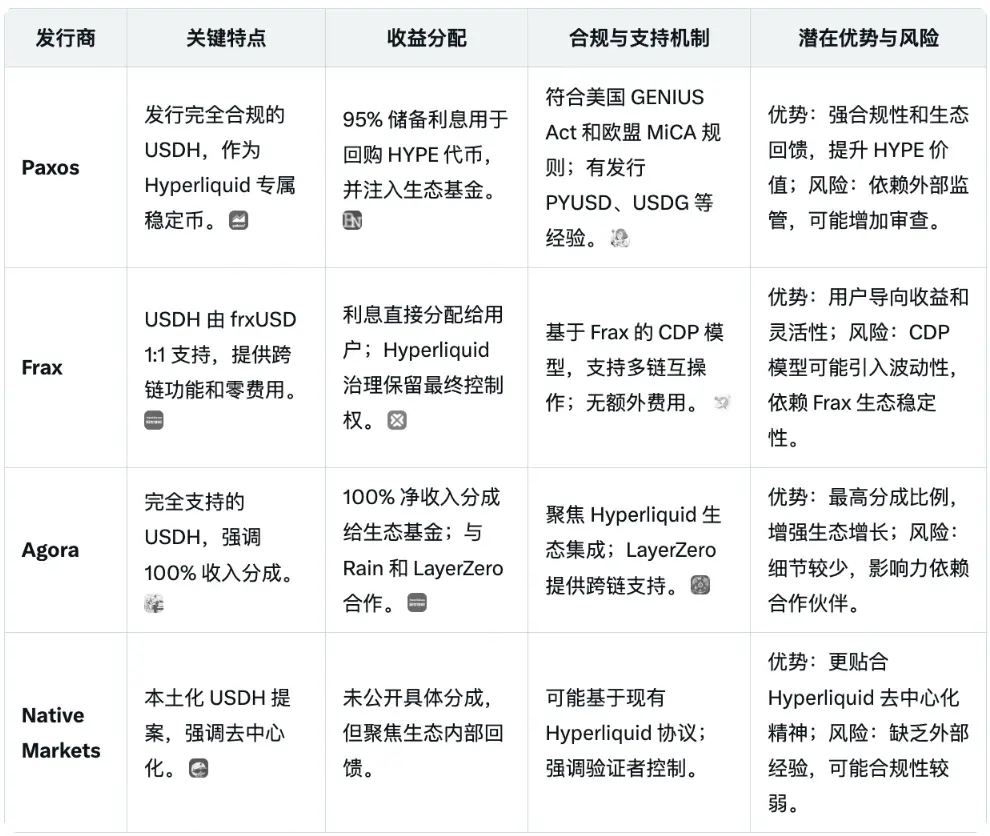
In addition, various issuers have briefly introduced their advantages in their proposals------
Paxos emphasized its compliance expertise in global regions and a strong partnership network. According to a member of the Paxos Labs team, Paxos has already begun establishing partnerships within the Hyperliquid ecosystem to prepare for the successful deployment of USDH, with initial partners including: FalconX, Looping Collective, HyperLend, Pendle, HybraSwap, Hyperswap, Neko, HypurrFi, DotHYPE, RubFi, Nunchi, and others.
The Frax team emphasized its "decentralized vision" similar to Hyperliquid, stating: "Frax has designed, transported, and operated various stablecoins worth billions of dollars across cycles, with zero security incidents. Our advantage lies in strict incentives and mechanism design, along with a good track record. We are committed to decentralization and surpassing all unlocks in the long term, rather than for extraction, which is why the collateral yield of USDH will flow back at a 0% acceptance rate."
Agora spokesperson Nick van Eck highlighted its backing by asset management giant VanEck and partnerships with well-known platforms such as the credit card payment network Rain, which has 2 billion users, interoperability infrastructure LayerZero, and EtherFi. Additionally, he emphasized Agora's neutrality as an issuer, taking the opportunity to criticize Paxos, stating: "Agora does not have its own settlement network or brokerage (unlike Paxos)."
Max Fiege's leading Native Markets emphasized its "localization attributes," planning to "donate a significant portion of its reserve earnings to aid funds; USDH will be minted directly on HyperEVM, enabling HyperCore transmission from day one; USDH will also inherit the global compliance attributes and issuance channels of the issuer Bridge (a Stripe subsidiary)." Thanks to Max's deep involvement and reputation in the Hyperliquid community, this proposal received considerable support in the comments section.
The Konelia team's stablecoin issuance proposal was met with skepticism and even ridicule from community members for hoping to rely on the "automatic compounding yield of short-term U.S. Treasury bonds" and emphasizing MEV protection, which is currently not prioritized in the Hyperliquid ecosystem.
The following are the deployment addresses of the existing stablecoin issuer proposals:
Paxos------0x999000B7c80550C5D3858a9C9505dd9A3654B339;
Frax------0x6e74053a3798e0fc9a9775f7995316b27f21c4d2;
Agora------0x8010f766AA84bB0Cc57e7C0bf13149cF9BC62b65;
Native Markets------0xc4bb9B6FdA3112B381Cb94f571bc72db541e7577;
Konelia------0x274f2c145B413f76cD3ED52C05221ddAb0E582A1.
As the on-chain voting has not yet commenced, feedback from community proposals indicates that the proposals from stablecoin issuers Paxos and Max Fiege have relatively high support.
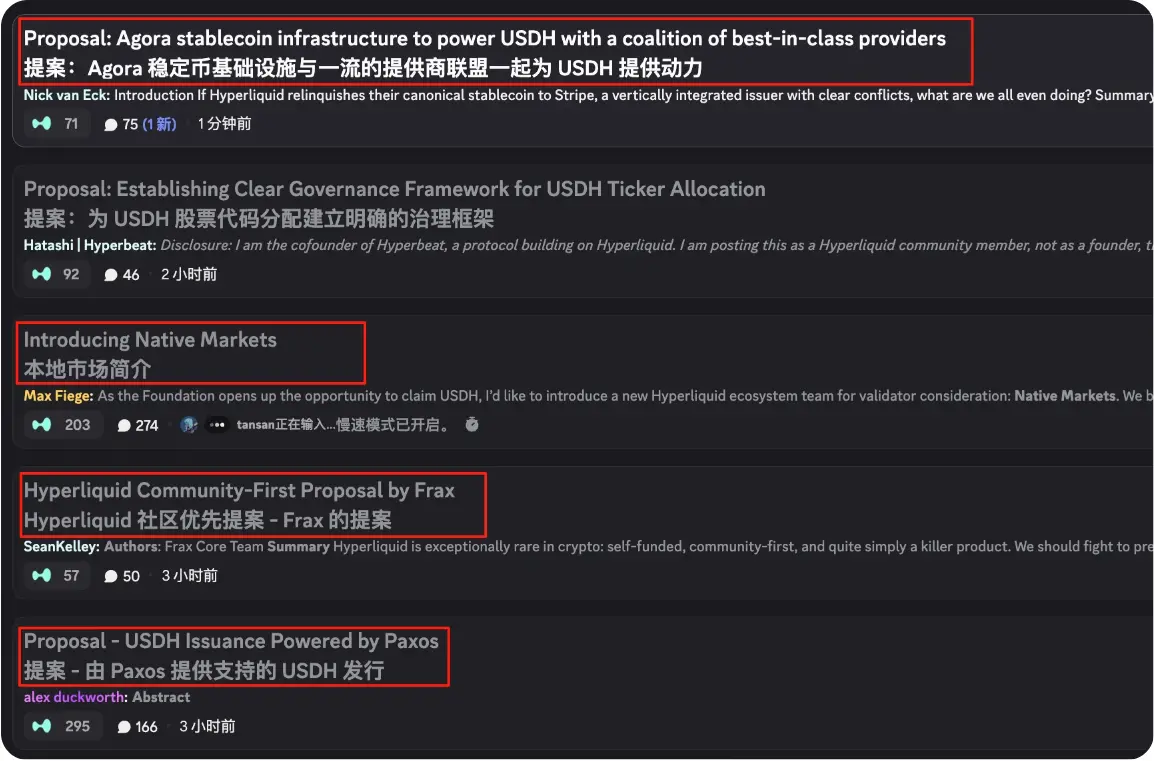
Hyperliquid Community USDH Sub-channel Page
It is worth mentioning that Frax faced criticism from Hyperliquid community members due to its previous collaboration with the Luna algorithmic stablecoin UST, although some later clarified: "The partnership was in the Curve's 4-token pair pool USDC/USDT/UST/Frax, when they were the top four stablecoins in the EVM."
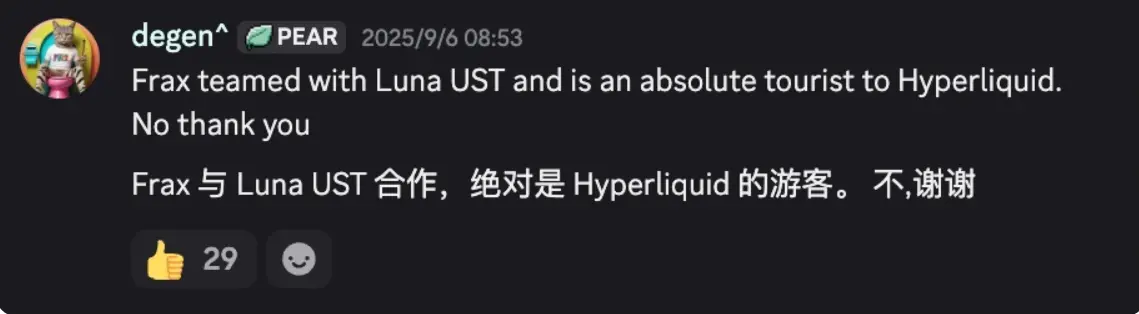
Hyperliquid Community Members Question Frax
Mixed Attitudes from Hyperliquid Ecosystem Projects: Some Cry Unfairness, Others Abstain
Regarding the USDH proposal voting, projects within the Hyperliquid ecosystem have expressed differing attitudes:
The liquidity staking protocol Kinetiq officially announced that it will re-delegate all its rights to the Hyperliquid Foundation nodes from 12:00 PM ET on September 10 to 12:00 PM ET on September 15 to abstain from this vote.
The Hyperstable team, a project focused on over-collateralized stablecoins within the Hyperliquid ecosystem, stated that they had planned to launch a decentralized and over-collateralized stablecoin supported by HYPE, HYPE LST, etc., since the end of last year. However, at that time, all tokens starting with USD were blacklisted, including USDH. The sudden opening of USDH issuance highlights that many teams (like Max Fiege) received news in advance, which is extremely unfair, and they suggested keeping the USDH code on the blacklist.
USDH Is About to Launch, Circle Behind USDC Is Getting Anxious
The competition for USDH issuance has not officially started, but Circle, the issuer behind USDC, the only stablecoin in the Hyperliquid ecosystem, is already feeling the pressure. Circle co-founder and CEO Jeremy Allaire stated not to be misled by hype. Circle will become a major participant and contributor in the Hyperliquid ecosystem. He expressed happiness to see others purchasing new USD stablecoin codes and participating in competition, but emphasized that USDC, with deep liquidity and almost instant cross-chain interoperability, will definitely be warmly welcomed by the market.
It is worth mentioning that as early as July, Circle announced the upcoming deployment of native USDC and CCTP V2 to the Hyperliquid chain, but more than a month later, native USDC has still not been launched. The emergence of USDH undoubtedly makes Circle feel threatened, and CEO Jeremy Allaire's response seems somewhat powerless. Ironically, the stablecoin USDe issuer Ethena Labs today hinted on X platform that they had sent a USDH proposal to Circle's CEO but did not receive a response.
Chaos Among Stablecoin Issuers: All for Market Share and Distribution
As the U.S. stablecoin regulatory bill "GENIUS Act" is about to land, the stablecoin sector will welcome a new round of explosion, and the emergence of USDH provides a new piece of cake for major stablecoin issuers.
For the currently somewhat saturated stablecoin market, Hyperliquid, with hundreds of thousands of high-frequency trading users and monthly trading volumes in the hundreds of billions, will undoubtedly bring significant incremental growth to the stablecoin market. This is also the reason why many issuers are vying for the deployment rights of the USDH code. BitMEX co-founder Arthur Hayes previously pointed out that the key to stablecoin success lies in distribution channels.
As Frax founder Sam Kazemian stated, "For stablecoin issuers and infrastructure companies, the key point for all parties competing to submit Hyperliquid stablecoin USDH issuance proposals is not revenue sharing; the real value lies in achieving interoperability and deep 1:1 integration with Hyperliquid's massive distribution scenario. In fact, all parties whose proposals made the cut (Frax, Paxos, Agora) have expressed their willingness to return 100% of the profits." (Odaily Planet Daily note: Paxos's proposal is to use 95% of the interest generated from USDH reserves to repurchase HYPE tokens and distribute them to users, validators, and partner agreements.)
If we use retail as a metaphor, Hyperliquid is like a beverage brand with its own retail channels, while Paxos, Agora, and Frax are akin to beverage manufacturing subcontractors. What they are competing for now is this vast retail channel network.
For the Hyperliquid community, the most concerning issue for most members remains how the issuance of USDH will serve the development of the Hyperliquid ecosystem, especially the allocation of corresponding income for HYPE token repurchases and the previous activity levels of project team members in the Hyperliquid ecosystem and community.
It is worth mentioning that the issuance and application of USDH may bring Hyperliquid a potential annual revenue of up to $220 million. Additionally, according to BitMEX co-founder Arthur Hayes's prediction, by 2028, the stablecoin market size will reach $10 trillion, and by then, the price growth of HYPE, as an ecological token based on the native stablecoin USDH, is expected to be promising.
In conclusion, Odaily Planet Daily reminds HYPE staking users to pay attention to node voting statements to avoid missing corresponding voting delegations.
 Risk warning
 Risk warning