








The Final Battle of AI Payments: The Three-Body Game of Google, Coinbase, and Stripe
 Core Viewpoint

 Who defines how machines trade?
Author: Luke, Mars Finance
While the global tech community is still focused on the parameter competition of large language models, a more profound transformation, concerning the future economic lifeline, has quietly begun beneath the surface. This is not about how beautifully AI can write poetry, but about how they— as emerging digital species— will autonomously participate in economic activities. Recently, Google, in collaboration with over sixty organizations, released the open-source Agent Payments Protocol (AP2). Almost simultaneously, payment giant Stripe, in partnership with OpenAI and others, announced the construction of its own payment Layer-1 blockchain, "Tempo." These technological releases have collectively ushered in a new era: the race to build financial infrastructure for the upcoming "Agent Economy" has already begun.
This is not a simple technological upgrade, but a paradigm revolution. As AI evolves from "conversationalists" to "executors" capable of autonomous decision-making and trading, traditional, human-designed payment systems are facing reconstruction. This article will delve into the three core players of this transformation— Google, Coinbase, and Stripe— each representing distinctly different visions for the future. They not only carve out their own technological paths but also provide their answers to the fundamental question of "who defines how machines trade" on a philosophical level.
Google's Top-Level Design: Establishing Order in the AI World with AP2
Before understanding AP2 (Agent Payments Protocol), we need to place it within Google's larger agent protocol matrix. Previously, Google released the MCP protocol, which serves as the "senses" of AI, enabling it to perceive and connect with external tools and data; the subsequent A2A protocol acts like the "language" of AI, allowing multiple AIs to work collaboratively. However, if an AI team that can perceive and communicate gets stuck in the final payment stage, its autonomy is meaningless. AP2 fills this crucial last link— the ability for value exchange, solving the "last mile" problem of AI automation execution.
The core goal of AP2 is to make AI agents "trustworthy, controllable, and traceable" within the existing financial world. When a transaction is initiated by an autonomously operating AI, merchants, banks, and regulators are immediately confronted with three classic questions: Is this authorized by the user? Does it misinterpret the user's intent? If something goes wrong, who is responsible?
The brilliance of AP2 lies in its approach; it does not attempt to overthrow Visa or Mastercard but builds a universal "trust semantic layer" on top of them. It introduces an authorization mechanism based on Verifiable Credentials, which can be simply understood as issuing "digital passports" and encrypted notarized "power of attorney" documents to AI. This mechanism consists of two modes:
The first is real-time authorization, where the AI finds a specific product and generates a "Cart Mandate" containing precise information, which must be encrypted and signed by the user before execution. The second is delegated authorization, where the user can preset a "Intent Mandate" containing complex rules like budget limits and time windows, for example, "Automatically purchase for me when a limited edition sneaker is released, provided the price is below $200." The AI will autonomously monitor and execute transactions based on this preset "power of attorney."
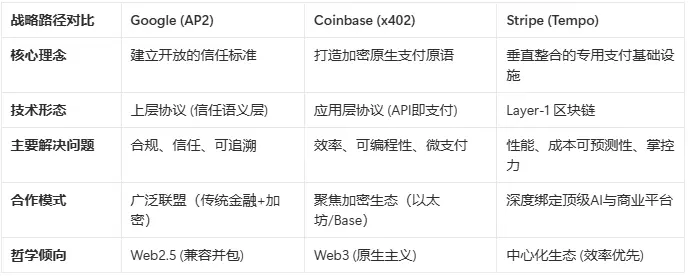
These two mandates together form an immutable chain of evidence, making each payment request from the AI no longer come from a "black box robot," but rather from a verifiable user authorization for the downstream payment network. Google's strategic intent is crystal clear: by partnering with traditional financial giants like American Express, Mastercard, and PayPal, as well as leaders in the crypto world like Coinbase and the Ethereum Foundation, it aims to become the "standard setter" of the new order. It does not produce currency or handle clearing but defines "trust" itself, attempting to position itself at the core of the future agent economy.
Coinbase's Crypto-Native Path: x402 Makes API Calls Payable
If Google aims to "invite" AI into the financial system of the real world, then Coinbase hopes to build a brand new, crypto-native economic environment for AI. The x402 protocol it promotes is a highly forward-looking attempt, named after an HTTP status code that has rarely been used on a large scale in internet history— "402 Payment Required."
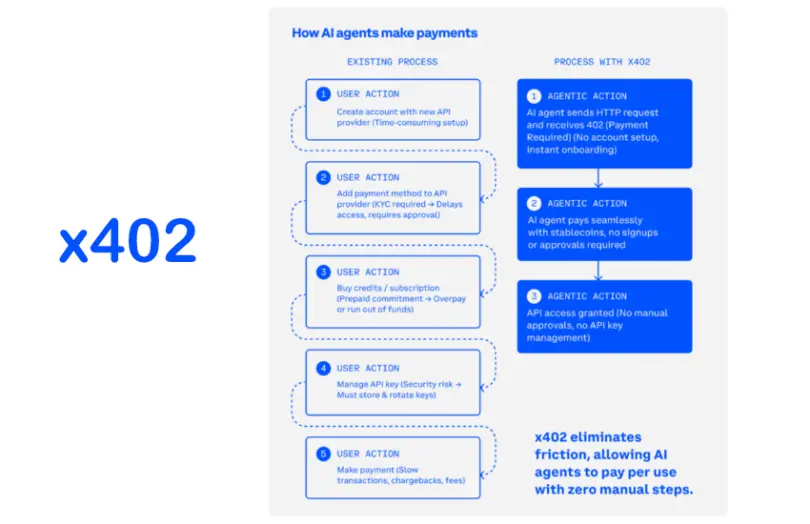
The concept of x402 is simple yet powerful: to make payments a native part of internet communication. When an AI agent calls an API service (for example, retrieving a data report or rendering an image), the server can directly respond with a "402 bill." The AI agent does not need to navigate complex payment gateways but can complete micro-payments directly on-chain using stablecoins like USDC and immediately receive the service after payment.
This mechanism outlines a clear blueprint for instant, automated, high-frequency trading between machines. Leveraging the global instantaneous settlement and low-cost characteristics of stablecoins, AI services can be broken down to the extreme atomic granularity, charging based on request counts, usage duration, or even computational resource consumption. This is a realm that human payment processes cannot reach.
More critically, Google, in its AP2 release, explicitly announced a collaboration with Coinbase to launch the "A2A x402 extension," viewing it as a "production-grade solution for agent crypto payments." This official endorsement is significant, indicating that x402 is not merely an "isolated experiment" in the crypto circle but has been recognized and incorporated into the grand landscape of mainstream tech giants' "crypto tracks." These two seemingly parallel tracks have achieved a historic convergence at this moment.
Stripe's Independent Path: Controlling the Future of Payments with Tempo Blockchain
As Google and Coinbase approach from the dimensions of "standards" and "native," payment giant Stripe offers a third answer: vertical integration. Stripe is not satisfied with building protocols on existing networks but has directly announced the creation of a Layer-1 blockchain specifically designed for payments— Tempo.
This is an extremely ambitious plan. Stripe's logic is that neither traditional payment networks nor existing public chains can meet the extreme performance, predictable low costs, and strict compliance required by the future AI economy. Rather than patching up on someone else's land, it prefers to establish a new "financial continent."
Tempo is designed to be EVM-compatible but has been deeply optimized to provide a highly controllable environment for massive payment transactions. Stripe's list of strategic partners— OpenAI, Shopify, DoorDash, Anthropic— reveals its goals. It aims to directly integrate top model companies in the AI field and top platforms in the business realm onto its blockchain, forming a highly coordinated ecosystem from underlying technology to upper-level applications. This stands in stark contrast to Google's open platform strategy, resembling more of an "Apple-style" closed ecosystem approach. By controlling the underlying blockchain, Stripe can not only define the rules but also directly capture value, providing customers with a seamless, efficient, yet relatively centralized solution.
Opportunities at the Execution Layer: Giants Pave the Way, Who Will Build the Cars?
As the three giants lay down highways to the future, a massive market opportunity arises: who will manufacture the "mass-produced cars" that drive on these roads? The protocols and underlying blockchains themselves cannot be directly used by consumers or businesses; the market urgently needs an "execution layer" to transform these complex technologies into usable, secure, and easily integrated products.
This is where startups like Kite.AI come to the forefront. PayPal Ventures recently led its $18 million funding round, recognizing its potential as "agent infrastructure." Kite.AI's concepts of "Agent Passport" and "Agent App Store" directly address the core issues: the former provides a trustworthy on-chain identity for AI agents, while the latter offers a marketplace for discovering, evaluating, and paying for various services. This almost perfectly encapsulates the core functions of the execution layer: identity, discovery, payment, and risk control.
In addition to Kite.AI, a number of similar companies such as Skyfire and Crossmint have emerged in the market, all attempting to package abstract standards like AP2 and x402 into SDKs and APIs that developers can easily call. These companies do not directly compete with the giants but serve as "fillers" in their ecosystems, transforming the potential of the protocols into real commercial value.
Conclusion: Two Paradigms, One Future
The battle for AI payments has begun, defining far more than just technical standards. The interplay and fusion of Google's "order," Coinbase's "native," and Stripe's "integration" will fundamentally reshape the form of digital commerce. The ability of AI agents to acquire payment capabilities marks their coming-of-age transformation from a clever "information processor" to a true "economic participant."
It is worth noting that the traditional authorization framework represented by Google and the purely native solution pursued by Web3AI, which seeks "decentralized custody + on-chain verification," differ in paradigm. The former focuses more on automated execution, while the latter aspires for AI's autonomous management of digital assets. However, the two are more likely to be complementary rather than competitive. As users become accustomed to the convenience of AI payments in traditional domains, their acceptance of AI's autonomous management of on-chain assets will naturally increase. Scenarios such as anonymous transactions and censorship-resistant payments, which AP2 cannot touch, leave ample space for crypto-native solutions.
It is certain that the game has changed. When AI can not only understand your intent but also mobilize funds to realize it, a new economic era centered around machines has truly begun. Ultimately, who can gain an advantage in this race will depend on who can better balance the eternal tension between innovation, trust, and efficiency.
 Risk warning
 Risk warning




Popular articles





