








ASTER surged 400% within the week. Can it truly challenge Hyperliquid's dominance?
 Core Viewpoint

 Behind the ASTER Surge: Is it Real Competitiveness or Short-term Hype?
Original Title: The Aster Counterstrike
Author: Token Dispatch
Compiled by: LenaXin, ChainCatcher
Background
On September 18, 2025, Zhao Changpeng released a price chart that was neither Bitcoin nor BNB.
The chart displayed the native token of the decentralized perpetual exchange ASTER, which had just launched the day before.
"Well done! A smooth start. Keep it up!" he said.
Within hours, the ASTER token surged 400% from its issuance price. The market clearly received this signal: the former CEO of Binance was not just expressing congratulations but declaring war on Hyperliquid.
As HYPE token holders watched their Hyperliquid assets soar to nearly $60, Zhao Changpeng's meticulously calculated tweet landed like a precision strike. Although Zhao was banned from operating Binance, he was evidently not prohibited from shaking the market, and he was fully backing Hyperliquid's strongest competitor.
However, the war machine had already been set in motion. YZi Labs (formerly Binance Labs) had been quietly funding the development of ASTER. The BNB Chain cooperative network was being activated. The world's largest crypto empire was launching a full-scale assault on this decentralized newcomer daring to seize market share in derivatives.
This was the first shot in the war of decentralized perpetual exchanges, and Binance had no intention of conceding defeat.
(1) What is ASTER?
ASTER was born from the merger of two major DeFi protocols, Astherus and APX Finance, in December 2024. This integration built a unified trading infrastructure aimed at directly countering Hyperliquid's expanding market share.
(Note: Astherus focuses on multi-asset liquidity for yield products, while APX Finance is a decentralized perpetual trading platform.)
The platform is a multi-chain decentralized exchange that supports BNB Chain, Ethereum, Solana, and Arbitrum networks, enabling seamless trading without manual cross-chain transfers through aggregated multi-chain liquidity. Since its launch in March 2025, ASTER has processed over $514 billion in trading volume for 2 million users. After the token issuance, the total locked value on the platform briefly touched a peak of $2 billion, but had fallen back to $655 million by September 2025.
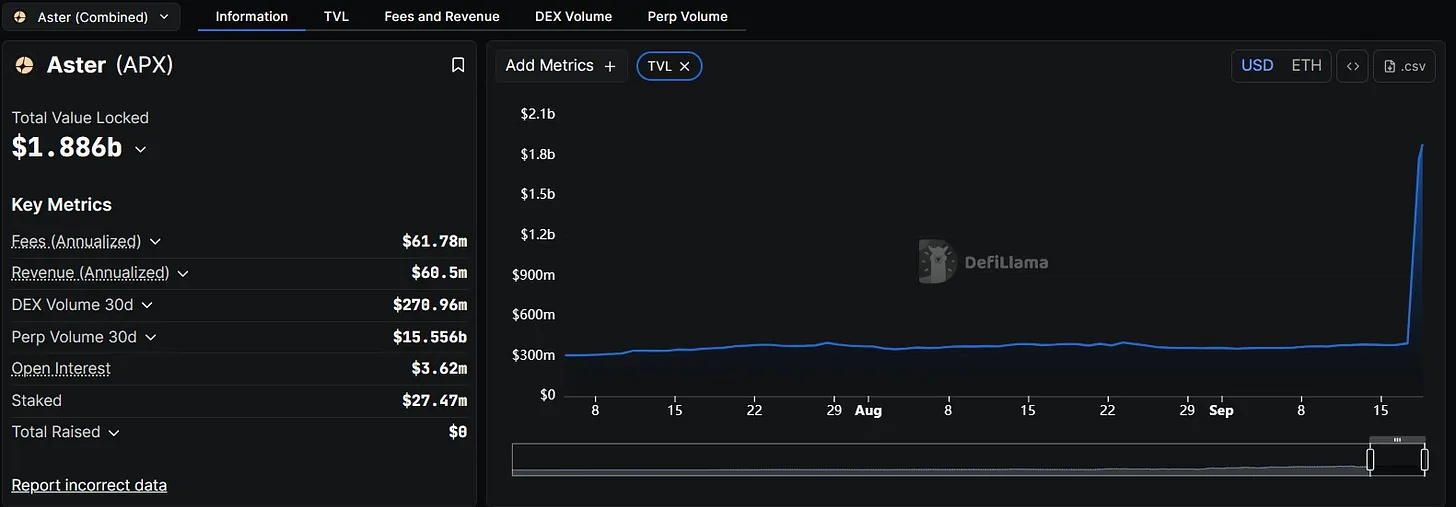
Unlike decentralized exchanges that focus solely on spot trading, ASTER positions itself as a comprehensive trading platform offering both spot and perpetual futures markets. While perpetual derivatives are its core business, the platform also provides spot trading functionality, with its native token ASTER/USDT being the first trading pair launched.
(2) How does ASTER address front-running and liquidation manipulation?
The core architecture of ASTER is dedicated to solving the liquidity fragmentation problem that plagues multi-chain DeFi. The platform constructs "unified liquidity" by aggregating cross-chain order book depth, rather than forcing users to transfer assets across chains.
Its "hidden orders" system is particularly noteworthy, as it keeps the order size and direction concealed until execution. This dark pool-style design effectively addresses key pain points of on-chain trading: front-running and liquidation manipulation.
Zhao Changpeng previously commented on this feature, noting that it resolves "the liquidation manipulation issues present in other on-chain DEXs."
The platform's margin system supports both isolated and cross-margin trading, allowing users to use liquid staking tokens like asBNB or ecosystem stablecoins as collateral. This capital efficiency innovation enables traders to earn passive income on their staked assets while maintaining active positions.
The core of the ASTER ecosystem is USDF. USDF is an ecosystem stablecoin backed by delta-neutral positions. Users can mint USDF by depositing supported assets and use this stablecoin as collateral for trading while earning yields. This creates a self-reinforcing liquidity system where holders of stablecoins naturally become liquidity providers.
The ASTER roadmap includes the integration of zero-knowledge proofs to enhance privacy and the development of a custom Layer 1 blockchain, Aster Chain, optimized for trading. By June 2025, this feature had been opened for beta testing to select traders, allowing the platform to ultimately compete with Hyperliquid's customized L1 architecture.
(3) The Epic Showdown Between ASTER and Hyperliquid
ASTER and Hyperliquid represent two different paths in decentralized perpetual trading. Hyperliquid builds a proprietary Layer 1 blockchain from scratch, employing fully on-chain order book trading to achieve performance comparable to centralized exchanges. This vertical integration sets Hyperliquid's trading execution efficiency and user experience as industry benchmarks, but confines it to a single ecosystem.
In contrast, ASTER adopts the opposite strategy, maximizing coverage and liquidity access through multi-chain deployment. While this increases technical complexity, it allows ASTER to leverage existing DeFi ecosystem resources to serve user groups that prefer specific chains.
Hyperliquid dominates with approximately 70% of the DeFi perpetual contract market share, with open interest reaching $15 billion and maintaining an average daily trading volume of over $800 million.
However, ASTER's multi-chain strategy possesses advantages that Hyperliquid finds difficult to replicate. The capital efficiency opportunities created through integration with yield protocols like Pendle and Venus are beyond the reach of Hyperliquid's isolated L1 architecture.
ASTER users can simultaneously earn BNB staking rewards, USDT deposit interest, and trading fees.
There are also significant differences in leverage configurations. Hyperliquid sets its leverage cap at 40x, while most trading pairs on ASTER support up to 100x leverage, with specific assets reaching as high as 1001x. ASTER's US stock perpetual contracts provide 24/7 traditional market risk exposure, extending its service range beyond crypto-native traders.
(4) Token Flow Reveals Competitive Landscape
The token economic model of ASTER emphasizes community incentives and long-term sustainability. The total supply of 8 billion tokens is allocated in specific proportions: 53.5% for airdrops and community rewards, 30% for ecosystem development, 7% for the treasury, 5% for the team, and 4.5% for liquidity and exchange listings.
The community allocation ratio ranks among the top in the DeFi space, exceeding 50% of the total supply. The unlocking mechanism releases 25% of the tokens immediately upon generation events, with the remaining portion subject to a three-month lock-up period followed by a linear release over nine months.
The token has multiple functions within the ecosystem, including governance rights, fee discounts, staking rewards, and access to premium features. Revenue sharing is achieved through fee buybacks, with a portion of trading fees used to purchase and potentially burn ASTER tokens, creating deflationary pressure as trading volume increases.
Users can stake their ASTER tokens while also using these tokens' ecosystem derivatives as collateral for trading. This allows a single position to generate multiple streams of value.
(5) Token Showdown: Comprehensive Analysis of ASTER and HYPE
The economic models of ASTER and HYPE tokens showcase different philosophies of value capture and distribution mechanisms.
Hyperliquid's HYPE token employs a more traditional crypto economic model, engaging in aggressive buybacks through protocol revenue. The platform generates over $1 billion in annual revenue, with a significant portion allocated for HYPE buybacks, creating strong deflationary pressure.
The core advantage of HYPE lies in its proven " revenue-buyback " flywheel effect. Currently, 43.4% of the total supply is staked, combined with substantial protocol revenue, maintaining strict circulation limits for the token. This powerful price support mechanism is something ASTER has yet to achieve.
In November 2025, Hyperliquid will initiate a large-scale token unlock for core contributors. These unlocks will bring significant selling pressure, potentially overwhelming aggressive buyback plans. Hyperliquid is preparing to launch the USDH stablecoin to generate additional buyback pressure, but the timing introduces uncertainty.
ASTER's strategy prioritizes community ownership over immediate value capture. While this means weaker buyback efforts in the short term, it can create stronger network effects and governance decentralization. The 53.5% community allocation ensures that value flows to actual users rather than early investors or team members.
(6) Binance's Strategy
Analyzing ASTER's liquidity supply system reveals the strategic depth behind its launch. Professional market makers provide core order book depth, while the platform's cross-chain architecture aggregates multi-blockchain liquidity. Strategic partnerships with protocols like Pendle, ListaDAO, Kernel, Venus, YieldNest, and PancakeSwap create additional sources of liquidity and user incentives.
Pendle enables yield tokenization, ListaDAO provides liquid staking for BNB (generating asBNB), Venus offers lending services, and PancakeSwap directs arbitrage trades from the largest DEX on the BNB Chain. These collaborations position ASTER as a central hub where users can engage in multiple DeFi strategies while trading derivatives.
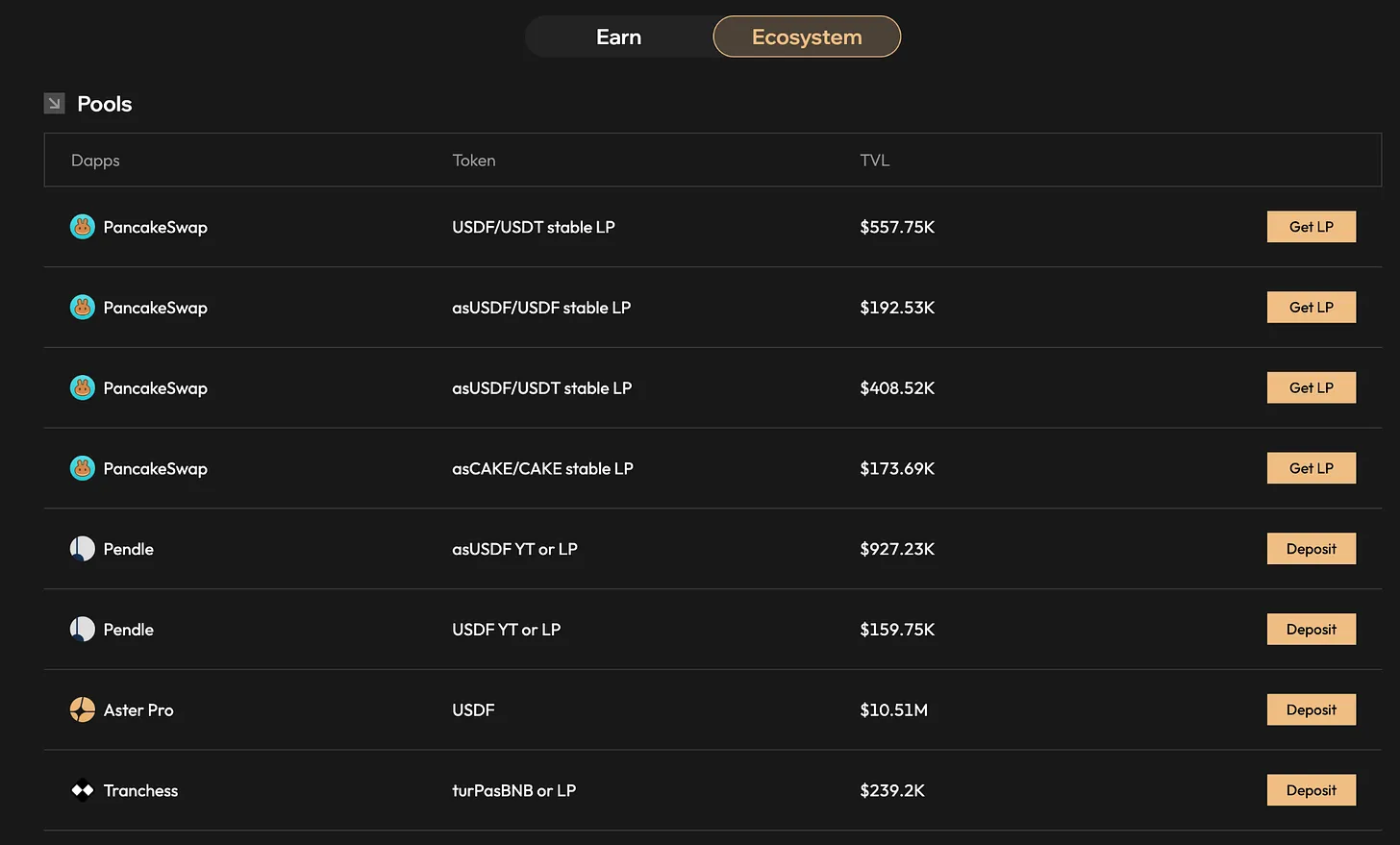
The ecosystem collateral system addresses opportunity cost issues by allowing users to earn yields from trading margins. Users do not need to hold idle USDT; they can mint USDF to earn delta-neutral yields while using it as collateral.
(Note: USDF is ASTER's ecosystem stablecoin.)
Similarly, asBNB can still earn staking rewards (approximately 5-7% annualized) while serving as margin for leveraged positions. This allows a single deposit to generate multiple streams of income, including staking rewards, trading profits, and token incentives, encouraging users to keep more funds on the platform long-term, thereby deepening liquidity pool depth.
The investment timeline of YZi Labs provides a key annotation for Binance's strategic layout. This investment firm completed its funding of Astherus (the predecessor of ASTER) in November 2024, coinciding with Hyperliquid posing a substantial competitive threat to Binance's dominance in derivatives.
According to representatives from the BNB Chain, ASTER, as a key project in the YZi Labs incubation program, received mentorship, ecosystem exposure, and technical marketing resources support, thereby establishing its position as the largest perpetual contract DEX on the BNB Chain.
Hyperliquid's trading volume has steadily increased between 2024 and 2025. While Binance still maintains a significant advantage in absolute trading volume, Hyperliquid's growth trajectory from nearly zero to a notable market share demonstrates its success in carving out an independent market rather than directly poaching Binance traders.
Combined with its investments in other projects like MYXFinance, YZi Labs' investment strategy becomes increasingly clear. These investments indicate a coordinated layout to build the BNB Chain DeFi infrastructure and create alternatives for successful protocols on other chains.
(Note: MYX Finance is a perpetual contract on the BNB Chain, and its DEX has also experienced explosive growth.)
Binance's overall strategy leans more towards ecological defense rather than direct competition. It has not simply replicated Hyperliquid's customized L1 solution but has fully leveraged existing ecological advantages: regulatory relationships, fiat on-ramps, institutional partnerships, and deep liquidity pools. While ASTER enjoys the benefits of these network effects, it is also providing a decentralized trading experience increasingly favored by mature traders.
Binance does not view decentralized protocols as threats to be ignored or marginalized; rather, it actively invests in and promotes DeFi alternatives that remain within its ecological influence.
(7) Conclusion
The rise of ASTER either marks a turning point in decentralized derivatives trading or becomes Zhao Changpeng's most expensive "I can do it too" to his competitors.
On the surface, the platform possesses all the elements of success: multi-chain liquidity, ecosystem collateral, US stock perpetual contracts, and strong support. The idea of earning yields while trading derivatives sounds wonderful, but one must recognize that innovations in the cryptocurrency space that seem "too good to be true" often are.
The reality of the total locked value plummeting from a peak of $2 billion to $655 million may warrant caution: there is an essential difference between initial hype and sustainable adoption. When daily TVL drops by 67%, we might question whether these numbers truly represent real users or merely reflect the interests of yield farmers chasing quick profits.
Its token economic model focuses on long-term community building rather than short-term value capture, a strategy that can be seen as visionary or naively idealistic, depending on one's perspective. Unlike Hyperliquid's proven "revenue-buyback" machine, ASTER's value proposition requires users to believe in the sustainability of a business model that generates 3% margin yields while operating 100x leveraged positions.
The real test lies in whether the platform can persuade traders to abandon Hyperliquid's well-established infrastructure in favor of a multi-chain experiment supported by the ecosystem that birthed the 2022 FTX collapse.
When the world's largest exchange feels the need to support DeFi competitors, it suggests that centralized models may not be as unshakeable as once thought. Whether this move will make ASTER a winner or merely an expensive hedge against risk remains to be seen.
Disclaimer
The content of this article does not represent the views of ChainCatcher. The opinions, data, and conclusions in the text reflect the personal stance of the original author or interviewee. The compiler maintains a neutral position and does not endorse their accuracy. This does not constitute advice or guidance in any professional field; readers should exercise caution based on independent judgment. This compilation is for knowledge-sharing purposes only; readers should strictly adhere to the laws and regulations of their respective regions and refrain from participating in any illegal financial activities.
 Risk warning
 Risk warning




Popular articles





