








Plasma Deep Research: Track Pain Points, Innovation Mechanisms, and Future Prospects
 Core Viewpoint

 Plasma is a new Layer 1 built specifically for the circulation of stablecoins. Just as TCP/IP made the internet a global information hub, Plasma's goal is to empower stablecoins to become a global payment center.
Source: “Global Rails For The Future Of Money Movement”
Compiled by: Hu Tao, ChainCatcher
Money is rarely static, and so is the way we move money.
Few things are as simple and eternal as the transfer of value between individuals. Ancient herders would exchange livestock for grain or tools when they needed them. Medieval farmers would bring a bushel of wheat to the local village market when they needed a pair of shoes. Over time, people found it inconvenient to carry bulky items and livestock while traveling, so they began using precious metals like gold and silver bars. But soon, people realized these precious metals were neither practical nor convenient, leading to gold being melted into coins, which were eventually replaced by paper money, promissory notes, and banknotes. As technology has become increasingly important in people's daily lives, the way money circulates has accelerated accordingly.
Today, Americans can send digital dollars to friends in Peru or Thailand in seconds for just a penny. They cannot do this through local banks or Western Union. This borderless, low-cost, and nearly instantaneous flow of funds is made possible through stablecoins.
Stablecoins are digital dollars issued and transferred on blockchain rails. They provide a stable unit of transaction in digital form: just as anyone with an email address or WhatsApp can communicate instantly worldwide, stablecoins enable anyone with internet access to transfer funds globally.
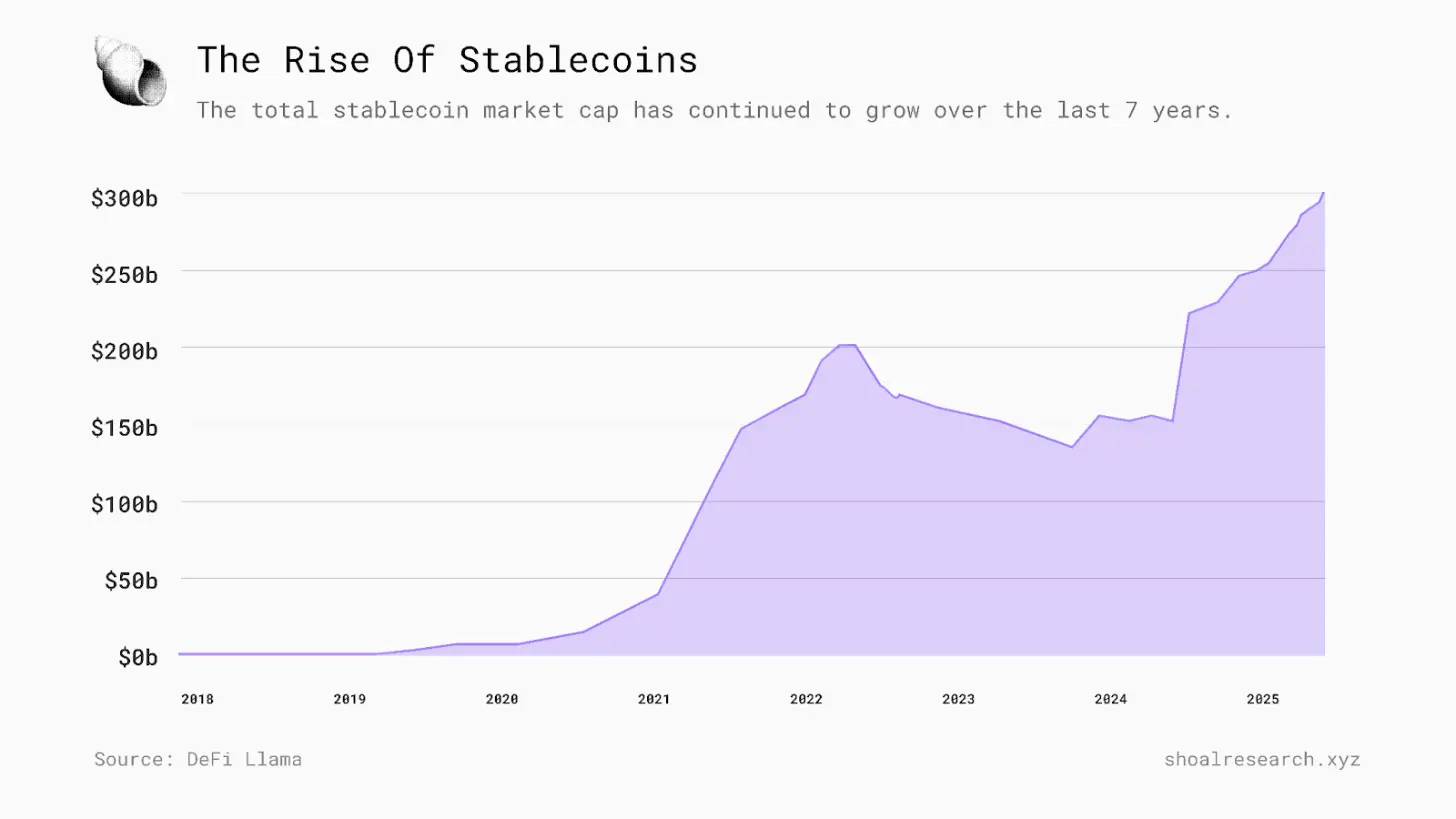
Trillions of dollars have already flowed through stablecoins. Their supply continues to grow and has reached all-time highs. While not a new phenomenon, the adoption of stablecoins has recently accelerated unexpectedly.
Impressively, stablecoins are not only growing but also eroding traditional payment networks.
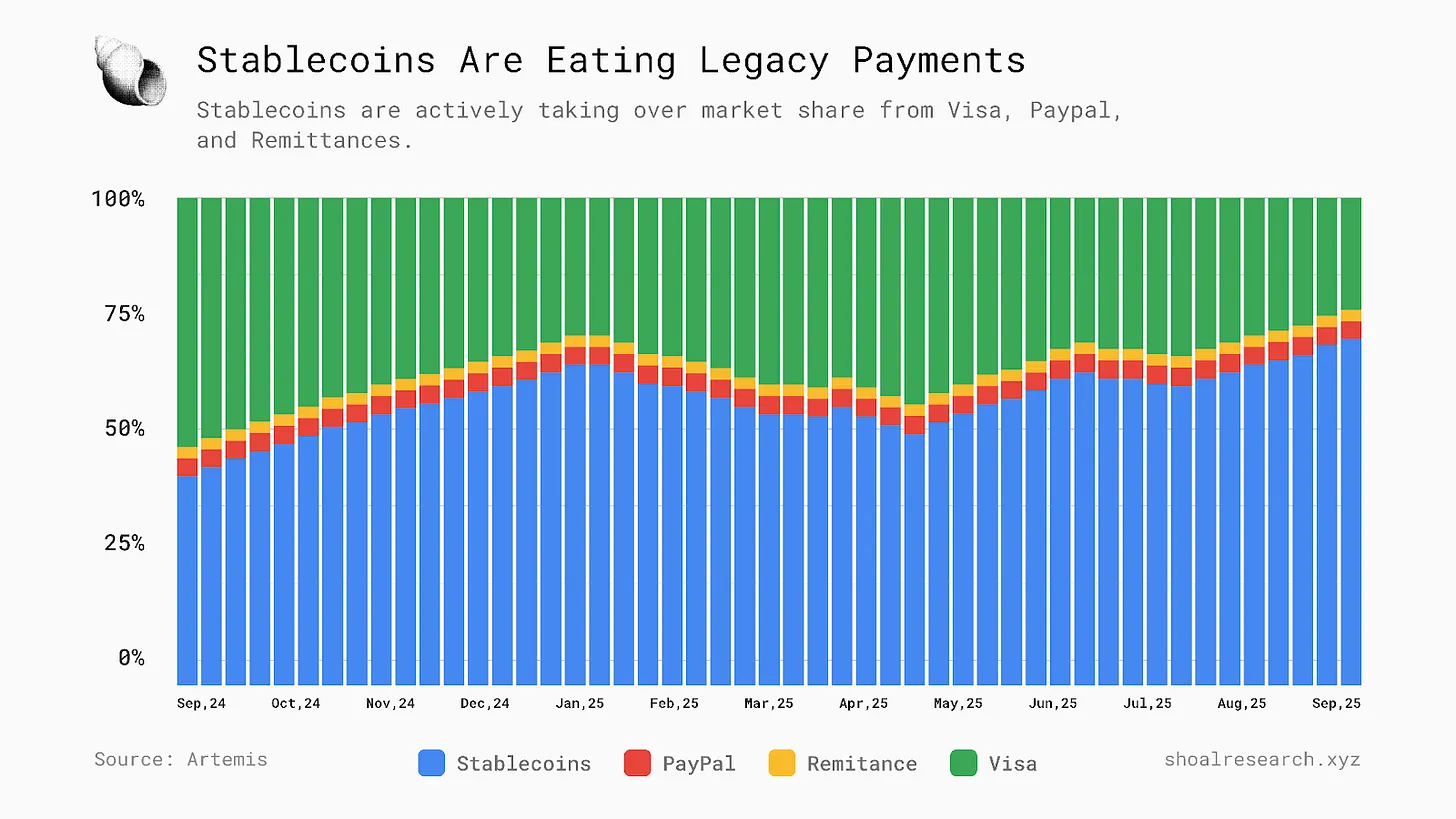
We believe stablecoins will inevitably permeate various sectors of the financial services system, not just payments, ultimately disrupting consumer banking, lending, B2B settlements, payroll systems, and more. But this raises a question: what is so special about these digital dollars?
The Value Proposition of Stablecoins
"Tools can be created that allow end users to create currency protocol layers with stable value pegged to external currencies or commodities. This way, users of these currencies can have stable virtual currencies pegged to the dollar, euro, gold, oil, etc." ------ Mastercoin White Paper (2012)
Fundamentally, stablecoins are digital assets designed to maintain the value of the underlying asset to which they are pegged. The most common case is that stablecoins are pegged to fiat currencies, especially the dollar (which is why we refer to them as digital dollars). To maintain this peg and stable value, stablecoin issuers implement specific mechanisms to ensure that each stablecoin is pegged 1:1 to its underlying asset. The most common practice is to hold cash and short-term U.S. Treasury bills as reserves, matching the supply of stablecoins in circulation. For every new stablecoin issued, users must deposit dollars with the issuer. These funds are held by regulated financial institutions and custodians. When stablecoins are redeemed, an equivalent amount of funds is withdrawn from these reserves and returned to the redeemer, with the corresponding stablecoin supply removed from circulation, or "burned."
Note: There are other stablecoin anchoring mechanisms, some represented by OG leading stablecoin protocols like Maker DAO (now Sky), which built a CDP protocol allowing anyone to borrow DAI. Conversely, there are cases like Luna/UST that encountered massive failures, losing billions of dollars.
The value proposition of stablecoins is far from singular:
Global 24/7 Settlement: Stablecoins can be transferred globally at any time of day, any day of the week. They are based on blockchain technology and are designed to settle in minutes or even seconds. In contrast, traditional transfer systems like ACH or international wire transfers often take days to clear and can only process during limited business hours, with weekends or holidays potentially causing further delays.
Superior User Experience: Stablecoins outperform traditional payment systems in both speed and cost. On certain blockchains, stablecoin transfers can be completed in just seconds. Traditional systems like ACH or wire transfers can take hours or even several business days to complete.
Stablecoin transactions are also several times cheaper than traditional payment networks. Stablecoin transactions are merely redistributions of digital ledger balances. The primary resource consumed is the computational power required to update balances, paid in transaction fees or Gas fees. Today, Gas fees are approaching zero, as low-cost transactions are becoming the norm for most blockchains.
In contrast, wire transfers or ACH transactions involve multiple intermediaries—remitting banks, receiving banks, clearinghouses—all of which charge substantial fees for transfers. Traditional cross-border transfers still average a 6.49% fee.
It is worth noting that while stablecoins offer near-instantaneous and low-cost blockchain transfers, converting funds from on-chain to bank accounts or cash, known as "offramping," may still involve traditional fees, foreign exchange spreads, and delays. But overall, even with this final step included, stablecoin-based transfers are still faster and cheaper than today’s traditional networks.
Permissionless Global Access: Stablecoins inherently democratize access to stable currencies like the dollar. Anyone with internet access can send, receive, and hold stablecoins, regardless of whether they have a bank account or can access financial services. Despite ongoing improvements in global financial inclusion, over 1 billion adults still lack bank accounts and access to formal financial services, often being excluded from the digital economy. Meanwhile, many countries still face hyperinflation and currency devaluation. By enabling permissionless global access to dollars, stablecoins provide a financial lifeline for residents in these developing regions.
Programmable: Since stablecoins are built on blockchain rails, they exist in the form of tokenized smart contracts. In short: they are code. This unique design means that specific conditions and rules (such as settlement rules, transfer restrictions, etc.) can be directly programmed into the asset itself. This programmability helps streamline operations, as writing code is easier and more predictable than anticipating human error. Moreover, since the crypto-native economy consists of a coalition of open, permissionless protocols, stablecoins can naturally integrate and enhance almost any application based on public chains: earning yields through lending or liquidity provisioning, serving as collateral for borrowing other assets, acting as margin for perpetual contract trading, betting on various quirky prediction markets, and more.
Native PMF
Unlike most other blockchain-native innovations, stablecoins have stood the test of time because there has always been market demand for them. Their development trajectory has largely been determined by the organic applications birthed by clear catalysts at each stage.
Trader's Best Friend
Stablecoins were initially favored by traders looking for a simple way to transfer value in and out of volatile positions without converting to fiat. In the early 2010s, there were few other uses besides trading Bitcoin, and traders lacked a convenient way to store funds between trades.
The early mention of the stablecoin concept first appeared in the Mastercoin white paper and was put into production with the launch of Realcoin (now known as Tether) in 2014.
USDT was initially issued on Bitcoin via the Omni Layer and traded on exchanges like Bitfinex. After USDT launched, it brought new utility to cryptocurrency traders: transferring funds between assets, stabilizing volatility risk exposure, and executing more complex trading strategies without first converting to fiat and then back to cryptocurrency. However, due to its small audience, its adoption rate was quite limited.
Global Access to Stable Currency
As stablecoins matured, their impact has far exceeded speculative markets. In countries with hyperinflation, local currencies can depreciate significantly overnight, making the value of stable currencies like the dollar invaluable. Today, the best way to access dollars is through stablecoins.
Some notable data points:
In 2024, stablecoin purchases accounted for over 4% of Turkey's GDP.
In 2024, Argentina led the region in stablecoin trading volume share, with over 61% of crypto trading volume coming from stablecoins.
From June 2024 to June 2025, the amount traded via stablecoins in the Asia-Pacific region reached $2.36 trillion.
In 2025, the on-chain value in Sub-Saharan Africa (SSA) grew by $205 billion, reflecting a 52% year-over-year increase in cryptocurrency adoption since 2024.
Thus, stablecoins have become essential tools for millions of people in much of Latin America, Africa, and Asia for personal savings, payments, and remittances.
The Best Partner for Reserve Currency
As stablecoins gain popularity in emerging markets, their role in solidifying the dollar's global dominance has become increasingly pronounced. However, while the value of accessing digital dollars is evident in emerging economies, it is harder to grasp in the West, especially in the U.S. Most Americans have savings accounts. They can make instant transfers through apps like Venmo. Few lose sleep worrying about the dollar depreciating overnight (by 20-30%).
The most compelling reason for U.S. policymakers to support stablecoins is geopolitical: to solidify the dollar's global dominance. For a long time, the U.S. has leveraged the dollar's status as a reserve currency to maintain global financial power, most commonly through the petrodollar system.
Today, this opportunity lies with stablecoins. The concept is simple: dollar stablecoins are almost entirely backed by cash and short-term U.S. Treasury securities, requiring real dollar reserves for every stablecoin issued. For every stablecoin minted, overseas investors choose to hold a dollar, creating a new source of demand for U.S. government debt.
One might argue that the U.S. has no choice but to embrace stablecoins. In Q4 2024, Tether was ranked as the seventh-largest foreign buyer of U.S. Treasuries, with annual inflows exceeding those of countries like Canada and Mexico. Tether's latest stablecoin report confirms that Tether holds over $127 billion in U.S. Treasuries, making it one of the largest non-sovereign holders of U.S. government debt.
This dynamic is reshaping policy. The U.S. recently passed the landmark Stablecoin Act (GENIUS Act), which lays the groundwork for a regulatory framework for U.S. stablecoin issuance for the first time. Unsurprisingly, the Stablecoin Act requires that dollar stablecoins must be fully backed by [U.S. assets], and it also mandates monthly disclosures of reserves and independent third-party audits. This helps reinforce a kind of flywheel effect between stablecoins and debt financing: every time a new token is issued, it effectively creates a new buyer for U.S. debt, making the adoption of stablecoins a powerful strategic tool for maintaining the dollar's dominance. Treasury Secretary Scott Bensinger has publicly stated, "We will maintain the dollar's status as the world's primary reserve currency and will leverage stablecoins to achieve that goal."
In short, dollar stablecoins are evolving from mere crypto products into key tools of U.S. geopolitical strategy, meaning the U.S. government is very eager to see the adoption of U.S.-backed stablecoins continue to grow from now on.
Current Challenges and Pain Points
Despite the large scale and widespread application of stablecoin rails today, they were not originally designed to serve a global-scale payment network outside of crypto-native rails. Specifically, the current stablecoin infrastructure falls short in three key areas: scalability performance, actual user experience, and integration infrastructure with fiat rails.
Scalability Performance
Since the Layer-1 Gas wars of Ethereum, standards for blockchain performance and network capacity have made significant strides. The fees for stablecoin transfers (which can reach tens of dollars during peak congestion on Layer-1 networks) have dropped significantly and stabilized. Even so, most public chains still lag behind traditional payment networks in terms of scalability and uptime. Ethereum and its Layer-2 solutions have an average daily TPS of around 244. Solana's daily TPS often reaches 2000-3000, with previous peaks around 4800 (though it is always important to note the nuances between voting and non-voting transactions). However, the design goal for global payment networks is to support tens of thousands of TPS, which cannot withstand downtime even during peak congestion.
There are many promising developments on the horizon that could improve this situation. From the rise of application-specific perpetual decentralized exchange (DEX) chains to the upcoming launches of Firedancer and Alpenglow on Solana, to the performance improvements expected from Monad and MegaEth, as well as the rise of SVM L2. However, none of these are specifically targeting stablecoins. As network activity and adoption rates expand, stablecoin transfers on these chains still compete for more block space among exchanges, perpetual contract trading, and all other operations users can perform on these chains.
User Experience
Although on-chain transaction settlement speeds far exceed those of banks, the user experience remains subpar. The Boston Consulting Group's 2025 stablecoin report notes that "gas token management for transaction fees" and liquidity fragmentation are key technical barriers faced by retail and enterprise users when using stablecoins for payments.
The most obvious and easily solvable issue is gas token friction: someone receiving USDC on Ethereum or SOL on Solana essentially needs ETH or SOL to transfer or use their funds. The onboarding training for net new users remains impractical.
Liquidity is another challenge. Currently, the supply of stablecoins is dispersed across hundreds of blockchains, making it more difficult to transfer large amounts of funds or guarantee immediate conversion back to fiat outside of Ethereum. This fragmentation also dilutes network effects, forcing users and institutions to seek various bridging tools, gas tokens, and liquidity sources instead of relying on a single, unified liquidity market.
Today's stablecoin infrastructure also lacks privacy protections. Public chains default to exposing transaction details. While some privacy-preserving applications exist, users must go to great lengths to find and use them. Stablecoins do not have a built-in "switch" to enable private transactions. This means that using stablecoins for everyday payments is far more transparent than using cash or even traditional banking. For individual consumers, this may simply feel like an invasion of privacy. For businesses and financial institutions, it is simply untenable.
On-chain user experience has improved significantly, but there is still room for enhancement.
Lack of Integrated Infrastructure
One underestimated challenge facing today's stablecoin channels is the lack of integrated infrastructure, especially with fiat channels. Sending USDT to a friend is one thing; spending USDT at a grocery store is another. In reality, when users try to transfer between blockchain channels and local payment systems, they still face foreign exchange spreads, hidden fees, and compliance bottlenecks.
The so-called "offshore" refers to using centralized exchanges or other intermediaries, requiring users to create accounts (often requiring KYC verification) and pay service fees. Cross-border transactions become even more complicated, as they typically introduce more intermediaries and foreign exchange spreads, further eroding the transfer amount.
Before stablecoins can seamlessly integrate into fiat rails, they are well-suited for transferring value between cryptocurrencies but remain impractical for mainstream global payments.
So What’s Next?
Stablecoins have crossed the chasm. They are no longer niche byproducts of the cryptocurrency market. Their settlement volumes reach trillions of dollars annually, sometimes even monthly, and they have powered cryptocurrency trading, DeFi, and peer-to-peer markets in emerging economies.
However, while this level of adoption is significant, it still falls short of the standards required to become a pillar of the global financial rails. The operational requirements of settlement systems like VisaNet, SWIFT, and ACH are much stricter: near-instant finality, reliability, and a unified compliance framework across different jurisdictions. Stablecoins have processed vast amounts of data, but the blockchains they operate on were never designed to consistently meet these standards on a global scale.
One solution is to wait for universal chains to develop and strengthen as payment-grade infrastructure. Another solution is to adopt dedicated stablecoin infrastructure.
Dedicated Stablecoin Infrastructure
Almost every industry that prioritizes reliability, risk management, and performance is built around dedicated, specialized infrastructure.
Global payment networks like Visa and SWIFT have specific functionalities for secure global fund transfers and operate in isolated environments optimized for data integrity, regulatory compliance, and uptime. In the cloud computing space, financial institutions and research centers do not use AWS or Google Cloud; they still rely on purpose-built setups for handling PB-level physical data. In finance, high-frequency trading firms colocate servers with exchange matching engines because general-purpose infrastructure cannot provide the latency or reliability required in millisecond-sensitive markets. Compared to general-purpose infrastructure, using industry-specific data to train legal language models (LLMs) in healthcare, insurance, or finance consistently yields higher accuracy, lower error rates, and stronger regulatory compliance.
The same logic applies in the cryptographic space. Standards critical to the expansion of the internet—RSA for secure communication, SSL for browser authentication, and ECDSA for digital transactions—were all built for a common mission: to protect and verify data between online transaction counterparts.
Stablecoins are now at this inflection point.
Application Chain Theory
Blockchains follow the same logic. As applications become more popular and activity scales up, the limitations of general-purpose chains become increasingly apparent. Unpredictable gas fees, throughput ceilings, compliance gaps, and more are just a few examples. Thus, applications are increasingly motivated to launch their own chains.
We have seen this trend: decentralized exchanges (DEXs) like Osmosis, dYdX, and the recent Unichain; gaming and NFT platforms like Immutable; data networks like Pyth; all adopting some version of the application chain model. This argument stems from Cosmos, which posits that applications should have their own sovereign block space optimized for their needs while still being interoperable with the broader ecosystem.
When a chain is purpose-built, it can offer deterministic performance and predictable pricing, free from the demands of unrelated block space. It can embed compliance routines, information disclosures, and risk management tailored to regulated products. It can directly align economic incentives, governance, and value capture with the needs of its user base and community.
Dedicated application infrastructure allows blockchains to break free from the constraints of one-size-fits-all environments, enabling more customization, stronger performance, and better user experiences. Given the trend of stablecoin adoption, we believe it is only a matter of time before stablecoins require the same dedicated infrastructure. Plasma is one of the first teams moving toward this vision.
Plasma: A Blockchain Built for Stablecoin Circulation
Plasma is a new Layer 1 built specifically for the circulation of stablecoins. It combines a custom consensus protocol, an EVM-compatible execution layer, and dedicated smart contracts to support large-scale high-performance operations while providing security by natively publishing state roots to the Bitcoin network.
Plasma's mission is simple: to change the way global funds flow through specialized stablecoin infrastructure. Just as TCP/IP made the internet a global information hub, Plasma aims to empower stablecoins to become the global payment hub.
Plasma aims to address the pain points of today's infrastructure through its core features—performance, user experience, and integration:
Day-One Liquidity: Plasma launches with native USDT and $2 billion in day-one stablecoin liquidity.
Zero-Fee USDT Transfers: Transferring USDT directly through the Plasma frontend is free. Gas fees are subsidized by paymasters within the protocol, using permissioned transfer controls to limit transfer rates and prevent abuse.
Custom Gas: Users and applications on Plasma can pay gas fees using whitelisted tokens. After Plasma goes live, it will support gas payments using native USDT and pBTC.
Specialized Architecture: Plasma is built on a modular architecture that combines a custom high-performance consensus protocol with an EVM-compatible execution environment.
- Bitcoin Security: Plasma anchors its state roots to Bitcoin through a trust-minimized bridge, enabling direct programmability of BTC-EVM. This bridge also supports native BTC deposits, which can be converted to pBTC on Plasma.
- Integrated Infrastructure: Plasma will support over 100 DeFi applications at launch, including leading protocols like Aave, Ethena, Fluid, and Euler, as well as various physical peer-to-peer cash networks. Additionally, Plasma will support a wide range of developer tools and infrastructure ecosystems, covering account abstraction, on-chain analytics and block explorers, interoperability protocols, oracles, indexers, and RPC providers.
To better understand how Plasma actually achieves these functionalities, it is worth delving into its core architecture.
System Architecture
Essentially, Plasma is a Bitcoin sidechain that maintains its own consensus and publishes state proofs to Bitcoin. It is built on a modular multi-layer architecture that combines a custom BFT consensus protocol (PlasmaBFT), an EVM-compatible execution environment based on Reth, a trust-minimized Bitcoin bridge, and protocol-native stablecoin smart contracts.
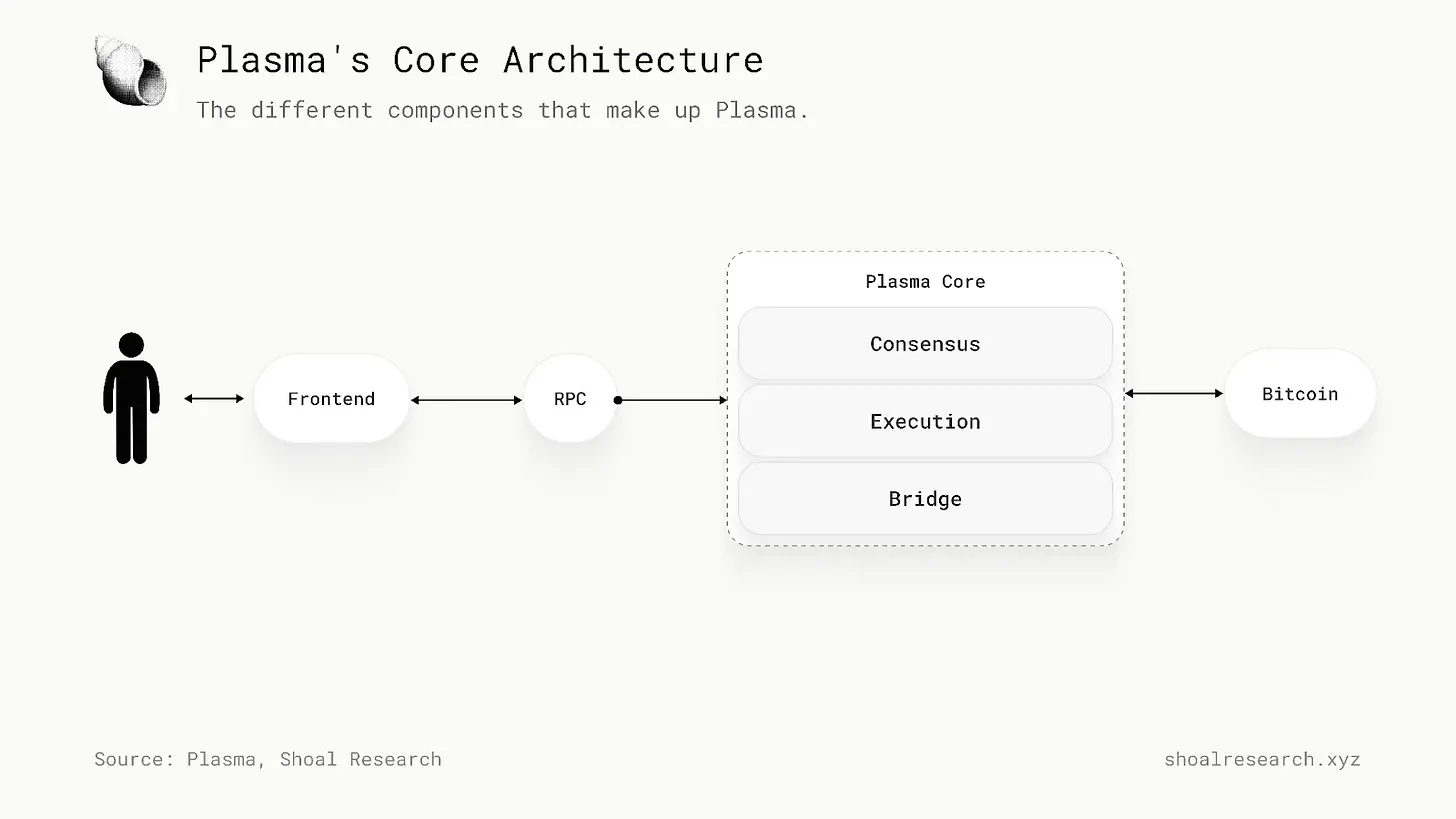
Transactions on Plasma begin at the user layer through supported frontends. They are broadcast to the Plasma chain via RPC. Afterward, consensus is reached, and once 2/3 of the PlasmaBFT validators successfully verify, the user's transaction is executed. Plasma then regularly publishes the state root to the Bitcoin network through its native bridge.
Let’s take a closer look at these core components.
PlasmaBFT
Consensus is at the heart of on-chain systems. It is a coordination mechanism that distinguishes blockchains from banks and fintech: transactions are verified not by a single authority but by a decentralized network of distributed nodes. However, this design mechanism can introduce latency, especially as the network scales and more validators are added, and for many of today’s blockchains, this comes at the cost of performance.
To overcome latency bottlenecks, Plasma introduces PlasmaBFT, a custom consensus protocol designed to support high throughput. PlasmaBFT is a pipelined implementation of the Fast HotStuff protocol, written in Rust. Finality is deterministic and can be achieved in seconds.
As the name suggests, PlasmaBFT follows classic Byzantine Fault Tolerance (BFT) assumptions. In practice, this means that as long as no more than one-third of validators are malicious, the network can remain secure (this can be reflected as n ≥ 3f + 1, where n is the total number of nodes and f is the number of Byzantine nodes).
To participate, validators must stake XPL and run supported hardware (2 CPU cores, 4 GB RAM, SSD-based persistent storage). Validators are then selected to propose and validate blocks on Plasma based on an XPL-staked weighted voting process.
The protocol finalizes blocks through a dual-chain submission process. Validators vote on block proposals, and once two consecutive quorum certificates (QCs) are formed, the block is finalized. A QC is an aggregated proof from validators; linking them together enforces a single canonical history.
PlasmaBFT is optimized for high performance on Layer-1. This is thanks to Plasma's pipelining technique: while one block is being finalized, the next block can already be submitted. Thus, only two rounds are needed to finalize a block.
This design is derived from Fast HotStuff, a modern BFT protocol designed with speed in mind. HotStuff introduced a leader-based structure and QC chaining to reduce communication overhead. Fast HotStuff further optimized the chain submission path, reducing latency and increasing throughput.
Similar to HotStuff, PlasmaBFT employs a leader-based polling structure aimed at minimizing communication overhead while maintaining fault tolerance. The leader proposes blocks, validators vote, and once enough votes are collected, a QC is generated. If the leader fails or goes offline, the protocol will transfer to a new leader using the aggregated QC.
Plasma plans to expand validator participation in several phases. Initially, the priority is to ensure baseline stability for the network, so Plasma will launch with a whitelist of validators. Over time, the number of validators will gradually increase to stress-test under a larger committee until the final phase opens participation to the public.
Plasma's Execution Environment
The virtual machine (VM) processes transactions, runs smart contracts, and maintains state synchronization among all participants on its underlying chain. The VM reads the current state of the chain, executes new inputs, and deterministically updates the state. It ensures that the same code always produces the same results and that the state is consistently updated across all Plasma nodes.
Plasma uses a general Ethereum Virtual Machine (EVM) execution environment. This means developers can deploy existing EVM smart contracts and use familiar tools and infrastructure.
Plasma's execution engine is Reth, a Rust-based modular Ethereum client that separates consensus from execution. This makes updates more efficient, clarifies the boundaries between block production and execution, and enhances performance and behavioral predictability.
When transactions are submitted on Plasma, Plasma's execution environment processes them through the EVM, ensuring that relevant smart contracts run and that the state is consistently updated across all Plasma nodes.
Bitcoin-Level Security
Blockchains typically secure themselves solely through their own set of validators. This security is limited by the size of the validator pool and the economic weight behind it. For stablecoins that may involve significant value, relying solely on a new or relatively small set of validators can pose risks.
To mitigate this, Plasma regularly publishes its state root to Bitcoin. Anchoring to Bitcoin provides additional settlement assurance: once Plasma's state is recorded on Bitcoin, changing it would require rewriting Bitcoin's history. This makes censorship or rollback extremely difficult and provides Plasma with a stronger security baseline than relying solely on its validator set.
Plasma achieves this through a native Bitcoin bridge. This bridge consists of a network of validators, each running a full Bitcoin node to monitor deposits and verify state anchoring. Plasma's state root is regularly submitted to Bitcoin via transactions (e.g., OP_RETURN), and the validator network proves that these anchors match Plasma's canonical chain.
In addition to settlement, this bridge allows native BTC to flow into Plasma. Users deposit BTC into a designated address, validators confirm the transaction on the Bitcoin network, and then Plasma mints pBTC: an ERC-20 token backed 1:1 by BTC. Withdrawals follow the opposite process: users burn pBTC on Plasma, and once validated, BTC is released on the base chain.
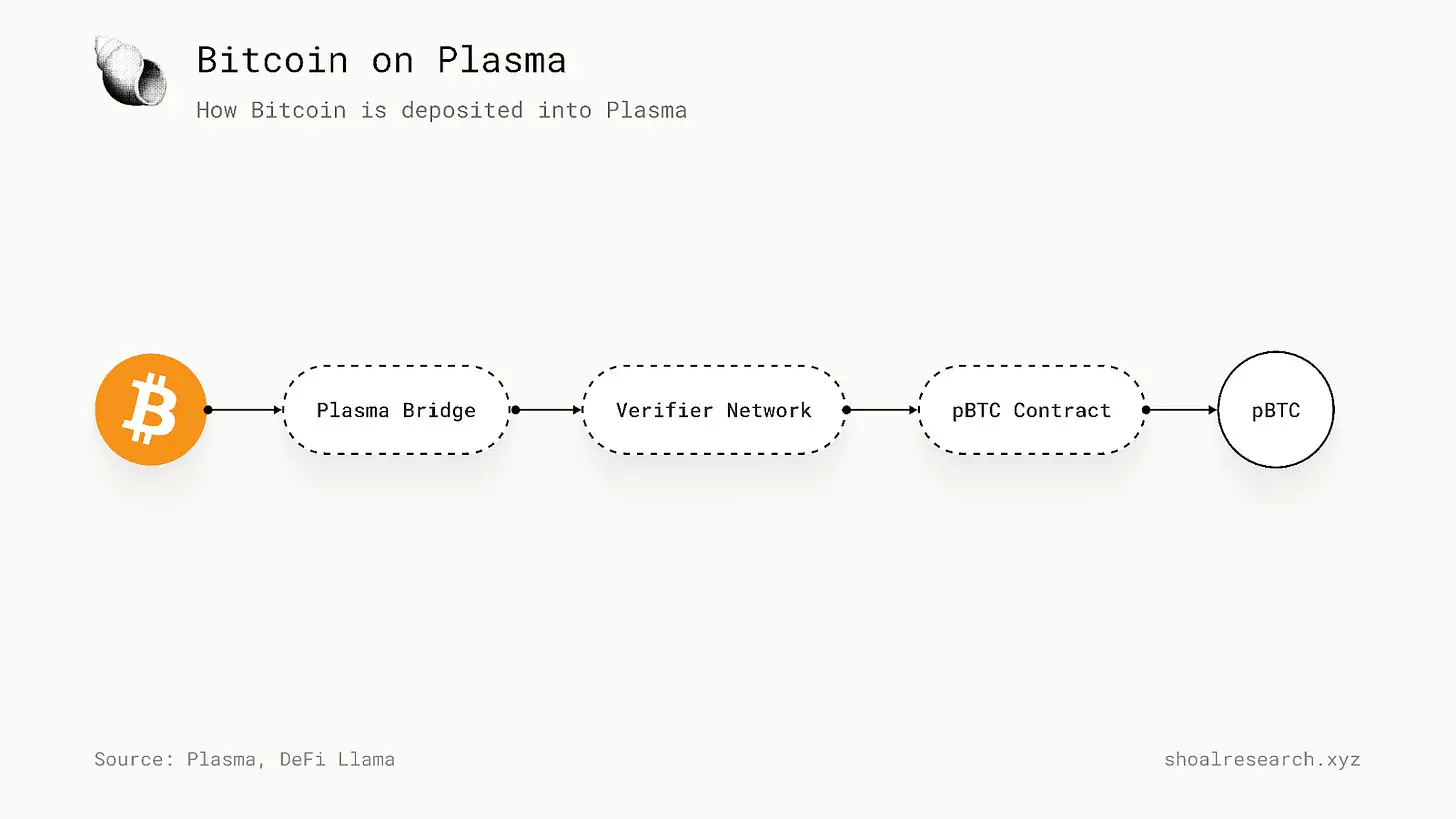
This bridge enables native BTC to be used in Plasma smart contracts. pBTC is issued in standard ERC-20 token form, built on the LayerZero OFT standard for cross-chain portability while preserving the verifiability of the underlying Bitcoin itself. Users always receive pBTC on Plasma at a 1:1 ratio with the BTC deposited.
To ensure withdrawal security, Plasma relies on Multi-Party Computation (MPC). Unlike a single entity holding a private key, Plasma's private key is jointly generated and signed by multiple validators, with no single entity able to unilaterally release funds.
Native Stablecoin Smart Contracts
On the current stablecoin development rails, stablecoins exist in the form of generic ERC-20 tokens. They are applications built on top of the base chain. This design is effective to some extent, but still presents friction: transaction fees are paid in separate gas tokens. Each application or wallet must run and maintain its own custom payment system. Private payments are impractical.
On Plasma, this functionality is directly built into the protocol. A set of protocol-native contracts written in Solidity and integrated into the execution layer provides first-class handling for stablecoins. These contracts are written in Solidity, integrated into Plasma's execution layer, and compatible with any EVM wallet or contract system, including AA standards like EIP-4337 and EIP-7702.
Plasma is set to launch two core modules. The first is the Protocol-Managed Paymaster for zero-fee USDT transfers. This contract covers the gas fees for direct USDT transfers (transfer() and transferFrom()), so users can send stablecoins without XPL. The scope of this module is narrowly designed: it only applies to official USDT transfers and only for direct peer-to-peer transfers, not arbitrary contract calls. To prevent abuse, eligibility is controlled through lightweight identity verification (e.g., zkEmail, zkPhone, or captcha systems) and is subject to rate limiting. Economically, Plasma's fund pool is managed by the foundation, which pre-funds XPL to cover gas fees on behalf of users. Developers do not need to perform custom integrations, as the system supports both EOA and smart contract wallets while routing transfers through standard smart account processes. Plasma is gradually exploring features like reserving block space for eligible USDT transfers to ensure inclusivity even during network congestion.
The second module is the ERC-20 Payment Module for Custom Gas Tokens. This contract allows users to pay for any transaction, not just transfers, using whitelisted tokens (initially supporting USDT and pBTC). The process is straightforward: users authorize the payment module to use their selected token, the payment module queries an oracle to calculate how much of that token is equivalent to the required gas, and then pays the validators in XPL in the background while deducting the equivalent gas from the user's account. This eliminates the need for transaction or native token balances, simplifying the onboarding process for new users. Developers will benefit from this as the payment module handles it at the protocol level, so they do not need to build or maintain their own fee extraction systems. Wallets only need to display approvals and error handling, while users can see a unified and intuitive user experience.
By running these modules at the protocol level rather than leaving them to individual applications, Plasma ensures consistent behavior across applications, enabling gas subsidies without external funding tokens and directly tying these functionalities to block production and execution.
XPL and the Economics of Plasma
At the core of Plasma's business model is its native token, XPL, which secures the network and subsidizes PlasmaBFT validators.
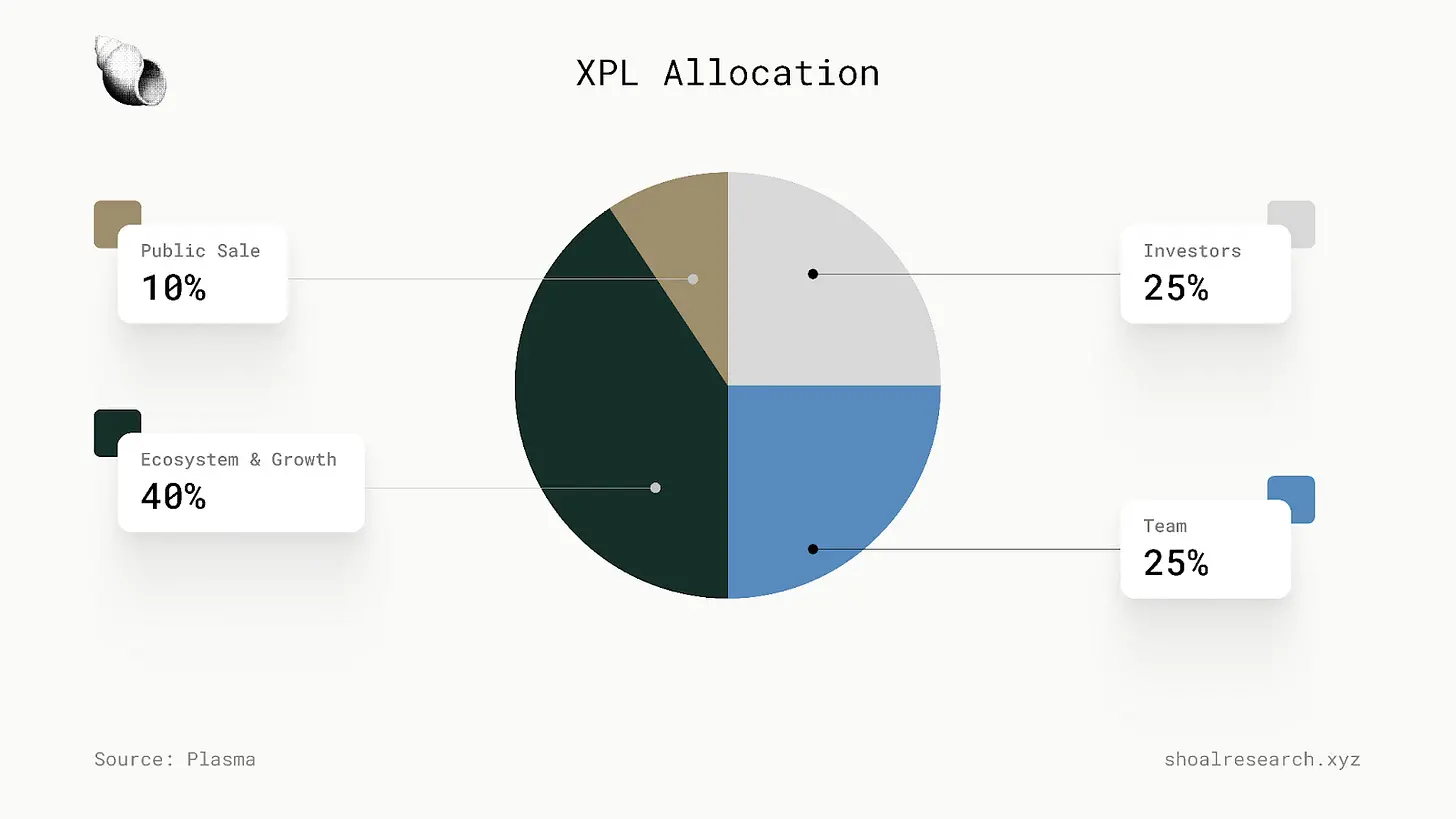
Every transaction on Plasma incurs a base fee, dynamically adjusted based on demand. These fees, along with newly issued tokens, form a reward pool to maintain validator incentives.
Plasma employs a unique penalty mechanism. It does not punish malicious validators but incentivizes honest behavior through a novel reward-penalty mechanism. In this model, misbehaving or inactive validators lose their block rewards but retain their principal. The penalties are lighter, reducing participation risk for institutional operators, as sudden capital losses are often unacceptable in business. Importantly, under the assumption that fewer than one-third of validators behave maliciously, Byzantine security remains guaranteed.
Validators earn XPL rewards by proposing blocks, participating in consensus voting, and validating transactions. Their rewards come from transaction fees and token issuance, making validator incentives directly tied to network activity and the overall economic performance of XPL.
The Plasma Ecosystem
Plasma's technical work revolves around an evolving, integrated ecosystem. Plasma is set to launch with $2 billion in stablecoin liquidity and has integrated over 100 DeFi projects, including Aave, Ethena, Fluid, and Euler.
Plasma recently released its consumer-facing flagship application, Plasma One. It is a native stablecoin wallet and card interface, providing users with a "one-stop" platform to hold, send, and use USDT. Transfers incur no gas fees, balances can be used directly for payments, and users can issue virtual cards in minutes.
In terms of integration, Plasma has partnered with Binance Earn, allowing users to access yield products directly from the network. Additionally, development work is underway for fiat on/off ramps and peer-to-peer cash networks in emerging markets, aimed at reducing reliance on centralized exchanges between stablecoins and local currencies.
Plasma will also launch a comprehensive ecosystem of developer tools and infrastructure, covering account abstraction, on-chain analytics and block explorers, interoperability protocols, oracles, indexers, and RPC providers.
The Future of Plasma
Given our current understanding of Plasma, it is worth looking ahead and considering some of the most important catalysts and considerations that will influence its future direction.
Competitive Landscape
Plasma carries an ambitious and important mission: to change the way global funds flow. Unsurprisingly, it faces competition from multiple fronts.
First, general-purpose blockchains are not going away. Ethereum still dominates in terms of stablecoin liquidity and network effects. Tron holds the largest share of USDT transfers and peer-to-peer trading volume, while Solana continues to improve its performance. Meanwhile, new chains like Monad and MegaETH are also competing on high performance and full EVM compatibility.
At the same time, we are seeing the rise of stablecoin-specific chains (or "stable chains") similar to Plasma. Circle is building Arc, a permissioned chain designed for regulated USDC settlements. Stripe is developing Tempo, focusing on embedding stablecoins into merchant payments. Google recently announced the launch of Google Cloud Universal Ledger (GCUL), an L1 platform focused on providing digital payments and tokenization for financial institutions. Meanwhile, other companies are also emerging with differentiated approaches and unique value propositions. For example, Payy has introduced new banking stablecoin infrastructure, including its proprietary dedicated chain, but its core focus is on privacy-preserving transfers.
Even outside the cryptocurrency space, non-blockchain payment channels are converging, offering many of the same key advantages as stablecoins. This means Plasma must not only meet cryptocurrency benchmarks but also traditional standards, including performance, speed, and coverage.
Key Focus Areas
Given this, what key areas can help the Plasma team?
First, distribution is crucial. Like any business, a chain must get its product into users' hands to grow. For blockchains, this is primarily limited to crypto-native applications, exchanges, interconnected chains, and DeFi protocols. While Plasma launches with over 100 applications integrated and $2 billion in liquidity, the more daunting challenge lies in how to expand applications from crypto-native to retail and enterprise-level crypto-related areas.
Plasma plans to support over 100 countries, 100 currencies, and 200 payment methods, laying the groundwork for a robust initial distribution footprint. However, maintaining real-world adoption in the long term requires continuous effort: attracting merchants, collaborating with fintech partners, and leveraging Tether/Bitfinex's existing network. The rise of Tron illustrates the power of grassroots distribution. The question is whether Plasma can retain users and build lasting channels beyond its crypto-native user base.
Liquidity is another key focus area. For a blockchain built specifically around stablecoins, deep liquidity is essential. Plasma issued billions of dollars in native USDT on its first day, making it the eighth-largest USDT blockchain. To ensure it can continue to grow, cross-chain bridges, fiat channels, and deposit processes must be as simple and frictionless as possible.
Privacy is another underestimated feature. Confidential payment capabilities are planned but will not launch with Plasma's mainnet beta. The core idea of this feature is to protect sensitive transfer data while maintaining composability and auditability. This feature will initially be implemented as a lightweight optional module, but Plasma is likely to embed privacy features into the protocol layer in the future.
With its novel architecture, ecosystem coverage, and liquidity foundation, Plasma is well-positioned:
Anchoring to Bitcoin provides a differentiated advantage. Plasma regularly publishes its state root to Bitcoin, providing additional settlement assurance beyond relying solely on its validator set.
Additionally, building a public permissionless chain allows Plasma to reach a broader audience while enabling features like identity-based transfers to enforce special experiences like zero-fee USDT transfers.
Utilizing a custom consensus protocol enables Plasma to support high-throughput rapid execution.
With over 100 DeFi integrations and $2 billion in USDT, it has become the eighth-largest chain by stablecoin supply from day one.
Applications and Use Cases
Plasma supports a range of stablecoin-specific use cases and applications.
Global Payments and Remittances
One of the most direct applications is as a global payment channel. An American worker can send $100 of USDT to a relative in Nigeria. This relative can then spend it directly through integrated merchants, use a crypto card, or withdraw through local over-the-counter trading desks and exchanges.
In countries like Nigeria, Argentina, and Turkey, stablecoins have become inflation hedges and lifelines for remittances, and Plasma can further reduce friction. Success in these countries depends on integration with local wallets, ATMs, and payment systems. Tron achieved this through years of grassroots promotion, so Plasma will also need similar partnerships, potentially leveraging Tether's existing network. If executed well, Plasma could serve as the backend for remittance companies or new banks, providing instant dollar transfer services without requiring them to build blockchain infrastructure themselves.
Merchant Payments and Micropayments
Due to volatility and fee issues, using cryptocurrency for payments has been rare, but zero-fee USDT transfers on Plasma could change that. Merchants can accept stablecoins at the point of sale via QR codes, avoiding credit card fees and chargebacks.
Privacy features will enable businesses to protect revenue data from competitors, while micropayments will become feasible. Platforms can charge a few cents for each article, stream, or download without impacting profits. For merchants, the key lies in user-friendly tools and compliance. Stablecoin payment processors may emerge on Plasma, and over time, even traditional service providers may integrate them in regions with high fees or limited banking services.
Forex and Cross-Currency Trading
The stablecoin market has expanded beyond the dollar, with euro, offshore yuan, and gold-backed tokens also in circulation. If Plasma supports multiple fiat stablecoins, it is poised to become a hub for on-chain forex trading.
For example, users could exchange USDT for EURT at near-zero cost on a Plasma-based decentralized exchange (DEX). This makes forex trading cheaper and faster than banks. Imagine a multinational company instantly converting millions of dollars into euros and settling the transaction on-chain to pay European suppliers. This requires ample liquidity, but zero fees and institutional demand could attract market makers.
Institutional Finance and Settlement
Exchanges, fintech companies, and even banks can use Plasma as a settlement layer for large transfers. Given Plasma's speed and zero fees, exchanges may prefer to use Plasma for USDT cross-exchange trading rather than Tron or Ethereum.
Banks or corporate alliances could also run private overlay layers on Plasma for large interbank transfers settled with Bitcoin-backed finality. For corporate finance departments, transferring $50 million between subsidiaries could take just seconds, while using SWIFT might take days. The privacy module would allow auditors or regulators to selectively disclose information. If U.S. legislation like the GENIUS Act progresses, regulated entities may adopt public stablecoins like USDT and USDC, and Plasma is well-positioned to meet this demand.
Beyond this, there are many more crypto-native use cases worth exploring for the team to build on Plasma. Zero-fee USDT transfers could be a compelling case for building autonomous agent payment infrastructure on Plasma. With $2 billion already invested from day one, it can provide deep stablecoin liquidity forecasts to sustain meaningful user activity. Plasma could also serve as a routing layer for stablecoin liquidity across multiple chains.
Conclusion
The Plasma mainnet beta is now live. We look forward to witnessing the flourishing of dedicated stablecoin infrastructure. Stablecoins are bound to disrupt global payments and other financial services, but they need purpose-built rails to thrive. While Plasma is not the only project chasing this North Star, it offers one of the most promising solutions to seize the trillion-dollar stablecoin opportunity.*
 Risk warning
 Risk warning



Popular articles





