Stablecoin "1:1 printing rights," how much profit can it actually bring?
 Core Viewpoint

 The "money printing logic" behind stablecoins, why is Tether worth 500 billion dollars?
Author: RWA Knowledge Circle
1. Stablecoins: The "Private Mint" of the Digital Age
In the past year, "stablecoins" have been one of the hottest terms in the capital market. A stablecoin is a digital currency anchored to fiat currency, theoretically equivalent to fiat currency at a 1:1 ratio, and requires real assets to back it.
So the question arises: if large cross-border e-commerce companies issue stablecoins to save on transaction costs, saving millions each year, that seems reasonable. But in reality, those who truly issue stablecoins are often blockchain platforms and digital service providers. So how much profit can this "1:1 minting right" actually bring?
Don't underestimate this business. The global stablecoin market landscape is already clear: USDT occupies 60% of the market share, while USDC holds 25%. Among them, the issuer of USDT, Tether, has shocked many: its average employee salary ranks second globally; Bloomberg has also revealed that it is considering selling 3% of its shares for $15-20 billion, corresponding to a valuation as high as $500 billion, comparable to OpenAI and SpaceX.
Why is Tether worth this price?
2. The "Minting Logic" of Stablecoins
The traditional banking profit model involves absorbing deposits and then lending them out to earn interest spreads; stablecoin issuers, on the other hand, collect dollars and mint tokens on the blockchain. The money they hold is the source of profit.
- Circle (USDC issuer): Operates conservatively, primarily investing in U.S. Treasury bonds and cash after receiving funds to ensure a 1:1 exchange with the dollar.
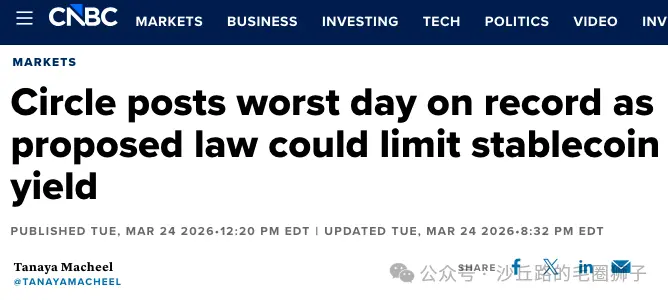
- Tether (USDT issuer): A more aggressive model, currently holding $100 billion in reserves, earning over $4 billion a year just from interest. In 2024, net profit is expected to reach $13.7 billion, with a profit margin of 99%.
Tether's asset portfolio includes not only cash and U.S. Treasuries but also Bitcoin, equity investments, and spans areas like payment infrastructure, renewable energy, artificial intelligence, and tokenization. To some extent, Tether no longer resembles a simple stablecoin company but more like a top investment bank and asset management giant.
3. The "Stablecoin War" of DeFi Protocols
Once the "minting model" was discovered to be so profitable, it naturally attracted countless imitators. Many DeFi protocols have joined the stablecoin battle:
MakerDAO's DAI: One of the earliest successful decentralized stablecoins
- Innovation: First to include U.S. Treasury bonds in reserves, at one point holding over $1 billion in short-term Treasuries.
- Revenue distribution: Excess income enters a surplus buffer, which is then used for repurchasing and burning MKR governance tokens. MKR is no longer just a "governance voting right," but is directly linked to cash flow, becoming a "equity-like token" with real value.
Frax: A small yet focused "refined mint"
Frax's overall scale is not large, with circulation long maintained below $500 million, but its design is extremely sophisticated.
Revenue distribution:
- A portion is used to burn FRAX tokens to maintain scarcity;
- A portion is distributed to stakers to enhance user stickiness;
The remaining portion is invested in the sFRAX treasury, which tracks Federal Reserve interest rates, effectively providing users with a product that "follows U.S. Treasury yields."
Although its scale is far less than Tether, Frax can still generate tens of millions of dollars in revenue each year, making it a representative of "small scale, high efficiency."
Aave's GHO: An extension of DeFi lending
The well-known lending protocol Aave launched its own stablecoin GHO in 2023.
Model: When users borrow GHO, the interest paid goes directly to Aave DAO, rather than to external institutions.
Revenue distribution:
- Approximately $20 million in interest income annually;
- Half of which is distributed to AAVE token stakers, while the other half remains in the DAO treasury for community governance and development.
Currently, GHO's scale is about $350 million, but its logic lies in deeply integrating stablecoins with lending operations to form a "vertical ecological closed loop."
It can be said that "each shows their skills," with every stablecoin protocol trying to create its own private mint.
4. Hidden Concerns: Is It Really Stable?
While stablecoins reduce cross-border transaction costs and improve efficiency, they also harbor several hidden risks:
- Anchored assets are not absolutely stable: Tether's reserves include Bitcoin, which, if it experiences severe volatility, could cause the stablecoin to "de-peg."
- Revenue distribution processes are opaque: Many protocols claim that income will be used for token buybacks or rewards, but the actual operation process is a "black box."
- Hedging strategies carry risks: Using futures for hedging does not theoretically guarantee 100% safety.
Compared to state-backed credit, the "creditworthiness" of private stablecoins remains limited.
5. Why is Tether Valued at $500 Billion?
Given the numerous risks, why is Tether still valued at $500 billion?
The answer lies in the fact that stablecoins have become the infrastructure of the digital age.
They are not only payment and settlement tools but can also be embedded in lending, trading, RWA (real-world asset tokenization), and other scenarios, providing new channels for global capital circulation. Tether's high valuation actually reflects the market's enormous expectations for the future of RWA.
Of course, the implementation of regulatory compliance remains a key factor in determining how far stablecoins can go in the future.
Stablecoins may seem like just a cornerstone of the digital currency market, but they are, in fact, a new type of "minting power" in the financial system. Whether it is Tether's $500 billion valuation or the flourishing of DeFi protocols, they remind us that the currency landscape of the digital age is being quietly rewritten.
Click to learn about job openings at ChainCatcher
Recommended Reading:
NAKA's stock price plummeted 54% in one day, is the market starting to tire of DAT?
Is the Base chain about to launch its token? 6 projects worth paying attention to
 Risk warning
 Risk warning