RWB New Narrative Rise: From "Asset Tokenization" to "Business Tokenization"
 Core Viewpoint

 This article analyzes the emerging crypto concept of RWB (Real World Business), comparing it with the currently popular RWA (Real World Assets) in terms of similarities and differences, and examines its potential models and early cases.
The original text is from Odaily Planet Daily Wenser
Undoubtedly, RWA (Real World Assets) has become one of the biggest hot topics in the crypto market. Data from RWA.xyz shows that the total market value of global RWA assets (including stablecoins) has approached $32 billion, with the number of on-chain holders exceeding 400,000 and a monthly growth rate of up to 9.22%.
At the same time, a new concept called RWB is quietly emerging and gradually moving from the crypto circle to the mainstream. What is RWB? How does it differ from RWA? Can it take over from RWA and become the next narrative in the industry? Odaily Planet Daily will analyze these questions for readers.
Introduction to RWB: Real World Business or Just Another Buzzword?
RWA stands for Real World Assets; RWB has different interpretations.
The currently widely accepted explanation is Real World Business, meaning the tokenization of operational businesses in the real world (such as physical enterprises, supply chains, or service processes) through blockchain, allowing investors to hold "business equity tokens" to share in business profits or decision-making rights. It expands RWA from static assets to dynamic business models, supporting micro-financing, community-driven initiatives, and decentralized governance.
Another interpretation is Real World Blockchain, referring to the practical application of blockchain technology in real-world scenarios (such as supply chains, transportation, or identity verification), emphasizing practicality and cross-industry integration rather than pure financial speculation. This is commonly seen in projects like the Real World Blockchain Association (RWBA), which focuses on the infrastructure support for RWA.
A more niche interpretation is Real World Behavior, referring to the tokenization of "real behavior data" of users on the blockchain (such as behavior points or AI training data), particularly in applications related to transportation, combining blockchain technology with the sharing economy, the Internet of Things, and intelligent transportation systems to optimize travel-related services.
In short, these different interpretations correspond to different models:
- The first can be understood as the tokenization of actual businesses and processes on-chain, primarily for business financing;
- The second leans more towards a technical solution, mainly serving the on-chain of information data;
- The third is similar to blockchain technology as an auxiliary, focusing on quantifying behavior data and integrating it with systems like the sharing economy and the Internet of Things.
Currently, the RWB concept is still in its early development stage, and there is no consensus or clear definition in the crypto and traditional industries.
RWA is Asset Tokenization, RWB is Business Tokenization
Regarding the comparison between RWA and RWB, Coinstreet founder and CEO Samson Lee published a detailed article titled “Paradigm Shift in Financial Markets: The Competitive Evolution of RWA and RWB --- A Dual-Track Strategy Under the Wave of Tokenization” in April this year. Although it has not received much attention or large-scale discussion in the industry, its viewpoints still hold certain reference significance.
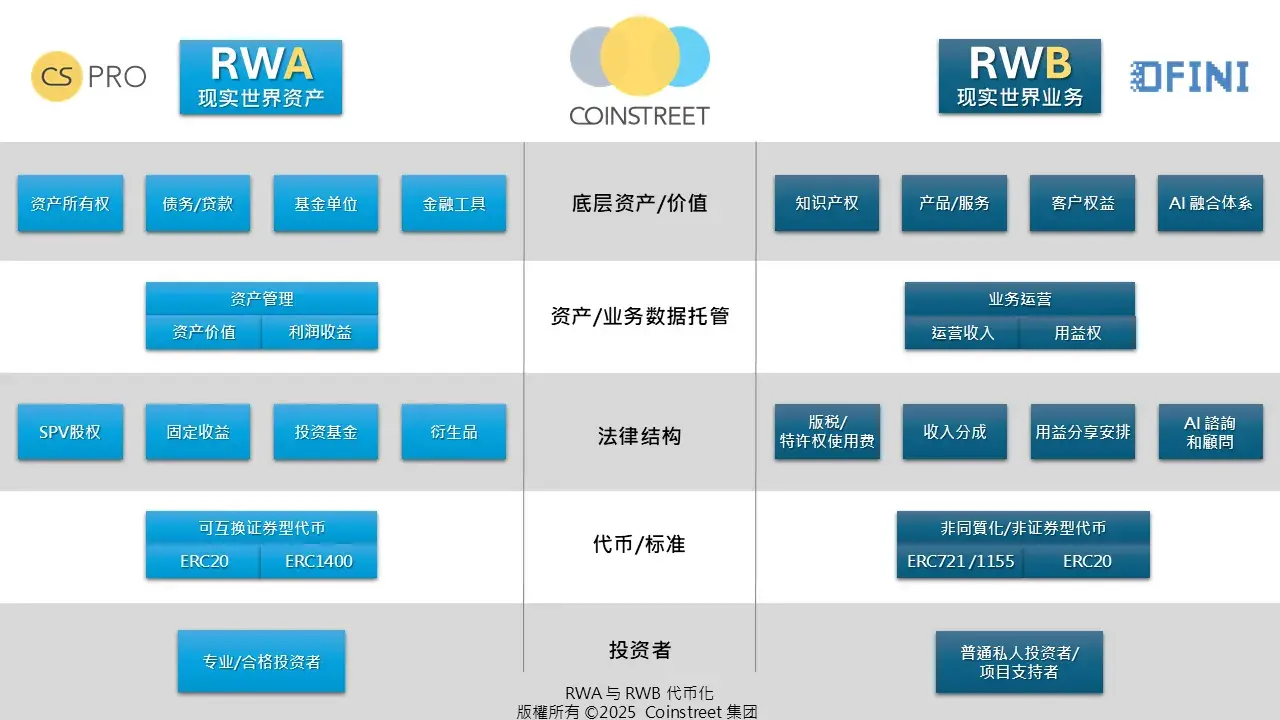
Currently, the value of RWB lies in the blockchain digitization of business operations, product sales, revenue streams, commercial contracts, intellectual property, and customer rights, indirectly bypassing the regulatory constraints related to securities financing, providing new financing channels for small and medium-sized enterprises, and offering new investment targets for ordinary investors, thereby lowering the investment threshold to some extent.
Moreover, RWB further broadens the scope of real-world business, where corporate intellectual property, operational income, and various business products can all be tokenized on the blockchain. Thus, not only can the real-world assets involved in RWA be quantified, digitized, and tokenized; the future revenues, decision-making rights, and revenue dividends related to RWB can also be transformed through blockchain technology, achieving tokenization and digitization.
Taking the emerging coffee chain brand BeanFi mentioned by Samson in the article as an example, it is said that the company tokenized 10% of its operating income for the next five years and completed a $20 million financing in just three hours, with over 50,000 retail investors participating. (Note from Odaily Planet Daily: This information has not been confirmed by actual sources, and another article mentioned that the financing amount for this case was only $500,000. Based on the existing information, this project may have already failed.)
It has been proven that, unlike the relatively mature narrative and business model of RWA with actual cases, the true implementation of RWB still has a considerable distance to cover.
RWB Has Not Yet Gained Mainstream Attention, But Binance and Sequoia Have Started to Bet
It is worth mentioning that while searching for information related to RWB, I unexpectedly discovered a project called Talex Chain, which was selected in the Binance MVB Accelerator Program Season 8 along with projects like Four.meme, Meet 48, and Balance in October 2024. According to the founder's X platform account profile, this project may have also received support from the well-known investment firm Sequoia.
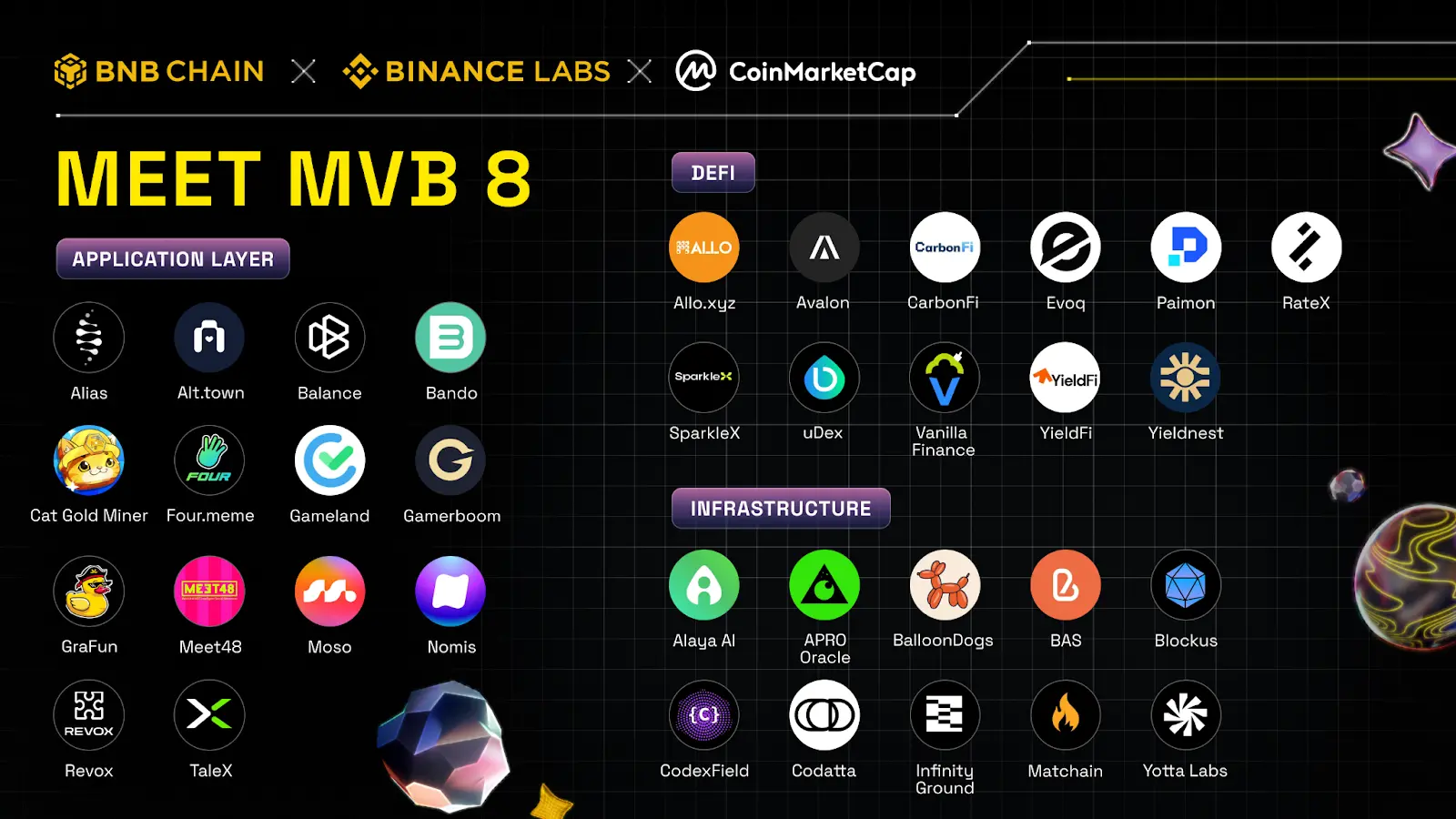
MVB 8 List
The project’s founder Chari and his team have also written a series of articles about the RWB business model, proposing a fiat-based token issuance model called PoP (Proof of Purchase) and citing Binance founder CZ's views on "transaction mining" as a model endorsement. They also mentioned: "There is no problem with transaction mining. This is a form of Proof of Purchase. However, simply pushing up the token price to attract more people to participate in mining will only lead to ineffective volume. It will affect the team's and users' judgment of the project. If we can ignore the price collapse and focus on iterating the product experience, ultimately users are using it well, and buying back tokens with normal fees, then what could be wrong? Very crypto native. Co-build and share."
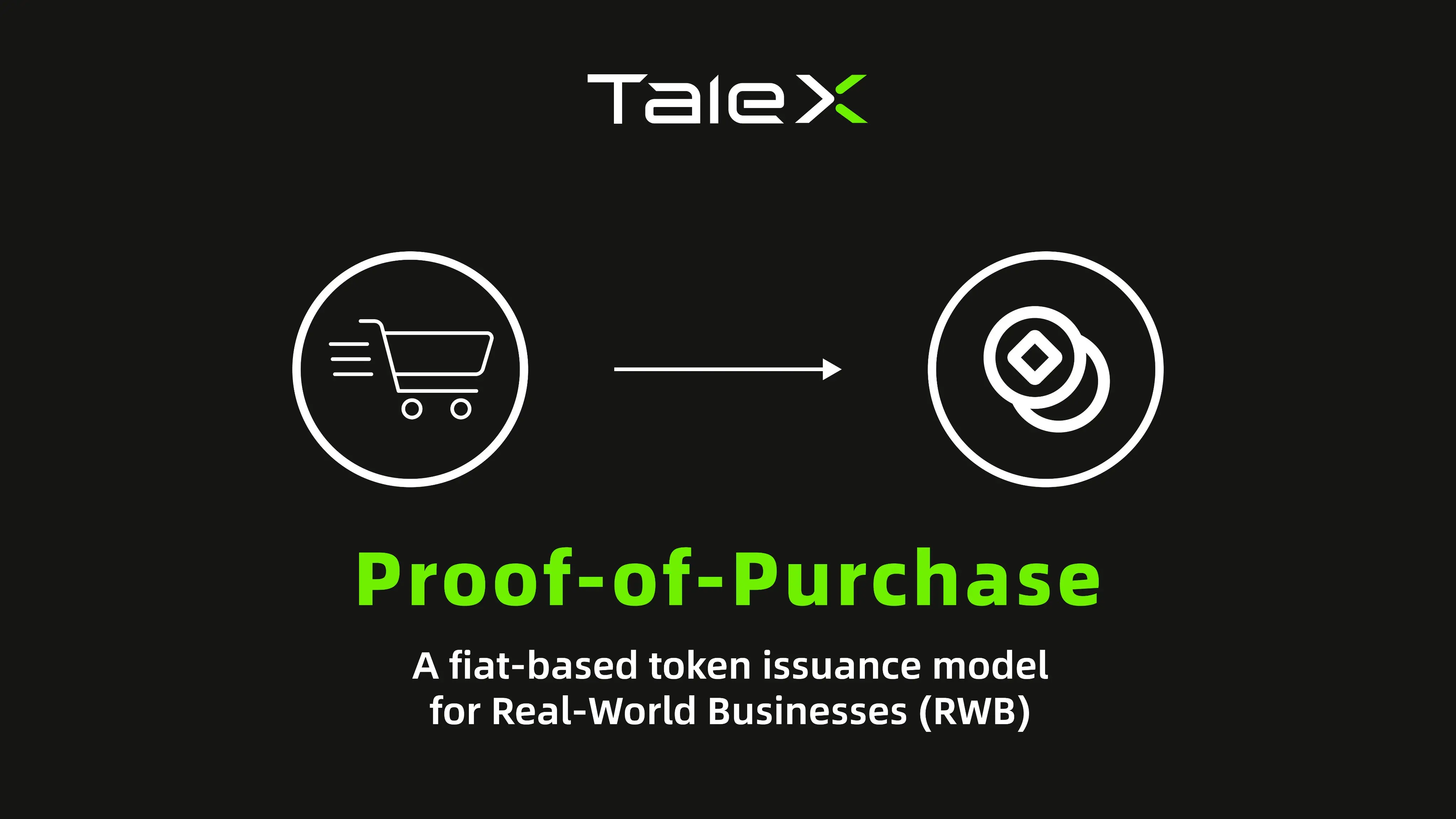
It is clear that the Talex project views transaction mining as a significant case for RWB issuance, where users contribute transaction fees through trading interactions, and the platform uses the fee income to buy back platform tokens, while users receive rewards through platform token incentives, thus achieving an "ecological closed loop."
However, it should be noted that this model still heavily relies on the continuous inflow of external funds, which tests not only the platform's product optimization and user experience but also whether the platform token price can be maintained and whether the entire incentive system can operate stably.
Additionally, it is interesting to note that the Talex platform currently resembles a creator economy platform that integrates short dramas, e-books, animations, and other content. Whether it can attract more attention resources and liquidity through content in the future remains uncertain.
Conclusion: RWB Seems to Provide a Foundation for Liquidity in Real World Businesses
Regardless, although the RWB concept has not yet gained much attention and faces a series of risks related to regulatory compliance and asset management, it indeed provides a new idea for financing small and medium-sized enterprises. Just like the gravel used to lay a foundation, RWB may serve as a foundational element providing flexible funding for companies that operate real businesses in the real world, while participants gain corresponding emotional value, loyalty incentives, and economic returns.
As for whether it can carve out a new development path in the tokenization process of traditional financial assets, it remains to be seen with time.
 Risk warning Risk warning

Popular articles